

Thanks for subscribing to SatPost.
Today, we find out why Docusign has 7,000 employees (and what can it tell us about how AI coding agents will chance B2B SaaS)?
Also this week:
29 Thoughts on Super Bowl LX
Jony Ive & Ferrari Collaboration
…and them wild posts (including EV charging tech)
In early February, Anthropic released some plugins for its AI chatbot Claude.
These plugins were for legal, financial and other white-collar work.
There wasn’t even a major announcement, so the market response was pretty muted.
Hahahahaha, no I’m kidding. Everyone is so on edge about AI tools replacing the work of professional services that a few news blurbs about the plugins led to the stock wipeout of $285B in market cap in a single day, per Bloomberg:
Goldman Sachs’ software basket fell by 6% (the most since Liberation Day)
A Financial Services Index declined by 7%
Legal software LexisNexis (RELX) dropped 14%
Massive asset managers including Ares Management, KKR, TPG, Blackstone and Apollo each sunk 8-10%
Then, earlier this week, a $2B fintech startup called Altruist released an AI tax-planning tool…and that led to a multi-billion sell-off for wealth management firms including Raymond James (down 8.8%), Charles Schwab (down 7.4%) and LPL Financial Holdings (down 8.3%).
These paper-handed reactions capped off a broader B2B SaaS sell-off that commentators are calling SaaS-mageddon or SaaS-pocalypse (inspired by this portmanteau, I’m currently writing a script called Saas-pocalypse Now, about a young Marine who travels up the Mekong Delta to get a 30% discount on next year’s license renewal).
Listed B2B SaaS firms have lost $1T since start of the year. This table of popular tickers is two weeks old but delivers the same point:
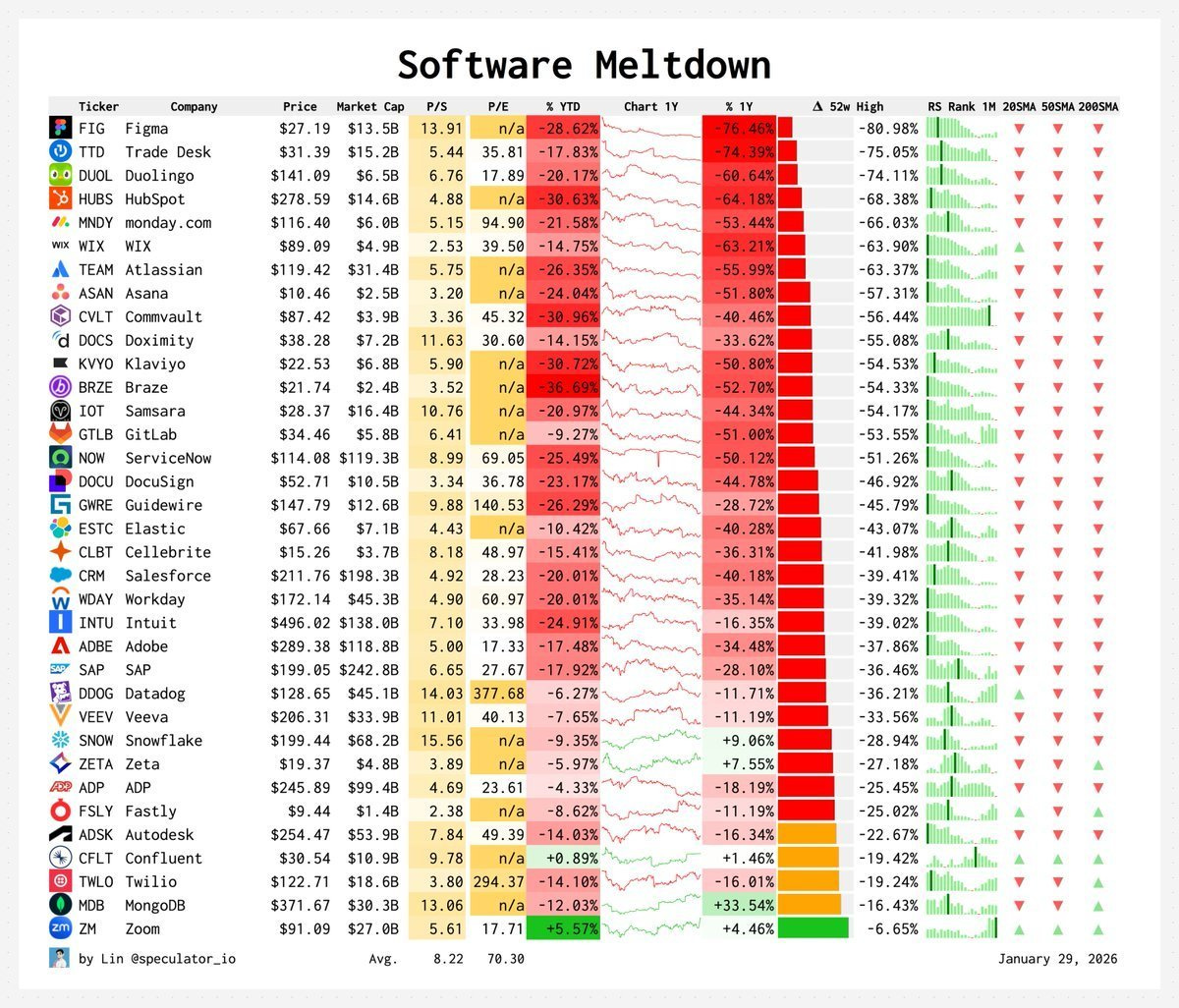
Some of the largest software firms — Salesforce ($173B), SAP ($210B), ServiceNow ($100B) — are trading like NFTs.
What happens to SaaS firms in a world when any software tool can be coded up by an AI agent in a fraction of the time and cost?
[Insert scary CNN chyron] IS SOFTWARE DEAD?!?!?!??!!
WHAT HAPPENS NEXT?!?!!?!?!?!?!
The SaaS-ma-kick-in-the-nuts has been so wild that people are asking if $3T Microsoft will be OK…which is a bit much. As Tae Kim points out, the sell-off was a misreading of Claude tool’s capability: the plugins weren’t replacing existing software, but actually utilizing them.
Having said that, the coding models (OpenAI’s Codex, Anthropic’s Claude Code) are advancing so fast that it’s worth a conversation. The leaders at Anthropic and OpenAI have straight up said that 90%+ of their code is now created by an AI agent. Spotify announced its team hasn't written a line of coe since December (FYI: read this piece from Dean Ball on how these AI labs could have 100,000+ AI employees by the end of the year).
Here is my current thinking based on reading the thinking of people much smarter than me:
AI coding is very real.
The number of AI coding agents will explode across major software firms.
Roles of software development, designing and product management will all slowly blend into one. If AI can handle code, the value comes from taste, planning and orchestrating.
Probably going to be a lot more site reliability and security engineer roles.
There will still be massive demand for new software addressing old (and new) problems.
AI coding will change the addressable market for SaaS tools and the traditional SaaS business model of 80-85% operating margins charging per seat for an entire suite of features that most people won’t use (and is a pain in the d*ck to unsubscribe) is unsustainable.
If AI agents commoditize the creation of software, SaaS businesses will have to create defensible moats by taking on mission-critical tasks, owning proprietary data and establishing tight customer integrations, becoming systems of record while taking on legal and regulatory risk.
A lot of PE firms that bought SaaS companies (and loaded them with debt) could be in a world of hurt.
Let’s unpack these ideas by focusing on one startup: Docusign, everyone’s favourite legal document signing tool that somehow employs 7,000 people.
***
A popular meme in tech social media is, “How does Docusign have [impossibly large number] of employees?”
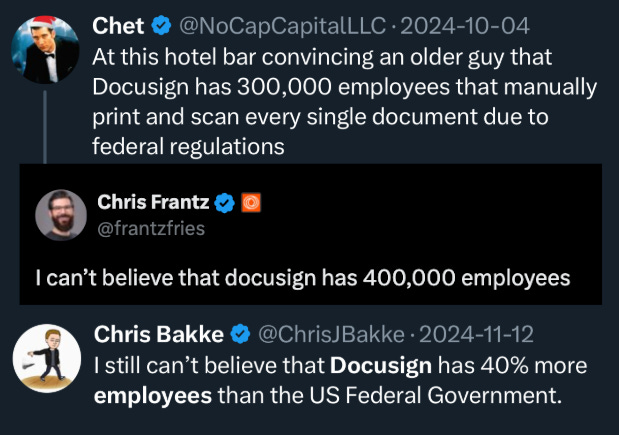
It’s just a digital signature tool, right? Hell, they keep your autograph and initials on file and all you have to do is click the box. That’s it? Why can’t I just copy and paste a template online in Word?
I ask these questions every time I’m signing a Docusign PDF that I didn’t read and hoped that I wasn’t giving away anything important in my life (TBD).
The meme was really funny when Docusign was worth ~$60B on $1.8B of sales during peak pandemic madness in 2021. It’s now worth a still respectable $10B, but on a much more reasonable multiple on $3B of sales (it went from 33x to 3x trailing-twelve-month sales).
Sufficiently curious about how a software company could employ (maybe) more people than the American federal government, I finally did some digging a few months ago.
I read through financial filings, some analyst reports and forum posts.
Man, was I wrong because Docusign having 7,000 employees is very reasonable.
My favourite explainer comes from a post in the r/WebDev subreddit. The post has since been deleted but I got a screenshot and let’s go through a fun thought experiment:
Let’s say most people use Docusign 5x a year. But 1% of power users are signing documents 10x a day. Among American adults, that would be (5 x 250 million) + (10 x 365 x 2.5 million) = 10 billion signatures a year.
America is probably above average since the country is super litigious and lawyers love to lawyer. So, let’s assume the rest of the world does 25 billion signatures a year.
So, that’s 35 billion signatures a year…or 95 million a day…or 4 million an hour…or 1,000 every second.
This system has to work in 180 countries around the world, following local contract laws in each of them (that’s a lot of system administrators and lawyers).
Docusign builds a hybrid cloud system in every country that keeps all records and a ton of back-ups across AWS, Google Cloud, Azure and its own data centres (that’s a lot of engineers and system administrators).
In total, Docusign serves 1.8 million paying customers (including 3,000 government agencies and most of the Fortune 500).
These paying customers are sending signature requests to over 1 billion users.
The headcount is about 5,000 employees for sales, marketing and support to serve that customer base. Another 2,000 employees for engineering, system admin and product development.
I don’t think anyone is vibe coding a Docusign product and gaining market share by undercutting current prices. Trust me, I tried for a solid 47 minutes. No bueno.
Nor will any serious company build an internal replacement. A 72-hour Claude Code session won’t be able to handle the required 99.9999999% uptime and semi-network effect with all the people that have a Docusign account.
If none of those numbers convince you of Docusign’s mission critical moat, allow me to share this glorious qualitative rant from the aforementioned Redditor:
So you’ve got to have multiple international teams of [System Admins] managing data centers all over the world. Except you have to be able to lose one of those datacenters without losing all the signatures stored there. So you need backups. And you need backups for those backups. And you need just-in-case code already written for if that data center goes offline for 5 hours.
And you need HR for those employees. And if you aren’t managing your own centers, you need business [execs to] negotiate contracts with whatever company you outsource to. And you need SO MANY f*cking Zendesk drones handling the infinite influx of people who can’t use the app or used the app wrong or got themselves in a weird situation.
Or sh*t man, what if something VERY IMPORTANT was signed, but the person who NEEDS THAT SIGNATURE RIGHT NOW forgot his password? Like really forgot? Lost access to his email?
He can prove that he was the owner of that real estate conglomerate during those years. He can pull up the proper legal paperwork. But you need a team of trained legal professionals able to sort through it and make sure he is who he says he is.
What happens when your signed documents are needed for a court case? What happens when a judge has a warrant for them? What public-facing service are you going to build and maintain for judges in... oh yeah, every country in the world, using wildly different legal structures.
And they all need access to... potentially thousands of signatures all at the same time.
Nothing. Nothing at “global standard” scale, is simple. You’re looking at the face of it. There’s a monster underneath. Always is.
With that context, Docusign employing 2,000 acrossengineering, system admin and product development doesn’t sound that crazy.
In a solid blog titled “Docusign's 7000 employees and the iron law of B2B SaaS sales”, José Luis Ricón shows that it is not unusual for B2B SaaS firms to have a sales-to-engineering ratio of 2:1.
Docusign would have 4,000 sales employees at that ratio…but they added a a bit more and then throw in back office stuff and you get 5,000 non-engineers.
José writes:
Suppose you model sales as a lottery, where every sales call has some chance of progressing through the funnel, and eventually to a customer signing up. Then one could have a model where to get X dollars of revenue one needs Y hours of salespeople work, and translate that to people working regular hours, given a low enough chance of a sale, and that leads to needing a large sales staff.
This model could explain why, if a company believes it has a potential to make in revenue, it needs a staff of 7 people per $M to handle sales. But it doesn’t explain why engineering count is what it is. One could imagine, for the sake of the argument, a team of 2 very capable engineers building a great product and a team of 1000 salespeople selling it all over the world.
Why is engineering headcount half of sales instead of much lower given how software scales?
A fun exercise: Suppose you have 7 sales people. Per the model earlier, the company has $1M in revenue. Half of that (per the averages earlier, but also with some guesses about salaries) will be their salaries. Assuming 2 engineers paid $160k (it’s a startup) that’s already $820k. Add the CEO’s salary ($100k say) plus rent and infrastructure and we get to the revenue being fully utilized. The number of sales people sets a maximum on how many engineers you can have essentially, and that number might end up being 2 engineers per sale s person at the going salaries.
Great. So if you are a startup that has some extra cash to spare, what are you going to do? You could just keep the cash and enjoy your earnings, or you could try to make more revenue hiring even more sales people. Or you could hire more engineers. You could be fearing competition, driving a need to throw as many resources as possible to building the product as possible; so if this hypothetical company makes another $1M, they will be hiring in the same ratio to make it self-sustaining. If they did not do this, and were able to grow revenues without salespeople, or if they have a really efficient engineering team, then this multiple should change. But in a competitive market, if there are extra profits, these must be reinvested into the business, and that reinvestment means a ratio of 2 engineers and 1 extra sales person.
As fate would have it, Docusign CEO Allan Thygesen — a former top Google marketing exec — went on The Decoder podcast a few weeks ago and talked at length about these topics.
Some highlights:
How Docusign ensures digital signatures are real: “We do all kinds of IP tracing and other things to validate that you are the intended…signer [and] that you are the intended recipient. That whole trail is then auditable and can be used in a court of law. So, it’s a perfect substitute for a wet signature that you might otherwise have done…We worked on a federated identity strategy to give you all kinds of identity validation at different levels of risk. We let people do knowledge-based authentication…We do biometric-based identification [eg. video]. We can link up with the Apple and Google stuff. We do risk-based assessments…We use the new digital IDs [eg. Clear or ID.me, which is the government one that the IRS uses].
Docusign’s customer demographic: “We’re incredibly diversified. We are used by 1.8 million companies. By definition, if you have that many customers, most of them are going to be small. But we are used by over 95% of the Fortune 500 and equivalent in many other international markets. Then, many mid-sized companies, and then a huge long tail of small companies. No one company represent any meaningful share at all of our business. That said, our biggest customers tend to be banks or other large companies that have high volumes of high value agreements. You know, if you have agreements that matter, and you’re entering to them in large volumes, you’re very likely to be a Docusign customer.”
The breakdown of Docusign’s employee base: “Sales and marketing is the biggest area. We have about 1,000 account executives that cover everything from SMB accounts, all the way up to enterprises. We’re not a small company. We do over $3 billion in revenue. Our revenue per employee is pretty much in the median of the SaaS businesses. So sales and marketing is the biggest function. It’s everything from pre-sales to account executives to customer success people to help with implementation and support. We have about 1,000 people in engineering…and then there are product managers and designers and so on.
I think if you look at the number of countries and the complexity of the regulatory and compliance environments we’re in, that’s a significant effort.”
Thygesen became Docusign’s CEO in September 2022.
A month before ChatGPT launched. He’s been competing only in the generative AI world and believes it is much more of an opportunity for Docusign…rather than a threat.
Even if a legitimate AI-native competitor was launched, Docusign is sitting on juicy proprietary dataset: 150 million private consented agreements with 10 million being added every month (this legal data set is “orders of magnitude bigger than anybody else”).
Docusign is using this data trove to help customers create legal documents and find value that may have otherwise slipped through the cracks:
[Customers always have a template] for something really complex (like an M&A agreement) or something really simple (like an NDA) or anything in between. [It] could be a master service agreement between company and another company, or a license agreement. But they always have a template.
Then, they tailor it. Some of that is done sort of legal tailoring, right? [They’re] going to have different limitation of liability. [They] want to have a different payment term. Some of it is just mass customization. [They] want to get the data about [customers and previous negotiations].
Then, they want that to flow automatically from whatever the system of record is. Could be Salesforce. Could be Workday. Could be SAP. And [they] want to populate that into the agreement. […]
The other piece is [that Docusign will] take AI and…extract data out of the agreements to run [the] business better. That’s something that was conceptually possible…but it was just too heavy and hard to do with legacy LLMs. Now, [Docusign] can do that in a completely automated way.
So we can go [to customers] and say “Hey, you have 5,000 agreements with me. Would you like to know what’s in them? Let me highlight how these agreements deviate from agreements with peers. You know, your company X is coming up for renewal in 90 days. How can [you review or improve] that?”
Due to the mission-critical (and, errr, legal ramifications) of the work, Docusign creates all of its workflows to keep humans in the loop:
We have a whole queuing system where a sales rep or a procurement rep can trigger the sending of documents for legal. It can get an automatic first review.
Then it gets assigned to a lawyer. The lawyer does a quick edit. Everyone has real time status.
That’s an example of reimagining the legal workflow, which today is totally asynchronous emails, unpredictable and non-transparent. […]
Of course, we benchmark you versus your existing templates or playbooks, as they’re often called inside of companies. And highlight things that deviate from that. And this is true both for agreements that the company prepares themselves and for third-party agreements that they receive from others. Because, of course, most companies are takers of terms from other companies, right? […]
We also don’t fully automate flows. We deliberately put humans in the loop at key decision points. And I think that will persist for a very long time.
The biggest AI challenge may be the new customer habit of asking ChatGPT or Claude or Gemini to query legal documents. Not because it’s an alternative to Docusign. But because Docusign has had to create a chat tool.
Thygesen and his team think this is a valuable feature, especially as they can customize LLM models with the >150 million consented agreements.
However, he acknowledges the models can never be 100% accurate and that’s a risk if the customers believe otherwise and end up making a costly uninformed decision based on the chat tool.
Now, I’m not saying Docusign is perfect. I’m not saying Docusign can’t improve. I’m not saying anything about what the proper Docusign valuation should be. I’m not even saying Docusign couldn’t run a bit leaner (AI agents could replace AEs, but they should be employing humans for the paid accounts on customer support).
I’m just saying, “Docusign, I’m sorry for laughing at all those Why Does Docusign Have 7,000 Employees memes. It makes a lot of sense and a one-person AI startup isn’t going to replace you.”
***
Going back to my earlier bullet points about AI and SaaS, Docusign serves a mission-critical task, owns proprietary data and establishes tight customer integrations while taking on legal and regulatory risk.
Docusign is a good example of this reality: most large firms (>1,000 employees) simply don’t want to waste resources building and maintaining random tools that aren’t their core competency.
On that note, a recent piece from The Economist shared this striking chart.
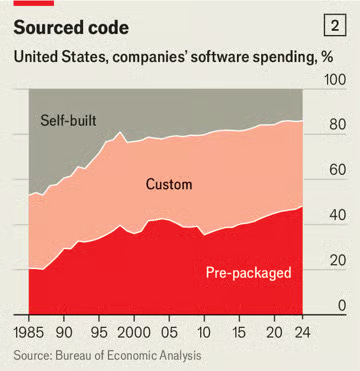
Over the past 40 years, corporate spend on software to build internal tools has fallen from ~50% to ~15% of budgets. That means the other 85% is third-party custom and pre-packaged software.
Think about how OpenAI and Anthropic — the most AI agent forward firms in the world — still run comms through Slack. They want to focus on their core work instead of going on a side quest to build an internal comms tool (although, I could see that change in a few years).
Forget AI for a second. There’s literally been free open-source software alternative for decades and people are still paying for third-party software.
Here’s a bonkers stat. Are you sitting down? According to Okta, the average large company in America uses to 350-400 SaaS apps.
Dafuq?!?!?!??!
I fell out of my seat when I heard that stat. Hence, the warning.
The trend to spend on third-party (and non-core) software has only gone in one direction. I don’t think it’ll reverse but change is coming.
Here are some interesting projections on how AI agents will change the software industry:
An explosion in software (which we actually need): Steven Sinofsky writes “There will be more software than ever before. This is not just because of AI coding or agents building products or whatever. It is because we are nowhere near meeting the demand for what software can do. This holds for software I use on my own, software a business needs, software an organization needs, or software to control the explosion of devices that replace every analog device with an automated one…[Take banking]. Consider what banking was like in 1995. If you have any experience you know your choices, features, options, etc were one-thousandth of what you have today, even if fundamentally you got a paycheck, paid your bills, and might have had a credit card.” (Side note: openings for software development roles are actually up in the past year since Claude Code took off).
Need for new pricing models: Scott Belsky writes that “Pricing models must evolve beyond ‘seats’ to better monetize usage and impact. While human seats remain valuable in this new world, the bigger opportunity for the companies that build the indispensable services described above should explore variable pricing models, like charging per task or unit of labor performed, and outcome-based pricing (where agents earn their keep by saving or making money, much like a salesperson!).”
The traditional SaaS TAM will probably shrink: Brad Gerstner says “It’s not that software is dead. But the argument…is that the profit pool available to software is decreasing. The profit pool available to the agentic layer is increasing. When that happens, the discount rate [and the] terminal value of those software companies plummets…It could be true that you’re not going to replace [Salesforce], but it can also be true that it’s never going to trade at 30x free cash flow again. It’s going to trade at 17x free cash flow because its available TAM in the future is now dramatically and permanently changed. Now, what could change that? There’s only one thing that could change that. They have to accelerate their revenue growth in their core business and prove that they are AI beneficiaries.”
SaaS can still create value (but may not capture it): Ben Thompson uses the analogy of Microsoft under Steve Ballmer, “[Maybe] that means a lot of these software companies actually retain real world value, but never have stock market value, and the analogy I’m thinking of is Microsoft from basically 2001 to 2015, where the company generated astronomical profits year after year after year, and the stock price was totally flat the entire time. It was stuck at $40 or $45 basically for 15 years — is that maybe the future of software generally where it lasts longer than we think.”
“Fintech is perhaps best positioned in this SaaS sell-off narrative”: Seth Rosenberg says “you can’t vibe code: 1. Brand/trust; 2. Distribution; 3. Regulatory licenses; 4. Capital markets relationships; 5. Underwriting data.”
Finally, David Ondrej makes the case that SaaS Firms Primarily In The UX Layer Will Get Clapped In An AI Agent World:
If 10 AI agents can do the work of 100 employees, you don’t need 100 Salesforce seats anymore. AI doesn’t kill the software directly. It kills the headcount that uses the software. Which kills the per-seat revenue model. Which kills the business.
Top layer — the AI agent. The thing that actually executes the work.
Middle layer — the SaaS UI. The dashboards, the workflows, the buttons you click.
Bottom layer — systems of record. The databases, CRMs, and ERPs that store the real data.
Right now, value is getting sucked upward into the agent layer and downward into the data layer.
Another point to consider is that the diffusion of technology takes a long time and it often has nothing to do with the quality of the technology itself.
A nuclear viral article from AI startup founder Matt Shumer wrote an essay comparing the AI agent takeoff to COVID in February 2020. As in, most people underestimated the severity of the virus and how fast it would reshape the world.
Shumer extrapolates the recent improvements in Codex and Claude to mass white-collar joblessness in a few years.
In a response to that piece, David Oks points how many human bottlenecks slow tech adoption:
People frequently underrate how inefficient things are in practically any domain, and how frequently these inefficiencies are reducible to bottlenecks caused by humans being human. Laws and regulations are obvious bottlenecks.
But so are company cultures, and tacit local knowledge, and personal rivalries, and professional norms, and office politics, and national politics, and ossified hierarchies, and bureaucratic rigidities, and the human preference to be with other humans, and the human preference to be with particular humans over others, and the human love of narrative and branding, and the fickle nature of human preferences and tastes, and the severely limited nature of human comprehension.
And the biggest bottleneck is simply the human resistance to change: the fact that people don’t like shifting what they’re doing.
Even Anthropic’s Dario Amodei — who has one of the most aggressive AI timelines (he believes 50% of entry-level white-collar jobs could be gone within 5 years) — that while AI adoption will happen “faster than anything in the history of the world”, there are still real-world “limits” to economic diffusion.
So, software isn’t going anywhere. But the explosion of AI coding agents will change workflows, business models and source of value capture…with the shakeout really taking place in (probably) the 2030s.
Either way, Docusign and its 4,500,000 employees will be ready with the service agreement contracts for our AI-powered software future.
Today’s SatPost is brought to you by Bearly.AI
Why are you seeing this ad?
Because I co-founded an AI-powered research app called Bearly AI. And I really like putting blue buttons in this email.
If you press this blue button below, you can save hours of work with AI-powered tools for reading (instant summaries), writing (ChatGPT) and text-to-image art (literally type some text and get a wild image).
It’s all available in one keyboard shortcut (and an iPhone app).
29 Thoughts on Super Bowl LX (Including So Many AI Ads)
Game was pretty boring.
I was still excited to watch with my kid and to meme the ads.
In the lead-up to the Super Bowl, my kid kept asking me “when was the first Super Bowl?” He knew the answer but wanted me to say “1967” so that he could say “67”. He got me many times.
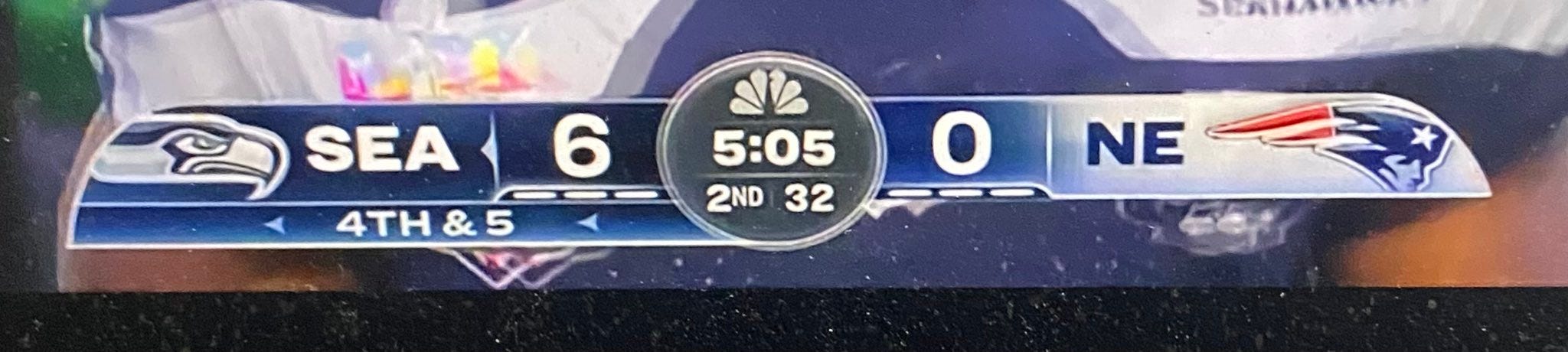
When the game hit 6-0 for the Seahawks, my kid was very hyped to see New England score a touchdown so he could say….”67”.
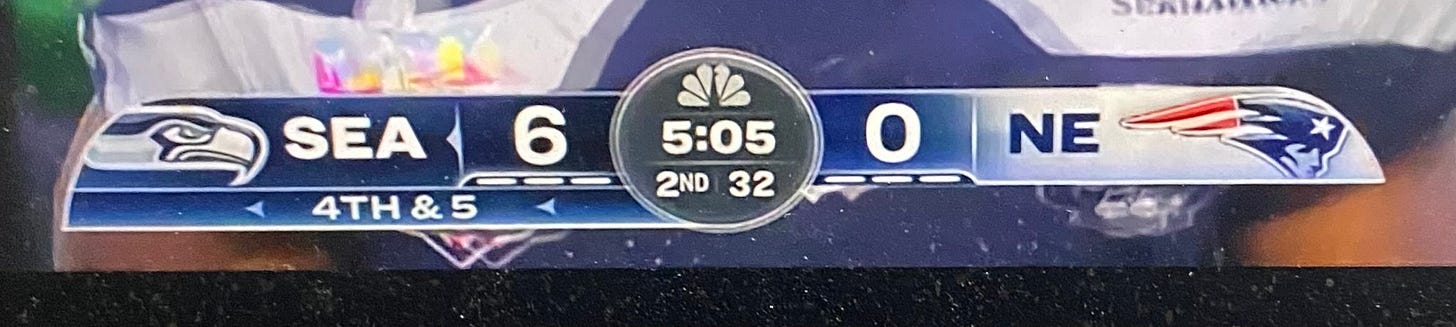
The Seahawks scored next with a field goal and he was done. While we watched Bad Bunny at half-time, he skipped the rest of the Seahawks win.
Bad Bunny is super talented and the choreography was ace. Lady Gaga made a cameo. The Latino dance party energy was top-notch, a couple got married live and Jon Hamm was going HAM. Unfortunately, I knew none of the songs or lyrics, and no moment stuck out to me as compared to recent years: Kendrick (“a minor!!!!!”), Usher & L’il Jon (very sweaty), Rihanna (I know literally every lyric), The Weeknd (he sang so much about party drugs that someone made one of the greatest tweets ever: “I know Pepsi sponsors this half-time show, but why is it all about coke?”), West Coast Rap (50 Cent hanging upside down was incredible) and Shakira & JLo (this got a bit PG-13).
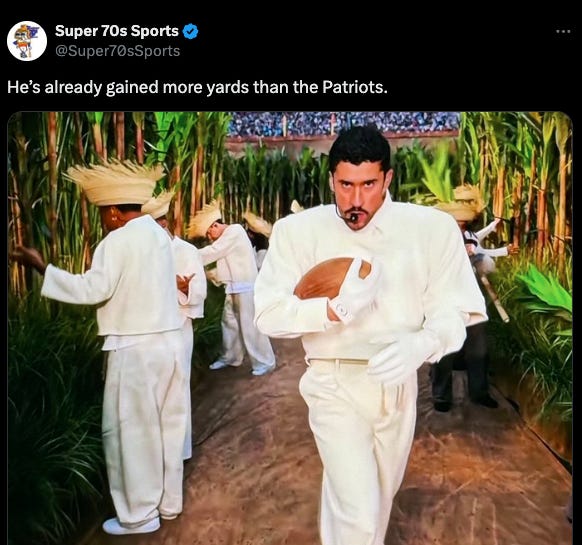
To be fair, I’m also musically out of touch. As Lucas Shaw writes, “The backlash to [Bad Bunny’s] performance — from people upset that someone who performs in Spanish is headlining the most American of sporting events — is confusing. He is not a niche artist, or a coastal artist. His music videos on YouTube over the last year generated 1.56 billion views — compared to 158 million for Kid Rock, who is performing the alternate half-time show. If you look at the markets where his music is most popular, it looks like a list of the biggest cities in the country: New York, Los Angeles, Houston, Chicago and Miami are the top five. The northeast (New York), mid-atlantic (Philadelphia), midwest (Chicago) and southeast (Orlando) all appear in the top 10, as do San Francisco and three cities in Texas.”
BTW, Bad Bunny has an insanely great music deal with Sony. Roberto Nickson talks about how Bad Bunny was “a grocery bagger posting to SoundCloud” who refused to trade growth for equity. He gets a 90/10 split of revenue from music, streaming and concerts. Most top artists might get a 30/70 split on a distribution deal.
Bad Bunny apparently asked Drake to join his performance. They’ve known each other for nearly a decade and made the incredible banger “MIA” back in 2018. But Drake thought his presences would have been a distraction and perceived as some clapback at Kendrick. “MIA” is actually the only Bad Bunny song I know and was pretty choked that he didn’t sing it at the Super Bowl. It’s very good.
The contrast with the Turning Points USA alternative half-time show was objectively hilarious. In the end, some 120m+ people watched Bad Bunny while single-digit million watched Kid Rock (side note: this is one of the funniest Trump impressions I’ve ever seen).
BUT, about 10m viewers did drop off at halftime and it raises a question about the NFL’s strategy. Ryan Glasspiegel writes “Based on my understanding of the data, Bad Bunny lost more % of the Super Bowl viewership from the end of the second quarter than has ever happened before. The NFL has an interesting dilemma in trying to court new fans vs alienating the base.”
Since Roger Goodell became NFL Commissioner, the league has grown revenue from $8B to $25B a year. The NFL in basically maxxed out in America. They’ve been doing games in Europe and South America to build a more global audience. But the appetite for American football outside of America is miniscule. There is a a breakeven between adapting the product to court new fans vs. making sure the existing fans stay happy. If Goodell is obsessed with growth, that’s the challenge that he faces.
Aside from the culture war chatter, the most controversial thing about the half-time show was probably people getting mad at Kalshi and Polymarket because they bet that Cardi B would perform at the half-time show. While Bad Bunny put her in the performance, Cardi B was dancing and mouthing the lyrics as part of the crowd, and that didn’t really count.
Also, looks like the popularity of prediction markets took a bite out of Las Vegas sportbooks. Per ESPN, “$133.8 million was bet on Super Bowl LX with Nevada sportsbooks, a 10-year low”. While Kalshi saw “more than $1 billion was traded on the Super Bowl, including $113 million on the first song performed by Bad Bunny during half-time and $24 million on whether actor Mark Wahlberg would attend the game.”
AI ads took over the timeline. Back in 2022, it was Crypto ads including an infamous FTX one with Larry David…and the exchange blew up 10 months later.
In total, AI was 15 of the 66 ads (23%). At $8m for 30 seconds of airtime, that was a total of $120m for just the ad spots. Sounds bubbly until you consider that $120m is the going rate for a single top-tier AI researcher and only amounts to 0.01% of Big Tech’s projected $650B CapEx spend on AI data centres for 2026.
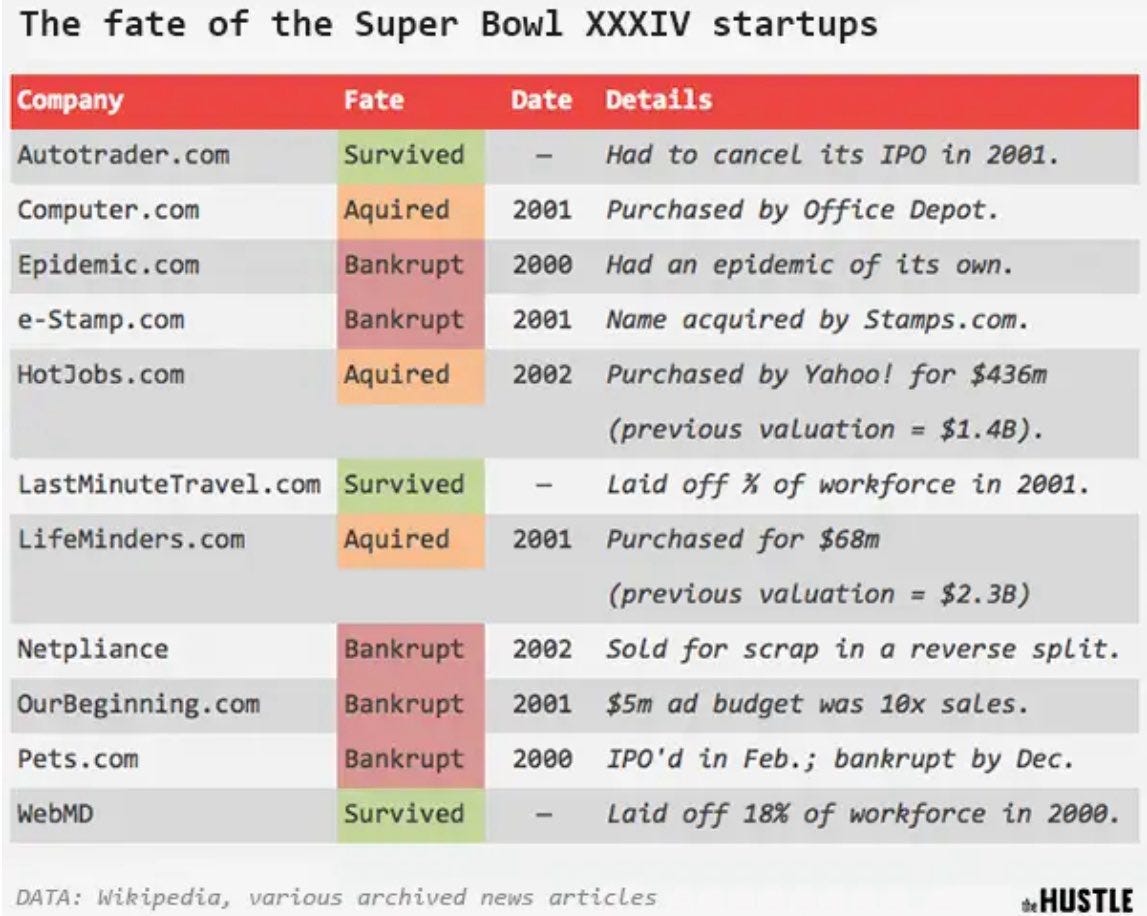
A popular example that people bring up of “a nascent industry overspending on Super Bowl ads because they have nothing better to do with their funds and its clearly a top signal” is the 2000 Super Bowl: 11 DotCom startups paid $2m for a 30-second spot…and, within a few years, 8 of them had either gone bankrupt or were acquired in a fire sale.
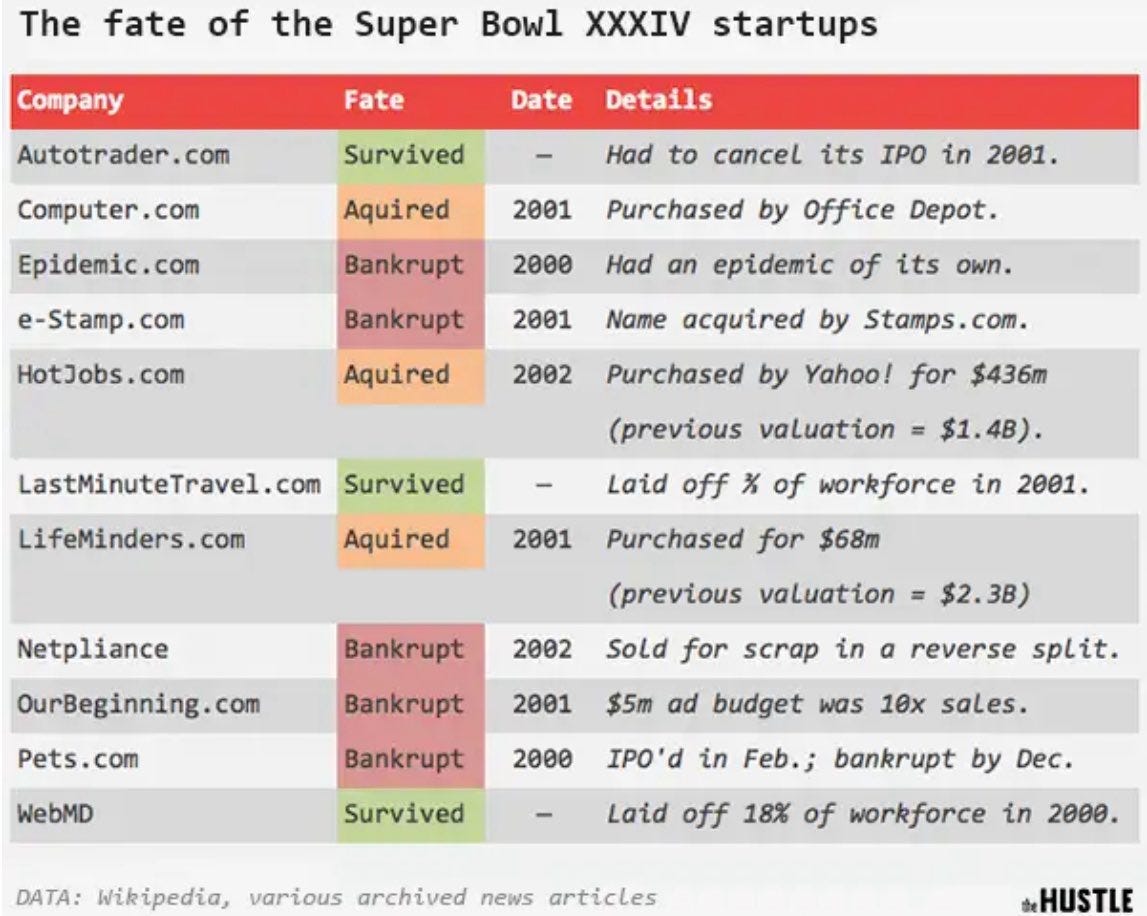
The current AI hype cycle may be nascent but the companies are not. The AI ads in 2026 included ones from Google with Gemini ($400B revenue), Microsoft with Copilot ($300B revenue), Meta with Oakley Ray-Bans ($200B), OpenAI with Codex ($20B revenue) and Anthropic with Claude ($10B revenue). Sure, things are a bit frothy, but we’re not talking about ads for OurBeginning.com or Netpliance here.
People were mad at Amazon for its Ring ad (which helps you find a lost pet at the expense of civil liberties) and Salesforce for doing an ad with MrBeast (because their grade-school kids are now asking about how to get a new CRM).
Meanwhile, Microsoft is probably a bit desperate in terms of consumer AI. Microsoft 365 (Word, Excel, PowerPoint, Outlook) has over 450 million paid seats. Only 3% of the seats (15 million) have added the AI Copilot feature. That’s how we got this football-themed Excel Copilot ad (which I don’t think is going to move the needle).
OpenAI ran an ad for its coding agent Codex. A few days earlier, Anthropic revealed its Super Bowl ad campaign about how ChatGPT ads will lead to sketchy outcomes. Savage but a bit deceiving and doesn’t cost Anthropic much since 80% of its revenue is enterprise or coding related. While the Anthropic Super Bowl ad was catnip for the tech crowd, the normie crowd was incredibly confused. In one survey, respondents placed the Claude ad in the bottom 3% of all Super Bowl ads in the past 5 years.
F IT, here’s Drake bringing out Bad Bunny to perform “MIA” live in LA a fe years ago. Got Dang it goes hard.
One company that did go overboard was AI.com. The owner of Crypto.com — which bought a Super Bowl ad in 2022 — paid a record $70m for the AI.com domain a few weeks ago. Then, spent $10B+ to produce and run a 30-second ad spot. But the website wasn’t ready and crashed from the traffic. All that effort for an email capture form pointing to an eventual OpenClaw wrapper AI agent product.
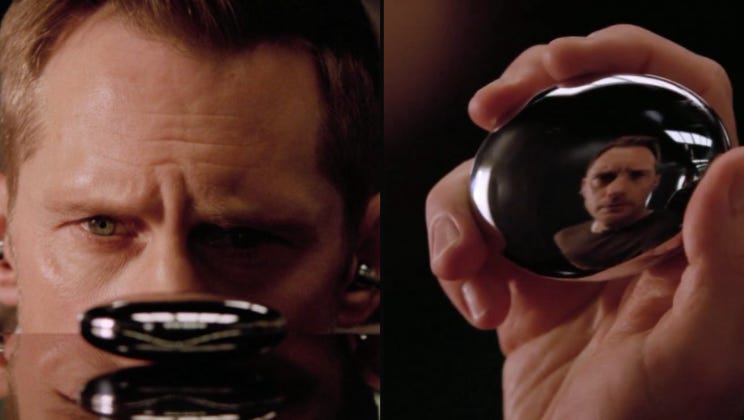
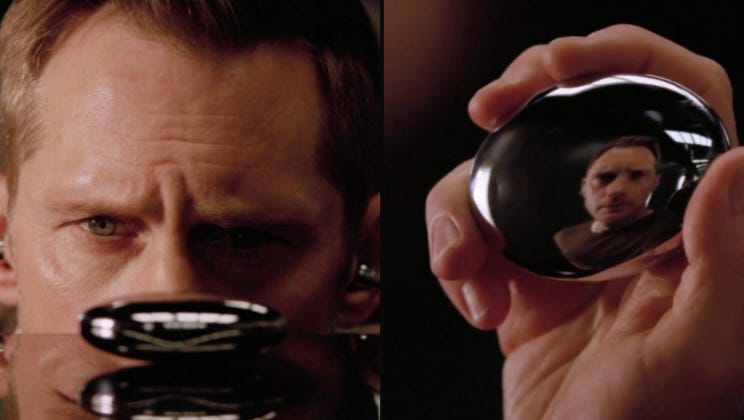
The biggest AI what-if is an apparent “leaked” OpenAI ad that was pulled from the Super Bowl. Lukas Matsson (Alexander Skarsgård) from Succession examines a Jony Ive-designed OpenAI hardware device. Called Dime, it looks like a metallic earbud and puck. Apparently, this was a hoax…but damn it looked cool.
Svedka Vodka made the first AI-generated Super Bowl ad ever. It did so with the same studio that did Coca-Cola’s first AI-generated Christmas ad.
My favourite ad is probably Jurassic Park Xfinity…and Svedka was definitely the worst one.
Overall, the ads were pretty meh and Jack Butcher has a solid theory: “One simple hypothesis on mediocre superbowl ads, LLMs telling everyone their ideas are brilliant”.
NBC is in the THICK of it right now. The media giant spent $8B on sports rights for 2026, up 2x from 5 years ago. In the first two weeks of February, it’ll have the Super Bowl, Milan Winter Olympics and NBA All-Star Game. The total ad haul from these events will be $2B+ and provide a ton of marketing lead-in for “new shows and films from Comcast’s Universal Pictures, including the new Minions and Super Mario Bros. movies, as well as Steven Spielberg’s sci-fi flick Disclosure Day. The Super Bowl will also lead into a new television series on the Peacock streaming service called The ’Burbs.”
Between Bad Bunny and the AI ads, my main takeaway from Super Bowl LX is that dressing as a tree during a live musical performance will be one of the only jobs left for humans when AGI hits.


Some other wild posts (including 21 Savage rolling up to the Super Bowl with Kylie Jenner):


Jony Ive & Ferrari Collaboration
Speaking of Jony Ive, his firm LoveFrom partnered with Ferrari to design the steering wheel, dashboard and interior for the luxury carmaker’s new EV SUV (Luce).
The vehicle’s body won’t be unveiled until later this year (which gives me just enough time to YOLO some World Cup and midterm election prediction market bets to afford this bad boy).

The design idea was to blend the tactile and digital controls.
My basic read of the timeline was that a lot of techy folk loved it but car aficionados were underwhelmed.
Here’s a representative post from Hacker News:
In case anyone was wondering what the Apple Car would have looked like inside, it would have been roughly this.
As an Apple Car™ it makes sense, but as a Ferrari it’s incredibly soulless and oversimplified. This Ive design aesthetic (Dieter Rams’ aesthetic really) is fine on consumer electronics where you want the device to disappear and give way to the display, but on something as emotional as a vehicle (Ferrari especially), this design falls flat.
I do hope some of the design details work their way through the industry (e.g. using glass instead of gloss black plastic, convex glass to add depth to digital gauges), but I hope the rest of it stays as a one-off experiment demonstrating the hubris and one-dimensionality of a top designer.
LoveFrom is reportedly charging up to $200m a year for top-tier clients and has also worked with Airbnb, Moncler, Christie’s Auction House, King Charles III on his Coronation Emblem and OpenAI (the startup acquired Jony’s separate AI hardware startup “io” for $6B in equity last year).
Ive named the firm — which employs many former Apple colleagues — LoveFrom in honor of Steve Jobs, who said one of the ways to express appreciation for humanity was “the acting of making something with a great deal of care and love”, per NYT.
Jordan Golson has more details on the LoveFrom and Ferrari partnership:
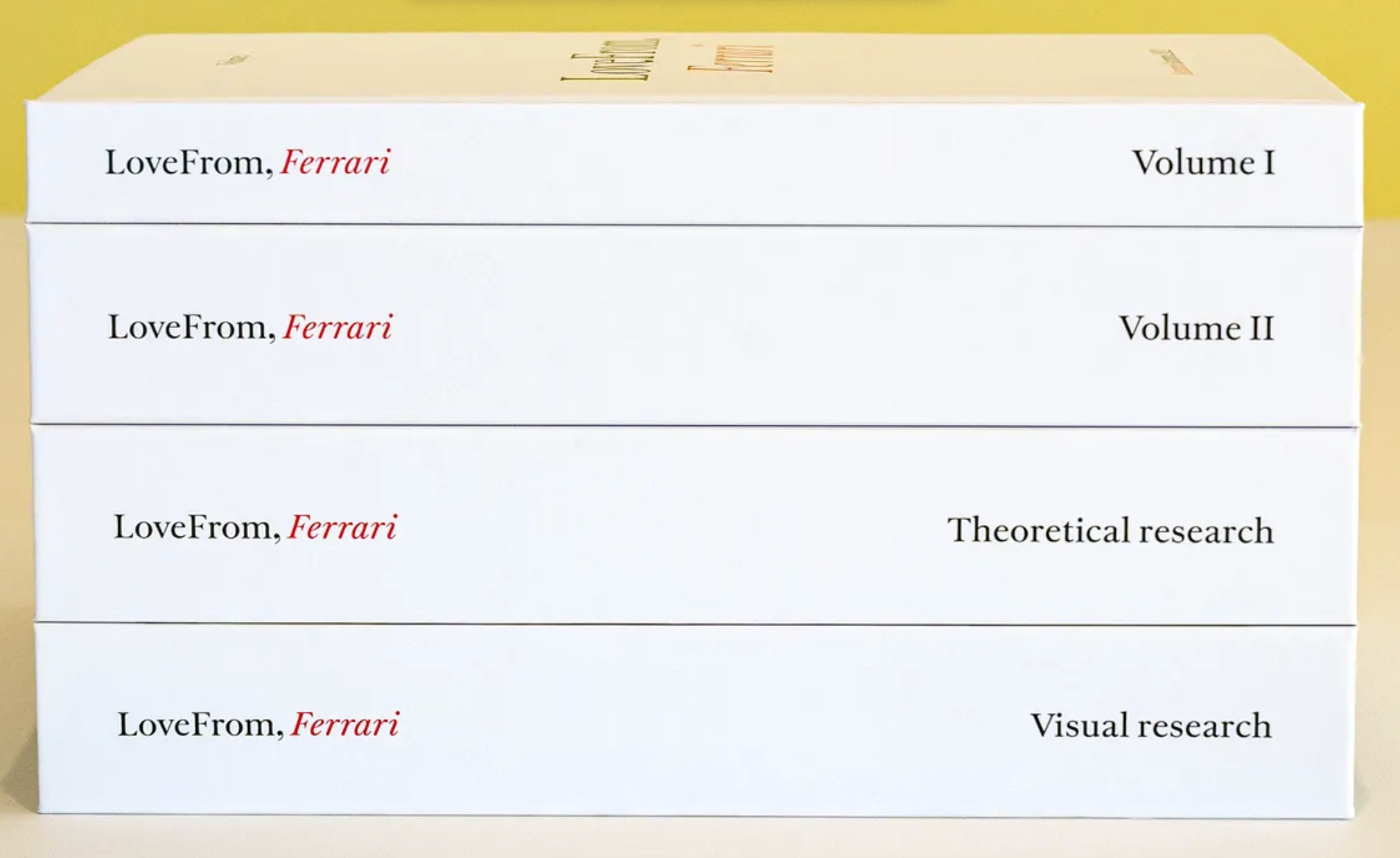
Before LoveFrom drew a single line, they spent six months on research. They presented Ferrari with four books — substantial, rigorous volumes printed in both Italian and English, left page and right page, covering philosophy, design history, the cultural significance of Ferrari within Italy, the relationship between human attention and physical interaction. These weren’t mood boards. They were arguments — about why certain assumptions held, why others didn’t and what first principles should govern the design of a car interior in 2026.
I’m not saying these books are worth $200m but they look real baller.
As for Ive’s former employer, Apple (in)famously shuttered its car project in 2024 after spending $10B over 10 years.
When Apple shut down its car project in 2024, it had spent $10B+ over 10 years.
Jony Ive created a concept that looked like a “European minivan such as the Fiat Multipla 600”.
The NYT has another piece recounts Ive demo-ing the vehicle for Tim Cook:
“One day, in the fall of 2015, Mr. Ive and Mr. Cook met at the project’s headquarters in Sunnyvale, Calif., for a demonstration of how the car might work. The two men sank into the seats of a cabinlike interior. Outside, a voice actor read from a script of what Siri would say as the men zoomed down the road in the imaginary car. Mr. Ive asked Siri what restaurant they passed and the actor read an answer, said two people familiar with the demonstration. But by 2016, it was clear that the car effort was in trouble.”
One reason Tim Cook started Project Titan — which some internally joked about as Project “Titanic” — was because the Watch was just completed and engineers were “restless” looking for the next challenge.
The company went back and forth on whether to make an EV (eg. Tesla) or a self-driving car (eg Waymo).
Apple apparently briefly spoke to Elon about buying Tesla (~$40B market cap at the time and Apple has a $155B cash pile).
On a recent podcast, former senior Apple exec Tony Fadell — who worked with Steve Jobs to create the iPod — said that Apple's biggest recent fumble was the Car project.
Fadell says it was a mistake trying a create a 4-wheel vehicle, instead of lightweight 2 or 3-wheeler.
Apple had "redefined" categories (eg. desktop publishing with Mac, music with iPod)…so it should have redefined mobility:
When Steve Jobs and I would walk around the Apple campus back in 2008-9, we talked about the Apple Car. What would it be and he was really like 'we need to do [something as] revolutionary as the Volkswagen (the people's car).' What's the next-generation people's car? What's going to be used in the cities? […]
Now you're seeing the [two-seater] Fiat Topolino. You see the [two-seat quadricycle] Twizy. You see all these different things [in cities]. I live in Europe, right? So, you see all this stuff running around and they're selling out like crazy.” […]
Don't make a four-wheel car that competes with everybody else and the Chinese. How would you change mobility in two, in three, and lightweight four-wheel vehicles? How do you do that? [Vehicles that 14-year-old kids] can use.
I think the failed car project is probably the biggest feather in the “Apple has lost its design mojo” cap. The Apple Vision Pro actually shipped and is a technical marvel…and the AI issues are software-related (…also looks like Apple may finally fix Siri with a Gemini partnership).
But man, Apple really should have made some vehicle. A large TAM and right in its wheelhouse. Apple Fanbois were already buying special wheels for their Pro Macs at $700. They woulda forked over for a whip.

In China, Xiaomi started with smartphones and home electronics. Then, its CEO Lei Jun (who is obsessed with Steve Jobs) decided he wanted to make an EV, which are basically smartphones on wheels. Well, he did and Marque Brownlee says the Xiaomi SUV7 is a luxury-calibre EV selling for only $42k.
It’s worth noting that Jobs looked at buying GM during the 2008 financial crisis when the carmaker neared bankruptcy. Another what if. But obviously nothing materialized…and this is why Ive’s partnership with Ferrari is as close as we’ll get to an Apple Car.
His design has a lot of buttons and clicking sounds…which is surprisingly different from Apple’s minimalist glory days.
While we’re on the topic of Apple glory days…

iPhone’s Blockbuster Sales
Speaking of Apple, when the iPhone 17 came out in September, I did the standard “hate on the new iPhone for guaranteed engagement” thing.
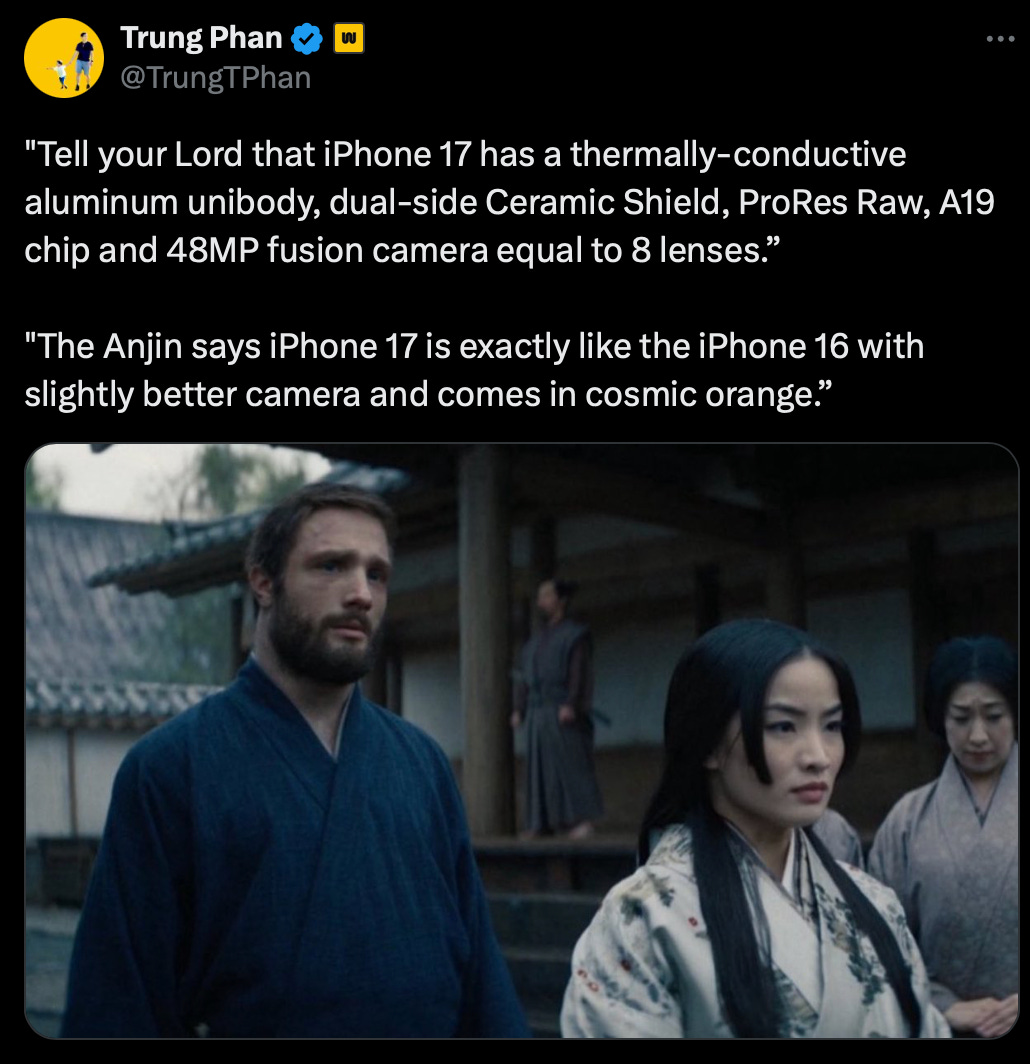
Turns out the joke is entirely on me.
The iPhone 17 sales have been absolutely gangbusters with its slightly new form factor…and Cosmic Orange has been a massssssssive hit.
In its latest Q4 filings, Apple saw iPhone sales in China jump +38% YoY to a record $26B (nearly 1/4 of Apple’s total $102B).
Why Cosmic Orange? Well, it looks like Hermès orange and the luxury giant is huge in China (the country accounting for 40%+ of the luxury giant’s sales).
iPhones are a total fashion item. in China That’s why market response to the GIANT sales figures were meh. Apple barely moved on the news.
What if the Cosmic Orange is a little less Cosmic-y next year and the form factor is too similar. China sales could go kaput.

Anyways, Tim Cook, if you’re reading this email…I have an idea of how to turn around Apple Vision Pro sales:

Some other links for your weekend consumption:
How do Narratives Move Markets? A very interesting conversation between Barry Ritholtz and Ben Hunt.
ByteDance’s new AI video model (SeeDance 2.0) is very good. Zero regard for IP protection means we got some wild videos of Lebron, Kanye and Tom Cruise.
Disney and some Hollywood groups…have already sent Bytedance Cease & Desist letters.
Why would Elon Musk pivot from Mars to the Moon all of a sudden? Eric Berger explains why Elon is focussing on Moon missions first: “By focusing on the Moon, Musk is making a decision that benefits NASA and the United States. Because for all of Blue Origin’s promise with a slimmed-down lunar lander, Starship offers a promising avenue to return humans to the Moon in the near term. Another advantage of Starship is its enormous payload capacity, able to bring 100 metric tons or more of cargo down to the Moon. For anyone seeking to build a commercial business on the Moon, Musk’s 180-degree pivot represents an enormous opportunity.”
The most impressive Winter Olympics performance so far…is Johannes Hoesflot Klaebo’s sub-6 minute mile pace running uphill on skis is the most impressive snowy mountain sprint since Rocky shook his Soviet handlers before fighting Ivan Drago.
The most annoying part of the Winter Olympics performance so far…is the drone buzz (which the athletes can’t hear but the broadcasts choose to keep) but the footage is unreal and shoutout to the drone operators (can go 160km/hr).
The absolute most demented cold email template…that is guaranteed to get a 90-95% customer open rate.
The New Economy: Waymo is offering DoorDashers $6 jobs to close open doors on the parked self-driving vehicles.
That was such an awesome weekly recap. Thanks Trung!
Docusign is stronger than the “it’s just a wrapper” meme suggests, but it is not a data monopoly like Wolters Kluwer (which I recently wrote about) or RELX. The core of Docusign’s moat lies in workflow integration, compliance, and trust. Not in unique, protected datasets. That makes it a defensible moat, but also vulnerable in an AI world where software will become increasingly cheap and easy to replicate. In my opinion the distinction between a workflow system (software) and a truth system (database) will ultimately determine who preserves, or even expands, their long-term value.