

Note: If you haven’t watched You Can See Everything, don’t worry…no spoilers here.
A year ago, I walked out of the theatre for One Battle After Another and immediately predicted it would win Best Picture, Best Director and a bunch of other Academy Awards.
Wasn’t really a hard call tbh. Some films just scream Oscar bait and OBAA was an ideal vehicle to finally give Paul Thomas Anderson his flowers.
I just watched Nathan Fielder’s documentary about Elizabeth Holmes (You Can See Everything) and am getting similar Oscar Spidey tingle.
I’m clearly not the only one.
The film scored a 99% critic / 98% audience score on Rotten Tomatoes and was briefly the highest film ever on Letterboxd. Sean Fennessey and Amanda Dobbins at The Big Picture podcast think the documentary will become the first documentary to be nominated for Best Picture.
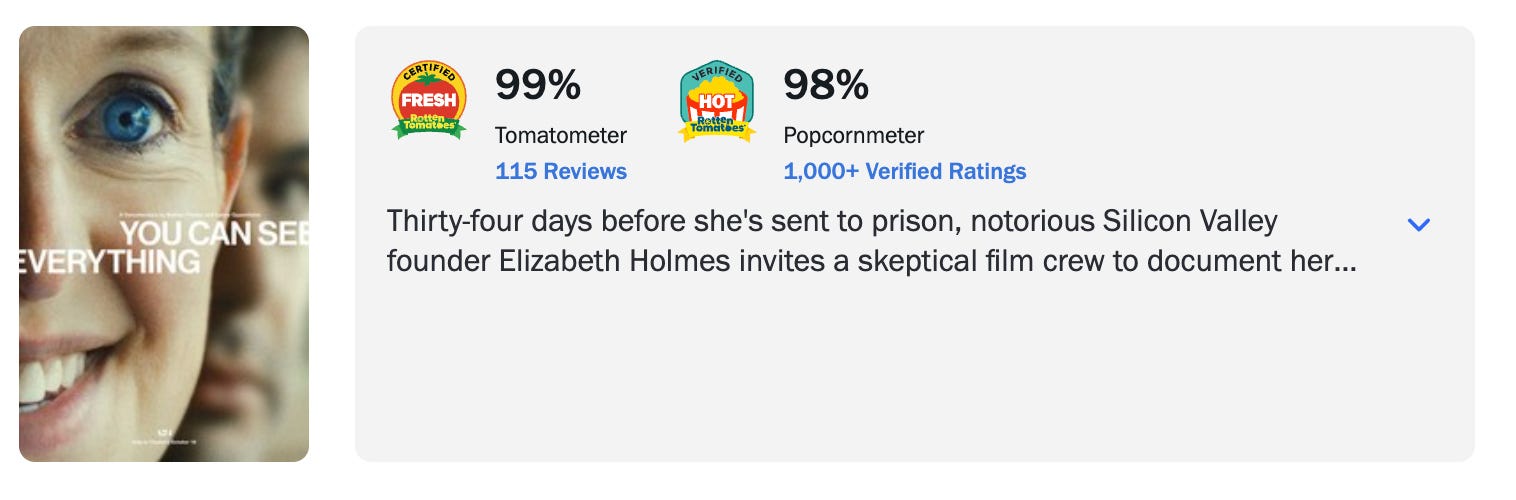
I’m sure there’s a massive dose of recency bias. But I will say from my N=1 experience, that You Can See Everything was one of the funniest theatre experiences I’ve had in a long time. The audience had at least a dozen legit laugh-out-loud moments watching Fielder’s unstoppable (cringe deadpan) force meeting Holmes maximally immovable (and unblinking) object.
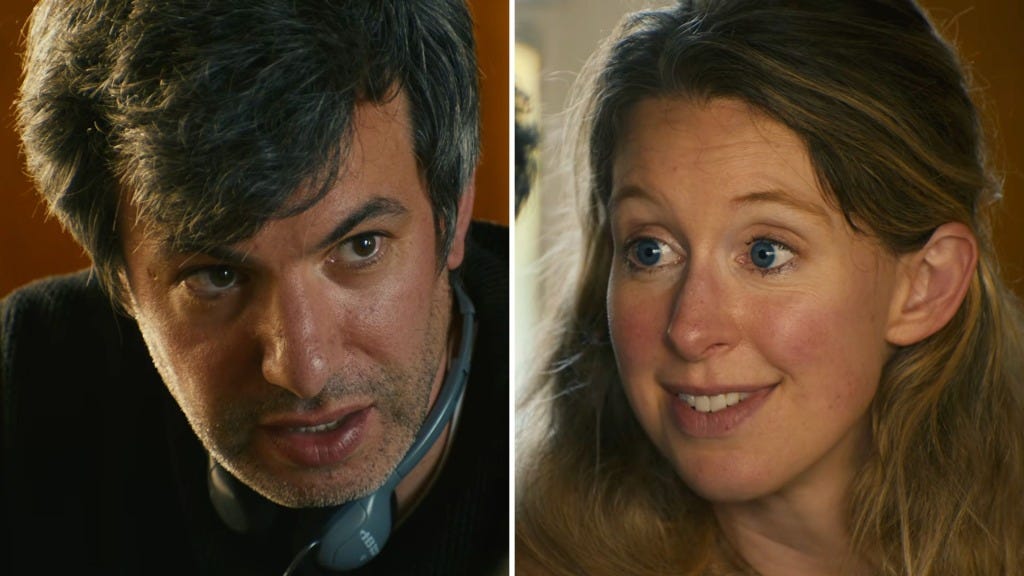
The A24 film is nearly three hours long and is divided into two very different films:
Part 1: Fielder spends 34 days in San Diego with Holmes, her husband Billy Evans and their two young children…before she begins her 11-year prison sentence for defrauding investors. Kind of like a 90-minute episode of Nathan For You about Theranos. Fielder lives with them for a few weeks for extra absurdity.
Part 2: Two years later, Fielder revisits his original documentary work in the most surreal way possible. It’s taking every ounce of willpower not to spoil the story. Just know that Fielder smashes the fourth wall — just obliterates it — with reenactments, casting decisions and interviews.
In part, the film is a meta-look at the documentary genre. Fielder co-directed with documentarian Lance Oppenheim and there are so many documentary techniques they play and mess around with. This is what really sets off my Oscar’s spidey senses. Hollywood loves navel-gazing. In recent memory, we had The Artist — which was basically a love letter to silent film 1920s Hollywood — win Best Picture in 2011.
What’s so meta about You Can See Everything?
It either addresses or nods at the job of a documentary. What is the truth? Who is a reliable narrator? How can words be misconstrued? Where is the evidence? Can we trust our memories? What is the relationship between filmmaker and subject? How is the subject being framed? Why is the subject participating? What is real vs. fictionalized? Why the hell doesn’t Holmes blink?
Did I actually think about any of these questions after the film?
Not really. I was still reeling from the fact that NATHAN FUCKING FIELDER MADE A THREE-HOUR DOCUMENTARY ABOUT ELIZABETH HOLMES, INCLUDING SITTING WITH HER AT BREAKFAST WHILE SHE BREASTFED HER KID.
One question I did ask: Why dafuq would Holmes and Evans agree to this film?
Without giving too much away, the couple clearly want to tell their version of the story (and also promote some personal projects).
This was a massive risk since they didn’t have creative control.
To illustrate the point, let me point you to the other “most meta” documentary I’ve ever seen: Raw Iron, a 2002 film is a 25th anniversary retrospective of Pumping Iron, Arnold’s classic bodybuilding film.
I am a huge fanboy of Pumping Iron. Most people remember the “biceps cumming bit” but I’m partial to Arnold’s gem of advice on playing mind games with your opponents:
The day of the contest, if he comes in his best shape. And he’s equally as good as I am — or if he’s a few percent better than I am — I spend with him one night…I will mix him up.
By the time the night is over, the next morning... he will be ready to lose. I mean I will just talk him into that, it’s no problem to do. So, all [these psychological games] are available.
I was under the impression that Arnold is the greatest 10D chess mind ever…and he is, but it wasn’t about him playing mind games with his opponents.
The entire thing was a setup.
Basically, Arnold wanted to get into mainstream Hollywood and the documentary was a vehicle to help him achieve the goal.
To do so, he had to create an engaging conflict and make “Arnold” appear larger than life.
While the bodybuilding competition was real, Arnold and the directing team invented the conflict between him and Lou Ferrigno. They invented the Good vs. bad. The Dark brooding contender vs. Easy going charismatic champion. The Physical vs. psychological competition.
Was I a bit naive not to realize the setup? Probably. Still good to have Arnold articulate it so transparently.
This is standard WWE or reality show stuff now. But pretty wild to think Arnold was already so ahead of the curve in the mid-70s with a plan to pivot from bodybuilding to full-blown movie star.
“There were certain things that are not true,” Arnold explained about Pumping Iron. “And that’s why we never called it a documentary, we called it always a docu-drama because certain things were created in order to make it more interesting because it was very clear to us that the only way we could raise the money for the movie was by making it more dramatic. So therefore, let’s create some drama, some conflict. Let’s create a villain. Let’s create a hero. Let’s create the guy that has the psychological power over people.”
Raw Iron has put me on guard for every documentary I’ve watched since.
Example: I loved Michael Jordan’s The Last Dance. That documentary probably kept me sane for a few months in COVID. However, I watched it knowing that Jordan had the final cut privileges (which he apparently never used).
Back to You Can See Everything. On the one hand, Fielder and Oppenheim had full creative control. On the other hand, Holmes has nothing to lose. She went from youngest self-made female billionaire to jail. Her actual prison sentence is based on defrauding investors, though. The courts acquitted her of defrauding patients and the documentary is certainly an avenue to hammer home that point. To be sure, Theranos had to void over 50,000 blood tests and caused patient harm from false diagnoses and uncertainty (while Holmes also tried destroying the lives of people who tried to expose the BS Edison machines).
My first weekend vibe check of the film has shown more people in the “I’m sympathetic to Holmes” camp than I expected.
Maybe Fielder got manipulated? Maybe that’s what he wants us to think?
A few days after watching the film, I am definitely stewing on those questions…along with the questions I had posed earlier (Polina Pompliano with a solid case that You Can See Everything set out to manipulate the viewer).
These are legit philosophical questions...and the fact that they are in the zeitgeist from the madman behind Dumb Starbucks only makes You Can See Everything that much more intriguing.
I guess we shouldn’t be that surprised that Fielder would drop this gem of a film.
He’s been on an absolute heater of absurd comedy works that keep levelling up.
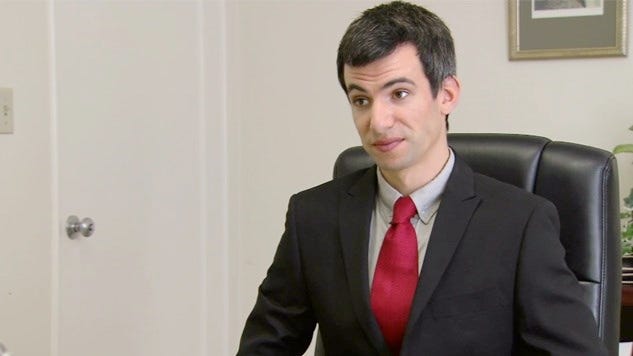
Since Nathan For You — the satirical docureality series about fake businesses — Fielder has done two seasons of the unscripted social experiment series The Rehearsal and the 10-episode dark comedy The Curse.
He made The Curse with Benny Safdie and it turns out that Christopher Nolan was a huge fan of the show. Nolan interviewed Safdie and Fielder about the show and Fielder has a great segment about his creative process.
So much of it comes through in You Can See Everything (no spoilers, don’t worry):
Setting the tone is Fielder’s top priority, even more so than narrative (he says, “when you have the tone right, everything falls into place”).
The musical score is crucial in setting the tone (the sound doesn’t even have to match action on the scene, it can be asynchronous and float above the dialogue while just setting the mood)
He doesn’t want to rush scenes. Fielder lets them develop to the point where the audience is expecting any action to be consequential and it builds the tension. This was inspired by old detective TV show Columbo. Long silences also rev up the cringe…but, as Fielder finds out, Holmes is very comfortable with the cringe.
For me, the score really helped for the film’s long runtime. I think it’s a major reason why I didn’t feel bored. There was always some type of emotion bubbling up.
A similar thing happened with the other clear Oscar’s frontrunner in 2026: The Odyssey, which had a pretty intense score pacing a nearly 3-hour film (Dunkirk is still Nolan’s best score-pacing-this-movie; Hans Zimmer was not effing around).
Just re-watch the viral teaser trailer for You Can See Everything to see Fielder’s approach at work.
None of those creative insights explain why Fielder would take on Holmes, though.
This exchange may be the skeleton key:
Nolan: How was it for you Nathan? Moving from — I don’t even know what to call what it is that you’ve done in the past so I’m not going to try and put a name on it — but moving into scripted drama.
Playing a character. What was that shift like? Was it something you wanted to do for a long time?
Fielder: No I don’t really want to do anything that I do. I just end up sort of like stumbling in. It starts with an idea you get excited about it and then you just sort of you pile things on and it grows.
A24 had given Fielder and Oppenheim a ton of rope for the project. Living and filming 16 hours a day with Holmes and her family was a massive ask. Fielder says they offered many times to “pull the plug” on the film.
They just kept piling things and growing it…to the point I think Fielder realized he could make the most meta documentary imaginable.
And here we are.
At the start of 2026, don’t think anyone had Nolan vs. Fielder on their Hollywood Bingo card…and I am trying to mentally prepare myself for a world in which this graduate of one of Canada’s top business schools with really good grades wins Best Picture and Best Director.
I hope there are more SatPosts to come!
I liked this review too