

Thanks for subscribing to SatPost.
In this issue, I’ll be sharing my thoughts on Nathan Fielder’s absolutely out of control documentary on Elizabeth Holmes.
Also this week:
iPhone Duo reviews are in
Hermès taking over American suburbs
…and them wild posts (including the Atlanta Falcons)
Note: If you haven’t watched You Can See Everything, YOU HAVE TO DO IT…but also, don’t worry…no spoilers in this write-up.
Nathan Fielder is Going to Win Best Picture
A year ago, I walked out of the theatre for One Battle After Another and immediately predicted it would win Best Picture, Best Director and a bunch of other Academy Awards.
Wasn’t really a hard call tbh. Some films just scream Oscar bait and OBAA was an ideal vehicle to finally give Paul Thomas Anderson his flowers.
I just watched Nathan Fielder’s documentary about Elizabeth Holmes (You Can See Everything) and am getting similar Oscar Spidey tingle.
I’m clearly not the only one.
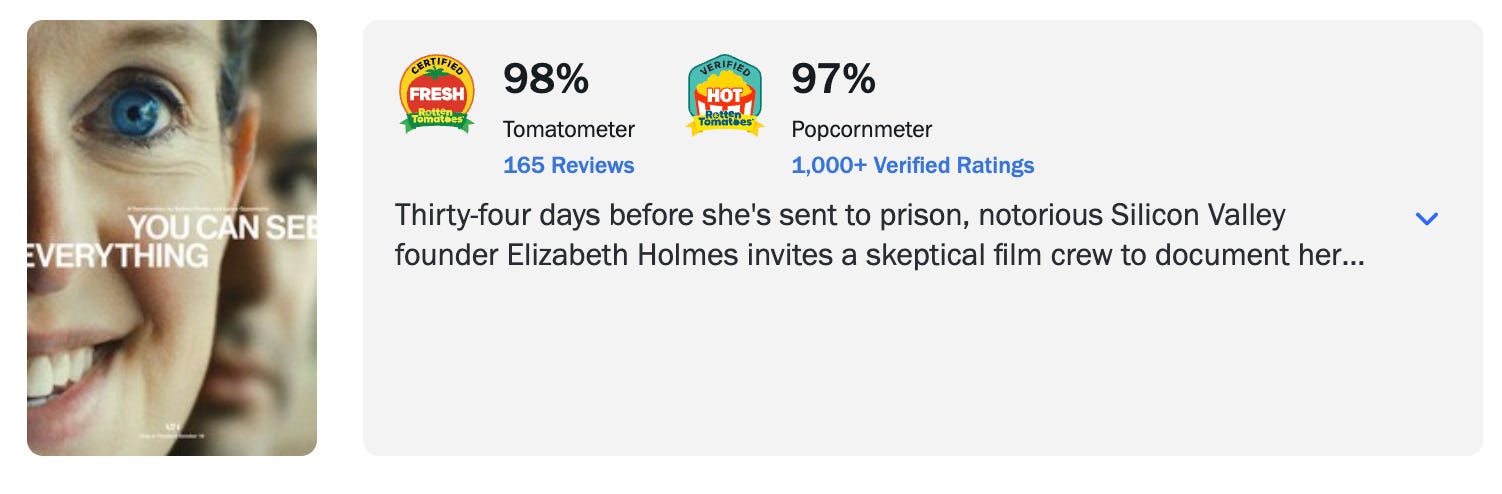
The film scored a 98% critic / 97% audience score on Rotten Tomatoes and was briefly the highest-rated film ever on Letterboxd. Sean Fennessey and Amanda Dobbins at The Big Picture podcast think the documentary will become the first documentary to be nominated for Best Picture.
I’m sure there’s a massive dose of recency bias. But I will say from my N=1 experience, that You Can See Everything was one of the funniest theatre experiences I’ve had in a long time. The audience had at least a dozen legit laugh-out-loud moments watching Fielder’s unstoppable (cringe deadpan) force meeting Holmes maximally immovable (and unblinking) object.
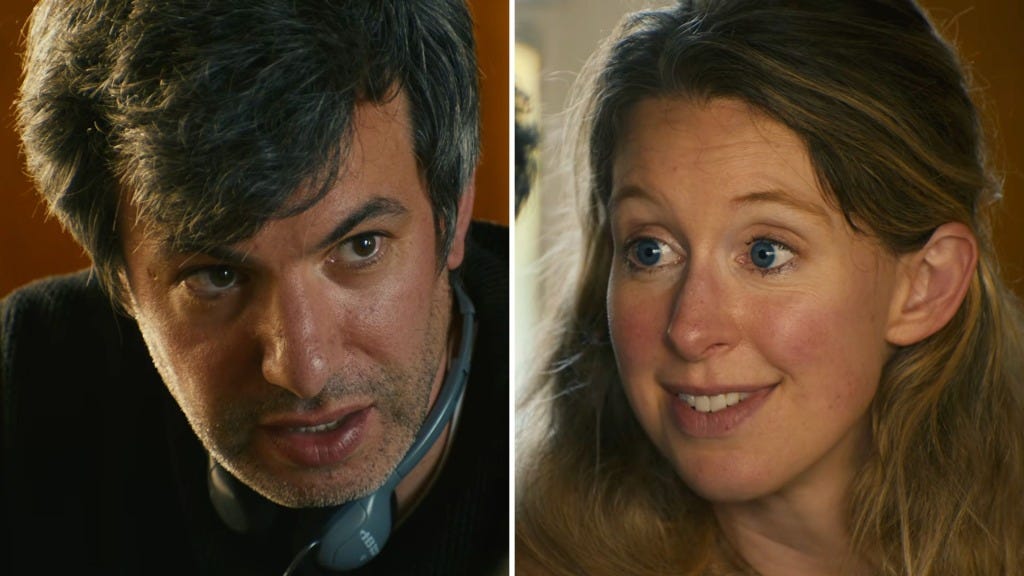
The A24 film is nearly three hours long and is divided into two very different films:
Part 1: In 2023, Fielder spent 34 days in San Diego with Holmes, her husband Billy Evans and their two young children at a beach house rental…before she begins her 11-year prison sentence for defrauding investors. Kind of like a 90-minute episode of Nathan For You about Theranos. Fielder wants to come to his own conclusion on if she’s a liar and whether Theranos was a fraud. He lives with them for a few weeks for extra absurdity.
Part 2: Two years later, Fielder revisits his original documentary work in the most surreal way possible. It’s taking every ounce of willpower not to spoil the story. Just know that Fielder smashes the fourth wall — just obliterates it — with reenactments, casting decisions and interviews.
In part, the film is a meta-look at the documentary genre. Fielder co-directed with documentarian Lance Oppenheim and there are so many documentary techniques they play and mess around with. This is what really sets off my Oscar’s Spidey senses. Hollywood loves films that examine the art of filmmaking. The good and the bad.
In recent memory, we had best-picture winners including The Artist in 2012 (a love letter to silent film 1920s Hollywood), Argo in 2013 (showing Hollywood as a tool of geopolitics) and Birdman in 2015 (a critical look at fame and the superhero films).
You Can See Everything is very very very different than these other films. I mean, the Academy has never nominated a documentary. Math may be on Fielder’s side, though. The Best Picture category has 10 slots while Best Documentary still only has 5 slots…and the film is weird enough that it probably belongs in the former category.
Worth noting that A24 has already taken two films that were not Oscar’s frontrunners to the promised land: winning Best Picture with Moonlight in 2017 and Everything Everywhere All at Once in 2023.
Polymarket’s Best Picture 2027 trade currently has The Odyssey at 44% followed by You Can See Everything at 29% (up from 20% a week ago, but the volume still low-ish at $550k).
However, the Fielder hype is just getting started.
A24 only opened the film to 800 theatres. A blockbuster film usually opens to 5x that number. However, after notching 2,000 sellouts on opening weekend — and $15m+ (a near record for under 1,000 screens since 2000 while also being highest grossing non-musical documentary since Michael Moore’s 2004 work Fahrenheit 9/11 — bet your ass A24 is about to rev the marketing and distribution spend up).
Sony just won a bidding war for international distribution rights for the film…and the timeline is full of old Fielder gems including his top YouTube videos, an Asian accent, an autism test, that pee episode, a rigged blood test (dude’s been preparing for Holmes for over a decade without knowing it) and the most demented comedic Rube Goldberg machine in TV history.
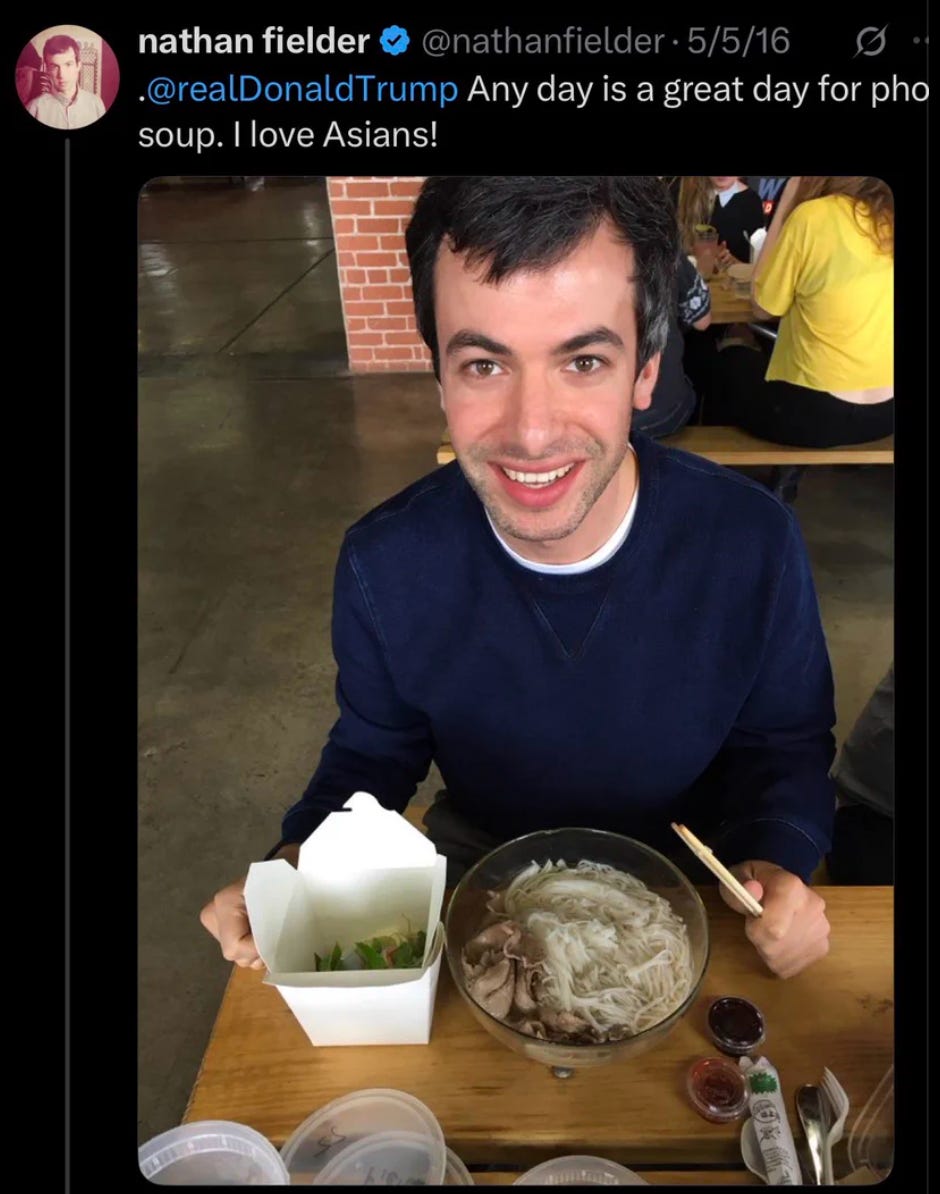
As an X addict, I can tell you that it’s very rare for a story to last more than 24 hours.
Fielder mania feels like its been on a solid weeklong run.
So, more people will def experience the meta-ness. But what is so meta about You Can See Everything?
It either addresses or nods at the job of a documentary. What is the truth? Who is a reliable narrator? How can words be misconstrued? Where is the evidence? Can we trust our memories? How well can we actually know a public figure? What is the relationship between filmmaker and subject? How is the subject being framed? Why is the subject participating? What is real vs. fictionalized? Why the hell doesn’t Holmes blink?
Did I actually think about any of these questions after the film?
Not really. I was still reeling from the fact that NATHAN FUCKING FIELDER MADE A THREE-HOUR DOCUMENTARY ABOUT ELIZABETH HOLMES, INCLUDING SITTING WITH HER AT BREAKFAST WHILE SHE BREASTFED HER KID.
One question I did ask: Why dafuq would Holmes and Evans agree to this film?
Without giving too much away, the couple clearly want to tell their version of the story (and also promote some personal projects).
This was a massive risk since they didn’t have creative control.
To illustrate the point, let me point you to the other “most meta” documentary I’ve ever seen: Raw Iron, a 2002 film is a 25th anniversary retrospective of Pumping Iron, Arnold’s classic bodybuilding film.
I am a huge fanboy of Pumping Iron. Most people remember the “biceps cumming bit” but I’m partial to Arnold’s gem of advice on playing mind games with your opponents:
The day of the contest, if he comes in his best shape. And he’s equally as good as I am — or if he’s a few percent better than I am — I spend with him one night…I will mix him up.
By the time the night is over, the next morning... he will be ready to lose. I mean I will just talk him into that, it’s no problem to do. So, all [these psychological games] are available.
I was under the impression that Arnold is the greatest 10D chess mind ever…and he is, but it wasn’t about him playing mind games with his opponents.
The entire thing was a setup.
Basically, Arnold wanted to get into mainstream Hollywood and the documentary was a vehicle to help him achieve the goal.
To do so, he had to create an engaging conflict and make “Arnold” appear larger than life.
While the bodybuilding competition was real, Arnold and the directing team invented the conflict between him and Lou Ferrigno. They invented the Good vs. bad. The Dark brooding contender vs. Easy going charismatic champion. The Physical vs. psychological competition.
Was I a bit naive not to realize the setup? Probably. Still good to have Arnold articulate it so transparently.
This is standard WWE or reality show stuff now. But pretty wild to think Arnold was already so ahead of the curve in the mid-70s with a plan to pivot from bodybuilding to full-blown movie star.
“There were certain things that are not true,” Arnold explained about Pumping Iron. “And that’s why we never called it a documentary, we called it always a docu-drama because certain things were created in order to make it more interesting because it was very clear to us that the only way we could raise the money for the movie was by making it more dramatic. So therefore, let’s create some drama, some conflict. Let’s create a villain. Let’s create a hero. Let’s create the guy that has the psychological power over people.”
Raw Iron has put me on guard for every documentary I’ve watched since.
Example: I loved Michael Jordan’s The Last Dance. That documentary probably kept me sane for a few months in COVID. However, I watched it knowing that Jordan had the final cut privileges (which he apparently never used).
Back to You Can See Everything. On the one hand, Fielder and Oppenheim had full creative control. On the other hand, Holmes has nothing to lose. She went from youngest self-made female billionaire to jail. The public perception of Holmes has been (unflatteringly) shaped by John Carreyrou’s best-selling book Bad Blood and Amanda Seyfried’s portrayal in the HBO mini-series The Dropout. Her actual prison sentence is based on defrauding investors, though. The courts acquitted her of defrauding patients and the documentary is certainly an avenue to hammer home that point.
To be sure, Theranos had to void over 50,000 blood tests and caused patient harm from false diagnoses and uncertainty (while Holmes also tried destroying the lives of people who tried to expose the Edison machines, which she said could run hundreds of diagnostic tests on a prick of blood…a pretty extraordinary claim, which can be made very credible sounding by a baritone voice and an unblinking stare).
My first weekend vibe check of the film has shown more people in the “I’m sympathetic to Holmes” camp than I expected.
Maybe Fielder got manipulated? Maybe that’s what he wants us to think?
A few days after watching the film, I am definitely stewing on those questions…along with the questions I had posed earlier (Polina Pompliano with a solid case that You Can See Everything set out to manipulate the viewer).
These are legit philosophical questions...and the fact that they are in the zeitgeist from the madman behind Dumb Starbucks only makes You Can See Everything that much more intriguing.
I guess we shouldn’t be that surprised that Fielder would drop this gem of a film.
He’s been on an absolute heater of absurd comedy works that keep levelling up.
Since Nathan For You — the satirical docureality series about fake businesses — Fielder has done two seasons of the unscripted social experiment series The Rehearsal and the 10-episode dark comedy The Curse.
He made The Curse with Benny Safdie and it turns out that Christopher Nolan was a huge fan of the show. Nolan interviewed Safdie and Fielder about the show and Fielder has a great segment about his creative process.
So much of it comes through in You Can See Everything (no spoilers, don’t worry):
Setting the tone is Fielder’s top priority, even more so than narrative (he says, “when you have the tone right, everything falls into place”).
The musical score is crucial in setting the tone (the sound doesn’t even have to match action on the scene, it can be asynchronous and float above the dialogue while just setting the mood)
He doesn’t want to rush scenes. Fielder lets them develop to the point where the audience is expecting any action to be consequential and it builds the tension. This was inspired by old detective TV show Columbo. Long silences also rev up the cringe…but, as Fielder finds out, Holmes is very comfortable with the cringe.
For me, the score really helped for the film’s long runtime. I think it’s a major reason why I didn’t feel bored. There was always some type of emotion bubbling up.
A similar thing happened with the other clear Oscar’s frontrunner in 2026: The Odyssey, which had a pretty intense score pacing a nearly 3-hour film (Dunkirk is still Nolan’s best score-pacing-this-movie; Hans Zimmer was not effing around).

Just re-watch the viral teaser trailer for You Can See Everything to see Fielder’s approach at work.
None of those creative insights explain why Fielder would take on Holmes, though.
This exchange may be the skeleton key:
Nolan: How was it for you Nathan? Moving from — I don’t even know what to call what it is that you’ve done in the past so I’m not going to try and put a name on it — but moving into scripted drama.
Playing a character. What was that shift like? Was it something you wanted to do for a long time?
Fielder: No I don’t really want to do anything that I do. I just end up sort of like stumbling in. It starts with an idea you get excited about it and then you just sort of you pile things on and it grows.
A24 had given Fielder and Oppenheim a ton of rope for the project. Living and filming 16 hours a day with Holmes and her family was a massive ask. Fielder says they offered many times to “pull the plug” on the film.
In fact, Fielder told Wired in his first tell-all interview that A24 told them to film and were fine if no final product came out of it:
I was really interested in [John Carreyrou’s Bad Blood] when it came out, and I thought [Holmes] relationship to the media was interesting too, because she sort of went silent and didn’t talk to anyone about anything in the aftermath. I was just personally curious. Like, “I wonder what this person’s like.”
And also, why now? Why is she wanting to speak and have her life documented and do it in this way? And even after I met her, if I didn’t know what I knew, I would just think I was talking with a very affable, soft-spoken, kind person. But then I kept having this thing where I was tracking my thoughts about how honest she was being, or if I was being manipulated in some way.
The feeling is so odd. It felt like watching a magician. I talk about it a little in the film, but when me and Lance were first talking about her, we happened to be at the Magic Castle. I’m a member, and it just came up that way. It was sort of poetic. I told A24, “I don’t really know what the angle is, but there is something tickling in my brain.”
She was about to go to prison, so we didn’t know what was gonna happen. I was like, “If you guys want, I’m down to go down and start filming and see what emerges. But we need the ability to deliver nothing to you guys if it doesn’t work out.” And they said sure.
Fielder and Oppenheim just kept piling things and growing it…to the point I think Fielder realized he could make the most meta documentary imaginable.
I mean, this is basically a description of Fielder’s entire creative journey. He kept creating absurd worlds and bringing other people into them.
In another interview for The Curse, someone asks Fielder why he makes such cringey content.
His reply is telling:
When I hear the word “Oh, it’s cringey” and someone’s like “I can’t handle it”. I wonder how that person can go through life at all.
Because every interaction is horrendous. Almost all in some way. Like, nothing ends with a cut when you’re in real life. Sometimes there’s nothing else to say, and everyone has subtext of things they’re not saying to each other, and that feels like normal.
It’s interesting that people have a hard time with it.
Just run through your head the last 20 interactions you had. Barista. Colleague. Family member. Customer suppport.
Fielder’s not wrong. Almost every interaction has some uncomfortable element. Something overhanging the conversation. Or a misunderstanding. Or tension.
No wonder he can keep levelling up his acts. Fielder has internalized this truth and and built the mental muscles to handle situations that the majority of people think are “cringe”.
It started with a “correspondent” job for This Hour Has 22 Minute, a satirical Canadian news show (akin to The Daily Show). He goes onto Nathan For You, putting himself into increasingly absurd business ventures with style of dry humor. The Curse saw him crank out scripted dark prestige comedy. Meanwhile, The Rehearsal is an unscripted docu-series that left viewers asking “WTF, is this real?”…including Fielder piloting a 737 Boeing passenger jet (JFC).
As many have noted, Fielder was building the creative toolkit to prepare him for You Can See Everything. He just piled on and grew his craft.
So, here we are.
At the start of 2026, don’t think anyone had Fielder vs. Nolan — who just swept with Oppenheimer in 2024 (voter fatigue?) — on their Hollywood Bingo card.
I am now mentally preparing myself for a world in which this graduate of one of Canada’s top business schools with really good grades wins Best Picture and Best Director.

If you enjoyed that read, smash the subscribe button to receive future SatPost newsletters on all things tech, business, media and memes.
iPhone Duo Reviews Are In
The first iPhone Duo devices shipped.
When John Ternus announced the foldable phone in September, I obviously made the dumbest memes possible about the new device.

I also strongly considered getting the Duo.
I’m always behind a few iPhone generations and had been using my wife’s old iPhone 11 Pro Max for the past 3 years and it’s been screaming at me to upgrade:
battery port no longer worked
had to do MagSafe, but iPhone 11 Pro Max requires a special magnetic case
my iMessage would randomly stop working every other day and I would have to answer the brutally embarrassing question, “yo, you get an Android? What’s up with the green bubbles?”
took Safari 10 seconds to load a new tab
a crack in the top right corner really started spidering out
Anyway, you all know the drill. First-world problems. Planned obsolescence.
Ended up getting an iPhone 17 Pro Max (wasn’t ready to go full 18 Pro Max). Mostly because the Duo didn’t come out until October. I’d be waiting even longer because it sold out within hours and the earliest delivery date is January 2027.
The jump from iPhone 11 Pro Max to iPhone 17 Pro Max has been insane. It’s already paid itself back by freeing up 400-500 hours of my mental bandwidth that would have been otherwise wasted on “I’m on 27%, where the hell is the nearest MagSafe charger?” (pathetic, I know).
Think I also made the right decision based on the first batch of reviews.
The best one I read is from long-time Apple observer John Gruber. The TL;DR of his review is: 1) if you like iPhones, do NOT get the iPhone Duo (he calls the front screen the worst iPhone ever made); but 2) if you like iPads, the iPhone Duo might be superior to the iPad experience.
More here in his text-only review:
If you really want to do something, or sit back and read or watch something, the big display is fantastic. But that Duo-as-tablet experience is so cumbersome compared to the “just look at it” experience of using a regular iPhone uno that you simply cannot do it every time you use the Duo. You will use the outer display quite a bit. And using the outer display delivers the worst iPhone experience ever. I mean, some iPhone has to be the one that offered the worst iPhone experience ever. That iPhone is the outer half of the iPhone Duo. Perhaps for some people looking to be more mindful of their screen time, this is actually a selling point.
Here’s my steelman argument for the Duo. iPads are good devices. Almost everyone likes them, and many people love them. But wouldn’t it be better if you could fold an iPad in half to make it more portable? The answer has to be yes — if that foldability did not saddle the device with an ugly visible crease in the display. Folding in half would be a nice trick for any iPad, but especially the iPad Mini. An iPad Air folded in half would fit in more compartments in your backpack, but it would not fit in your pants. An iPad Mini folded in half would. Wouldn’t it be even better if Apple added a small screen to the outside of this hypothetical foldable iPad Mini we’re imagining? That way, even when folded, you could check the time, see recent notifications, and pay attention to Live Activities. That sounds like a great idea, right? Well, that’s the iPhone Duo.
I haven’t owned an iPad in over a decade. Not my jam.
I’m sure Apple is going to optimize the shit out of the Duo and future versions will slap hard by ironing out the biggest issues including apps (many apps look awful for the Duo because developers haven’t finished porting them to the Duo form factor), camera (Pro Max cameras are much better but Apple will miniaturize more lenses for the Duo and close the gap) and Face ID (Duo uses Touch ID, which is much less secure and has more friction to work).
Once these issues are fixed — and iPhone Duo can deliver a decent phone experience too — I will almost assuredly get one to experience whatever is happening to this guy’s dopamine receptors.
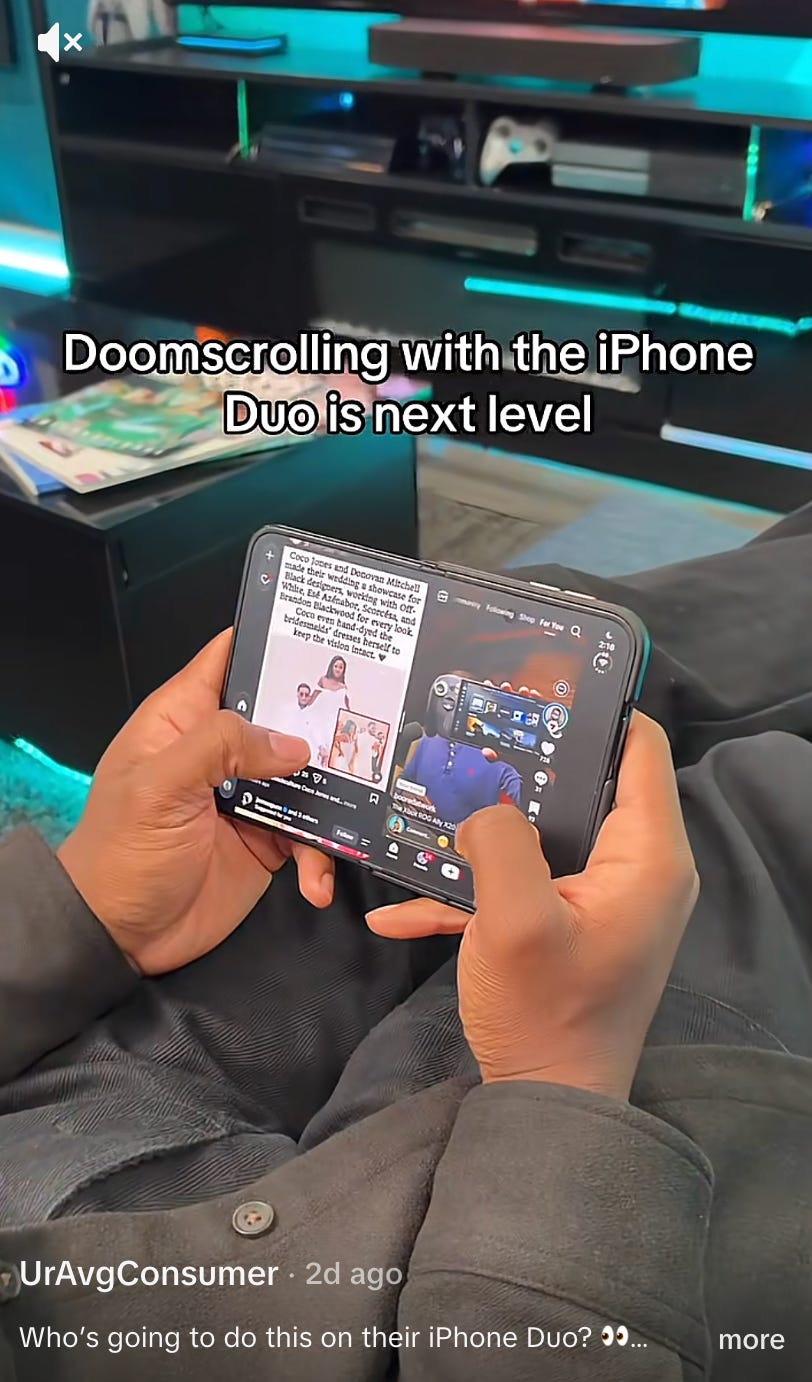
PS. The two best video reviews of the iPhone Duo I watched are by MKBHD and Joanna Stern (who built a folding machine to fold her Duo non-stop 8 hours a night during her review period; ended up doing 32,400 folds and it held up…Apple doesn’t actually say how many folds a Duo can take over its lifetime but Samsung says 200,000 for it’s Galaxy Z Fold 8).
Oh, and Jerry Rig’s durability test came out…which means many people about to get triggered:

Hermès taking over American suburbs
The Wall Street Journal has an interesting look at the current state of Hermès (aka “Air Mez” as my very European friend keeps telling me every time we hang out).
Hermès sales are slowing in previous hot spots including China and the Middle East.
So it’s finding new “emerging markets”…including the “emerging market” known as American suburbs.
Upper-income US consumers — half of the new millionaires created in 2025 were American (the country has 37% of global wealth) — are so voracious that tier-2 American cities will anchor Hermès’ next leg of growth.
New Hermès stores since 2020 include Short Hills (New Jersey), Wilmette (Illinois), Scottsdale (Arizona), Princeton (New Jersey), Nashville (Tennessee) and Manhasset Long Island (New York).
Unsurprisingly, sales grew fastest in America (+15% YoY) and the market is so juicy that the luxury giant — which does $18B a year — is looking for more.
America currently has 45 of Hermès’ 300 stores. Expansion can’t be too fast, though. Each Hermès store is unique and the company works with a single Parisian architectural design firm to make the stores.
WSJ says Hermès’ strategy is to look at “a ZIP Code analysis of where existing clients live and where e-commerce clients seem clustered…they analyze shopping patterns and adjacency to other lifestyle destinations, for example a fantastic coffee shop or restaurant.”
We’re about 5 years away from Air Mez putting a store next to every Buc-ee's in Texas.
Links and Memes
Some other posts for your weekend consumption:
“On the Death of Amazon’s Writing Culture: How AI has turned what was once a superpower into a liability.” (by Steve Huynh, who spent 20+ year at Amazon)
“How to be more ambitious: A tutorial for humans with models” (by Felix Rieseberg, Anthropic engineer working on Claude)
“Asked Claude Code to make a new GTA: San Andreas mission where CJ vibe codes a startup and raises money from SF investors” (by Pieter Levels, legendary solopreneur)
…and them wild posts (including one on how New York Knicks owner James Dolan did the most insane corporate IT test ever for his employees: the Knicks won the NBA Finals over the summer and most employees expected to get a championship ring.
Dolan — who has an extensive track record of douchebaggery — sent an email to a bunch of employees asking them what type of ring they wanted…anyone who clicked on it did NOT get a ring and had to go re-do corporate training about phishing emails…the internet bullied the Knicks so hard that they will now give a ring to 275 employees totalling $3.75m).


Finally, the Atlanta Falcons unveiled a re-imagined throwback logo, which looked eerily similar to iconography for a certain political party that ruled Germany between 1933 and 1945.

How many layers of PR, design and marketing were asleep at the wheel?
A 2-second spot check on [insert AI chatbot] would have nipped this at the bud…I know because I checked:

The Falcons did chang the bio pics in their social handles but left the X post up…and it has over 45 million views…and feels like an equal amount of next-level comments and quotes:


Im so happy to have SatPost back!
Great to have u back!