

Thanks for subscribing to SatPost.
Today, we are talking about Blumhouse Productions. Jason Blum’s horror film studio pioneered a unique Hollywood business model and gave us movies such as Paranormal Activity, The Purge, Get Out, Obsession and Whiplash (not a horror but still a banger).
Also this week:
Berkshire’s $26B Google Bet
Eric Tulksy: The Chemistry PhD in the NHL Finals
And some wild memes (including LEGO’s La Sagrada Familia set)

Green Eggs and Ham is one of the best-selling children’s books of all time.
It is also the embodiment of the aphorism that “constraints breed creativity”.
As the story goes, Theodor Seuss Geisel — aka Dr. Seuss (who was def not a doctor) — wrote The Cat in the Hat in 1957. The book had 236 different words. Enter Bennett Cerf, Geisel’s publisher and co-founder of Random House. Cerf challenged Geisel to write a children’s book with only 50 different words.
They bet $50 on the outcome.
In 1960, Geisel delivered his orange-covered classic with exactly 50 different words. He won the bet and the book has sold ~10 million copies over its lifetime (personally, I prefer Hop on Pop).
Can constraints be applied to an entire business model to yield creative results?
The answer is “yes,” and one of the best examples is Blumhouse Productions, the film and TV studio founded by Jason Blum in the early 2000s. It took him nearly a decade to score a smash hit with 2009’s Paranormal Activity.
It quickly became a horror hit-making machine, turbocharged by a first-look deal with Universal Pictures in 2014 (the agreement gave the major studio first dibs to finance and distribute Blumhouse projects).
In 2024, Blumhouse merged with Atomic Monster, the production house founded by James Wan (the mind behind Saw, Insidious and The Conjuring).
The merged entity is called Blumhouse-Atomic Monster and these two giants of horror are on a heater right now with two of the top-grossing films in America (both of these films were directed by under-25 Gen-Z talents that came up through YouTube):
Backrooms (May 29, 2026 release): In 2022, 16-year-old creator Kane Parsons made a YouTube series inspired by a 4Chan post about an eerie building with endless hallways and rooms. The videos garnered tens of millions of views and Wan reached out to Parsons without realizing he was a teenager. Parsons’ father managed the connection and Wan (along with Blum) brought on A24 and Chernin Entertainment to develop a film on the concept. They convinced the studio to let Parsons direct it. After one week, the film has made $141 million on a $10 million budget.
Obsession (May 15, 2026 release): Curry Barker built a YouTube channel with more than 1 million subs based on comedy skits and short horror ideas. He then filmed a 62-minute horror on a $600 budget before making Obsession — a film about a guy who makes a Faustian bargain for his crush to fall in love with him — for less than $1 million at the age of 25 (he is now 26). Blum saw it at the Toronto Film Festival and knew it was a hit. His partners at Universal’s Focus Features bought the distribution rights for $14 million. After three weeks, the film has made $151 million on that sub-$1 million budget.
These low-budget horrors are popping off at the same time that Disney’s first Star Wars film in 7 years has been a dud. The Mandalorian and Grogu is tracking to $350-400 million at the box office on a $165 million budget (and another $200-250 million on marketing).
Backrooms and Obsession are tracking to hit a comparable box office gross on a fraction of the spend.

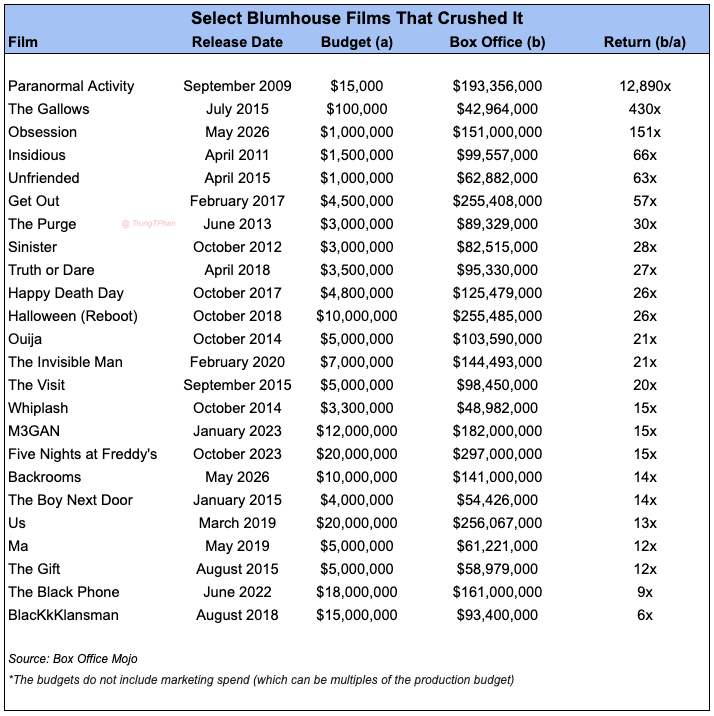
On a pure budget-to-box-office basis, Obsession ranks near the top of all Blumhouse-affiliated films (take a look at that bonkers return column):
I have a confession before we dig into the numbers. The only films I’ve seen on this list are Get Out, BlacKkKlansman and the A+++ gem Whiplash ("Not my tempo. Were you rushing or were you dragging?")
Trung Phan does not do horror. My brother was a huge Stephen King fan and convinced me to watch The Shining when I was 8. I had nightmares for weeks. Redrum. Nope nope nope. Not for me.
Thankfully, someone took The Shining trailer and turned it into a comedy including an incredible use of Peter Gabriel’s “Solsbury Hill.” This parody video completely defanged the original film in my mind.
I am aware of all these horror film plots, though. How? I’m that dude that reads Wikipedia summaries for scary flicks. It’s pathetic. I know.
Still, I appreciate an outrageous investment track record and Blumhouse films regularly post double-digit returns on the production budget.
The biggest home run was Paranormal Activity, likely the most profitable film ever on an ROI basis.
Made on an original budget of $15,000 — which jumped to $18 million including distribution deals, re-shoots and marketing — the film grossed $193 million worldwide.
The origins of Blumhouse Productions actually traces back to another low-budget horror film that crushed at the box office: The Blair Witch Project.
Released in 1999, the “found footage” horror was made with an original budget of $60,000 and went on to gross $249 million.
At the time, Blum was working under (the now very disgraced) Harvey Weinstein at Miramax, which produced major commercial and critical hits in the 1990s including Pulp Fiction, Scream, Good Will Hunting, The English Patient and Shakespeare in Love. The latter two won Best Picture in 1997 and 1999, respectively.
Miramax didn’t make The Blair Witch Project, though.
It passed on the project multiple times and the film’s massive ROI would change the trajectory of Blum’s career.
“I watched [The Blair Witch Project] marching towards success and was reminded by my bosses what a dope I was,” Blum told Nightmare Magazine. “What was formative about the experience is that people who were older than I was and who knew more than I did also passed on this movie.”
In 2000, Blum left Miramax and formed Blum Israel Productions with another producer, Amy Israel. Two years later, Israel left and Blum launched Blumhouse Productions.
Blum made the leap at 31 years old, and Blumhouse Productions was in many ways a Venn diagram of his early life.
The Blum family had Hollywood connections dating back decades. His father was a noted art dealer and once asked comedy legend Steve Martin to read a project Blum was developing with his then roommate Noah Baumbach. That film (Kicking & Screaming) came out in 1995 but Blum and Baumbach had a falling out a few years later.
Blum also had an entrepreneurial streak. He learned how to sell and “eat what you kill” after working sales jobs in cable TV and real estate.
So, it was natural for him to eventually set up his own Hollywood production shop.
After fumbling around for a few years, Blum watched Paranormal Activity in 2007 and immediately saw the potential.
He told Nightmare Magazine that he moved quickly on the project, thus rectifying his earlier mistake with The Blair Witch Project:
When I first saw Paranormal Activity, I had gotten it in the context that it was going straight to DVD and that it wasn’t going to be distributed.
Then I watched it with an audience to check myself and saw how the audience responded and said, to the filmmaker, ‘I think there is an audience for this movie and I think it could work in a movie theater.’
And even though everyone said ‘no,’ everyone said no to Blair Witch and look what happened to that. That gave me the strength and conviction to hang on when everyone kept saying I was a dope.
As we know, Paranormal Activity went nuclear at the box office and its remarkable success showed Blum the path forward: make a lot of low-budget horror films and hope a few break out.
The Blumhouse model was to produce 10 or more films a year with each film getting a budget in the $5 million range. That is cheap by Hollywood standards (one reason the Blumhouse approach works less well in TV is that streaming platforms throw funny money at TV show-runners; top talents don’t even have to go the budget route).
Compare that with a major film studio, which puts $200 million behind a few blockbusters every year.
Once when asked what he’d do with a $50 million budget, Blum replied “I would still make ten $5 million movies.”
Part of Blum’s cost-conscious lore is that he still flies coach while Blumhouse offices are barebones (unlike major Hollywood studios).
The Blumhouse strategy is similar to that of an angel investor who is trying to find the next startup unicorn. Instead of giving a single $500,000 check to one company, he cuts $10,000 checks and hands them out to dozens of intriguing founders.
But why horror? It is the best genre for fictional low-budget films. You don’t need special effects, because gritty and raw are actually scarier. You don’t need superstar talent, because an A-list actor can actually detract from the scariness (if you’re watching Tom Cruise, you’re thinking “wow, that’s Tom Cruise…Edge of Tomorrow was dope” and not “dude, get out of the house!”).
With a $200 million superhero or summer action film, you need to have CGI and A-list stars as table stakes.
Furthermore, horror films travel internationally much better than low-budget alternatives like drama or comedy. Anyone can pee themselves watching Paranormal Activity — again, this is why I read Wikipedia summaries — while the latter two genres are more dependent on local cultural knowledge (as much as I love The Big Lebowski, the subtle jokes do not land in Southeast Asia).
In a 2017 NPR interview, Blum explained how budget constraints influence specific filmmaking decisions. He called it the “three rules” of cheap films:
Fewer speaking parts: “Extras are a union. And extras are paid — I think they're paid $80 or $90 or $100 a day. Now, the funny thing is if an extra speaks, you have to pay an additional $400. So you'll notice [in our movies] when the waiter doesn't say anything or this post office clerk doesn't say anything…there's a reason. Because as soon as they do say something, you got to give them a check for 500 bucks. So you don't want extras to talk because it really costs you.”
Not too many locations: “The most economical way to shoot a movie location-wise is to have it take place all inside a house. And you will notice a lot of our movies, in fact, do. But I would also say that [a house is] where you're most vulnerable because you're not expecting it.” (Blumhouse films that fit this bill include Insidious, Ma, Get Out, Invisible Man, Unfriended and Paranormal Activity…and, yes, I have read the Wikipedia summaries for all of these films)
Pay as little salary as possible (but offer a lot of upside): Blum employs union staff on all his shoots but they work at “scale”, the minimum pay rate for unionized actors, writers and directors with an opportunity for profit participation (Blum says, “So what we do is we have box-office bonuses. If you have made a million dollars on a movie in the last two years upfront, I say to you — If the movie makes X amount of money, we're going to get you to your million dollars. If it makes beyond that, we'll get you more than a million dollars.”)
To keep these lean budgets, Blum has a formula as he explained at the Decoder Conference in 2017:
Our [$5 million] number is actually totally reverse engineered. So the number used to be $3 million then $4 million. Now, it’s $5 million.
Besides inflation…we get to the number by worst-case scenarios: what are we going to lose?
Studios do low, mid and high-ranging cases. But [their] movies can come in below their low case and often do. We can’t get worse than our low case.
[If we think we can only] get $2 million out of the United States…you don’t even put it [in theatres].
It’s a pillar to our strategy, which is: “no distribution guaranteed.”
We don’t decide how the movie is going to be distributed until it is finished. I say to the directors, “I guarantee your movie will be seen, but I’m not guaranteeing how it will be seen.”
So it might just be seen on iTunes or it might be in 3,000 theaters. We make that decision after the fact.
The “being scared with a bunch of other people in a dark room” is so important for horror films.
Compared to other film genres, horror makes much more of its total pull from the box office vs. secondary income streams (which has gone from VHS —> Cable runs —> DVD —> iTunes —> streaming).
How does Blum decide if a film is theatre-worthy?
He does multiple screenings with the director:
When you screen a movie with an audience in Burbank or Westlake Village…99 times out of 100, if you were there and I’m there and the director’s there and Universal’s there…we kind of all agree. […]
[The concept is] almost director-proof…because the bar is so low. The movie cost $5 million. If it opens to $10 million and gets to $23 million, it’s not like a home run but it’s a success.
Everyone made a little bit of money.
If the movie doesn’t come out well, it goes to iTunes and kind of disappears.
This approach is only for originals. Established IP and sequels do get a guaranteed release and the budget range is $10 million or more.
“[Sequels] follow much more closely to a traditional studio movie,” says Blum. “[Our films] are still a lot less expensive. We still don’t get paid [upfront], but they follow a line much more like a traditional studio film.”
These costs constraints on original projects unlock creativity in two major ways.
First, Blumhouse can take chances on many more scripts and directors (a $5 million flop won’t hurt as much as a $200 million flop). Second, Blumhouse offers its directors final cut in exchange for staying under budget and having compensation weighted towards a box-office bonus (which means a lower guaranteed salary).
Final cut is hugely important for creativity. In major Hollywood productions, the studios and producers often have the final say, leading to middle-of-the-way or cookie cutter compromises. This is the reason why the HBO show Entourage has so many people complaining about “bean counters” and “suits”.
“Jason gives us final cut, which is unheard of,” says Veena Sud, a showrunner for a Blumhouse TV show The Lie. “It means he trusts the artist 100%. And when you trust us, you teach us to not work in fear.”
One interesting case study from Blum’s NPR episode is the film The Boy Next Door, a thriller starring Jennifer Lopez which mostly takes place in a house. Its director — Rob Cohen — had previously worked on big budget films like The Fast and The Furious and talked about the challenge of working with much less money (in this case: $4 million):
“You're going to have to be clever. And that cleverness stretches you and makes you think outside the box because the money panacea isn't in your arsenal anymore. You have to fix the problems another way.”
If a film screens poorly, then Blumhouse and Universal don’t have to spend on marketing. A common heuristic for >$50 million films is that the marketing budget is equal to the production budget.
This additional financial pressure can also unduly influence the creative process (which is why the way Blumhouse selects distribution is helpful).
The spectre of a large check also hampers film creativity because the financier has every right to influence the process. On The Town podcast, Blum tells Matt Belloni that it is “morally objectionable” not to listen to someone who has given you $100 million.
Directors in this situation — without final cut — have to make compromises and integrate dreaded studio notes.
More money equals less control, which leads to fewer creative risks.
I previously wrote about how Rick Rubin and Steve Jobs both shared similar thoughts on the creative process. One common theme was the importance of being stubborn in one’s taste and seeing it through to the final product. By setting clear financial constraints and offering big upside, Blumhouse gives its directors an opportunity to actually see their tastes through.
In a glorious meeting of the minds, Blum actually talks about this dynamic on Rick Rubin’s podcast.
Blum: I’m sure you’re the same, but I’m a huge believer that if you reduce capital [then] more creative, better decisions get made.
Rubin: Always. We see so many projects that just have money thrown at them and it’s all decoration. There’s no substance underneath. Because the ideas are not expensive. The breakthrough ideas are not expensive.
Blum: I think the reason why it’s so rare that streaming movies break out into the culture and have a cultural impact is…[they use too much money] and they’re too expensive.
Overall, the Blumhouse model maximizes the odds of scoring an unexpected outcome.
This is how you get films such as Get Out (Jordan Peele), BlacKkKlansman (Spike Lee) and Whiplash (Damien Chazelle). These three were passed up by traditional Big Studios, yet — under Blumhouse — they went on to win Academy Awards while also making very healthy returns.
“A risk-taking creative environment on the product side requires a fiscally conservative environment [on the business side],” Steve Jobs said in the early 2000s. “Creative people are willing to take a leap in the air, but they need to know that the ground’s going to be there when they get back.”
In recent years, Blum has adapted the model because the theatre game has changed post-COVID.
Hollywood faces as much competition as ever to get people off their phones and out of the home.
Blumhouse’s two M3GAN films help shed light on how to engage audiences.
The first M3GAN came out in 2023 and made $182 million on a $12 million budget.
The much-hyped sequel (M3GAN 2.0) in 2025 disappointed by making $40 million on a $25 million budget.
Blum went on The Town podcast after the sequel’s first weekend flop. He said they took two risks that didn’t pay off: 1) genre swap (the first M3GAN was a horror while the second was a comedy thriller); and 2) they tried to make M3GAN 2.0 a summer film.
The latter point speaks to what young audiences — and the key viewer for a Blumhouse film has traditionally been women under 25 — look for in the theatre experience: a live event they can go to with all of their friends.
Blumhouse thought M3GAN was a lovable character with event potential.
It wasn’t. The first film became an event after catching a viral social media wave. But it’s very hard for studios to predictably drum up that excitement. It has to happen organically.
“I think you need theatrical events and that’s a big thing that we are looking at,” says Blum. “That’s what we have. Black Phone 2 is a theatrical event. Five Nights at Freddy’s is a theatrical event. [These are] more expensive movies. Our friends at Atomic Monster have The Conjuring and Mortal Kombat coming out.”
One interpretation of this framing is that Blumhouse will go more traditional Hollywood and lean into IP and sequels.
The success of Obsession and Backrooms points to another direction.
At the top of this piece, we talked about how directors Curry Barker and Kane Parsons learnt their craft on YouTube.
Another YouTuber — Markiplier (who has over 30 million subs) — also scored a major success in January with Iron Lung. That horror film was based on video game IP but it needed Markiplier hyping up his audience to score $50 million at the box office on a $3 million self-financed budget.
Across all three films, between 75-85% of the audience was under the age of 35.
These YouTube stars — through the parasocial relationships they develop on the platform — have passionate Gen-Z audiences they can mobilize to theatres to create an “event”.

The current YouTube-to-Hollywood wave is drawing comparisons to:
The “New Hollywood” of the 1970s: After World War II, the Hollywood studio system put a ton of money into musicals and historical epics. In 1969, Dennis Hopper and Peter Fonda spent $400,000 on Easy Rider and scored a $60 million smash hit based on countercultural themes. Easy Rider opened the door for studios to cede authority to young auteur directors. This led to the “Movie Brats” — the most baller group of young directors ever (Francis Ford Coppola, George Lucas, Steven Spielberg, Martin Scorsese, Brian De Palma) — over the next decade.
MTV in the 1980s and 1990s: A number of influential directors cut their teeth on music videos including David Fincher (Madonna’s “Vogue”, Aerosmith’s “Janie’s Got a Gun”), Spike Jonze (Beastie Boy’s “Sabotage”, Weezer’s “Buddy Holly”) and frickin’ Michael Bay (Meatloaf’s “I'd Do Anything for Love”).
The main caveat to the recent YouTuber Hollywood breakout is that these were all horror films. As we’ve discussed, this genre frequently delivers an engaged audience with high ROI films on low budgets. Also, Iron Lung and Backrooms were also existing IP to some extent.
When a YouTuber brings a smash hit comedy or drama to theatres, then we’re really cooking.
Either way, Hollywood is a full-on copycat industry and we’ll see them backing more YouTube talents to flood theatres with horrors and thrillers.
But, at the end of the day, the films actually have to deliver on narrative.
Barker and Parsons are clearly special story-telling talents (Barker is working with A24 on a reboot of The Texas Chainsaw Massacre).
As Blum explained on Hot Ones in 2025, it’s not easy making a good horror film:
[Blumhouse] looks for basic things.
First of all: is it really scary? Is the movie scary?
Not gory. Not bloody. Not gross. But scary. It’s easy to do gross. Anyone can do gross. If you have great visual effects, you can do gross. It’s really hard to do scary. Really hard.
A lot of people say, “Making horror movies is easy.”
Well, go try making a good one. It’s very, very hard to do.
Which is why I have so much respect for the artists we work with who make the movies scary.
Number two: is it suspenseful? Is it compelling?
Number three: Is it new? Does it feel different? Is it not a knockoff of something else?
We don’t achieve all three of those things on all the movies that we do, but those are the three most important things we look for going into it.
Fourth, which is really number one: who’s the director?
What I’m really interested in: what can you do on a very low budget that has mass appeal?
Tie it all together and the Blumhouse model reduces financial risk…which allows the studio to take more shots…which lets directors express their taste…which creates unique films.
This increases the odds of producing more horror hits. I will watch none of them. But I will marvel at the success (and read the Wikipedia summaries).
This issue of SatPost is brought to you by Bearly AI
Are you looking for a no-logging, encrypted and anonymized AI chat tool?
Then try the Bearly AI research app, which provides an easy-to-use UX for the newest models from OpenAI, Anthropic, xAI, DeepSeek, Gemini and more.
While some AI providers keep chat logs indefinitely even after a user deletes them...Bearly AI has a default no-logging policy and user chats are encrypted while requests to LLM providers are completely anonymized.
Try one month FREE of the Pro Plan using the code BEARLY1.
Berkshire Hathaway’s $26B Bet On Google
Warren Buffett retired at the end of 2025 after a 60-year run as Berkshire Hathaway’s CEO. In the final years of his stewardship, Berkshire’s cash pile basically doubled from $200 billion to $400 billion.
In a May 2025 interview, he told CNBC’s Becky Quick that he was hunting for a $100B deal but couldn’t find anything on the stock market (counterpoint: he could have bought Wendy’s 200x over):
“I’m willing to spend $100 billion this afternoon. I’d rather have $100 billion and a really good business at a sensible price than $100 billion in cash. At certain levels, cash is necessary, but cash is not a good asset.”
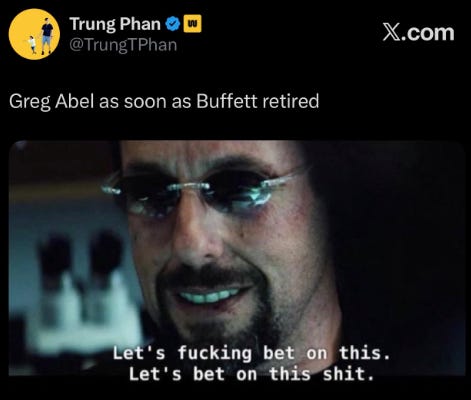
Well, it looks like new Berkshire CEO Greg Abel may have found a suitable target to soak up that cash: Google.
Berkshire has now done 3 major buys of the Big Tech Giant:
Q3 2025: $5B
Q1 2026: $11B
June 2026: $10B private placement (at a 6% discount)
The $26 billion Google investment is now ~$32B after gains. That is 12% of Berkshire’s equity portfolio and its 3rd holding after Apple and American Express (ahead of Coca-Cola, Bank of America, Occidental Petroleum, Chevron).
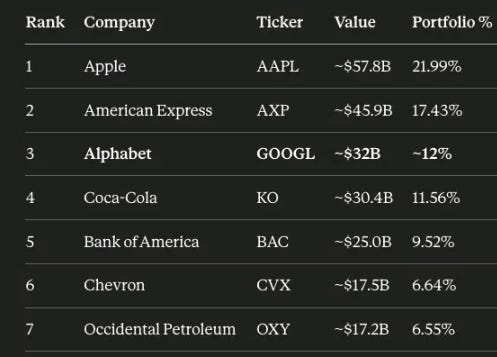
For reference, Buffett put $36B into Apple before clearing over $160B on that investment since 2016.
Berkshire has come full circle with Google. In 2019, Buffett and Charlie Munger explained why Google’s 2004 IPO was one of the only tech investments they actually regret passing on:
Munger: We screwed up.
Buffett: We did have some insights into that because we were using them at GEICO Insurance, and we were seeing the results produced. We saw that we were paying $10 a click — or whatever it might’ve been — for something that had a marginal cost to them of exactly zero. And we saw it was working for us.Munger: We could see in our own operations how well that Google advertising was working. We just sat there sucking our thumbs. So, we’re ashamed. We’re trying to atone. Maybe Apple was atonement.
Abel has probably found his Apple. He probably won’t get a 5x on Google but the investment makes sense for two major reasons.
First, there are only a handful of companies in the world that can move the needle on Berkshire’s cash pile and the Big Goog-A-Doogs is clearly one of them.
Second, Berkshire’s $10 billion private placement is part of a larger $85B equity raise by Google to fund its AI data centre buildout (and also help offset some employee tax bills tied to equity rewards).
Abel comes from the infrastructure and energy world. About 25% of Berkshire’s $1 trillion market cap is tied to energy including oil production and utilities. Berkshire also owns one of the largest freight railroad networks in North America and spends a ton of maintenance CapEx. The compute trade is building massive data centres to turn electrons into intelligence.
This is right in Abel’s wheelhouse. In fact, Berkshire Hathaway Energy already powers a ton of data centres in America. Abel says that 15% of all America’s natural gas runs through its pipes and a number of end customers are the hyper-scalers.
Berkshire investing in Google is form of vendor financing. Abel cuts Sundar a fat check so Sundar can build data centres that will use Berkshire’s energy assets…while Berkshire gets some upside from the equity.
The initial reaction was negative for Google with its shares falling 4% the next day. Investors didn’t like the dilution and signalled that Google was hedging on its own data centre buildout by sharing the risk with Berkshire (Google’s CapEx spend will be ~$190B in 2026 and similar for 2027).
While Google does have $126 billion cash against $81 billion — meaning it could still raise debt without impairing its balance sheet (although it already has raised $37B in debt this year) — getting the Berkshire seal of approval was probably worth it for Sundar…even if Buffett’s retired.
Analyst Rihard Jarc has an interesting take:
There are a few possible options why Google went this path:
Option 1: They see another big step up in accelerating demand for [Google Cloud Platform] and their Gemini models and need to increase CapEx substantially more than they already did.
Option 2: They want to front-run OpenAI, SpaceX, and Anthropic IPOs and drive some liquidity out of the market — and with the cash — lock up more of the semi supply chain for them to not be locked out by OAI or Anthropic.
Option 3: They have reached an internal breakout in their model development or some other front, and they see they are going to need a lot more compute to serve this and want to get ahead of it while the market is still sentiment positive on it.
Google could also be doing the massive equity raise so its next massive debt raise doesn’t throw its balance sheet out of…errr…balance. The company isn’t just looking at a 1-year outlook. It’s considering the 5-year and 10-year timelines. Its equity multiple may not be as juicy a few years out. Meanwhile, the business could turn and the debt looks more onerous.
By the end of the week, GOOGL’s shares had clawed back most of those initial losses. Now, Meta may be trying its luck. On Friday, news leaked that Meta was looking to raise “tens of billions of dollars” in an equity offering. The stock sold off over 5%.
Anyway, Abel closed a second big deal during the week by acquiring a homebuilder (Taylor Morrison Home) for $6.8 billion. He’s putting his stamp on the company.
Eric Tulksy: The Chemistry PhD in the NHL Finals
I love me a good career pivot story.
Colonel Sanders went from lawyer to insurance salesman to history’s greatest slanger of fried breaded white protein. Arnold went from bodybuilder to actor to Governor of California. Julia Child went from intelligence analyst during WWII to celebrity chef. Kim Kardashian went from…never mind.
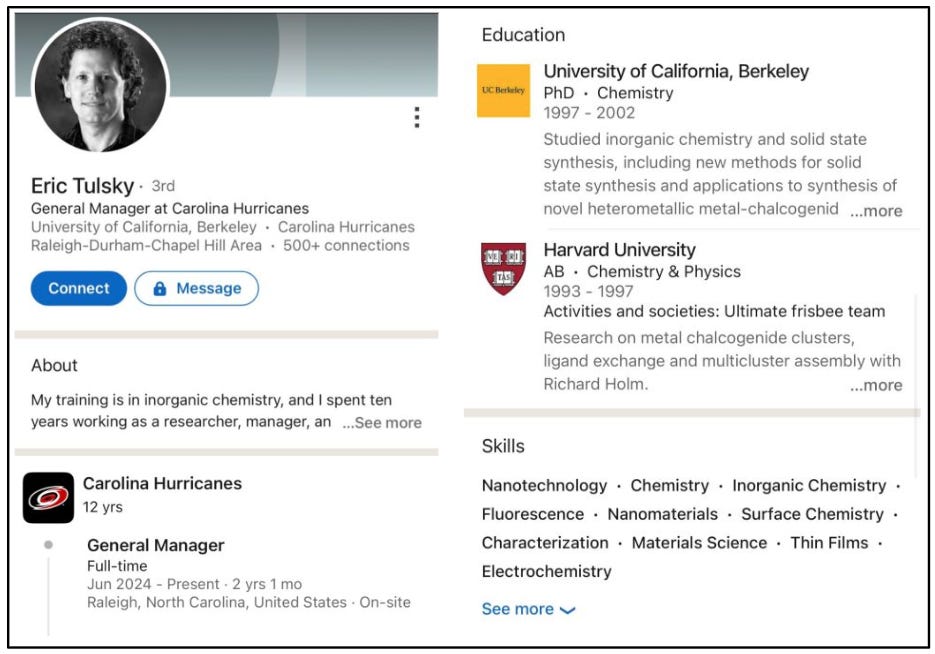
Here’s a relevant one now that the NHL Finals has begun between Las Vegas Knights and Carolina Hurricanes (tied 1-1): the Hurricanes GM Eric Tulsky did AB Chemistry and Physics at Harvard before getting a PhD in Chemistry at Berkeley.
He spent the first part of his professional career doing research on science that I literally only learned about by Googling last week (“quantum dots for LCD screens”, “nanoparticle ink used to print low-cost solar cells”).
The entire time he was writing on hockey blogs. Pseudonymously at first but then as a public figure. He presented at the 2013 MIT Sloan Sports Analytics Conference showing that a controlled entry into the opponent’s zone generated 2x the scoring opportunities compared to a “dump and chase” strategy.
In 2014, he had a job offer from Apple to work on battery technology.
Tulsky turned it down and took a job in the Hurricanes’ analytics department and has since hired neuroscientists and mechanical engineers for the team.
The Athletic profile of Tulsky has this great anecdote about his unorthodox approach:
In 2021, Tulsky was the Carolina Hurricanes assistant GM and had built a small analytics department in the organization, with a web developer, a data engineer and a neuroscientist helping him lead the team’s push into new frontiers for the sport.
But because of what he saw in the tracking data, Tulsky believed his next addition needed to be someone who was working on autonomous vehicles — perhaps “a robot submarine,” he says now — and had an advanced mechanical engineering background.
“I knew that that was the kind of problem that put people thinking about the kinds of data that we had and the kinds of problems we faced,” Tulsky explained.
It goes without saying that there aren’t many robot submarine engineers working in NHL front offices. So Tulsky began a deep search through universities’ mechanical engineering departments.
He would scour the faculty listing and professors’ research interests to see if they might align with what he was looking for, then reach out to learn more about their work. He started with the top schools in Canada, reasoning that there was a greater chance he would find someone interested in working on a hockey problem.
And that was how an NHL team came to fund the PhD research of a young engineering student named Jonathan Arsenault at McGill University in Montreal.
His thesis, the first to be backed by a professional hockey team? “Quantitative Analysis of Hockey Using Spatiotemporal Tracking Data.”
Check out this legendary LinkedIn profile including a glorious “skills” section for the sporting world.
Links and Memes
Some other links for your weekend consumption:
Paul McCartney is 83 years old and just released a new album. Been listening with my son. He says its inspiring someone that old is still doing his art. I agree and “Ripple In The Pond” goes hard.
How Europe’s “forced heirship” inheritance laws…disincentivize entrepreneurship (via John Arnold).
A Business Breakdown of Toast. The cloud-bases restaurant SaaS platform might have an interesting moat with the tablets that it manufactures. Those things are everywhere. I didn’t realize they were custom made to handle kitchen heat, drops and water damage. Way better than an iPad.
If you only invested in stocks located on New York Route 237…you’d be laughing. LAUGHING. Companies include Marvell, Micron Tech, Arm and Sandisk…also In & Out Burger but that’s a private firm unfortunately
Anthropic released a blog post with a very not scary title “When AI builds itself”…the AI startup says “today, Anthropic engineers on average ship 8x as much code per quarter as they did from 2021-2025.” It believes recursive self-improvement is on the horizon and makes the case for why AI labs should consider “world to have the option to slow or temporarily pause frontier AI development to enable societal structures and alignment research to keep up with the advance of the technology.”
Steph Curry signed a 10-year deal with Li Ning. It pays $40 million a year and Curry gets to expand his own brand. The Chinese sportswear firm has $6B market cap, so betting he got huge equity too. Can only assume they’ll somehow make a robotics AI play like the automated rebounding and passing machine the Warriors use.
We knew FIFA was going to get greedy and milk fans. Seems to be evidence that the official website prices are grossly inflated but FIFA won’t reduce it because it’ll piss off fans that did buy and now they’re dumping giant blocks of tickets on SeatGeek.
SpaceX amended its S-1 to show a new contract with Google paying $920m a month for compute (or $11B a year). Combined with annualized Anthropic contract ($15B), SpaceX is selling $26B a year in compute. That is 40% more than SpaceX’s entire revenue in 2025 of $18.7B. Also, S&P will not fast-track any mega-IPOs and all new public companies will have to wait at least a year for entry in the index. I wrote more on these storylines in a deep dive of SpaceX’s S-1.
“Hackers simply asked Meta AI to give Them Access to High-Profile Instagram Accounts. It Worked”. This is a wild story from 404 Media. Somewhat ironically, Meta unveiled AI Business Agent across “WhatsApp, Messenger and Instagram to respond to customer inquiries, recommend products and book appointments.”
The Hidden Tech Behind an NBA Broadcast! Very cool behind-the-scenes video from MKBHD.
Bill Simmons and The Rewatchables podcast brought on Steven Spielberg…to talk about 2001: A Space Odyssey. Some incredible details on Spielberg’s relationship with Stanley Kubrick and how much Kubrick influenced an entire generation of directors. A positive thing about rise of podcasts is the GOAT directors will go on awesome shows and shoot the shit to promo stuff (Spielberg’s Disclosure Day comes out next week).
…and them wild posts (including Victoria Secret, which saw its shares pop after a strong earnings report…the Ozempic Effect is a boon for lingerie…also, the company changed its stock ticker)


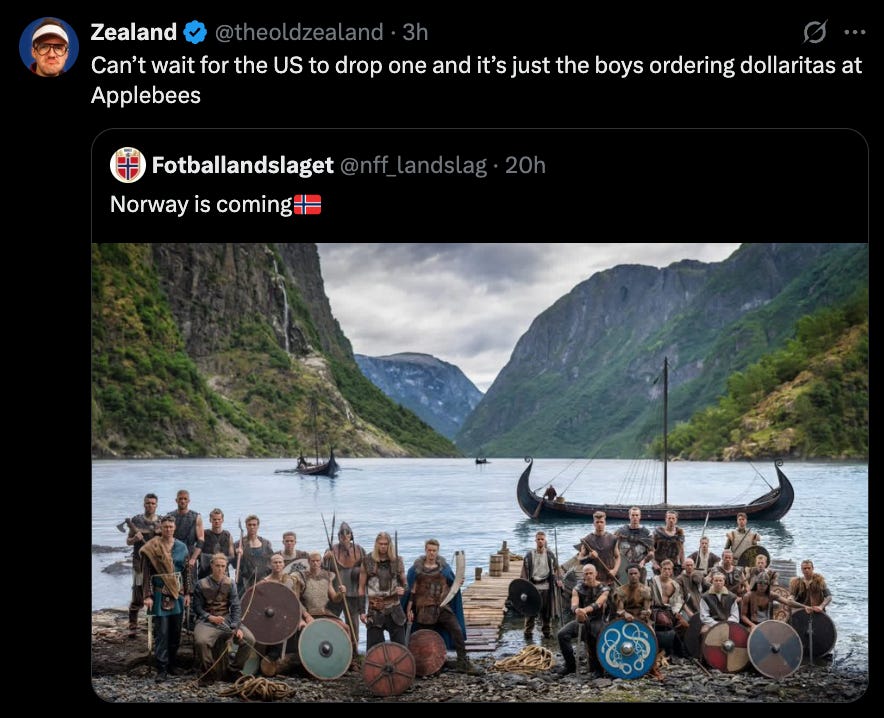
Finally, Norway’s World Cup team dropped a team photo as vikings. The comments and quote RTs on the team post is absolutely out of control…and Erling Haaland played the part to perfection (acclaimed British photographer David Yarrow took these photos and said, “If you had to choose one sportsperson in the world that doesn’t need much hair and make up to look like a Viking, it’s Erling Haaland. And so it was easy to shoot with him.”)

Bro the Canes are tied 1-1 with Vegas in the finals. You turned it off too early—they came back from a 2-0 deficit with 10 min remaining in game 2 to win 3-2 in OT 🤠
This was awesome, but so many Hollywood folks are entranced by the "small bet, potential big returns" approach. But it's not the only one. Far from it.
Blum's model doesn't really account for something like the Matrix or Kpop Demon Hunters. Huge upfront bet, bigger returns (arguably). It's also important that we have ongoing real life examples that big budget originals can still be a great bet for studios/streamers. The more ongoing examples in both areas, the more bets placed in the industry, which should be the true ultimate aim. The more we fantasize about only one, the less of the other is accounted for.
It's great to speculate on the best courses of action in Hollywood, but it (as well as business) will always be the space of just when you think you have it figured out, one film or show flips everything on its head.