

Thanks for subscribing to SatPost.
Today, we will look at some numbers from SpaceX’s S-1 document in advance of a June IPO.
Also this week:
The Enhanced Games
MacBook Neo & How Apple Uses Defective Semi Chips
…and them wild posts (including Victor Wembanyama)
This issue of SatPost is brought to you by Bearly AI
Are you looking for a no-logging, encrypted and anonymized AI chat tool?
Then try the Bearly AI research app, which provides an easy-to-use UX for the newest models from OpenAI, Anthropic, xAI, DeepSeek, Gemini and more.
While some AI providers keep chat logs indefinitely even after a user deletes them...Bearly AI has a default no-logging policy and user chats are encrypted while requests to LLM providers are completely anonymized.
Try one month FREE of the Pro Plan using the code BEARLY1.
SpaceX dropped its highly-anticipated Form S-1 filing on Wednesday.
The document arrives as SpaceX eyes a mid-June IPO and it officially unveils financials for the space rocket startup founded by Elon Musk in 2002.
Elon is looking to raise $75 billion at a $1.75 trillion valuation. If you’re a value investor, please be sitting down for this next sentence: SpaceX’s revenue in 2025 was $18.7 billion, which works out to a potential price-to-sales (P/S) ratio of 93x.
Here is the P/S ratio for the current Mag 7:
Amazon: 4x
Meta: 7x
Apple: 10x
Alphabet: 11x
Tesla: 16x
Nvidia: 25x
Not the cleanest comparison but it’s worth framing the SpaceX valuation ask. Just put your spreadsheets away. The fundamentals are not the most important part of this S-1.
It is May 2026, people. Which means we are still very much in the AI bull cycle and the SpaceX S-1 has a lot of AI.
To be sure, the S-1 does highlight two of SpaceX’s dominant old school business lines:
Launch: 650 launches all time and its rockets sent 80%+ of global mass to orbit in 2025.
Connectivity: 10 million Starlink subscribers using 9,600 low-earth orbit satellites (75% of active maneuverable satellites in low-earth orbit).
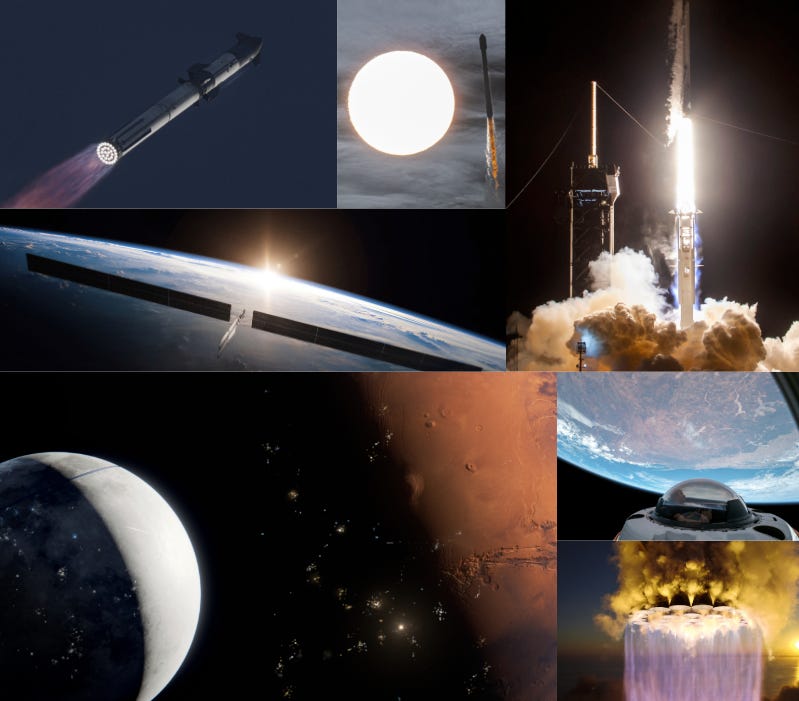
We also got dozens of #SpacePorn calibre photos of rockets, satellites and various manmade objects in orbit.
SpaceX is almost 25 years old but check out how often the AI business — which was only roped into SpaceX over the past 6 months — gets name checked (bolded) relative to space stuff.
“launch” (835 mentions)
“compute” (507)
“connectivity” (427)
“xAI” (400 )
“Starlink” (381)
“Grok” (243)
“Starship” (222)
“Falcon” (184)
“data centre” (154)
“rocket” (148)
“Colossus” (79).
“Macrohard” (17): Had to include this agentic AI platform that is an incredible riff on Microsoft.
Venta Nitro Cold Brew (0)
Searching for "AI" (3,789) or "X" (4,838) comes up with a quite a few false positives (eg. "train" or "external) so we can put those to the side.
The “Market Opportunity” section is really when “AI” shines. If you have a CFA, you’ll want to sit down for this:
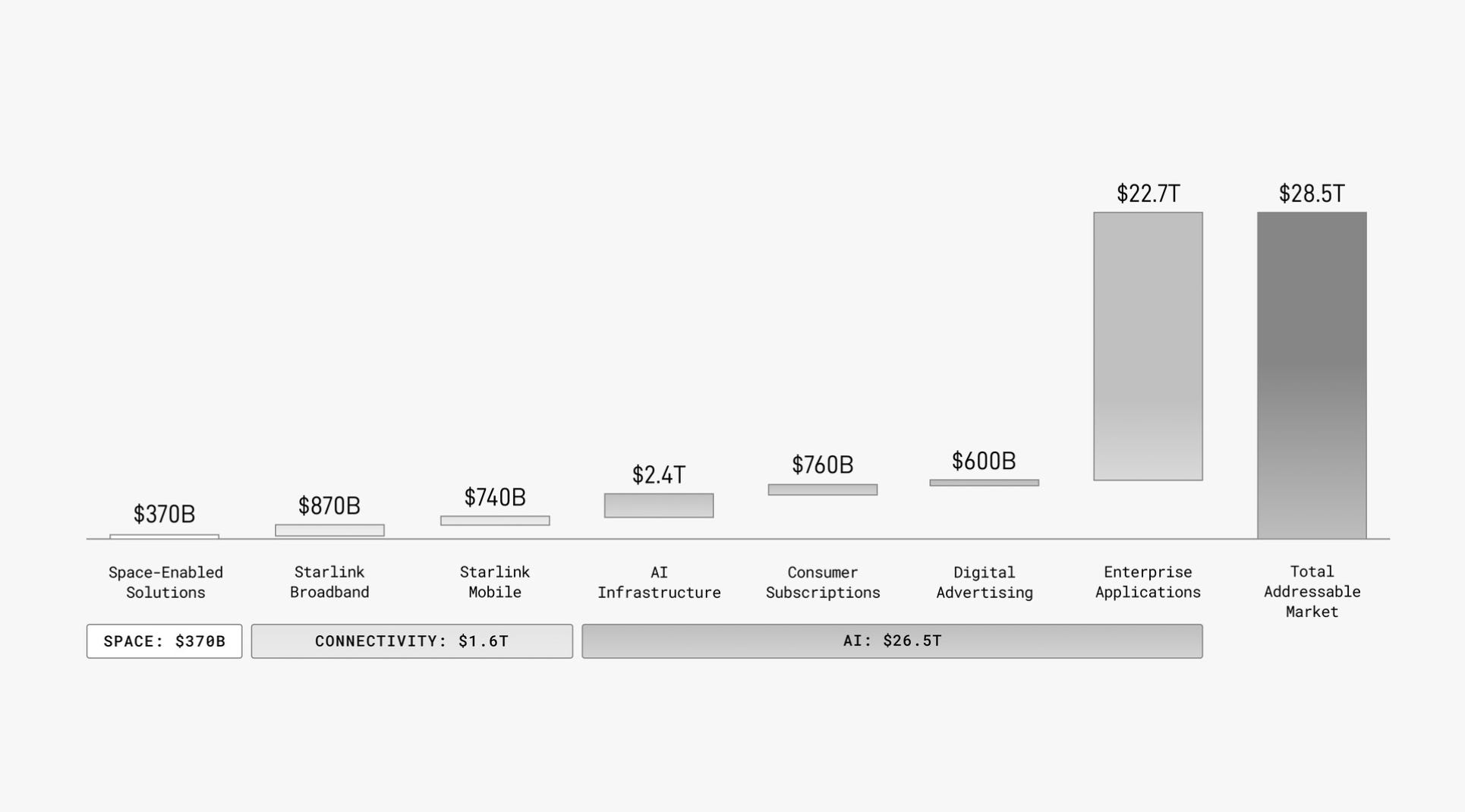
We believe we have identified the largest actionable total addressable market (“TAM”) in human history. We estimate that our quantifiable TAM is $28.5 trillion, consisting of $370 billion in Space from space-enabled solutions; $1.6 trillion in Connectivity across $870 billion in Starlink Broadband and $740 billion in Starlink Mobile as well as additional opportunities in enterprise and government; $26.5 trillion in AI across $2.4 trillion in AI infrastructure, $760 billion in consumer subscriptions, $600 billion in digital advertising, and $22.7 trillion in enterprise applications. For illustrative purposes of sizing our addressable market opportunity, we exclude China and Russia from our global estimates.
Looking at SpaceX’s stated opportunity of $28.5 trillion, about 93% of that TAM is related to AI. Even more specifically, ~80% of the overall TAM ($22.7 trillion) is classified as “enterprise applications” (AI agents automating knowledge work).
The entire US GDP in 2025 was………..$31 trillion (there are so many of these big numbers that I’m forced to write out the full word instead of using “M”, “B” and “T” as I usually do).
Like I said, “It is May 2026, people.”
We just had semiconductor chip startup Cerebras finish its first day as a public company with a $95 billion valuation. The market cap has since declined to $61 billion but it still sports a P/S ratio of ~100x. No investor is thinking about that metric. It’s all about future of AI and Cerebras has a new solution for a compute market that will see Big Tech spend over $800 billion on capex in 2026 and ~$1 trillion in 2027.
That capex spend is a touch lower than $28.5 trillion but it’s still a massive number and people are chasing the narrative. Cerebras is carrying that massive P/S multiple without having the benefit of the “Elon Markets Hypothesis” (Matt Levine explained this key investment concept in 2021: “the way finance works now is that things are valuable not based on their cash flows but on their proximity to Elon Musk”).
Let’s put aside $28.5 trillion and just say: Elon and SpaceX are going after a multi-trillion dollar AI opportunity.
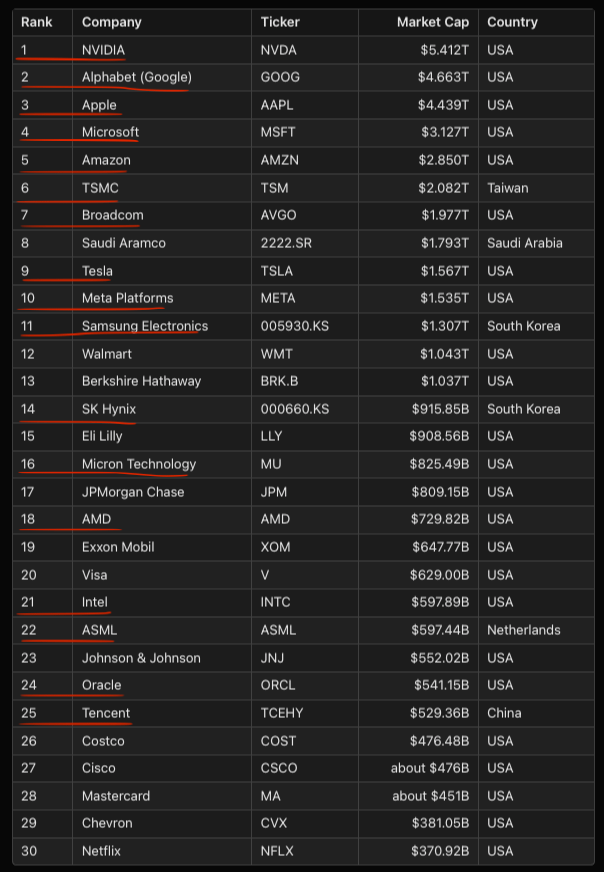
Currently, 17 of the 25 largest public companies in the world either design, manufacture or deploy AI semiconductor chips (as an aside, the 26th largest company in the world sells comically large party size bags of potato chips).
With that in mind, the SpaceX S-1 has one very important detail to support an AI narrative: beginning in May 2026, Anthropic has agreed to pay $1.25B a month to SpaceX to use compute from its two Colossus AI data centres in Memphis. There is a slight discount for the first few months but, broadly, this works out to $15B on an annualized basis.
That’s almost as much as SpaceX’s entire revenue of $18.7B in 2025.
SpaceX is probably headed to $35-40B in 2027 with half the revenue coming from this new AI neocloud business. Amidst a global compute shortage, Elon says there are already interested parties other than Anthropic.
Over the past 3 years, Elon has been in a rush to get into the AI game (while also making his Twitter co-investors whole…and one of those investors told the FT, “Never bet against Elon.”):
October 2022: Elon buys Twitter for $44B.
March 2023: Founds xAI.
July 2023: Twitter rebrands to X.
May 2024: xAI raises $6B at a $24B valuation.
July 2024: xAI completes the first Memphis Colossus Supercluster (100,000 GPUs up in 122 days when this type of project usually takes 2+ years).
December 2024: xAI raises $5B at $50B valuation.
March 2025: xAI acquires X in all-stock deal, which values xAI at $80B and X at $33B ($45B less $12B debt) and starts building Colossus 2 (>500,000 GPUs).
June 2025: xAI raises $5B at a $136B valuation.
January 2026: xAI raises $20B at a $230B valuation (then, is acquired by SpaceX).
May 2026: SpaceXAI agrees to a deal with Anthropic to provide compute for $1.25B a month (or $15B a year).
June 2026: SpaceX IPO at $1.75T.
2027 & Beyond: Inevitable merger with Tesla ($ELON ticker).
The new cloud computing venture has already been dubbed Elon Web Services.
Nvidia’s Jensen Huang said that the speed that xAI built its first data centre is something that has never been done before. There may not be anyone better in the world than Elon & Co. at putting a data centre up quickly. A major issue that Jensen frequently brings up is that data centre shells are not always complete when Nvidia chips are ready. Longer term, Elon Web Services may be the go-to partner for getting compute online as fast as possible.
This singular ability to attract top talent, deploy funds, secure industrial supply chains and bring ambitious projects online is why Elon gets some of the lowest cost of capital in the world for hardware ventures.
The S-1 flexes the F out of this skillset:
In order to bring compute clusters online as fast as possible, we employ a vertically integrated, nimble approach to construction. We brought the first cluster of COLOSSUS online in 122 days, repurposing the shell of an existing factory, and the first cluster of COLOSSUS II online even faster in 91 days. As an illustrative comparison, an industry benchmark to bring online a 100 megawatt greenfield data center is approximately two years
Now, does this mean xAI is throwing in the towel as a frontier AI lab? Has it given up on its race against OpenAI, Anthropic and Gemini?
No. Bloomberg reports that SpaceX will go ahead with its option to acquire AI coding startup Cursor for $60B a month after its IPO…using that brand new SpaceX stock.
Coding is AI’s killer app right now. Anthropic’s Claude Code and OpenAI’s Codex are the driving force behind each startup’s ~$1 trillion valuation (and both are headed to $100B in annual recurring revenue by the end of 2026).
Cursor is at $3B a year and has a very strong enterprise sales muscle to combine with SpaceXAI’s compute (now at 1 million H100-equivalent GPUs) and X’s distribution (550 million users).
The $15B a year compute deal with Anthropic “may be terminated by either party upon 90 days’ notice”. This is something to keep an eye on since Cursor and Grok are competitive with Claude (Cursor’s early rise was with Claude Code under the hood).
For the most part, the SpaceX financials by Q3 2026 will look a lot different than in Q1 2026…except for one detail: massive cash burn.
In Q1 2026, SpaceX had revenue of $4.7B (70% of sales was from Starlink) and recorded a loss of $2.5B as AI-related capex reached $7.7B.
With only ~$16B in cash & equivalents, SpaceX really needs the $75B IPO to fund the AI ambitions (SpaceX will be the largest IPO raise ever, topping Saudi Aramco at $26B in 2019 and Alibaba at $22B in 2014). The rest of the Mag 7 has mostly funded their AI capex with operating businesses but have started tapping debt markets as the spend dial turned to 11.
We haven’t even talked about the orbital data centres. Orbital. Data. Centres.
I’m in the camp that the demand for intelligence on tap will be basically infinite within the next decade. Land-based data centres are currently so unpopular — 14 states in America are floating bills that could ban their construction — that the idea of satellites beaming AI to earth looks increasingly viable every single day.
Per the S-1:
We believe these AI compute satellites in Sun-synchronous orbit will be able to handle energy-intensive AI workloads, such as inference demand, at far greater scale and efficiency than terrestrial alternatives, with Starlink providing low-latency, global connectivity linking these orbital AI systems to people around the world and delivering real-time intelligence. We expect to begin deploying our orbital AI compute satellites as early as 2028.
SpaceX has more of the engineering chops for this challenge than any other company in the world:
The first private company to develop and launch a liquid-fuel rocket to reach orbit (2008)
The first private company to successfully dock a private spacecraft with the International Space Station (2012)
The first to successfully propulsively land (2015) and refly orbital-class rocket boosters (2017)
The first to begin deploying a large-scale LEO broadband satellite constellation (2019)
The first private company to transport astronauts to orbit, returning America's ability to fly astronauts to and from the International Space Station (2020)
The first to manufacture consumer-grade phased-array user terminals at scale (2022)
The first to deploy a large-scale LEO satellite-to-mobile constellation (2025)
The first to build a gigawatt-scale AI training cluster and largest coherent supercomputer (2026)
The first gigawatt-scale Megapack battery installation (2026)
Orbital data centre sounds sci-fi AF. But Google — which invested $900m into SpaceX in 2015 at a $10B valuation (and now owns 6% of the company) — is in talks with SpaceX on a roadmap for future deployment.
The compute crunch on earth is very very real.

While the compute situation is driving SpaceX’s 2026 pitch of “we are going to AI harder than anyone has ever AI’d in the history of AI”, the longer term space story is worth keeping in mind.
“Our mission is to build the systems and technologies necessary to make life multiplanetary,” the S-1 writes of Elon’s OG mission. “To understand the true, nature of the universe, and to extend the light of consciousness to the stars.”
Elon has recruited some of the most talented engineers in the world — with business humming day-to-day under the guidance of COO Gwynne Shotwell — and SpaceX’s aim is still to put 1 million people on Mars.
FYI. We know about the “put 1 million people on Mars” because it is literally in Elon’s performance-based compensation. He is eligible for up to 1 billion SpaceX RSUs (roughly $750 billion at current private valuation) by hitting these two goals.
hitting market cap milestones (up to $7.5 trillion in $500 billion increments)
establishing “a permanent human colony on Mars with at least one million inhabitants”
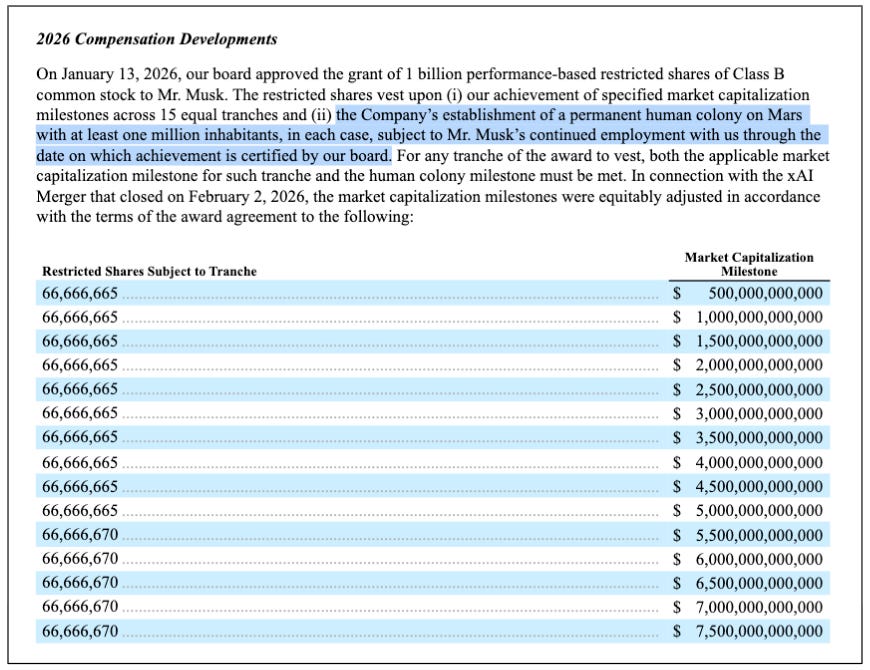
There is a similarly lucrative performance-based compensation if SpaceX delivers “non-Earth-based data centers capable of delivering 100 terawatts of compute per year” (the current global power grid is under 10 terawatts…so — like the Mars colony — it’s a stretch goal).
Getting any serious compute in space via orbital data centres will be an important source of funds to fund any and all future Mars missions.
The launch window to go to Mars is only available every 26 months.
SpaceX is still working on Starship. The largest rocket ever built that can carry 100 metric tonnes of cargo to orbit and will be fully re-usable. Elon’s stretch aim is to launch multiple times a day at an airline-like cadence. We are a ways from that future. But even when it arrives, Starship has so much cargo space to fill for the 25 months outside of the Mars launch windows.
Orbital data centres will be one important revenue source. Another speculative — but extremely baller looking — option is an “earth-to-earth” transport system that uses Starship to transfer people anywhere on earth in under an hour. Feel like this is even more sci-fi than orbital data centres.

Finding new business lines using Starship’s lower cost of sending mass to orbit is a repeat of history.
For the past decade, SpaceX’s workhorse Falcon rockets have sent thousands of Starlink satellites to orbit. The connectivity play developed because Elon had so much excess capacity by unlocking rocket reusability.
It historically cost NASA $18,500 to send a kilogram to space. The Falcon 9 dropped the price to $2,700 per kilogram and the Falcon Heavy is at $1,400 per kilogram. A fully working Starship at a regular launch cadence could send a kilogram to space for $200 (a 99% cost decline compared to that original NASA figure).
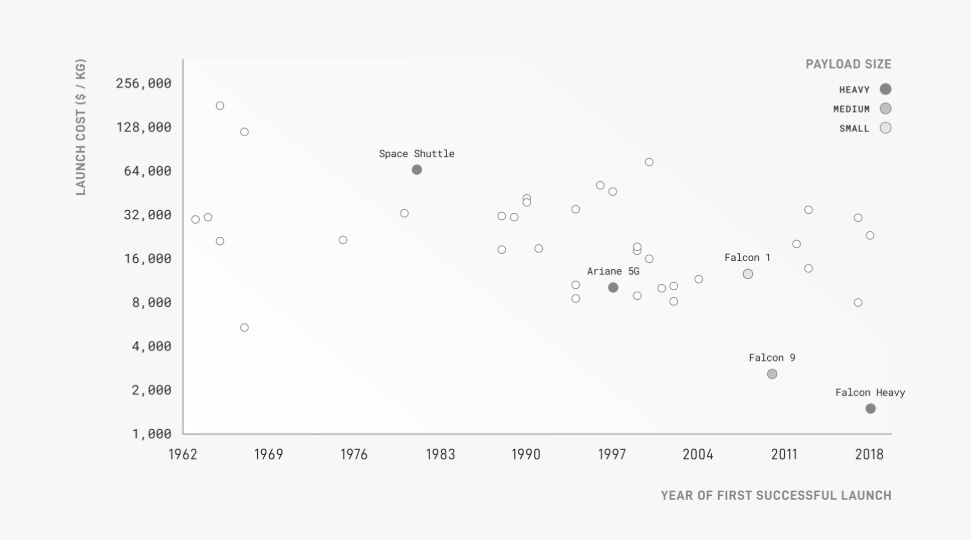
The S-1 highlighting potential opportunities that could be unlocked by such extreme cost reduction:
Space tourism
Asteroid mining
In-orbit manufacturing
Energy production on the Moon and Mars
Manufacturing capabilities on the Moon and Mars
Passenger and cargo transport to the Moon and Mars
During the week, CNBC’s Andrew Ross Sorkin asked Jeff Bezos about SpaceX’s potential $1.75 trillion valuation. Bezos — who owns competing space startup Blue Origin — hadn’t seen the S-1 and said, “One thing I can tell you for sure is that space is going to be a gigantic industry.”
Translation: TAM IS HUGE!!!
Since we brought back the word “TAM”, let me share one valuation exercise by The Information’s Martin Peers. He thinks SpaceX’s operating business is worth $678B based on an old school sum-of-parts analysis:
Starlink ($150B): He projects $15B in revenue by end-2026. Comcast has 29 million subs and trades at 2x forward sales multiple but is growing slower. Starlink still only has 10 million subs. If revenue continues to grow at its Q1 pace (+32% YoY), he gives it a 10x multiple and that puts the connectivity business at $150B.
Launch ($300B): Starship isn’t fully operational, so let’s use the $4B sales figure from 2025. Publicly traded Rocket Lab is worth $73B, or a 73x forward sales multiple. That puts SpaceX’s launch business at $300B.
X ($3B): The artists formerly known as Twitter has ~$1.8B in ad sales. Give it Snap’s 1.6x forward sales multiple and that is $3B in market cap value (sometimes I forget SpaceX owns X).
SpaceXAI ($225B): By end 2026, compute revenue could hit $20B a year with Anthropic as the anchor client. Two other neoclouds (CoreWeave, Nebius) are trading at 8.2x forward sales. So, that puts SpaceX’s compute business at $165B and we’ll add another $60B for Cursor.
All that adds up to $678 billion. In Peers’ take, the extra ~$1 trillion for the target SpaceX IPO is paying for Elon (the “Elon Market Hypothesis” strikes again).
I do think this analysis undersells Starlink. As with the launch business, it’s currently a monopoly and the global coverage in just 10 years is very impressive (with a lot more coverage to come).
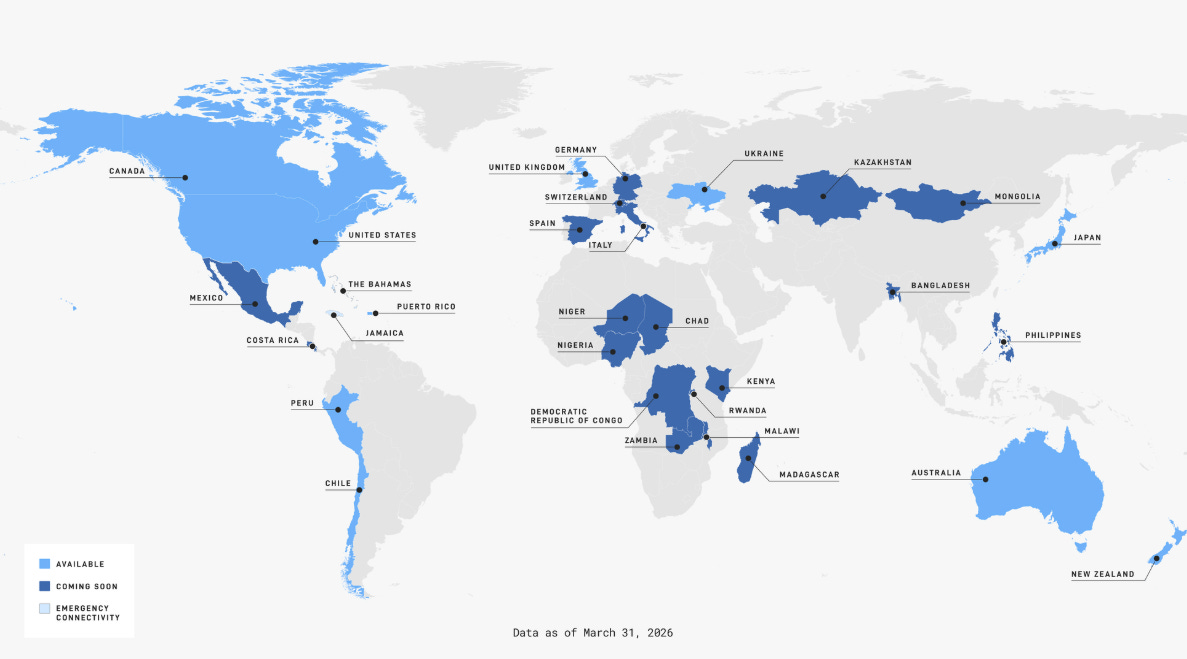
The Economist’s breakdown of SpaceX’s S-1 covers the range of opinions on long-term prospects for the satellite service:
Starship’s main job will be to bolster Starlink, the fastest-growing and only profitable part of SpaceX’s business. Since its debut in 2021 the service has signed up airlines, shipping firms and more than 10m individual customers, revolutionised warfare in Ukraine and spawned a secretive offshoot called Starshield for government customers. The firm’s newest “direct-to-cell” (D2C) satellites can communicate directly with smartphones and other devices on the ground, with no need for the special pizza-box-sized antennas that its residential plans require. Starlink’s revenue grew by 50% between 2024 and 2025, from $7.6bn to $11.4bn.
There is clearly more room for growth, says Mr Farrar. He notes that in one 80-day period in 2025 the firm added 1m new customers. He thinks Starlink may eventually sign up anywhere between 20m and 50m residential subscribers, although average revenues per customer are likely to decline as it adds users outside the rich world. At the moment, though, Starlink’s growth is held back by the size of the satellites that SpaceX can fit onto a Falcon 9. It plans “version 3” satellites that will each add 20 times more capacity than the “v2 Minis” it currently uses. But they are so big they can be launched only with Starship.
SpaceX is investing heavily to keep Starlink growing. Last year it spent $19.6bn to acquire spectrum from EchoStar, an American telecoms firm, to bolster the nascent D2C business, and has sought authorisation to launch 15,000 specialised satellites. PitchBook, which gathers data on venture-capital-backed firms, notes that these are expensive wagers. The EchoStar deal represents more than a year of SpaceX’s revenues. But it expects Starlink to top 1bn subscribers over the next 15 years.
Analysts are divided over Starlink’s potential. “I think D2C is just not going to live up to the hype,” says Mr Farrar, arguing that it will be used mostly in places where there are no terrestrial phone masts and therefore few people. Simon Potter of BryceTech is more optimistic: “It could enable ubiquitous connectivity between devices using standard smartphone kit. That could be transformational in applications such as cars, agriculture, logistics—and maybe in military ones, too.”
Franco Garda, at PitchBook, thinks that Starlink and SpaceX’s launch business could justify a $1.75trn valuation by themselves.
Wherever you think of SpaceX’s valuation, it was probably inevitable that Elon would merge space and AI. Peter Thiel — who is set to make $80B on the IPO — tells this story of introducing Elon to DeepMind founder Demis Hassabis in 2012:
The rough conversation was Demis tells Elon: “I’m working on the most important project in the world. I’m building a superhuman AI”.
Elon responds to Demis: “Well, I’m working on the most important project in the world. I am turning us into an interplanetary species.
Then Demis said: “Well, my AI will be able to follow you to Mars.”
Then Elon went quiet.
To see through both missions, Elon has kept ironclad control of SpaceX. He owns 42% of SpaceX equity but will own 85% of the voting power via Class B shares (super-voting shares).
Over the past few years, Elon has been in high-profile shareholder lawsuits over his compensation plan at Tesla (he doesn’t have a special share class and owns ~15% of voting power). The SpaceX structure ensures this won’t happen. Anyone investing in SpaceX post-IPO should fully understand the setup, per the aforementioned Matt Levine.
If you are buying SpaceX stock to tell Elon Musk what to do, you should stop. If you are buying SpaceX stock because you want exposure to the space/AI business but you have your doubts about current management, you should stop. If you are buying SpaceX stock because you like Elon Musk and want to go along for the ride with him, yes, that’s correct, that’s the investment thesis here.
If, later, you are disillusioned with Elon Musk, if you feel like you were misled and he didn’t do the stuff he promised to do, I mean … that’s also kind of his whole thing? It is possible that, in hindsight, you will find something bad about SpaceX that was not specifically disclosed in this prospectus. But at a meta level everyone knows everything about SpaceX. Musk’s gonna do whatever weird stuff he wants, and if you don’t like it that’s your problem.
On the day that SpaceX’s S-1 came out, news “leaked” that OpenAI was eyeing a September IPO. Then, Anthropic latest financials “leaked”, showing that its Q2 2026 revenue will hit $10.9B and the maker of Claude may even turn an operating profit in the quarter.
The day prior, Andrej Karpathy (OpenAI co-founder and former head of Tesla AI) announced he was joining Anthropic right before Google started its annual IO developer conference.
Hard to believe the timing of these “leaks” and announcement are coincidental. We are in the AI PR spin zone right now. While there is a lot of money in the capital markets, it is not infinite money.
Based on standard float percentages for a new IPO, investor Tomasz Tunguz estimated SpaceX, Anthropic and OpenAI would need to as much as $576 billion from public markets. That’s more cash money than the $469 billion that every single US IPO raised between 2015 to 2025.
This situation is further skewed by the fact that NASDAQ has loosened index inclusion rules to win SpaceX listing from the New York Stock Exchange. Typically, a newly listed company isn’t included in the index for 90 days. It’s a “cooling off” period to let public markets digest the new entrant. The NASDAQ created a “fast-entry” exception — which may also be used by OpenAI and Anthropic — to put a new size-able IPO into the NASDAQ-100 index after 15 days. This move leads to forced buying from passive index funds. Forced buying also means forced selling of other stocks in the index.
The flood of money won’t happen right away. SpaceX’s initial float in public markets will be 5-10% of the entire company. Elon and other insiders are locked up from selling for 366 day. That’s about half the equity. The other half of shares will expire in various milestones: 1) insiders can sell 20% of shares after the first quarterly earnings (August or September); 2) another 10% of shares can be sold if SpaceX stock is 30% above IPO price at the time; and 3) various tranches after the second quarterly report.
Once Anthropic and OpenAI hit, I don’t know if the math can keep math-ing for all three IPOs.
Which is why SpaceX has been pushing to get out first — it even structured its deal with Cursor to close after the IPO (because it if happened beforehand, SpaceX would have to update and delay its filings) — and hoover up as much capital as possible.
The IPO race is perhaps the best way to view Elon’s recent court case against OpenAI. He donated ~$40m into the organization in 2015 and says they defrauded him by transitioning from a non-profit to a for-profit. Elon lost after the jury ruled that the statute of limitation had lapsed. But the lawsuit tied up OpenAI’s resources and probably delayed its IPO plans. That’s a win in the race to go public.
It’s May 2026, people. Nvidia just reported $82B in its latest quarter, surging 85% YoY on 75% margins and an absurd operating profit of $54B. For now, the AI trade is still AI trading.
That is why I think the date SpaceX was able to file its S-1 (and confirm an IPO date) is more important than anything inside of the document. You don’t need a spreadsheet to figure out.
***
UPDATE Friday, June 5: SpaceX amended its S-1 to show a new contract with Google paying $920m a month for compute (or $11B a year). Combined with annualized Anthropic contract ($15B), SpaceX is selling $26B a year in compute. That is 40% more than SpaceX’s entire revenue in 2025 of $18.7B. Also, S&P will not fast-track any mega-IPOs and all new public companies will have to wait at least a year for entry in the index.
If you enjoyed that analysis, smash the subcribe button for a weekly newsletter on tech, business and banger memes.
The Enhanced Games
On Sunday, athletes will gather in Las Vegas for the inaugural Enhanced Games (aka “The Steroid Olympics”).
Backed by Peter Theil and Donald Trump Jr., the games will see nearly 50 athletes — across swimming, track and weightlifting — trying to break world records while on doping protocols under the guidance of medical teams. Protocols include mixes of testosterone, HGH, peptides etc.
The visual spectacle will be used as top-of-funnel to help sell performance-enhancing drugs, as explained by The Economist:
Up to $25m in prizes will be awarded, with $250,000 going to those who win first place and bonuses of up to $1m to world-record breakers. Around 2,500 people will watch from the stands of a purpose-built arena, where they’ll also be treated to a Super Bowl-style closing ceremony—The Killers, a rock band, are playing—and have the chance to mingle with scientists, crypto investors and celebrities. The games will be streamed on YouTube and Roku: Bryan Johnson, a venture capitalist who has become famous for trying to chase immortality by tweaking every aspect of his body and lifestyle, will be one of the commentators.
This spectacle is an advertisement for Enhanced’s other business: selling performance-enhancing products to non-Olympians. The company has pumped its competing athletes with drugs over the past three months in the hope that their achievements will inspire viewers—from ordinary gym-goers to grandparents trying to keep up with their grandchildren—to also get enhanced. A dizzying array of injectable drugs is already for sale on Enhanced’s website, promising to support everything from “sleep, energy and sharper mornings” to “healthy ageing”.
Unsurprisingly, event has courted controversy.
I’m pretty open-minded about it tbh… because let’s not pretend that the Olympics are clean ethically or business-wise.
In 2024, founder Aron D'Souza went on the Joe Rogan Podcast and it’s a simple pitch:
D’Souza: I learned some key statistics: 44% of Olympians admit to using banned or performance-enhancing drugs [in 2023] according to research commissioned by the World Anti-Doping Agency (WADA).
Rogan: The other [56% are] probably lying or losing.
D’Souza: Then, I learned that the average American Olympian only earns $30,000 a year and I thought to myself there’s something really wrong in the system. Instead of you know trying to reform it, let’s take a blank slate of paper and invent the third Olympiad from scratch.
Rogan: Well, the Olympics is kind of a scam because it generates billions of dollars in revenue and the people that are there to perform make almost none of that.
D’Souza: That’s correct. The International Olympic Committee (IOC) doesn’t pay any of the athletes. Incidentally, they may get some money in sponsorship or from their national Olympic Committee. Ultimately, billions of dollars come into the Olympics and none of that goes to the athletes. It gets wasted building stadiums. It gets wasted paying officials. We thought there’s a way to do a better and more honest model that inspires us to believe in the future of science and technology in the 21st century.
Two other notable stats from their chat: 1) 25% of the items you can buy off the shelf at GNC will get you banned by WADA; and 2) the year Lance Armstrong was banned from Tour de France, the first person that didn’t dope would have placed 18th.
On the first point, the Olympics bans substances not from a health point but a competitive point. I obviously don’t want people ruining their endocrine systems but “doping” is a large net to cast.
The point about Lance Armstrong is not to defend cheating but let’s the worst place to be is to pretend it doesn’t exist. It does and it can’t be 100% stopped.
THIS IS NOT AN ENDORSEMENT OF CHEATING OR DOING DRUGS.
BUT I CHOOSE TO LIVE IN REALITY.
Which is why I’ll be watching the Enhanced Games in Sunday.
One athlete I am particularly interested in is James “The Missile” Magnussen.
Australian swimmer with an Olympic silver medal. Said he’d “juice to the gills” if offered $1m to break 50m freestyle record of 20.88 seconds (he did later regret framing it like that and is actually interested in safe anti-aging procedures).
Enhanced Games agreed. A short video of him is most viewed on its YouTube channel and top comment is incredible: “you can see his back from his front”.
Absolute tank. 6’6 and will weigh ~250lbs for the swim.
For the inaugural Enhanced Games this weekend, Magnussen will also wear a full-body polyurethane super swimming suit that was banned after 2008 Beijing Olympics (he’s been training and doping at a facility in Las Vegas).
Enhanced Games is actually a listed stock with the ticker ENHA and is valued at ~$670m right now.
A big opening event could juice (sorry) the market cap.


MacBook Neo & How Apple Uses Defective Semi Chips
Carl Weathers (RIP) had one of the best cameos ever in a sitcom.
The actor — who legendarily played Apollo Creed in the first four Rocky films — was asked by a producer of Arrested Development to redo the famous (and frequently mocked) beach running scene Weathers had done with Sylvester Stallone.
Weathers was interested in the role but didn’t want to just be the butt of jokes. He pitched the idea of playing an over-the-top version of himself as a cheap grifter.
This cameo peaked during a dinner scene when Weathers sees a member of the Bluth family about to throw out some chicken leftovers and stop them with this line:
"Whoa, whoa, whoa. There's still plenty of meat on that bone. Now you take this home, throw it in a pot, add some broth, a potato. Baby, you've got a stew going!"
Anyway, I thought about that scene when reading on how Apple has mastered the art of re-using defective semiconductor chips.
Its low-end MacBook Neo came out in March.
The smell that permeated the tech industry at the Neo’s launch was a bunch of Windows PC manufactures (Asus, Dell, Lenovo, HP) shitting their pants when Apple announced the laptop would cost $599.
A huge reason Apple was able to pull this off was because it re-used slightly defective A18 Pro chips used for the iPhone 16 Pro in 2024.
So, Apple needs chips for over 200 million iPhones a year. The manufacturing process is obviously imperfect. A bunch of the chips don’t pass the quality bar for the phone but are fine to power cheaper devices.
The A18 Pro chips that powered iPhone 16 Pro has six GPU cores. Apple had millions of those chips slightly degraded with only five GPU cores…but the neural engine and CPU still fully intact. This was more than enough for the MacBook Neo, per the Wall Street Journal.
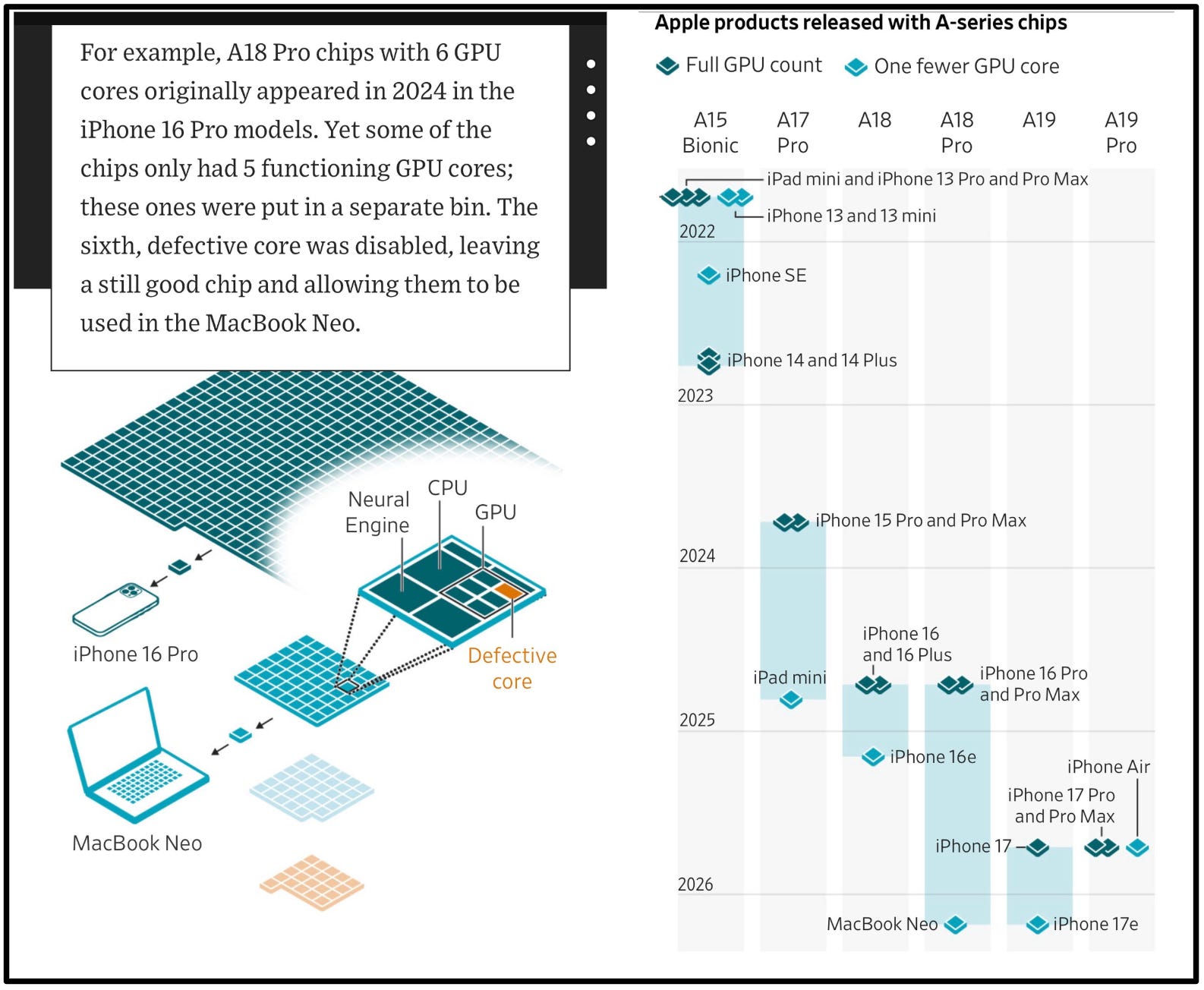
Aside from MacBook Neo, Apple has now sold numerous products since 2021 on slightly defective A-Series chips:
defective iPhone 13/14 Pro chips (A15 Bionic) used for iPhone 13 Mini and iPhone SE
defective iPhone 15 Pro chips (A17 Pro) used for iPad Mini
defective iPhone 17 Pro chip (A19 Pro) used for iPhone Air
Apple has been doing some version of this since its first chip: A4, “which powered the first iPad, then months later the iPhone 4, and after that the second-generation Apple TV box.”
Then, “the A8 chip first appeared in 2014 in the iPhone 6, then in 2015’s iPad Mini and Apple TV, and finally in 2017 in the first HomePod.”
A major reason Apple has to pull off this defective chip jujitsu is because the Big Tech Giant went all in on its own custom silicon in 2008 (when it acquired PA Semi for $278m).
Previously, Apple relied on Intel or Samsung to design and manufacture the chips. These companies only sent Apple the good chips. Now, Apple works directly with TSMC and takes all the chips, including defective ones.
The MacBook Neo — which was spearheaded by incoming CEO John Ternus (or so says Cupertino PR) — has been so popular that Apple has run out of defective A18 Pro chips. It ordered a new batch of normal ones. But even if a few of those are effed up, we all know they’ll find a way to use them.
Next move: give away slightly defective AirPod buds (that still kinda work) for free because literally every single person I know has lost at least one bud in their life. C’mon Apple, let us make some audio stew out of those metaphorical chicken bones.
Links and Memes
Students have been booing the mention of “AI” at a number of commencement speeches…including one given by former Google CEO Eric Schimdt. A total 180-degree turn from last year when the running joke was a student “showing off” how ChatGPT got him a degree. There is a legit job angst but AI leader messaging has also not been…ugh very good.
Shein acquired Everlane for $100m…the sustainable fashion startup hit a peak valuation of $550m. The fact that it’s now owned by the fast fashion Chinese platform which is the complete opposite of “sustainability” is peak irony. Well, almost as ironic as Everlane’s 2nd-to-last Instagram post.
Literary magazine Granta granted a short story prize and published on its website what looks to be AI slop. The internet is losing its mind over the apparent snafu, as detailed by Max Read.
The quant hedge fund arms race over posting promo videos about data centre water usage is getting out of control…with recent entries from Hudson River Trading and Jane Street.
Singapore’s Foreign Minister built a NanoClaw AI agent on a Raspberry Pi. Dr. Vivian Balakrishnan is a former eye surgeon serving government. He talks to his AI agent on WhatsApp to prepare for meeting. The reason he built it is because “Reading the executive summary tells you what the technology does…building with it tells you where it breaks, what it costs, and what it cannot yet do.” Just perfect example of how Singapore pays politicians top dollar to attract best talent. Has another foreign minister anywhere else in the world done this?
Google IO’s round-up in 15 minutes. A good round-up. One thing Google did was to overhaul its search experience. Instead of the traditional “10 blue links”, the search experience is built around an “Intelligent search box” with access to AI tools including agents. The overhaul is so major that Google clearly hasn’t ironed out the edge cases…and, for a while, you couldn’t Google “disregard”.
New results from Eli Lilly’s weight drug are astounding…leading Daniel Friedman to ask, “I wonder what will happen in the economy if 80 million people who have reliably consumed 3500 calories of food each day for the last 30 years suddenly start eating only 1800 calories.”
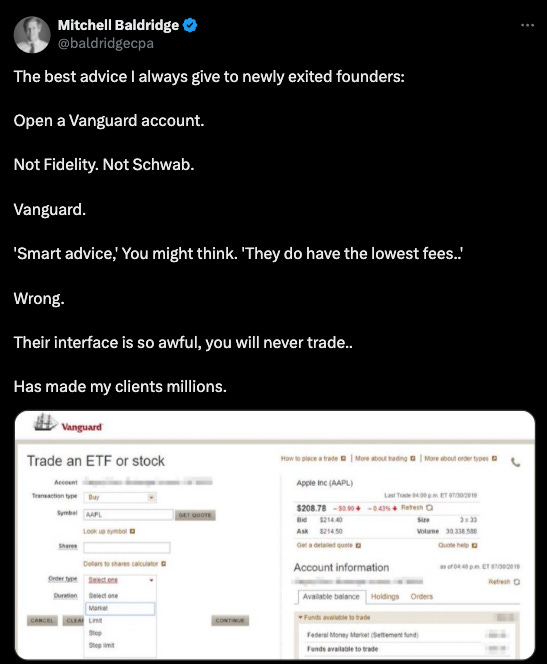
…and them wild posts (including this gem about Vanguard…the Acquired podcast just did an episode on how Jack Bogle’s investment management company pioneered low-fee indexing, which has saved investors $1 trillion in fees. #BogleHeads rise up):


Finally, we have to talk about Wemby. The 7’4 San Antonio Spurs superstar played one of the greatest playoff games every earlier in the week. ESPN’s Ramona Shelburne had an incredible article detailing two weeks he spent with Shaolin monks last summer to build up his mind:
Throughout his time at the monastery, meditation had been the most difficult aspect for Wembanyama to embrace. It’s hard for someone 7-foot-4 to sit cross-legged at all, let alone silently for up to 90 minutes, without moving.
But he kept at it. Each night he slept in three single-size beds that had been pushed together to accommodate his frame. Each morning he rose at 4:30 to train. The monks would have him run through the forests near the monastery or along an uneven 200-meter hillside track, doing frog jumps, sprints and one-legged hops uphill and downhill to build his balance and stamina. […]
Several times a day Wembanyama meditated with 100 other monks, each session’s length determined by the length of the wick of incense that burned in the center of the room. Thirty minutes was doable. But sometimes the incense burned for 90 minutes, and it was agonizing for the then-21-year-old Wembanyama to sit that long.
“I knew he could do it,” Master Yan’an said. “Because when he trains, he always tries again and again until he is the best.”
Master Yan’an recognized then what the basketball world is recognizing now: that Victor Wembanyama has perhaps the most unprecedented set of skills and untapped potential anyone has ever seen, and that he requires a similarly unprecedented training regimen to realize it.
Also, recall the Swatch x Audemars Piguet collab we talked about last week….so I can show you this meme comparing Wemby to OKC Thunder centre Chet Holgrem.


Re: Apple Neo - Semiconductor binning is as old as building your own PC. When they used to sell chips at different clock speeds, they were same silicon but more or less defective compared to the "perfect" version of that chip.
To fully appreciate SPACEXai potential, one needs to factor in the mega-kicker: Elon's oft-stated vision for Optimus robots.