Thanks for subscribing to SatPost.
Today, we will talk about:
Jensen Huang’s key note at Nvidia’s
Netflix Acquires Ben Affleck AI Startup (and What It Means For Meek Mill)
Garmin’s Best Year Yet
…and them wild posts (including Costco’s CEO)
How Jensen Manifests The Future
Nvidia recently wrapped its multi-day GTC 2026 developer conference.
CEO Jensen Huang kicked it off with a 2.5 hour keynote. He goes “grip it and rip it” style without a teleprompter or script. Huang knows his $4.5T company — and the entire AI ecosystem around it — from front to back, so he dropped mad facts while keeping it conversational.
Jensen introduced a new Vera Rubin GPU rack, some new CPU products and an inference-focused chip from Groq (Nvidia acqui-hired its key talent and licensed the IP for $20B a few months ago).
Just as important as these products was the vision he painted of the future. Not just a future where professional Asian dudes can look baller rocking $10K Tom Ford leather roadster jackets (thanks for trailblazing, Jensen).
But a future of “AI factories” that “manufacture tokens”. He coined these terms and they are a direct callback to the industrial revolution when steam power augmented (and later innovations replaced) human strength. The vision is that machine intelligence will be augmenting (hopefully not replacing; for real, please don’t replace me bro) human intelligence in the 21st century cognitive industrial revolution.
Jensen did so in a very Jobsian manner (a key difference is Steve Jobs tried to convince the end consumer while Jensen’s main audience is now Nvidia’s entire supply chain).
As with any great communicator, Jensen’s been cooking up new terms and roadmaps to manifest reality. I’m not just putting words in his mouth. On the Lex Fridman podcast that dropped after GTC, this was Jensen’s exact framing on the importance of messaging his team and the AI ecosystem.
When I believe it in my mind — you know how it is — you manifest a future, and that future is so convincing there’s no way it won’t happen. There’s a lot of suffering in between, but you’ve got to believe what you believe.
Then, you reason about how to get there. You reason about why it must exist…I reason about things step-by-step-by-step. Oftentimes, I’ve already made up my mind. But I take every possible opportunity — external information, new insights, new discoveries, new engineering revelations, new milestones — and I use those opportunities to shape everybody else’s belief system.
I’m doing that literally every single day.
I’m doing that with my board, with my management team, with my employees. I’m trying to shape their belief systems such that when I come in one day and say, “Hey, let’s buy Mellanox” [a $7B deal for the networking firm in 2019 has already made $50B+ for Nvidia in networking revenue]…it’s completely obvious to everybody that we absolutely should.
On the day I said, “Hey guys, let’s go all in on deep learning”…I’d already been laying down the bricks across different organizations inside the company.
Every organization and everybody in it had already heard pieces of it. So, on the day I announce it, everybody has already bought into many parts of it. […]
So, if you go back and look at the GTC keynotes over time, I’m also shaping the belief systems of our partners in the industry, and using that to shape the belief systems of our own employees. By the time I announce something — like, for example [the new Groq chip] — I’ve often been talking about the stepping stones for two and a half years. […]
We don’t really build computers. We don’t really build clouds. As it turns out, we’re a computing platform company. Nobody can just buy something directly from us in the simple sense. We vertically design and vertically integrate in order to optimize. But then we open up the entire platform at every layer so it can be integrated into other companies’ products and services — into clouds, supercomputers, OEM computers.
The amazing thing is: I can’t do what I do without having convinced them first. So most of GTC is about manifesting a future such that by the time my product is ready, they’re saying, “What took you so long?”
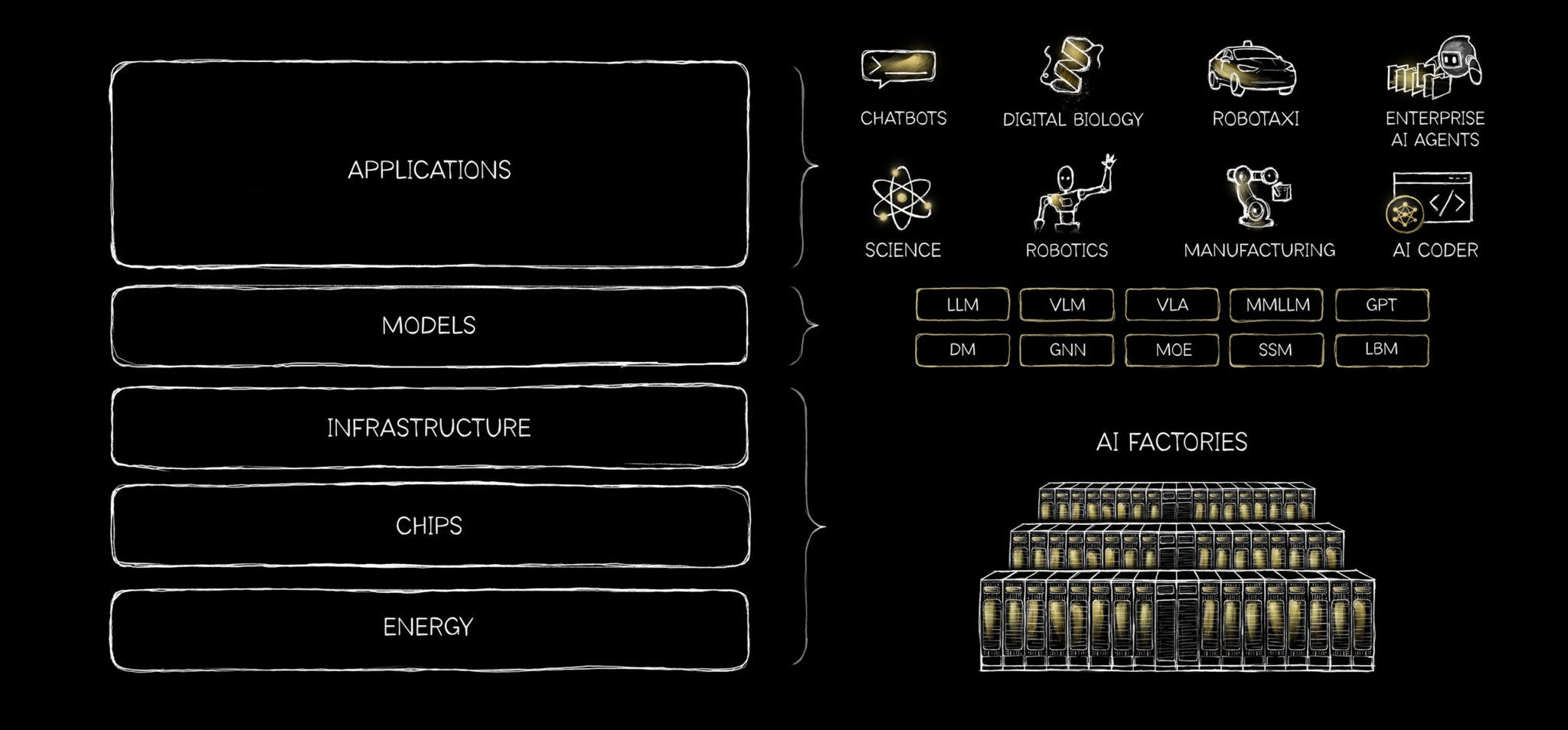
A future vision he plans to manifest came in the days before GTC: Jensen wrote a blog that frames the entire AI industry as a “5-Layer Cake” (energy, chips, infrastructure, models, applications).
He drew this for good measure (Jensen doodles a bunch of these images...old school way to manifest):
During the GTC keynote, a future he spent a lot of time manifesting was AI agents.
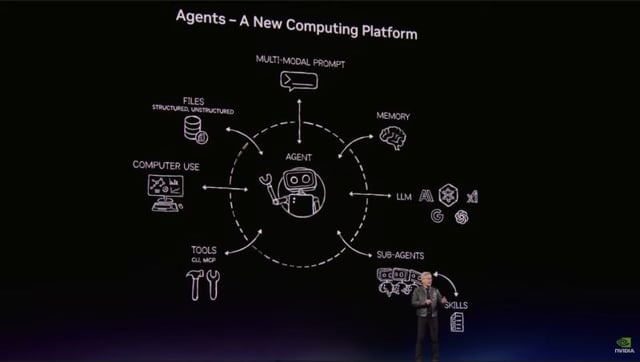
Jensen put up this drawing about OpenClaw and heaped praise on its creator Peter Steinberger. He placed it up there with the most important open-source projects ever (HTML, Linux) and said it was “an iPhone moment” for tokens on the Lex podcast (AI agents use ALOT more token than humans…easily 100x or 1000x more….pretty easy to do though when you don’t have to sleep!)
The entire segment was a bit of communications jujitsu, as explained by Jim Prosser:
Roughly two hours into the keynote, Jensen turned to OpenClaw, the open-source AI agent framework that’s taken the tech world by storm since January. Creator Peter Steinberger, who now works at OpenAI, was in the audience. Jensen called it “the most popular open source project in the history of humanity” and compared it to Linux, HTML, and Kubernetes, all foundational, era-defining protocols.
Then he said: “Every single company in the world today has to have an OpenClaw strategy.”
The CEO of a $4.5 trillion semiconductor company, at his own flagship event, used his stage to crown someone else’s project as the defining technology of a new era. He compared it to the technologies that built the entire fucking internet and said the entire enterprise world needs to reorganize around it.
That looks generous and visionary. It’s one of the most self-interested things he could do.
Every always-on autonomous agent is an inference call. Every inference call burns GPU cycles. Every CEO who walks out of that arena thinking “we need an always-on agent strategy” is a CEO who’s about to triple their inference compute budget. Jensen doesn’t care if you use OpenClaw or some other framework. He doesn’t care which models you run or whose API you call. He cares that you’re running persistent agents that consume compute 24/7 instead of intermittent prompt-response sessions.
“Every company needs an OpenClaw strategy” is Nvidia’s 2026 version of 1970s/1980s Microsoft’s mission of “a computer on every desk and in every home.”
This is a specific, nameable communications technique: category coronation as demand creation. You take something external (a technology, a movement, a shift in behavior) and you elevate it to the status of an inevitability. You don’t argue for your product. You argue for the world in which your product is essential. And once your audience accepts the paradigm shift, the downstream purchase becomes inevitable without ever needing to be argued for directly.
Jensen never said “buy more GPUs.” He just needed executives around the world to believe the age of autonomous agents had arrived. Gravity takes care of the rest.
There were 10,000 people (including 100 CEOs) at the SAP Centre in San Jose connecting the dots that Jensen placed on the board.
To be sure, not every pitch Jensen made hit the mark. As with any salesman, he made a few proclamations that were overly sales-y.
On the All-In podcast, Jensen talked about how he gets upset at his $500,000 engineers if they aren’t also using $250,000 in compute tokens for their coding agents.
Not very subtle (but, he's almost certainly right...it is already happening and this is the worst these models will ever be).

There were a lot of riffs on this gag. Local baker says you should eat 100 pieces of bread a day. Local plumber says you should take 67 deuces a day. Local cheesemaker said you should snort parmesan every morning.
The broader context of Jensen’s message is worth noting: he really frames token usage as work augmentation.
He is not alarmist about AI’s ability to replace white-collar professions as compared to other AI industry leaders. Elon says work will be optional in the future. Sama is one of the biggest boosters of UBI. Dario says 50% of entry-level jobs may be gone by 2030 (for real, please don’t replace me bro).
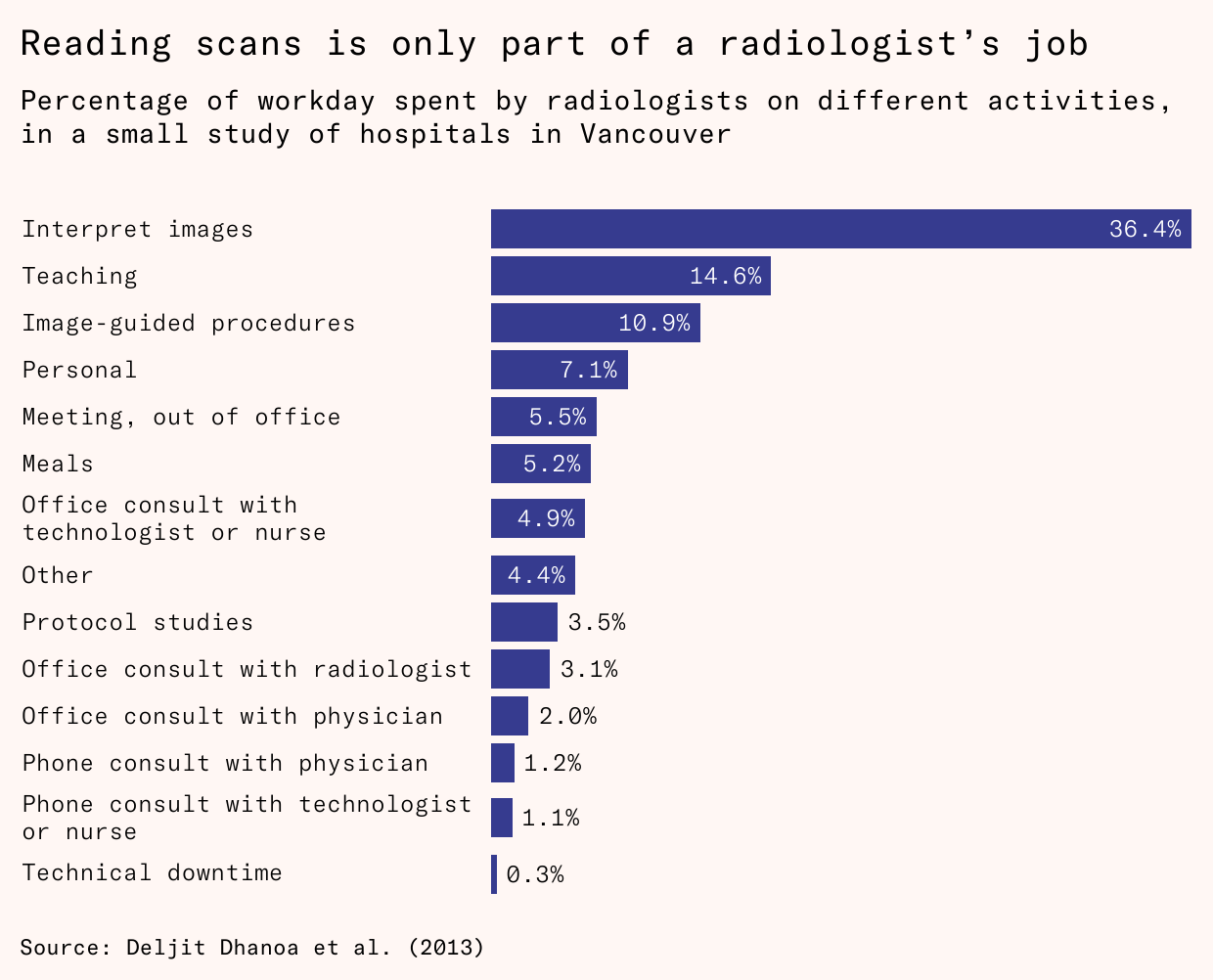
Jensen’s take is that a job is made up of many tasks. If you’re job is simply a task…then, yes, it’s at risk of AI. If it’s a bunch of different tasks, then AI is a tool to help you complete tasks as part your entire job responsibilities.
An example Jensen often brings up is radiology. In 2016, Geoff Hinton (one of the “Godfathers of AI” who used to work at Google) said that “people should stop training radiologists now” because machine vision was getting so good that the job would be soon be gone.
According to Works in Progress, there’s since been an increase in radiology jobs even as the AI has been popping off:
But demand for human labor is higher than ever. In 2025, American diagnostic radiology residency programs offered a record 1,208 positions across all radiology specialties, a four percent increase from 2024, and the field’s vacancy rates are at all-time highs. In 2025, radiology was the second-highest-paid medical specialty in the country, with an average income of $520,000, over 48 percent higher than the average salary in 2015.
Sure enough, a radiologist’s job is collection of tasks. AI is helping speed up scans meaning radiologists can spend more time on other tasks including teaching and consulting with patients...which drives demand for more radiologist roles.
Another Jensen-ism is that “AI won't take your job. But someone who understands how to use AI will".
He often talks about his own career to make the case.
Jensen has 60 direct reports. He says all of them are smarter than him. But he’s the orchestrator. Intelligence isn’t the only (nor, the deciding) variable for the success of Nvidia. In his eyes, everyone can be the “CEO” of AI agents.
That’s a more positive vision of the future.
Anthropic co-founder and Head of Policy Jack Clark was recently on the Plain English podcast and Derek Thompson asked him why Dario frequently gives the alarmist takes.
It’s been a clear turn off for the public.
An 80,000-person survey by the startup found that less developed markets were more positive on AI:
Globally, 67% of interviewees expressed net positive sentiment toward AI. Clear trends emerged in which people in South America, Africa, and much of Asia view AI with more optimism than those in Europe or the United States.
When asked about concerns, respondents from Sub-Saharan Africa (18%), Central Asia (17%), and South Asia (17%) were the most likely to say they had none—roughly double the rate in North America (8%), Oceania (8%), and Western Europe (9%).
One theory is that more developed Western markets have slower growth, which puts the population in a zero-sum mindset. Instead of growing the pie, people are trying to split it.
With that context, telling everyone that your tech will replace their jobs and drink their milkshake is an INTERESTING SALES PITCH!
Clark’s defense is that Anthropic doesn’t want to be overly-panglossian about AI. It can do tremendous good but also very very bad stuff.
Is Jensen’s approach too positive? Honestly, it seems measured (even with the occasional “local barber says you need a trim once a week” pitch).
Aside from the public messaging, Jensen is also having a bunch of C-suite negotiations that we don’t see. He’s trying to convince the brass up and down the ecosystem (ASML, TSMC, Caterpillar, Big Tech, GE Verona etc.) to put up multi-multi-billion dollar in CAPEX for the world he sees coming.
How much manifesting is going on there?
Jensen gives Lex one salient example. A few years ago, he told the world’s leading memory chip manufacturers to expand one type of product (HBM, high-bandwidth memory).
He doesn’t name check them but it’s obviously Micron, Samsung and SK Hynix…which were three of the top-performing stocks last year (which, surprise, I completely whiffed on by not investing).
Jensen explains:
If you look at the CEOs of the DRAM industry — about three years ago — I was able to convince several of them that even though HBM memory was still used pretty scarcely at the time (mostly in supercomputers), it was going to become a mainstream memory for data centers in the future.
At first, that sounded ridiculous. But several of the CEOs believed me and decided to invest in building HBM memory.
Another type of memory that seemed odd to put into a data center was the low-power memory we use for cell phones. We wanted them to adapt that for supercomputers and the data center. Their reaction was basically: “Cell phone memory for supercomputers?”
I explained why. Look at these memories — LPDDR5, HBM4. The volumes are so incredible. All of them had record years and these are 45-year-old companies.
So that’s part of my job: to inform, to shape, to inspire.
There’s a Steve Jobs story with the first iPhone that has similar energy about manifesting the future with a supply chain vendor.
In Apple’s case, Jobs had to convince Corning to commercialize Gorilla Glass for the first iPhone (an earlier prototype of the iPhone had a plastic screen that kept getting scratched).
Brian Merchant relays the story in his book “The One Device” (my write-up on the book here):
[In 2005, Jobs met Corning CEO Wendel Weeks and told him] he doubted Gorilla Glass was good enough, and began explaining to the CEO of the nation’s top glass company how glass was made.
“Can you shut up,” Weeks interrupted him, “and let me teach you some science?”
Jobs was sold, and, recovering his Jobsian flair, ordered as much as Corning could make — in a matter of months. “We don’t have the capacity,” Weeks replied. “None of our plants make the glass now.” He protested that it would be impossible to get the order scaled up in time.
“Don’t be afraid,” Jobs replied. “Get your mind around it. You can do it.”
According to [Walter Isaacson’s biography on Jobs], Weeks shook his head in astonishment as he recounted the story. “We did it in under six months,” he said. “We produced a glass that had never been made.”
Man, this story just hits all the notes of the Jobs mythology:
Total self-assurance (mixed with douchebaggery): “he…began explaining to the CEO of the nation’s top glass company how glass was made” (LOL)
Visionary: Jobs was willing to change his mind if convinced and — after being taught some science — he saw the potential of Gorilla Glass.
Reality distortion field: “Don’t be afraid…get your mind around it, you can do it.”
On the last point, Jobs’ reality distortion field clearly has parallels to Jensen manifesting reality.
So, what’s Jensen trying to manifest next?
Nvidia did $200B+ in sales last year and Jensen says there is $1T in backorder for Nvidia chips and racks over the next two years.
Jensen tells Lex that he believes Nvidia could still see material revenue increase on the continued rise of AI agents and integration across every industry...hopefully with major breakthroughs in healthcare, energy, science (NOT INVESTMENT ADVICE):
There’s nothing that I see that says $3 trillion is not possible. The burden is shared by 200 companies [in the supply chain]. The fact is that we scale out on the backs of the ecosystem.
The question is: do we have the energy to do so? Surely, we will have the energy to do so…that number is just a number.
Almost everything that I [am forecasting for the future token demand] doesn’t exist. That’s the part that is hard. If Nvidia was a $10 billion company trying to take market share, then it is easy to see for shareholders: “Oh, Nvidia could just take 10% share, they could be this much larger.”
But it’s hard for people to imagine how large we could be because there’s nobody I could take share from [note: Jensen often calls these yet to exist opportunities “$0 Billion Dollar” markets].
So I think that that is one of the challenges: the world’s imagination of the future.
That’s why his process of reasoning then manifesting a vision for different types of sick leather designer jackets AI token usage is as important as the new products at GTC.
Netflix Acquires Ben Affleck AI Startup For $600m (...and Meek Mill Was Briefly Mad at Me)
While we’re on the topic of manifesting the future, we need to talk about rapper Meek Mill.
Last May, Meek wrote on X that “Working on a ai tool that can change the world lol”.
Internet obviously piled on and said this was probably the top of the AI bubble.
In September, he said “I have some genius tech guy that’s building a ai tool that everyone will be able to use! I have to get one off first you will see!”
Again, the jokes came in. A lot of memes from The Big Short and Margin Call.
Then, the “Meek Mill AI startup” posting went quiet until he typed up a bunch of posts over the past week including:
Claude is helping me organize my whole music career and other businesses in days ... and it's moving my business forward at a high rate! Some tech youngbull I met on LinkedIn gave me a incredible template! Who else can help me with Claude
I need a GitHub too! Is it like that or nah?
There were more but the Github post really got tech and business corners of X excited:
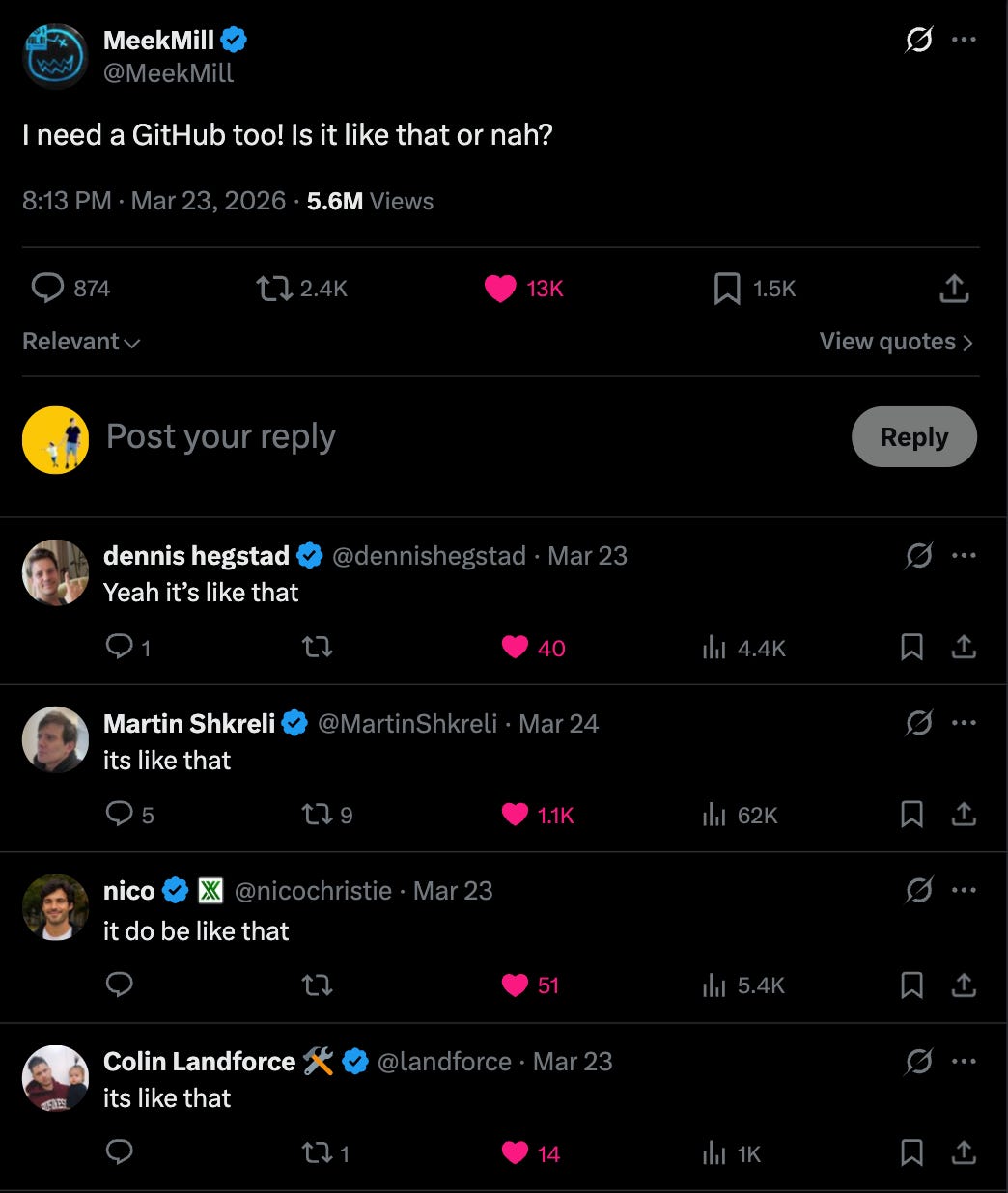
Of course, some memes too:
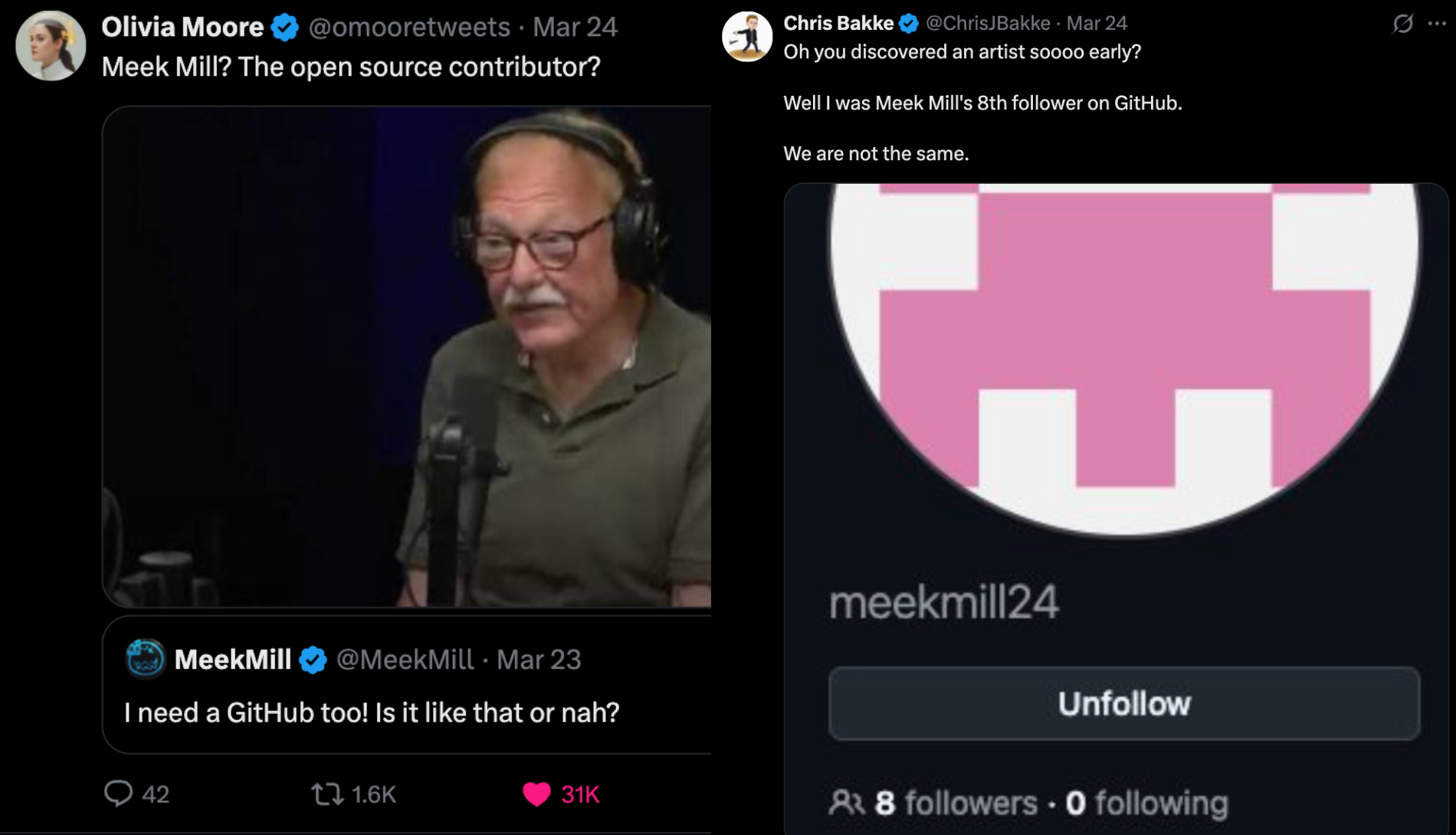
No one asked but I added my $0.02 on Meek’s AI journey…and he ended up responding:

It’s satire but…I was being directionally serious.
Why? Because — as the title of this sections notes — Ben Affleck literally just sold his AI startup InterPositive to Netflix for up to $600m!!!
For the uninitiated, Affleck co-founded a company that built a tool for post-production editing. He explained how it works in a talk with Netflix’s COO and CTO:
directors can train a small model from their own dailies of filming
the model is used in the the post-production editorial process
directors can more quickly mix, color and finish films (use their trained model to change shots, add props, enhance backgrounds or remove visuals while keeping consistency)
This is similar to work James Cameron is doing with AI and VFX.
Cameron says his interest in GenAI is to reduce post-production costs by making the “cadence faster, so your throughput cycle is faster and artists get to move on and do other cool things.”
If AI can reduce VFX costs by 1/2, Cameron thinks that means more blockbusters (including original IP or works by up-and-coming directors that wouldn’t otherwise get green-lit).
Affleck mentions “getting more episodes” of your favourite TV shows with his tech.
If Affleck hits the full $600 million cash deal, this looks to be Netflix’s largest tech acquisition ever (I’m an equal-opportunity shitposter and obviously did one for Affleck’s deal).
Whether or not the tech is worth $600m, Netflix is getting the Affleck halo of a well-known (but still skeptical) AI practitioner.
He has been Hollywood’s go-to takesman. He went on Rogan and totally cooked AI. Said it will never do truly creative work or write an interesting script. Called major AI founders scaremongers trying to pump up valuations by saying AGI will wipe out all jobs. on how AI can or can not change Hollywood. He thinks unions will protect a lot of acting/writing jobs for foreseeable future.
But there’s clear benefit on the workflow front.
“It’s not about text prompting or building something from nothing,” Affleck says. “You’re building a model from your own material.”
If Netflix wants to ramp its use of AI, Affleck’s narrow view of the technology’s use makes it less threatening and helps with creative talent (David Fincher is already using it for a Brad Pitt Netflix film, probably the sequel to Tarantino’s Once Upon A Time In Hollywood).
Back to Meek Mill, Affleck showed how creatives can use their industry-specific knowledge and brand to build AI tools.
I shared that in a reply to my original post.
Then, some of the comments and DMs from his fans were getting spicy enough that my first instinct was to reply to his post with “Mr. Mill, this was an unfortunate misunderstanding. Please accept…”
Wrote this instead:

Anyway, he responded and it was chill:

The playbook is there and, honestly, the a lot of the timeline wants to see him pull it off. Hopefully builds something. Not just a low-lift easy W.
Startup incubator YCombinator reached out to him. Meek got an offer to do an AI bootcamp. And almost certainly talking to VCs.
Wouldn’t be surprised at all if Meek Mill manifests an AI startup exit in the future. Things moving so fast in tech world, am primed for anything at this point.

Garmin is Cooking
The folks at Garmin at the absolute GPS OGs (or in industry parlance, “Global Positioning System Original Gangsters”).
They recently reported 2025 earnings and hot dang: the Kansas-based firm (which is legally domiciled in Schaffhausen, Switzerland) did a record $7.3B last year and is now worth $45B.
It racked up these figures after getting CLAPPPPPPPPED in key categories by Apple and Google over the last 18 years:
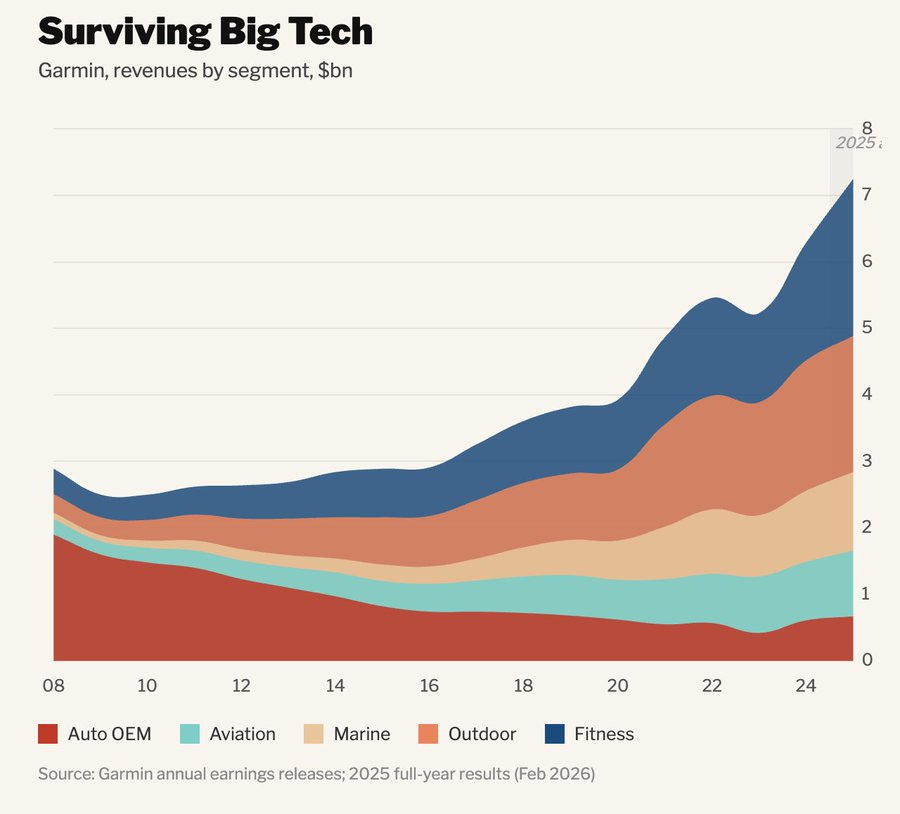
GPS: When Google released Maps for Android in 2008, Garmin’s car GPS devices made $2B a year (~70% of total sales). It’s now only $1B year (or ~15% of sales)
Smartwatches: From 2008 to 2014, Garmin pivoted into smart fitness watches (GPS, heart tracking, waterproof) and grew sales from $0 to $1B…just in time for Tim Cook & Jony Ive to take another dump in their yard with the release of the Apple Watch.
In response to the Apple threat, Garmin started selling high-end models and has carved out a niche in the premium fitness smartwatch market ($2-$3,000 price points vs. $1,099 for Apple Watch Ultra).
Smartwatches (under “Fitness”) made $2.3B in 2025 and was the company’s largest segment for the first time.
Today, fitness and outdoor equipment make up ~60% of Garmin’s $7.3B revenue projected for 2024 (GPS — evenly divided between car, aviation and marine segments — is ~40% of revenue vs. 100% in 2008).
After surviving Big Tech haymakers, Garmin’s market cap is up over 7x from 2008.
I previously wrote a 3,800 word deep dive on how they pulled it off (a lot of R&D) and you can read that piece here.
Links and Memes
Some other content for your weekend consumption:
Google Translate for Linkedin Speak…is absolutely unhinged.
OpenAI is shutting down its video app Sora…the startup is pivoting the business to focus on enterprise and coding use cases and it wasn’t worth having their scarce GPUs make videos of Sam Altman stealing GPUs at Target, or unhinged cat Ring footage videos or Jesus winning an Olympic Gold in swimming by walking on water (thankfully, we will always have the videos saved to our iPhones).
United Airlines now sells entire 3-seat rows in economy…that turns into a bed (and can’t imagine any parent with kids under 5 picking another airline if given choice).
…and them wild posts (including the CEO of Costco doing the “CEO eats his own product” challenge with a hot dog…no condiments…straight raw dogged it…wild):


Finally, absolutely nothing (NOTHING) can prepare you for this corner of the stock photo industry:


One more finally: Warner Bros announced the new Harry Potter TV show. They cast Paapa Kwaakye Essiedu as Snape, which made a bunch of original fans mad because of the race swapping. Alan Rickman played Snape in the film and the character’s description is “a thin man with sallow [pale/yellowish] skin, a large hooked nose, and shoulder-length, greasy black hair that frames his face”.
Embarrassingly, I haven’t read the books so don’t have any real opinions about the Potter-verse. The only thing that I know is that the Black Snape memes have reached an absurd level rarely ever seen in the meme-sphere…(including an absolutely out of control AI-generated music video).