

Thanks for subscribing to SatPost.
Today, we will talk about how two beast athletes (Sabastian Sawe, Yomif Kejelcha) did the previously unthinkable: run a sub-2 hour marathon.
Also this week:
GE’s very profitable break-up
Why AI sucks at reading PDFs
…and them wild posts (including Russell Brand)
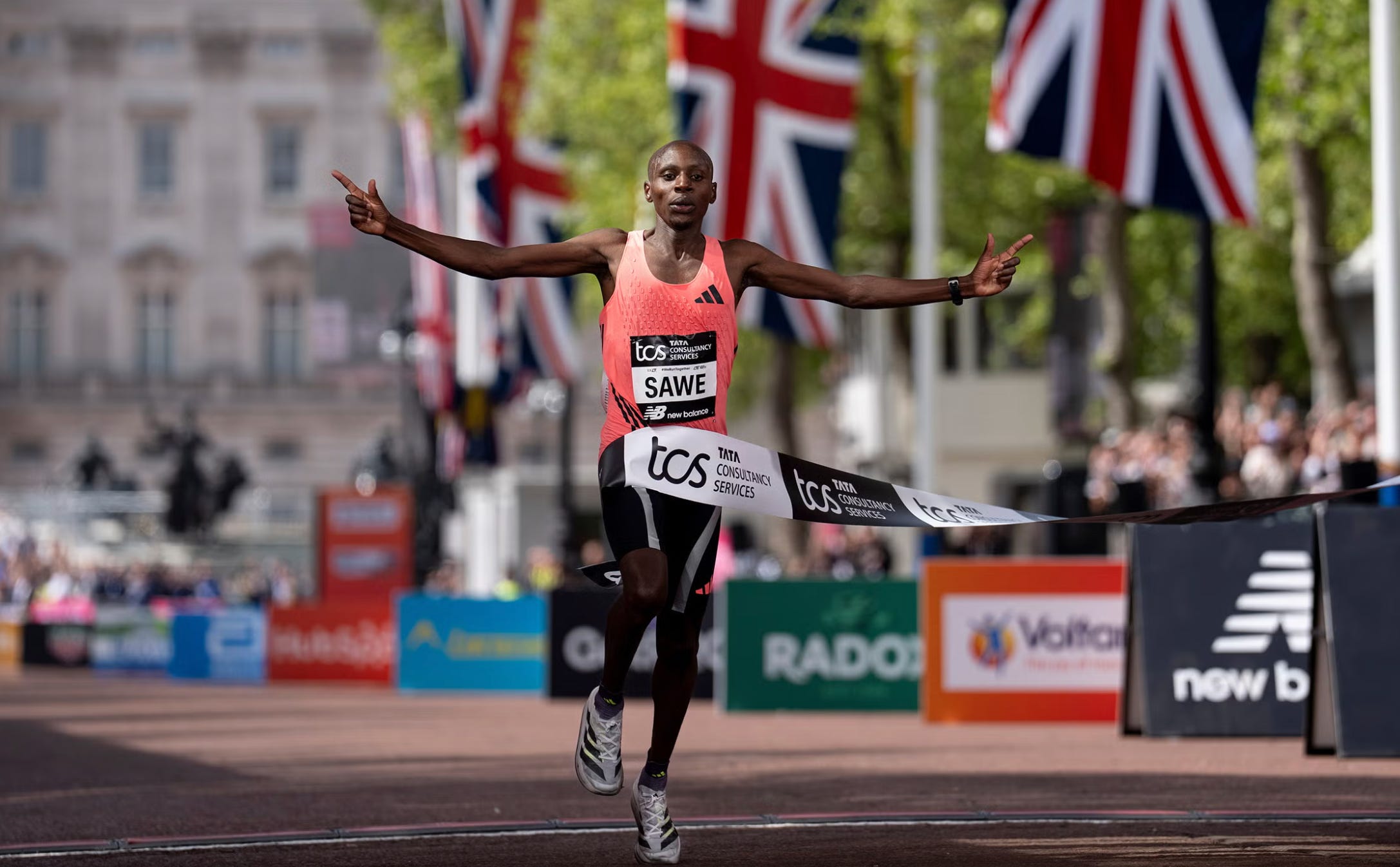
At the London Marathon last week, two runners — Sabastian Sawe (Kenya, 31) and Yomif Kejelcha (Ethiopia, 28) — broke the 2-hour marathon mark.
Sawe clocked in at 1:59:30 while Kejelcha finished the race in 1:59:41.
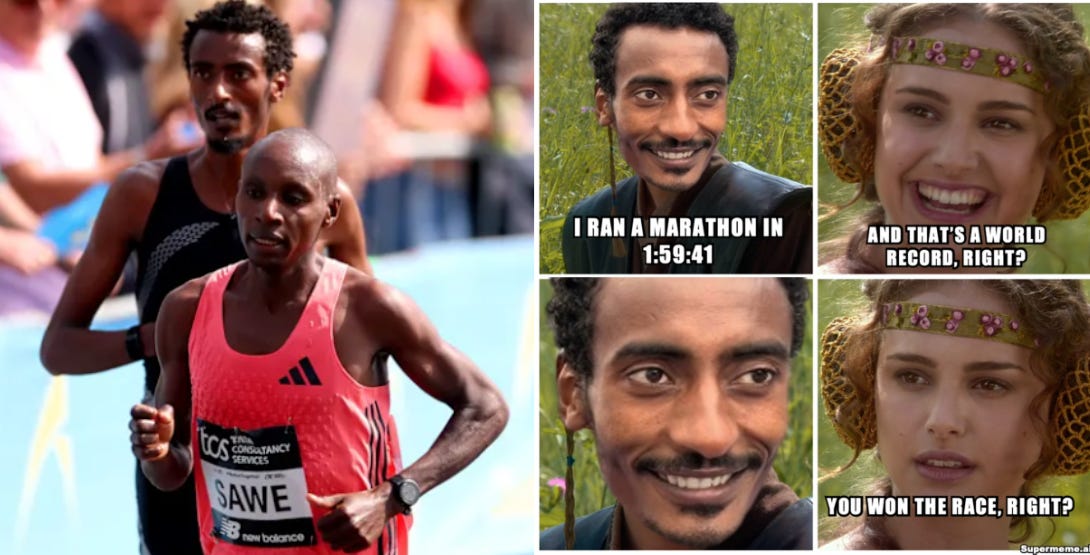
Incredibly, this was Kejelcha’s first official marathon and he STILL ONLY GOT 2nd PLACE!!!!
Humans are awesome.
The marathon’s outcome led to perhaps greatest use of the Anakin Skywalker meme template ever:
Alex Hutchinson — a former national distance runner, author and performance expert — reflected on the unlikely milestone:
To understand the significance of someone running a marathon in less than two hours, you also need to understand that, until recently, the notion of this actually happening was truly, utterly absurd. Sure, a physiologist named Michael Joyner had floated the idea that such a feat might be humanly possible in a journal paper way back in 1991. But his peers laughed off the idea, and not much changed over the succeeding decades. In Runner’s World in 2014, I predicted that it would happen in 2075. Frankly, even that forecast seemed overly optimistic to me, but I figured I’d be dead by then, so no one would be able to call me on it.
Unofficially, there was one person before Sawe and Kejelcha.
Kenyan marathon legend Eliud Kipchoge (Kenya, 41) ran a 1:59:40 in 2019.
But that was for a staged event with ideal conditions: Kipchoge ran on a specially prepared flat course in a Vienna park with a rotating cast of 41 other runners in V-formation and a car laser pointer to keep him on pace.
I mean, obviously, Kipchoge’s achievement was incredible and motivating. When Roger Bannister ran 4-minute mile basically wearing leather dress shoes, the rest of the world knew it was possible. Top-tier marathoners saw Kipchoge’s record-breaking run and knew the human body was physically capable of the milestone.
A year prior to Kipchoge’s special Vienna run, Runner’s World created a great piece of marketing for the sport: the magazine put a 20-foot long treadmill (aka "The Tumbelator”) in a bunch of public locations and let randos to try and match Kipchoge’s pace of 13mph (or 21km/h).
Comedy ensued.
If you ever been on a treadmill, you know how aggressive that thing gets when you crank it up. Hell, some treadmills don’t even have Kipchoge’s top speed. I would probably pull my hamstring just pushing the speed button past 15km/h.
Back to Sawe, his new record run broke the previous official fastest marathon time by 65 seconds. Kenyan runner Kelvin Kiptum had notched 2:00:35 at the 2023 Chicago Marathon (he was only 23 and looked certain to break the 2-hour mark but tragically died in a car accident one year later).
Every one of these athletes accomplished something amazing.
Take the time splits for Sawe’s marathon run…they are mind-boggling:
a pace of 4:33 per mile (the record for one mile is 3:43 and he kept the pace 26x)
or 2:50 per kilometer (he did it 42x)
his 100m pace was 17 seconds (which he did 422x)
he was faster in the second half (59:01) as compared to the first half (60:29)
the average speed was the same as Kipchoge’s at 13mp/h (21km/h)
the average men’s marathon time for 5km is ~30 mins (Sawe’s 5km pace was 14:10 mins, which he did ~8x)
the world record 10km track run is 26:11 (Sawe’s 10km pace was 28:19 which he did ~4x)
Dammit, just pulled my other hamstring typing those bullet points.
BBC reporter Matt Graveling may have also injured his vocal cords with this incredible live call: “ARE WE GOING SUB-2?!?” (also shoutout to the Google PM who gave Sawe and Kejelcha props when you Google their names).
An important detail of Sawe’s record-breaking run is that he voluntarily did multiple anti-doping tests in the year prior to the race. He must have known it was coming and didn’t want any doubts, per BBC.
Sawe runs about 200km per week — averaging almost 30km every day — at altitude, and credited his increase in volume as one of the key factors in his progress. […]
However, amid the spate of high-profile doping cases involving Kenyan athletes, including women’s marathon world record holder Ruth Chepngetich, he has also had an awareness for the need to instil confidence in these performances.
Determined to prove he is competing clean, Adidas provided $50,000 (£36,900) to the Athletics Integrity Unit, the sport’s anti-doping body, to frequently test Sawe over a 12-month period.
That began with a reported 25 out-of-competition tests in the lead-up to Berlin in September, continuing at a similar rate as he prepared for London.
Sawe said on Monday: “It’s very important to me because it gets out the doubt in my career of athletics and yesterday’s performance.”
Marathon runners don’t just have to contend with concerns over drug doping.
There’s also “technological doping”, which is when athletes benefit from advanced equipment or apparel.
In this case, the topic du jour was Sawe’s record-breaking running shoe: the Adidas Adizero Adios Pro Evo 3.
The craziest part of the Adidas story is that Kejelcha was also wearing the Adizero Adios Pro Evo 3 when he broke 2 hours…and so was Tigst Assefa, who set the women’s record at 2:15:41 at the same London Marathon.
Adidas may have just pulled off the most effective marketing campaign ever.
The shoe went for sale the day after the race. They cost $500 and were gone in 2 minutes. Then, some absolute savage resellers posted them on StockX for $1,900, the perfect price point for a shoe someone at your local gym will be wearing to use the recumbent bike while watching a Korean drama on their iPad.
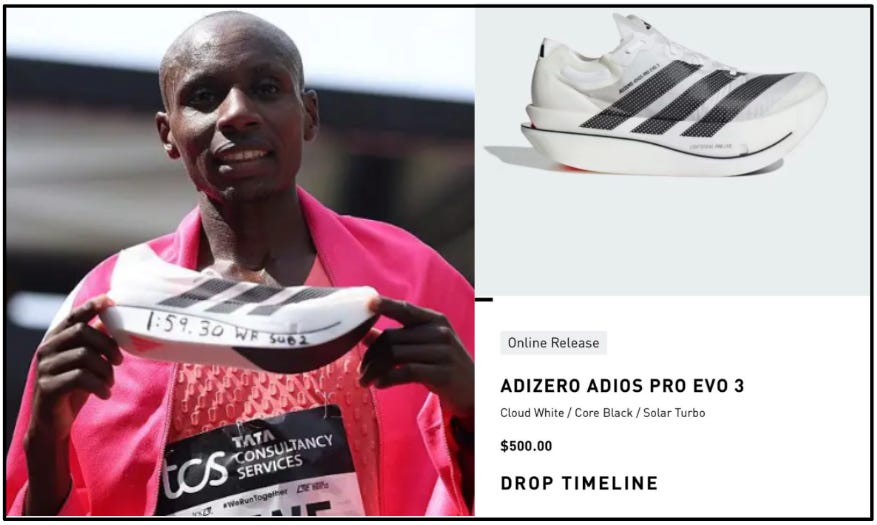
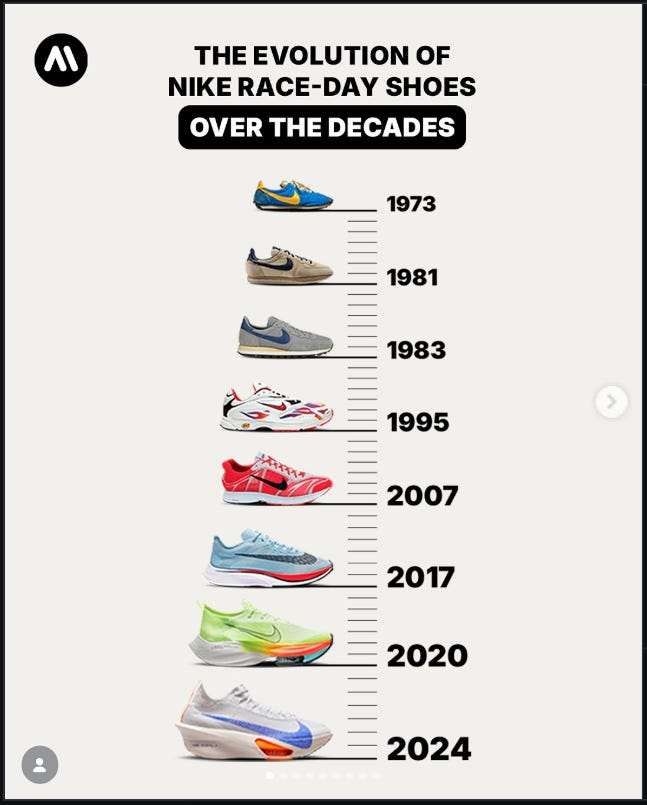
The Adidas Adizero Adios Pro Evo 3 is an obnoxiously long name the latest in the arms race to make better running shoes.
This graphic below shows how Nike race-day shoes have morphed since the 1970s. Note the absolutely absurd soles, which are now foamier and bigger than ever.
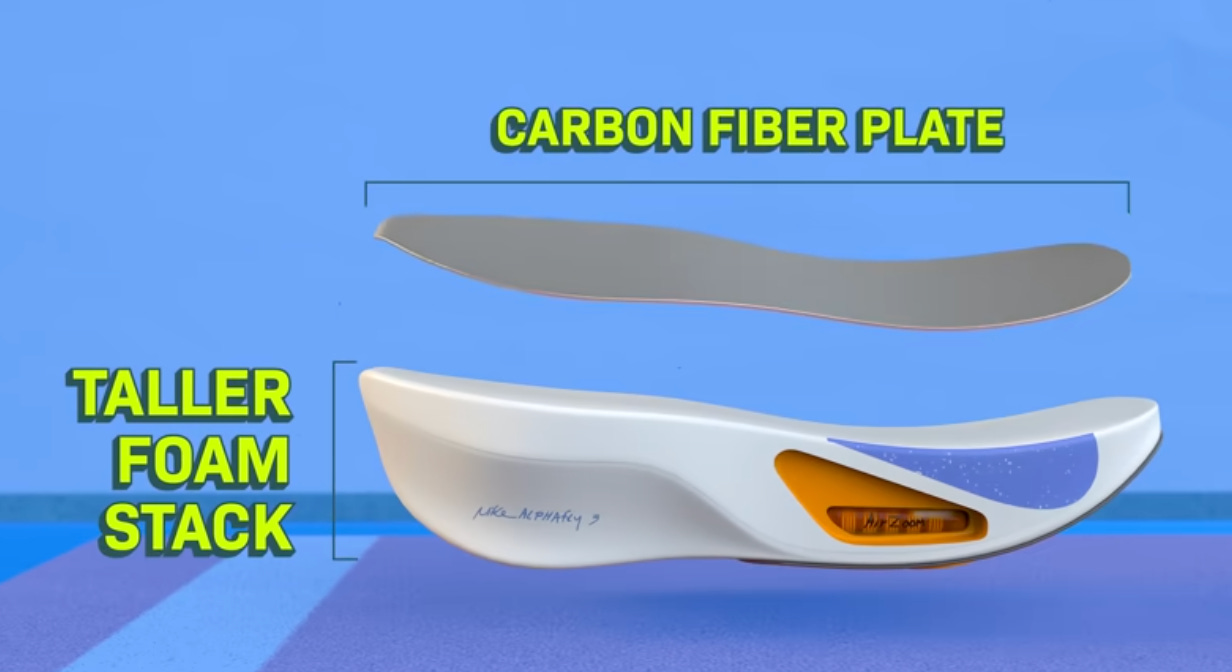
In 2024, YouTuber Cleo Abram toured an innovation lab at Nike — which started making the first super running shoes in the mid-2010s (including the Zoom Vaporfly for Kipchoge’s sub-2 hour run) — and did a good explainer video on the trend.
The two key advances are in the foam stack and the carbon fiber plate. These shoe parts work together to maximize “energy return” to the runner. Higher “energy return” helps an athlete be more efficient. Every stride impacts the ground and, ideally, some of the energy comes back to the runner instead of just dissipating away.
Older shoe technology had 60% “energy return” while these high-heel looking kicks have 80% or more.
Another key advance is weight. Or the lack of it. Shoe companies have done some real material science and manufacturing jujitsu to get the number down as low as possible.
Per WWD, the Pro 3 is the lightest legal race day shoe ever, weighing 97 grams (3.4oz) for a men’s size 9 (about 50% the weight of a regular men’s running shoe). That’s less than a bar of soap or a medium-sized apple. Or 3 hard-boiled eggs you buy at an airport bookstore after the security gate in those plastic container thingies that somehow cost $8.99.
Adidas was able to reduce the weight of the Pro 3 by 30% compared to the Pro 2 model. Most of the improvement came from a lighter foam compound and the upper part of the shoe inspired by kite surfing sail material.
The U-shaped carbon fiber plate is lighter and the laces weigh less too. The laces!!
To make its special Lightstrike Pro foam, Adidas used a gas injection process (nitrogen) to expand billions of microscopic cells in the sole to make it light and bouncy.
Whatever sorcery Adidas pulled off with the foam also meant that the Pro 3 needs less carbon plate. Typically, the plate is there to support the foam. But look at the Pro 3’s innards.
“Adidas has now figured out a way to create a more stable foam, that doesn't need a full carbon plate or rods to support it,” writes Tim Roozendaal. “That's why they can move to this ring design to still give the shoe some lateral stiffness but reduce overall weight.”

These advances are bumping up against the official restrictions from marathon governing bodies:
Foam stack height: Max 40mm sole thickness.
Rigid plates: Only one allowed.
The most famous example of technological doping is probably in swimming. Per Scientific America, Speedo’s high-performance full-body LZR swimming suit was worn by 98% of the medal winners at the 2008 Beijing Olympics. Michael Phelps set 7 of his 8 records rocking it. The suit was made of polyurethane, a non-permeable material that trapped air and made the swimmers more buoyant.
It was later banned. A move that Phelps himself supported…and then he went on to win 15 more medals combined across the rest of his Olympics career.
This Phelps anecdote nods to a larger point.
Shoe technology isn’t going backwards, so it’s up to the governing bodies to set the red lines. The current running shoe restrictions on foam stacks and carbon plates have allowed for this pretty incredible chart showing marathon progression times.
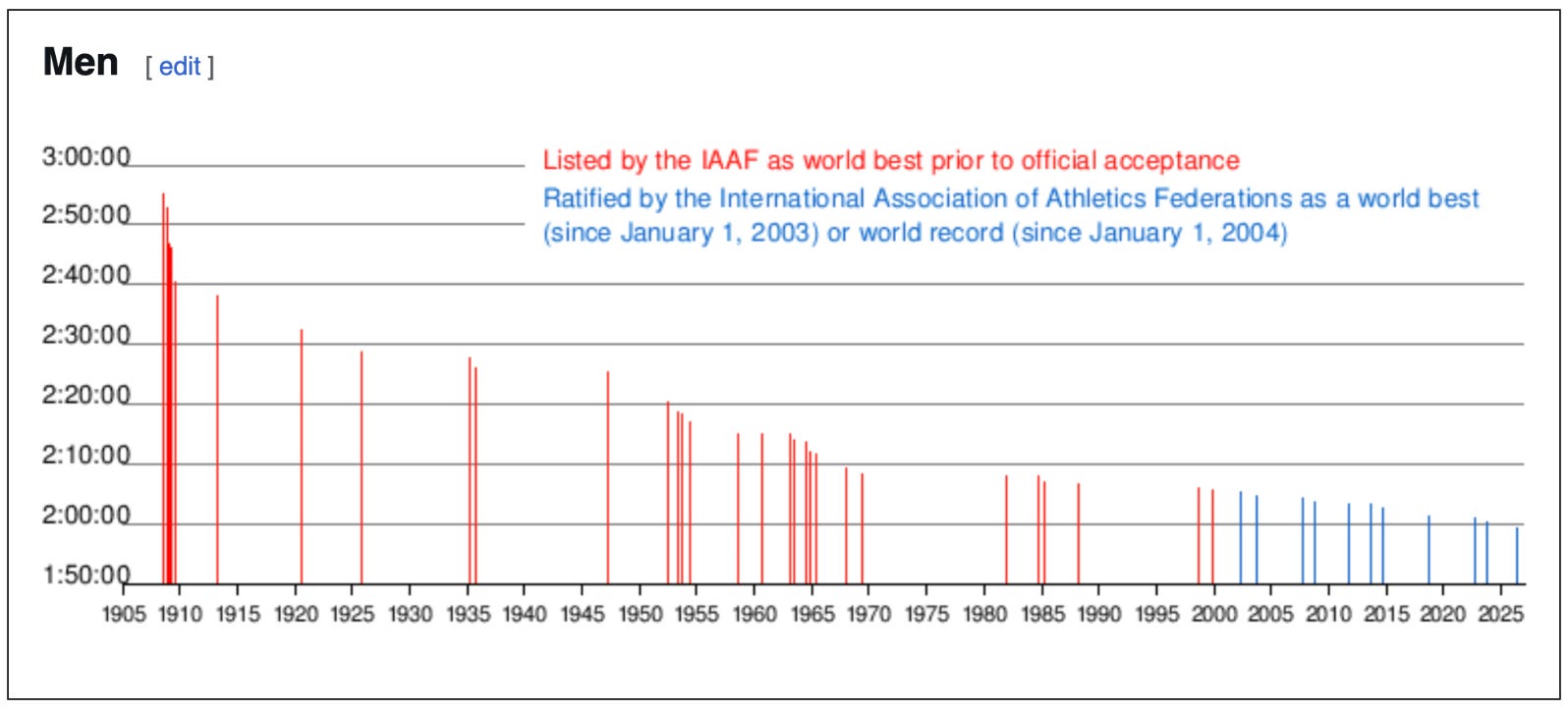
In the 1950s, the 2:20 mark was thought impossible. Jim Peters broke it at 2:18:40 in 1953 and the record fell 9 in the next 17 years. The 2:05 mark wasn’t broken until 2003 by Paul Tergat at the Berlin Marathon (2:04:55). Since then, the record has been broken 10 times and it’s not just about the shoes.
Steve Magness — a distance running coach to many world champions — has a thorough breakdown on how the marathon has been transformed in past few decades:
Fuel: Sawe downed 115g/hr of carb-heavy gels during his record run. That’s 230g or 920 calories for the entire race. A decade ago, a runner could comfortably consume 60g/hr without having potential gut issues (translation: explosive diarrhea). Elite marathoners train their guts for that high carb intake and the new Hydrogel delivery mechanism is less stressful on GI. Magness writes that the “end result is less bonking, and the marathon shifting from a fueling game to more like a half marathon or 10k where the fatigue mechanisms are muscular.”
Depth: The popularity of the marathon means it’s a lucrative starting point for many running athletes. So, there’s more talent to break records. Per Magness, “A few decades ago, you spent your career racing on the track and then once your speed started to fade a bit you went to the marathon. Now, many skip right to the marathon. That’s where the money is.”
Shoes (of course): Research has shown that super running shoes can save an athlete between 3-7% on energy output. The right-fitting shoe gets you near the higher end of that range.
Magness talks about how this has greatly affected the marathon: “Normally, it takes years of lots of miles and strength training to boost economy. But now we get that instant boost that not only helps improve performance but often leaves us feeling less beat up in the later stages of the marathon. One overlooked component of the physiology of the marathon is our economy gets worse as the race progresses thanks to fatigue and damage. The slope of that drop off is now getting shallower. We’re closer to ‘fresh’ for longer. In many ways, we’ve shortened the marathon. It used to be at this perfect point where we couldn’t quite make it without running low on fuel, our muscles getting beat up from damage, and more. Now, thanks to tech it’s as if it’s now a 20 miler, just on the right side of what we can handle.”
These new shoes also play a part in attracting more depth to marathons. Why? If the physical impact from the 26 mile (42km) distance race is significantly reduced, it doesn’t take as much training for a runner to work him or herself up to that distance…thus attracting more athletes.
And now all these athletes are aiming for Sawe and he sounds like he is just getting started.
“It was possible to run faster,” Sawe said after the race. “Even 1:58 is possible.”
Crazy.
When? I dunno. Someone will do it and one thing is for sure: shoe companies are in the labs right now cooking up space technology to shave a few more seconds off.
Apparently, the shoes arms race can go as low as 50 grams for a men’s size 9 shoe.
That’s nothing. It’s air.
But there is one more level: barefoot, which is what Ethiopian runner Abebe Bikila did at the 1960 Rome Olympics marathon. Bikila won Gold while setting a world record time of 2:15:16.
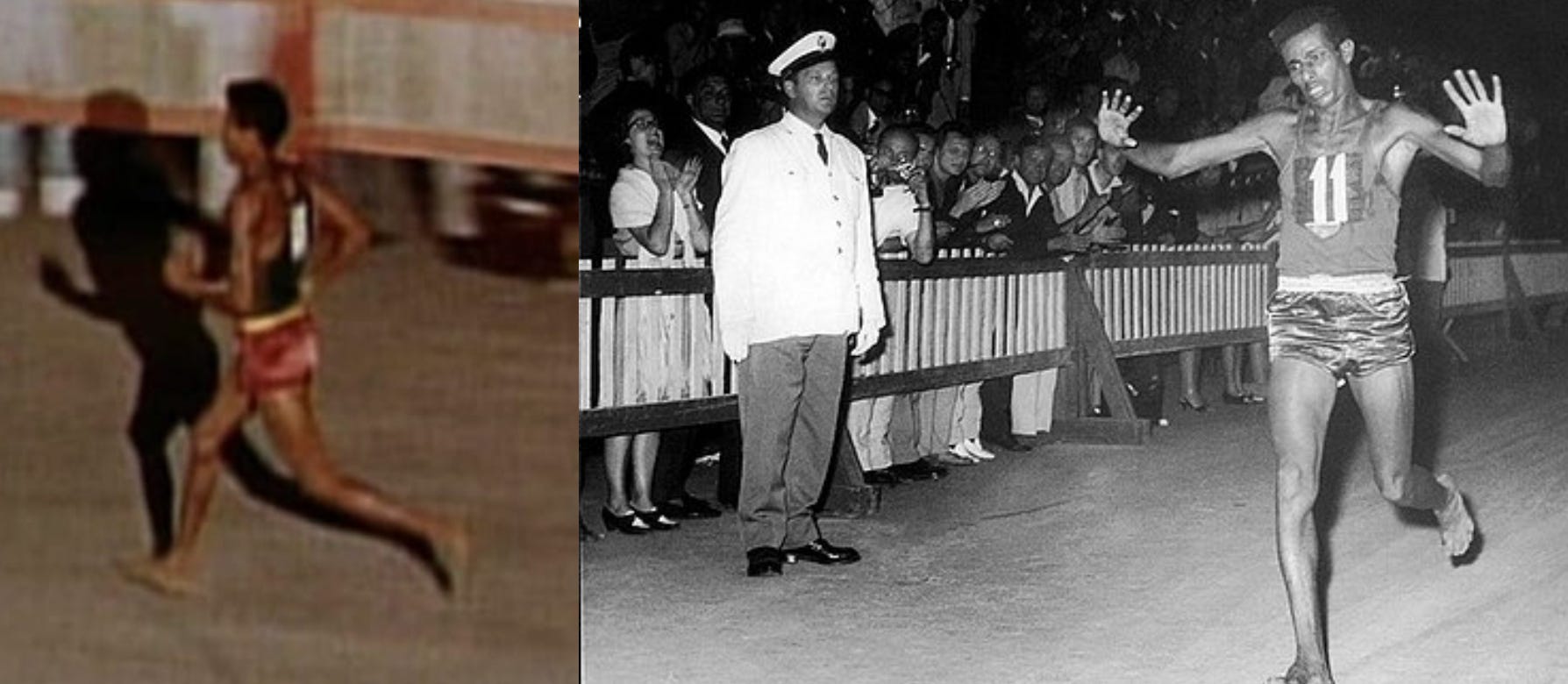
Dude, we’re talking Rome during a summer afternoon. On asphalts and cobblestones.
I need aloe vera if I step on beach sand for more than 5 seconds.
The whole story is so insane I’ll just blurb from the official Olympics website:
Nothing about Bikila’s athletics career had ever been straightforward. The son of a shepherd, he was working as a bodyguard to the Ethiopian royal family when his athletic potential was first spotted and he was soon showing great promise in training.
However, his selection for the team was still a surprise, and when he arrived in Rome there were no shoes to fit him. He initially tried running with a pair that weren’t quite the right size but didn’t like them and so, on the day of the marathon, he reverted to running barefoot, just as he had in training.
His coach told him to look out for the Moroccan runner Rhadi Ben Abdesselam who, he said, would be wearing number 26. Instead, Rhadi ended up sporting the number 185 bib, which confused Bikila, who carried on looking for the runner wearing number 26, even though Rhadi was right next to him.
The race was unusual in that it started in the late afternoon, finished in darkness and did not enter the Olympic stadium for the finale. Yet there was no shortage of excitement and drama, with the barefoot Bikila only pulling away from Rhadi in the closing 500m, yet sprinting so hard that he won by 25 seconds, breaking the world record in the process. When asked about his decision to run in bare feet, he said: “I wanted the world to know that my country, Ethiopia, has always won with determination and heroism.”
He was the first athlete from sub-Saharan Africa to win an Olympic Gold Medal and is responsible for East Africa going all in on long-distance running (including many future generations of Kenyan legends).
In 1964, Bikila found some shoes and won a second Olympic Gold at the Tokyo games with a time of 2:12:11. He did so a week after getting an appendectomy. Unbelievable.
“Humanity just got faster,” Sawe says in a mini-movie from Adidas celebrating his achievement. “As long as people dream and as along as they believe...it will never end. Maybe somewhere in the world, on a quiet road right now...someone is running to what comes next. This is belief."
Shoes or no shoes, marathons keep on proving that humans are awesome.
Them London Marathon 2026 Posts:


This issue of SatPost is brought to you by Bearly AI
Are you looking for a no-logging, encrypted and anonymized AI chat tool?
Then try the Bearly AI research app, which provides an easy-to-use UX for the newest models from OpenAI, Anthropic, xAI, DeepSeek, Gemini and more.
While some AI providers keep chat logs indefinitely even after a user deletes them...Bearly AI has a default no-logging policy and user chats are encrypted while requests to LLM providers are completely anonymized.
Try one month FREE of the Pro Plan using the code BEARLY1.
GE’s very profitable break-up
Last week, we talked about Tim Cook’s very impressive 15-year run as Apple CEO.
In a low-probability (but worth mentioning) hypothetical, the article notes that Cook’s CEO career has two potential landmines — Apple’s dependence on China and its decision not go all in on AI — could make future observers reassess his career in the negative.
Something similar happened to Jack Welch, GE’s CEO between 1981 and 2001. Welch briefly turned GE into the world’s most valuable firm but also created an internal time-bomb by financializing the conglomerate with GE Capital. Did a lot of “earnings management”. Welch left his successor CEO Jeff Immelt — who worked at P&G with Steve Ballmer way back in the day — a shit sandwich and it all blew up in the Great Financial Crisis.
I’m telling you all this because I really want you to read that Cook piece.
Also, because GE has spent the past 15+ years unwinding the damage…and has actually created a ton of shareholder value in the past few years, per The Economist:
In 2023, GE was worth $120B before splitting off into three. Those firms — GE Healthcare ($27B), GE Vernova ($293B) and GE Aerospace ($295B) — are now worth a combined $615B (5x).
In 2025, the combined $14B profit for GE Vernova (huge AI data centre demand for gas turbines) and GE Aerospace (sticky plane parts business) was more than GE’s total profit the decade before splitting off.
In 2018, GE sold an on-site generator business to PE for $3B, and it is up 5x to $15B now.
In 2019, GE sold its majority stake in O&G services business Baker Hughes and its market cap is since up 3x to $69B.
Also in 2019, GE sold GE Transportation in an $11B merger with Wabtec Corp, which is now worth $45B.
Even the GE Capital debacle has come out on the other side:
What about the financiers who almost sank the whole ship in 2008? GE Capital, the firm’s financial arm, had grown to supply nearly half of earnings by 2005, from 8% in 1981. Its assets are now scattered throughout the financial system. AerCap, the owner of its enormous plane-leasing business, is thriving; Synchrony, which lends to individuals, is not. GE Capital is a source of great inspiration in some corners of Wall Street. No firm has made more effort to recreate its operations than Apollo—so far without, thankfully, GE’s reliance on short-term funding markets. The private-equity investor turned life insurer has assembled a similarly eclectic range of asset-based lenders through which to invest its policyholders’ premiums. They include an aircraft-lending business previously owned by GE and a mid-market corporate-lending division staffed with former GE Capital employees.
Shareholders just swimming in value right now.
Right now, the wildest story is GE Vernova…absolutely riding that AI story (specifically, its gas turbines are powering data centres).
In a chat with WSJ, GE Vernova CEO’s Scott Strazik shared some wild stats: Vernova turbines generate ~25% of global electricity (and 50% in the US).
Globally, electrons are still only 20% of global energy consumption (the remaining 80% is molecules such as coal, oil, nat gas).
Since GE Vernova spun off in April 2024, it’s up 9x from $35B to $294B!!!
Why does AI suck at PDFs?
One of my favourite online hobbies is downloading 50+ page academic papers in PDF format.
Do I read them? Mostly no. Instead, the PDF files ate up so much precious memory on my 2014 MacBook Air along with pirated TV shows and taunted me as a try-hard, that I had to finally get a new laptop.
I thought the arrival of AI chatbots could help me power through these PDFs with useful summaries but LLMs haven’t fully figured out how to read the format type yet.
AI startup founder Pierre-Carl Langlais has an incredible mock graph on the expected timeline of “PDF parsing” on the road to AGI:
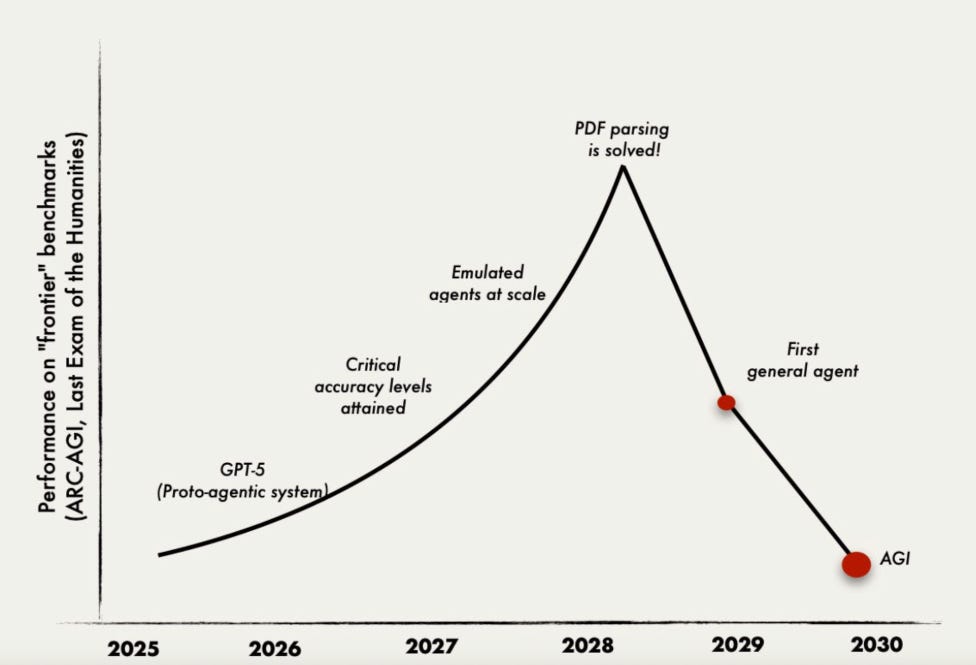
Why is it so difficult to extract information from PDFs? Why do models mix up footnotes with sidebars and the body of text? Why do they hallucinate so much?
The Verge has a solid explainer and the jist is that the file format was never meant to be machine readable:
PDFs are notoriously difficult for machines to parse, in part, because they were never meant to be read by them. The format was developed by Adobe in the early 1990s as a way to reproduce documents while preserving their precise visual appearance, first when printing them on paper, then later when depicting them on a screen. Where formats like HTML represent text in logical order, PDF consists of character codes, coordinates, and other instructions for painting an image of a page.
Optical character recognition (OCR) can turn those pictures of words back into text computers can use, but if it comes across a PDF where text is displayed in multiple columns — as many academic papers are — it will plow ahead left to right and create an unintelligible jumble. OCR tools are designed to detect and correct for these sorts of formatting variations, but tables, images, diagrams, captions, footnotes, and headers all present further obstacles. If you give an AI assistant like ChatGPT a PDF, it will cycle through a variety of these tools, sometimes fail, sometimes pass the PDF to a large vision model to perform OCR, sometimes hallucinate, and generally take a very long time and use a lot of computing power for uneven results. […]
A further problem that arises from and compounds PDF’s inherent difficulty is that models rarely train on them. This has begun to change, partly because AI developers are increasingly desperate for high-quality data, and PDFs contain a disproportionate amount of it. Government reports, textbooks, academic papers — all PDFs. “PDF documents have the potential to provide trillions of novel, high-quality tokens for training language models,” wrote researchers at the Allen Institute for AI last year in a paper announcing a new specialized PDF-reading model.
A number of startups are trying to tackle the problem by treating it as a machine vision problem (not a text problem).
For all the drawbacks, the PDF is an incredibly resilient format.
According to lore, the IRS created the first PDF ever in 1994 with the 1040 income tax return form (I get PTSD just seeing the numbers “1040”).
“The IRS wanted a way to share forms that were absolutely consistent without printing and mailing every possible document,” writes Josh Dzieza in The Verge article. “So it mailed CDs full of PDFs instead. From there, PDF spread with email to become a fundamental component of digital work. Book publishers sending manuscripts to the printer, patent applicants submitting diagrams of new devices, anyone who needed to share a document that would look the same to whomever received it turned to PDF.”
If anyone wants a CD full of PDF papers I have on my desktop but will probably never read, hit me up.
Links and Memes
Some other links for your weekend consumption:
The projected AI data centre spend for 2026 is now $700B…across the Biggest Big Tech Tech Plays (Google, Amazon, Microsoft, Meta). Good breakdown from Om Malik.
Amazon product pages now have AI-generated podcast reviews…obviously, the output is high-level comedy.
Lebron James tossed a pass to his son Bronny during Lakers game against Houston Rockets…and it led to a very very good post.
Talent at top AI labs are wild…CTOs of Workday, You.com, Instagram, Box and Adept AI have joined Anthropic as members of the technical staff.
The logo design for the upcoming golf Cadillac Champion…is something to behold.
“Fifteen Comms Observations from Musk v. Altman”…Jim Prosser previously ran “point on comms for Google around Oracle v. Google”…and shares his take on Elon’s case against OpenAI for pivoting from non-profit to for-profit.
An ophthalmologist in San Diego just performed the first Apple Vision Pro-assisted cataract eye surgery….very interesting use case for the $3,500 headset. Product was a flop but has clear industry applications and they are taking some of that $50B in R&D to make smart glasses.
The Grid: The Largest Machine Ever Built. An excellent 4-hour podcast on the history of the electrical grid from the Stepchange Podcast.
Former Republican senator Ben Sasse was given a terminal cancer diagnosis last year…and he spoke with the NYT’s Ross Douthat about his life, legacy and family. It’s one of the most impactful conversations I’ve watched in a long time.
...and them wild posts (including news that Spirit Airlines will shut down):





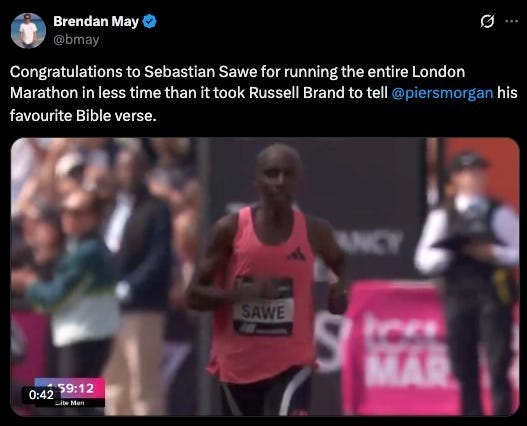
Finally, we have to talk about Russell Brand. He had the wildest interview of the year so far. Brand went on Piers Morgan’s show to discuss his new book “How to Become a Christian in 7 Days”. In a widely clipped clip, Morgan asked Brand to show his favourite Bible passage and Brand fumbled around the one he brought to the studio like the first time he ever saw one (this happened a day before the London Marathon, which lead to some incredible crossover memes):



I love the image of the spirit turbines being used as power generators. Reading the replies to your tweet full of "akshuslly" people who can't tell that it's a joke is infuriating. Idk how you can stand to be on Twitter with so many aggressively mean people
Small pedantic observation: "and the jist is that the file format was never meant to be" -- it should be gist, not jist (unless jist is the Canadian spelling). Or maybe this is a deliberate corruption in the Bearly database, like a watermark?