

Thanks for subscribing to SatPost.
Today, we’re talking about the Swatch x Audemars Piguet collaboration.
Also this week:
Cerebras, Nvidia & Speed in AI
Jensen at the Trump & Xi Summit
And them wild posts (including Claude Code spend)
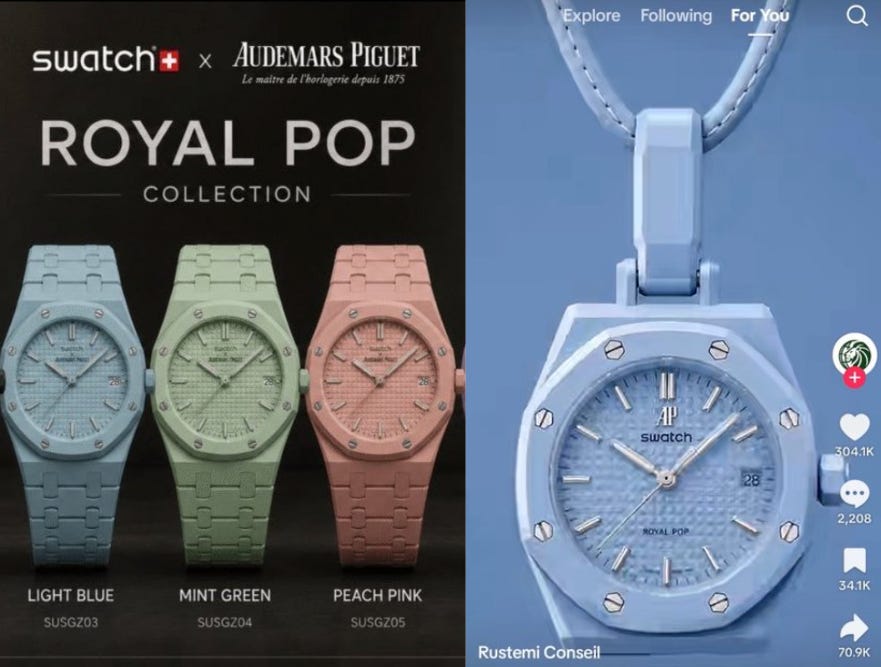
Super-duper ultra luxury watch brand Audemars Piguet (AP) has partnered with (much less ultra super luxury watch brand) Swatch on a pocket watch called the Royal Pop collection.
They teased a collaboration last weekend and it led to a number of AI-generated mock-ups. The riffs included lower-end plays on AP’s Royal Oak staple and higher-end plays on Swatch’s popular mid-1980s Pop Swatch, which was a detachable watch dial that fit on a lanyard, fabric, wristband and clothes.
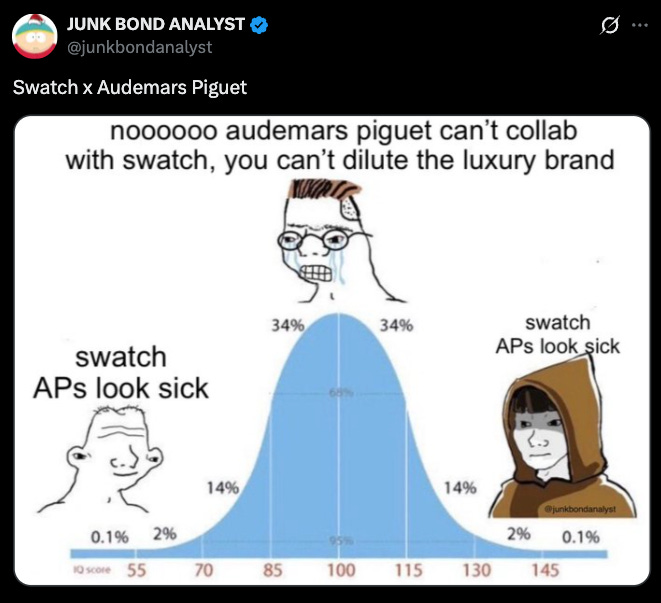
The potential collaboration also led to one of the most amusing meme cycles of 2026.


An official launch video came out on Tuesday. It was indeed a riff on the Pop watch (hence, Royal Pop). The collection offers 8 configurations, a nod to the Royal Oak’s octagon bezel. It starts at $400 and comes with a calfskin lanyard. The product starts selling this Saturday. Only in-store and there will assuredly be some hilarious moments when you find out someone that owes you $70 just waited in line for 96 hours to spend $400 to say they “own an AP”.
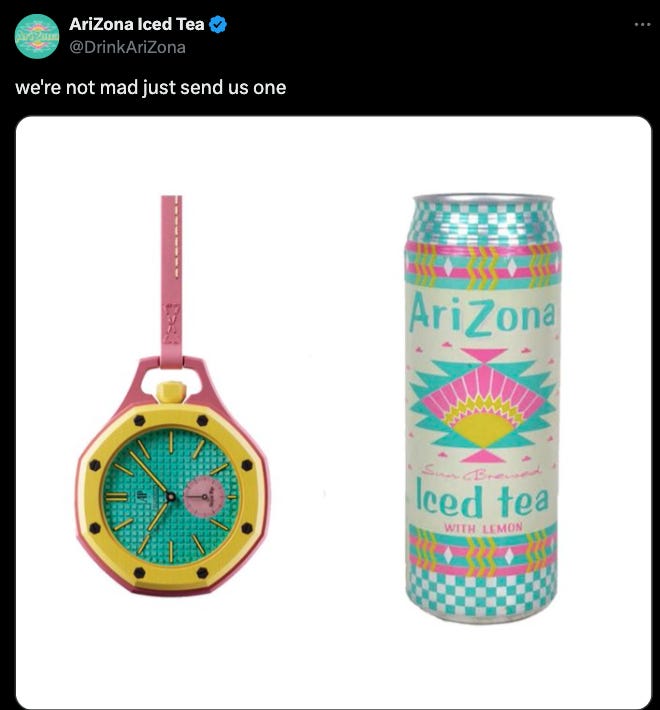
Again, the memes delivered.

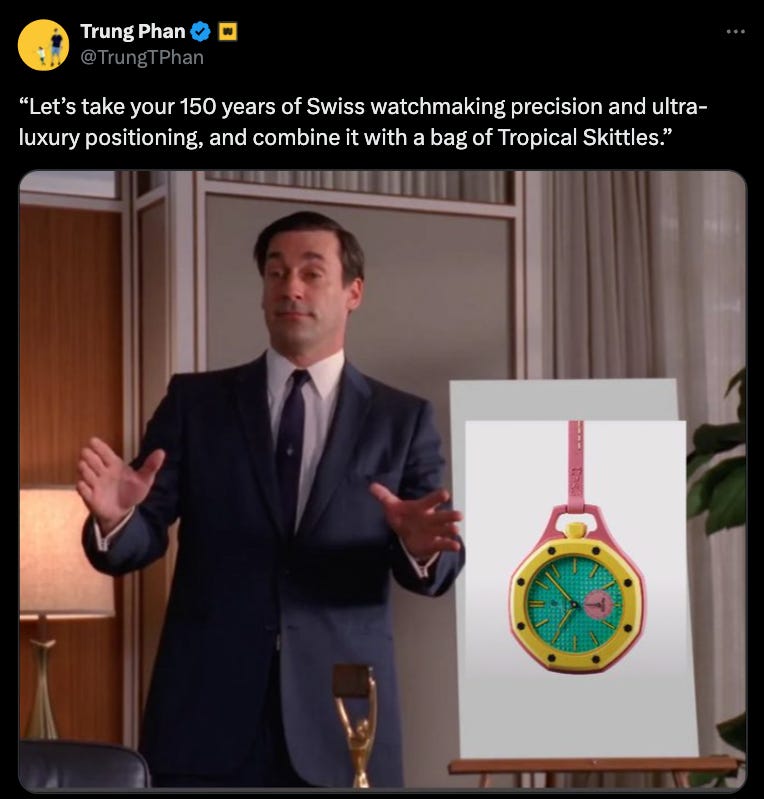
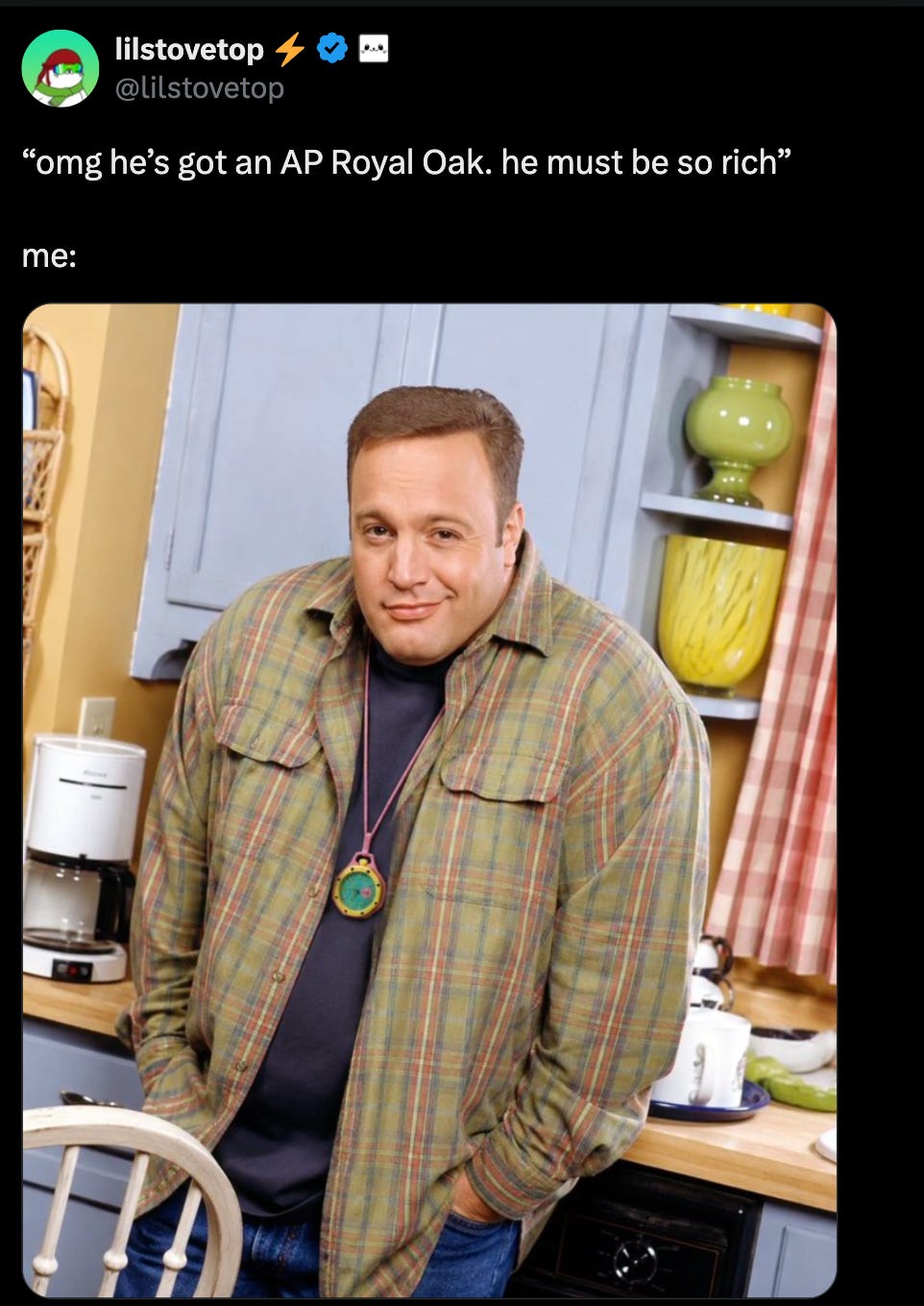


All snark aside, this collaboration will do numbers.
There is precedent: in 2022, Omega and Swatch created the $260 MoonSwatch. The collaboration has sold over 5 million units and now accounts for 60%+ of Swatch’s total unit sales.
I know. It’s not a perfect analog. Omega and Swatch are both part of Swatch Group and the two watchmakers share design elements. Meanwhile, Audemars Piguet is on another tier of luxury. It is the watch “holy trinity” along with Patek Philippe and Vacheron Constantin. The 150-year luxury brand is also a recipient of numerous hip-hop shout-outs:
“Ric Flair Drip”: The Offset, 21 Savage and Metro Boomin’ music video features many APs and Ric Flair himself (“Goin' to the jeweler, bust the AP, yeah / Slidin' on the water like a jet-ski, yeah”)
“Rich Spirit”: Kendrick Lamar calls out AP’s former Head of Complications (“AP, Michael Friedman, my friends cooler / Primary, so the resale value stupid”)
The MoonSwatch outcome does set the bar for Royal Pop, which is a very interesting bet for both brands. They both need it. But for different reasons.
Let’s unpack the collaboration with two of my favourite luxury concepts: the Dream Equation and the 3% Rule.
Audemars Piguet and the Dream Equation
Jean-Noël Kapferer is the author of “The Luxury Strategy: Break the Rules of Marketing to Build Luxury Brands”.
The book is regarded as the industry Bible. It’s the “Eat, Pray, Love” for luxury marketing. Instead of explaining the psychology of solo female global travel in the early-aughts, it explains how luxury brands are built.
Kapferer says the reason he put “strategy” in the title is because it is not enough to just create a great product. Nor is it enough to call something “luxury”. There have to be “obstacles” in the buying process. The three main ones he highlights are price, distribution and availability.
I’ve written on the canonical luxury brand example of Hermès. A Birkin Bag starts at $9,000. That’s a price obstacle. Buyers have to build a relationship with the store by purchasing smaller items before getting “offered” the bag. That’s a distribution obstacle. Each bag is hand-crafted, thus limiting supply and Hermès manages inventory to make people wait. That’s an availability obstacle.
Obstacles create social desirability which feeds into what Kapferer calls the Dream Equation, a concept in luxury marketing about how brands have to maintain a balance between awareness and accessibility (actual sales).
Also worth noting that “social desirability” really means “humans are obsessed with status and luxury brands are happy to create products for people to flex on each other.”
To wit: a lot more people know about the Birkin Bag than can actually afford or acquire it from Hermès.
But Hermès needs potential future buyers in the pipeline. So, it offers less expensive items — scarves, fragrances, slides, leather goods etc. — to get people on the purchase ladder (forget B2B SaaS, this is an incredible recurring revenue business model).

Is Wendy’s Coach a luxury brand? No. The quality is not as high and there aren’t any obstacles to purchasing a delicious breaded spicy poultry sandwich.
True luxury brands have to manage the balance between desirability and accessibility, as Kapferer explained on a podcast:
You need to be visible to be desirable. But not accessible enough so that too many people can buy your brand.
The [Dream Equation] is a statistical model we’ve developed to explain the relationship between desirability and accessibility.
We ask two questions. The first question is, do you know these brands? And we list 50 brands. Second, have you ever bought anything from these brands?
If we take Chanel, it can be a lipstick [or] it can be a fragrance. It is not always haute couture. It can be anything from that brand.
[Then, there’s a] third question: how much do you dream of this brand?
We noticed that desirability was a function of the difference between level of brand awareness and level of ownership. Which means that if you have no brand awareness, you cannot have desire.
The second thing is when this thing is too ubiquitous and too many people are own it. It’s not a problem in normal marketing. Everyone knows Zara and everybody buys Zara. But they are not in the luxury market.
Because desirability at some point in time has a price, and there is desirability at £20 and desirability at £2,000 and desirability at £20,000. In fact, it is this tension of “I know there are obstacles to ownership” which is the basis of desire in the luxury market.
The more desirable the luxury brand is, the more it sells. [But] the more it sells, the less desirable [it becomes].
Creating too many obstacles has a problem. [There is too little volume] to be profitable. But if…there are no obstacles, you are not in the luxury business. You are in the premium business.
There is a very clear application of the Dream Equation to AP.
The ultra-luxury Swiss watchmaker has seen its sales grow from $900m in 2015 to ~$3B in 2025. But its volumes are still very very low. AP sells 50,000 watches a year. Compare that to a Rolex, which sells 1.3m units a year with total sales of $14B.
Price definitely plays a part in AP’s lower volumes: an entry-level AP is ~$20K, while an entry-level Rolex is ~$6K.
It’s a similar situation to Ferrari vs. Porsche. Ferrari sold only ~14k cars in 2025 with revenue of $8B. Meanwhile, Porsche sold ~280k cars in 2025 with total revenue of $40B+. Ferrari is much more of a luxury brand than Porsche.
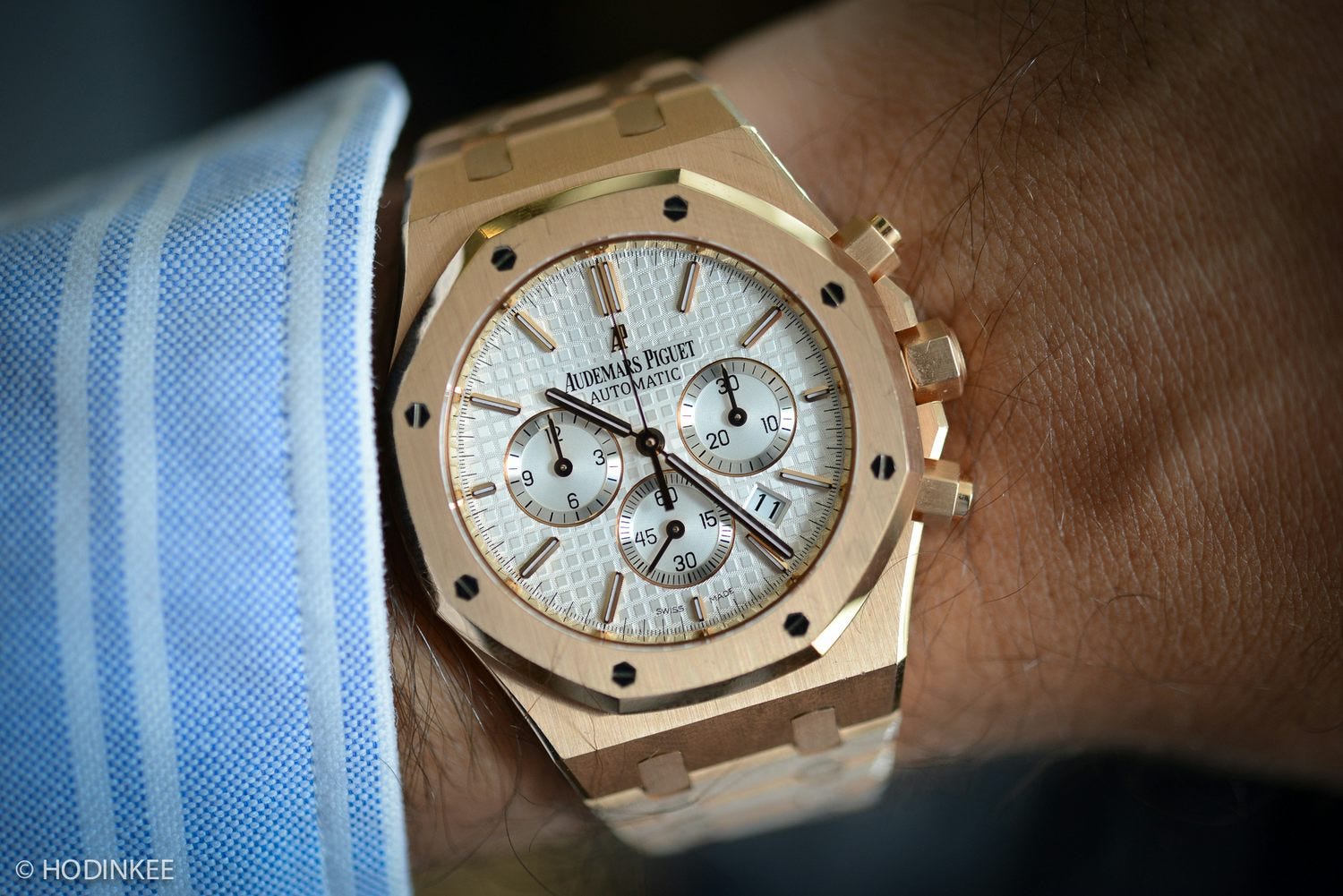
AP definitely won’t flood the market with 1m+ units. It also doesn’t have the same purchase ladder like Hermès since it doesn’t offer <$1,000 products. But, AP does keep customer purchase histories and allocates inventory to valued clients.
However, there is clear room to sell more watches and AP has identified a market: women.
Audemars Piguet’s CEO Ilaria Resta took over the job in 2023 after spending the past two decades marketing for beauty products (Firmenich) and hair products and homecare (P&G).
In an interview last year, she said:
In terms of opportunities, we are underdeveloped with women. We are in the range of below 20% of buyers of our watch are women. [It’s estimated that] by 2035, 45% of women will buy a mechanical watch.
The scene is changing because in the past women were not so much into mechanical watches. Now, they’re getting more and more interested.
AP has started making designs in smaller dimensions to cater to women’s rising interest in watch complications.
Something that many people pointed out about the Royal Pop collaboration is that its design is ready-made for AP to ride the Labubu keychain bag trend that’s gone wild in recent years.
The pocket watch is a great entry point. The design will also likely keep the existing owner base happy; a LOT of its OGs — including Eric Clapton and John Mayer — would probably be pissed if Royal Pop was a wristwatch (although you know those 3rd-party bands are already popping).
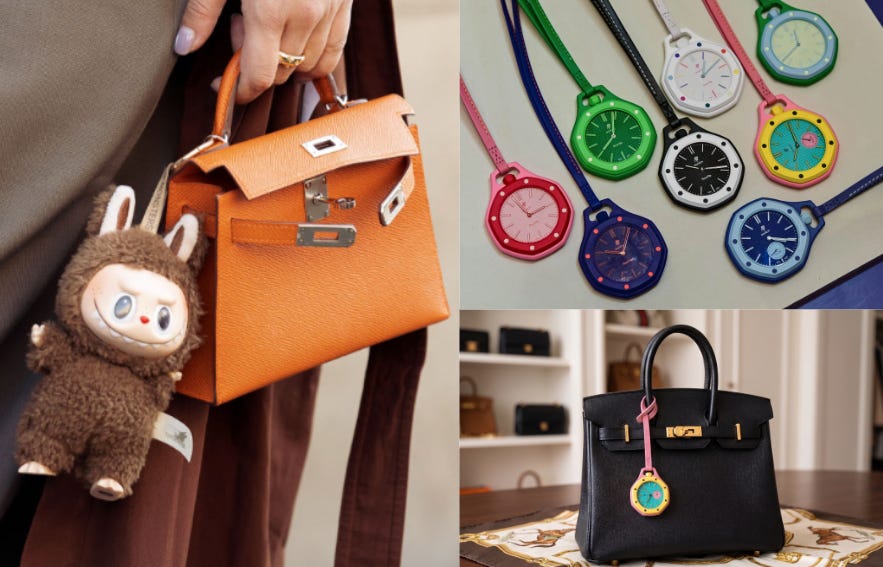
Resta doesn’t directly call out women buyers. In fact, one of her first moves as CEO was to get rid of the men’s and women’s categories. She wants every AP watch to be unisex.
However, the language in her official announcement seems pretty clear (bold mine):
At its heart, this project has a single purpose: perpetuating the love for mechanical watchmaking. To love something, you must first encounter it. To desire it, you must first understand it. That is why Royal Pop reimagines traditional codes through a bold mechanical pocket watch, available in eight models and designed to be worn in many ways: in the pocket, as a pendant, a bag charm, a personal statement. Because redefining how we wear time is also a way of redefining how we relate to it.
It is a measured risk.
The women’s market is so undersaturated that AP can serve it without putting the Dream Equation out of balance (and risking its ultra-luxury positioning).
One demographic that Resta does call out in her post are young people:
This project resonates deeply with me. My first watch, at thirteen, was a Swatch.
With Royal Pop, our ambition was to create a mechanical object that younger generations could access; one that might begin their journey with mechanical time. Perhaps as future collectors. Perhaps as future watchmakers.But first, simply as curious minds who understand how a watch works, why it matters and why it is such a beautiful object. Because it is understanding that drives appreciation.
Royal Pop is a way for these demographics to get emotionally invested in the brand with a purchase. It’s all about planting seeds for future customers (AP is donating 100% of Royal Pop proceeds to provide financial support for watch artisans and related education programs).

When the Omega MoonSwatch came out a few years ago, Swatch Group CEO Nicholas Hayek also called out the younger generation as a target market:
Young people everywhere in the world [don’t] know the story of Omega.
It has been on the moon. You have to tell this story.
So, Omega increases in sales after we launched. The young people are fascinated. They want to know what is happening. Swatch was the perfect means to do it. Swatch was always a communicator and brought new people to buy watches. It was like this in the past and it will be like this in the future. […]
AP’s previous CEO François-Henry Bennahmias echoed those thoughts: “[The MoonSwatch] collaboration is a great idea, which does not affect the integrity of Omega at all, contrary to what you may have heard. Why is that? Because it educates the younger generation about the icons of watchmaking.”
AP and Omega have to keep that pipeline fresh or the brands won’t be as socially desirable in the future.
Cool, what about Swatch?
Swatch and the 3% Rule
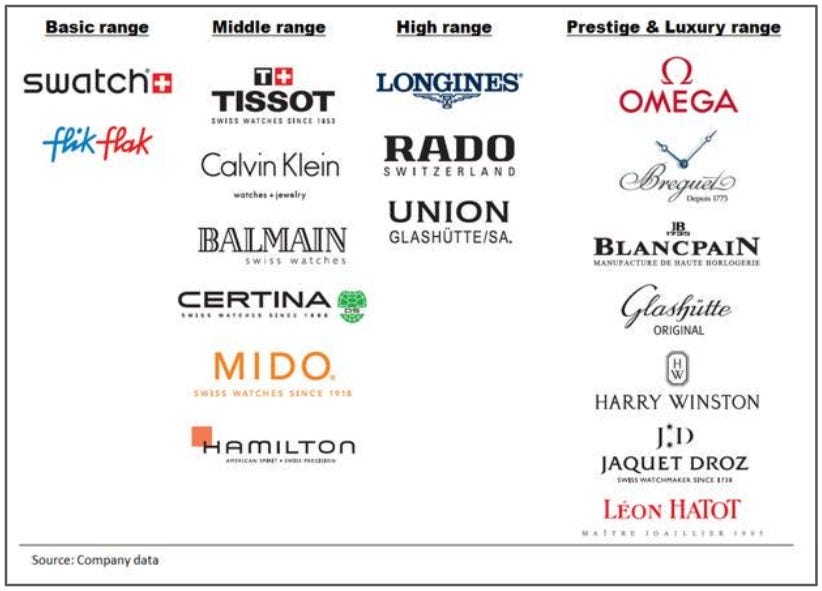
Swatch Group owns 16 watch brands across a range of buying power from basic (Swatch) to middle-range (Tissot) to high-range (Longines) to luxury (Omega) to super-duper ultra luxury (Breguet).
Quick note on Breguet. If a key part of luxury is the brand’s heritage…then it’s hard to beat an influencer sponsorship as powerful FRICKIN’ Napoleon Bonaparte.
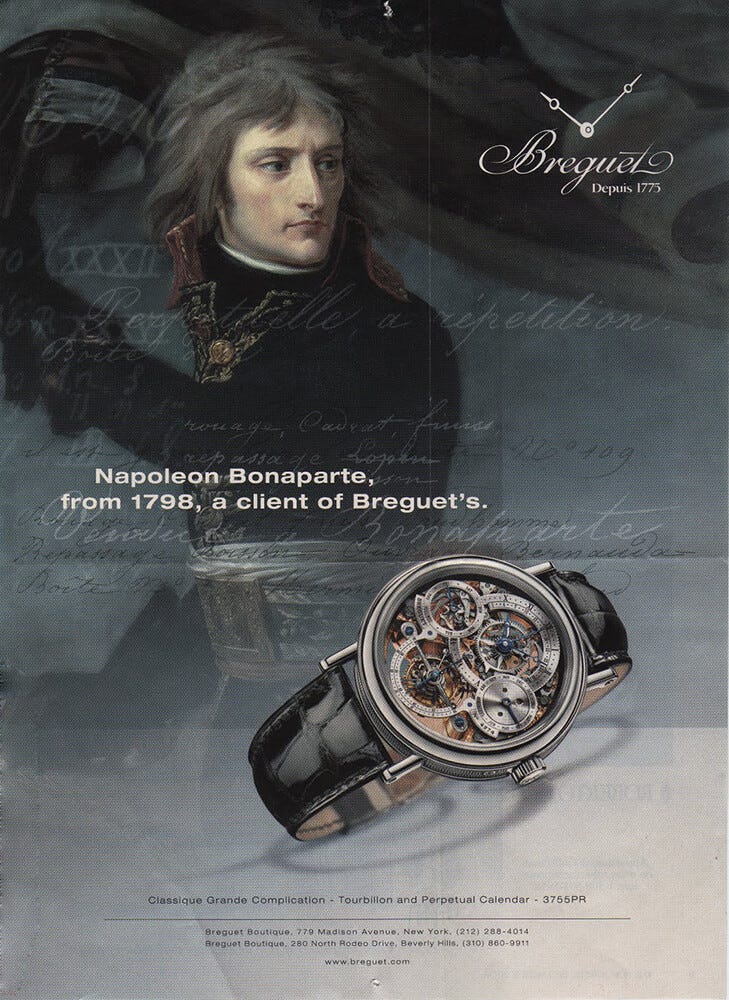
Good lord. AP might have top hip-hop artists but Breguet has the guy that said maybe the hardest bar in history: “I found the crown of France in the gutter, and I picked it up with my sword”.
Anyway, Swatch Group is valued at ~$14B and its the world’s top watch seller by volume. Annual sales of ~$8B puts it 3rd overall with a 15% market share (behind Rolex at 26% and Richemont at 16%; further down, LVMH is at 7% and AP is at 5%).
Nick Hayek Jr. has been the CEO of Swatch Group since 2003.
His father Nick Hayek Sr. is an absolute Swiss legend and the Swatch Group empire owes its existence to the namesake brand. Swatch is short for “Swiss watch” but also for “second watch” (as in, this was meant to be an every day watch people owned after their main baller piece). The £50 product had such mass appeal that it saved the Swiss watchmaking industry from Japan’s cheap quartz products (namely Seiko and Casio).
Swatch turned watches from precious timepieces to a fashion accessory and form of self-expression. Something people could swap in and out depending on their mood or fit.
The Wall Street Journal wrote this in the obituary for Hayek Sr., who died in 2010 while on the job:
Mr. Hayek, who was born in Lebanon in 1928 to a Lebanese mother and Lebanese-American father, studied physics, mathematics and chemistry, moved to Switzerland in 1949 and set up a consulting business in Zurich in 1957.
Among Mr. Hayek’s clients were troubled Swiss watchmakers such as Asuag and SSIH, which Mr. Hayek recommended to merge in 1983.
The newly founded company, Société de Microelectronique et d’Horlogerie, or SMH, in which Hayek took a stake, developed the plastic watch Swatch, which consisted of around 50 parts and was much cheaper to produce. Due to its low price of less than $100 a piece and continually changing pop-art look, the watch became an immediate success around the world.
Mr. Hayek remained a key shareholder of the group. Together with other shareholders such as the pension fund of Swatch, Mr. Hayek held a stake of about 39% in the company’s voting rights.
The success of the Swatch revived the Swiss watch industry and helped boost interest in Switzerland’s luxury watches, which dropped out of favor during the 1970s when customers preferred futuristic electronic watches. As a result, brands such as Breguet, Blancpain, Jacquet Droz and Longines drew broad interest and helped transform Swatch into the world’s largest watchmaker.
There have been hundreds of millions of Swatch watches sold in the past 4 decades (some of the most popular Swatch riffs re-sell for 5-figures on secondary markets).
Swatch’s signature round shape is known as “the Gent”. It’s simplicity — including the basic wrist band — has become a canvas for hundreds of collaborations with celebrated artists, designers, architects and IP!!!! So much IP!!!
I got one. My kid got one. You definitely got one. I may or may not also have another Mickey Mouse one.
Here are some gems from left to right:
original 1980s look (initial run of watches had basic colorways; if they flopped, Hayek Sr. had planned for any unsold inventory to go to the Swiss military)
Keith Haring
Alessandro Mendini
Alfred Hofkunst
Sam Francis
Nam June Paik
Annie Leibovitz
Museum of Modern Art
Yoko Ono
The Louvre
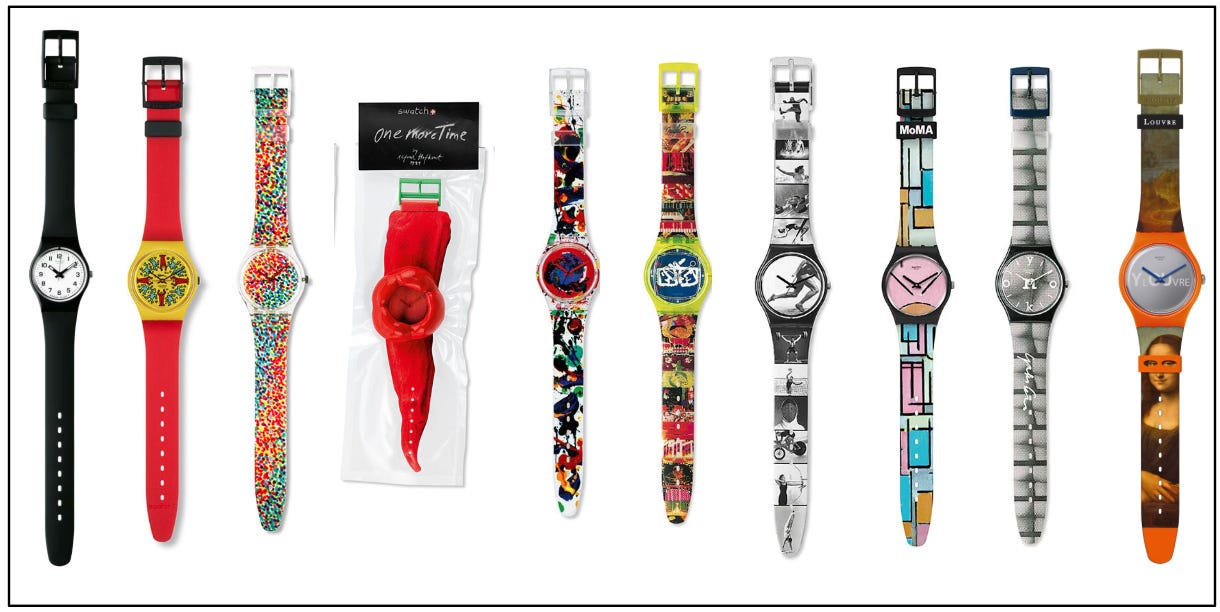
This “Gent” shape is an ideal canvas for Virgil Abloh’s design approach known as the “3% Rule”.
Abloh is the late streetwear designer who founded the Off-White brand and was artistic director of menswear for Louis Vuitton.
Famously, Abloh did a line of Nike collaborations where he took well-known shoes (eg. Air Jordan I) and made slight changes (some text here, an accessory there).

During a 2018 Harvard lecture, Abloh explained that Nike “products were so good” and “so perfectly put together” that he only wanted to make slight edits for his collaboration. He wanted to “recognize the shoe he already had” but with a personal touch.
Abloh called this the 3% approach (or The 3% Rule): you alter a product or idea by only 3% to create something new. Why does the approach work? Humans desire two competing things: familiarity (to give us comfort) and novelty (to fulfill our curiosity).
Whatever you think of Abloh’s work, the psychology behind the 3% rule is very sound.
In a piece for The Atlantic, Derek Thompson relays the story of French industrial designer Raymond Loewy, who was a master of combining familiarity and novelty.
Working in the mid-20th century, Loewy’s firm created some of the most iconic designs in American culture including logos (Shell, Exxon, TWA, BP, Greyhound), consumer products (Coca-Cola vending machine, Lucky Strike box), and vehicles (Air Force One nose, Studebaker Avanti). In 1950, Cosmopolitan Magazine wrote that Loewy had “probably affected the daily life of more Americans than any man of his time.”
The Frenchman’s design philosophy was summed up by 4 letters — MAYA (bold mine):
“Loewy had an uncanny sense of how to make things fashionable. He believed that consumers are torn between two opposing forces: neophilia, a curiosity about new things; and neophobia, a fear of anything too new. As a result, they gravitate to products that are bold, but instantly comprehensible. Loewy called his grand theory “Most Advanced Yet Acceptable”—maya. He said to sell something surprising, make it familiar; and to sell something familiar, make it surprising.”
The preference for familiarity and tendency to gravitate towards things we see more often is known as the “mere exposure effect”. This is evolutionarily sound: humans are cautious around new sights and sounds because they might be dangerous (but become more comfortable if the supposed threat turns out to be harmless upon repeated exposure). Thompson says that the “mere exposure effect” is one of the “sturdiest findings in modern psychology”.
However, there are limits to how much we want to see the same thing (eg. Marvel and Star Wars reboots). But a small change can provide the novelty humans also crave (fine, I’ll watch if there’s a random Samuel L. Jackson cameo).
Thompson cites two other examples of familiarity meeting novelty:
The Spotify team found that the custom Discover playlists they created for users — which started as a way to recommend you entirely new songs — performed best when it included tracks you had previously heard (Spotify stumbled on this after a bug mixed up people’s Discover playlist with songs that they had previously listened to).
Harvard and Northwestern researchers studied how the US’ National Institute of Health (NIH) assessed research submissions. They found that the NIH gave the worst ratings to papers with “the most novel proposals” whereas the best-performing papers only made slightly new discoveries. The conclusion: there is an “optimal newness” for ideas (I don’t know if optimal newness is 3% but you get the point).
With cultural icons as famous as Swatch and AP, any collaboration shouldn’t veer too far from the familiar aesthetics. Why throw away decades of built-up brand equity, mind-share and marketing spend?
AP’s octagon bezel is prominent. So is Swatch’s colorful and playful aesthetic.
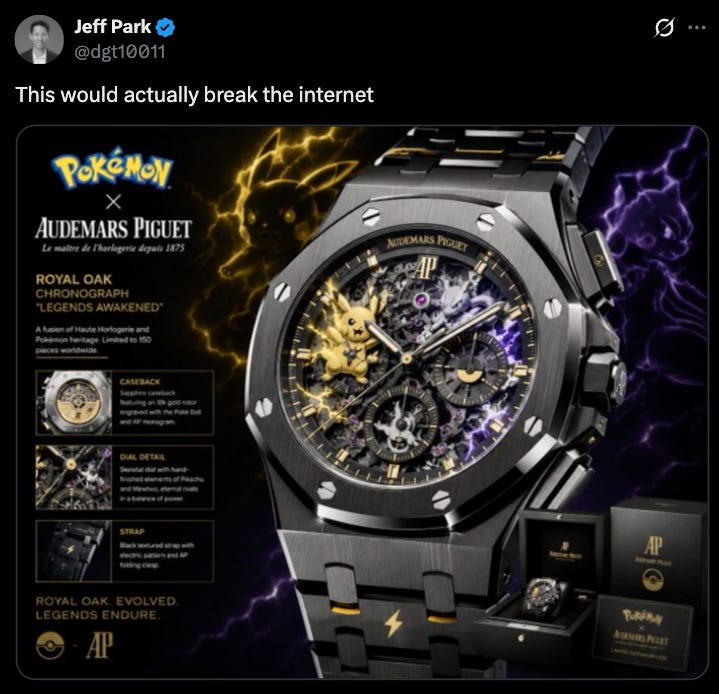
It’s worth noting that the Royal Pop collection comes after AP lost some high profile trademark cases in America and Japan, per Complex:
In February, 2020, AP sent an application to the Japan Patent Office to trademark the Royal Oak design. Specifically, they said that the features that made the Royal Oak distinctive were “a dial with a tapisserie pattern and hour markers, minute track, date window, an octagonal bezel with 8 hexagonal screws, case, a crown, and a lug of the famed ‘ROYAL OAK’ watch collections.”
They took the case to the Japanese IP High Court, and in March, 2024, they lost there, too. One Japanese law firm summarized the decision as: “[G]eneral consumers, as the target audience, do not distinguish the product in question based on its shape but rather identify it through the letters displayed on the dial or the descriptions provided in advertisements.” […]
The U.S. story played out similarly. Back in July, 2020, AP tried to trademark two basically identical watch designs…Both of them had features that should be familiar to Royal Oak lovers: octagonal bezel, eight screws, Grande Tapisserie decorative pattern, etc.
After a lot of back-and-forth, the US Patent and Trademark office submitted a final refusal to both in January of 2024. Their logic was that the features AP wanted to trademark were “nondistinctive” and “highly common in the watch industry.”
Understandably, AP and Swatch won’t address the theory. But if AP can’t trademark its trademark look, it makes total sense for AP to tie itself to the octagon bezel with new demographics by doing a splashy drop.
Remember, the Dream Equation requires attention and visibility.

The brain seeks familiarity. And if you can mix in novel repetition, it’s a potent combination. As Napoleon Hill said “Any idea, plan, or purpose may be placed in the mind through repetition of thought.” Or in marketing speak: the rule of 7 states that a prospect must see a brand at least 7x before making a buying decision.
In an essay, Abloh further expounds on the 3% rule and why you only have to slightly innovate an existing project to create a new one:
3 % is applicable across practices and fields, different media, eras of our history. Our future.
A series of 3%’s brings the classics to modernity. Connects icons to burgeoning talent.
[…]
3% is packaging, 3% is marketing.
3% is a single sneaker with Nike, executed 50 different ways.
[…]
The 3% ideology has its advantages. It recalls an eye-to-emotion-connection in the brain and adds an alternate voice. 3% expands our world view, without pushing our zones of comfort to the brink.
We’re exposed to “new”, but not eccentric or disconcerting.
Of course, Abloh has critics that call his approach unoriginal or borderline plagiarism. Abloh addresses this charge with a related concept: “Readymade”, the idea that people should build on what already exists. He cautions against the instinct to create stuff from scratch. You should build on the aesthetic of a mentor (whether dead or alive). Odds are, these mentors did the same:
“It’s important to recognize where we’re at in the lineage of art movements. I’m sure in your [design] class, you’re trying to challenge yourself to invent something new. To be so like avant-garde. The thing I’ve figured out through working is that we exist off the backs of many other things in iterations before us. So once you think about us as a collective, you then realize that we’re all tracking towards the same direction”
I mostly agree with this take. Now, I’m not saying plagiarize or “take inspiration without credit.” I’m saying that unless you’re a creative genius that can truly muster original masterpieces out of thin air (David Bowie, Jimi Hendrix or — my fave — Guy Fieri), the approach of building on top of what works is sound.
There’s a reason why the Hero’s Journey for film and same “Four Chords” for hit music keep on resonating decade after decade.
Same thing with Swatch. Over the past 43 years, the form factor has proven itself an ideal vehicle for brands to apply the 3% Rule.
The strategy worked with artists. It worked with world-famous museums. It worked with pop culture icons. It worked with MoonSwatch. It’ll probably work with Audemars Piguet.
Final Thoughts
The Omega MoonSwatch launched in March 2022.
There were many many doubts about the release. As we know, it became a massive success. Hodinkee named it the “Watch of the Year”. Time + Tide called MoonSwatch the best thing to happen in the watch industry over the past decade:
Omega was coming off the success of No Time to Die and the delayed Tokyo Olympics happening the year previous. Swatch was continuing to release fun, creative watches, and they also introduced their first models in their innovative Bioceramic material in early 2021. […]
[MoonSwatch was] a mixing of high and low in a way that brought the very concept of Omega into streetwear culture, flipper culture, and hype culture, a move no one could have predicted.
The collaboration sold 1m units in 2022. Then, 2m units in 2023. It fell to 1.5m units in 2024. Even with the drop-off, MoonSwatch had grown from 60% of Swatch Group’s total volume sales in 2022 to 64% by 2024 (Omega accounts for ~1/3rd of Swatch Group’s revenue by value).
The watch probably sold another 1m+ units sold in 2025. At $260 a pop, that’s ~$1.4B in lifetime sales across 5.5m units.
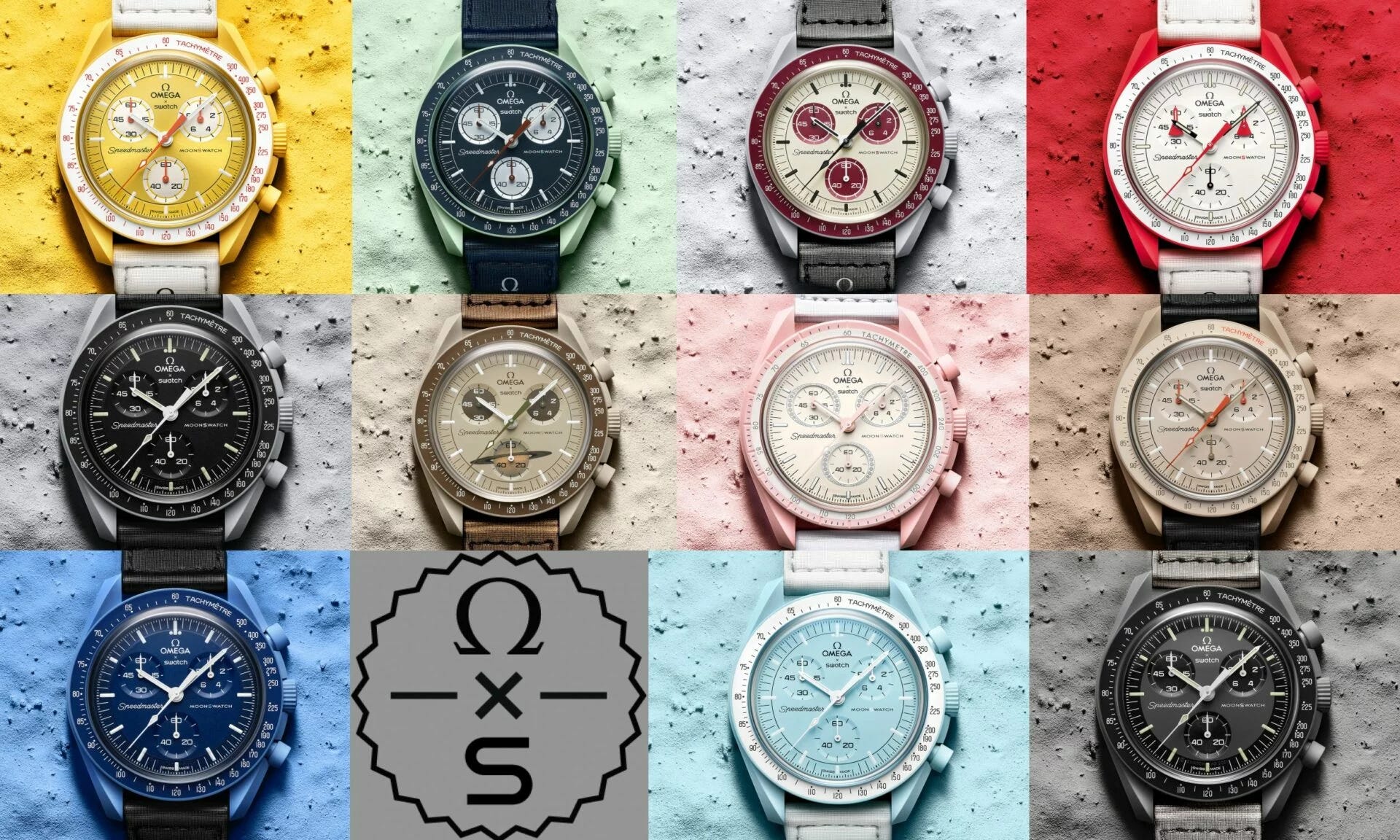
The MoonSwatch’s financial success hasn’t been able to balance out some larger Swatch Group issues.
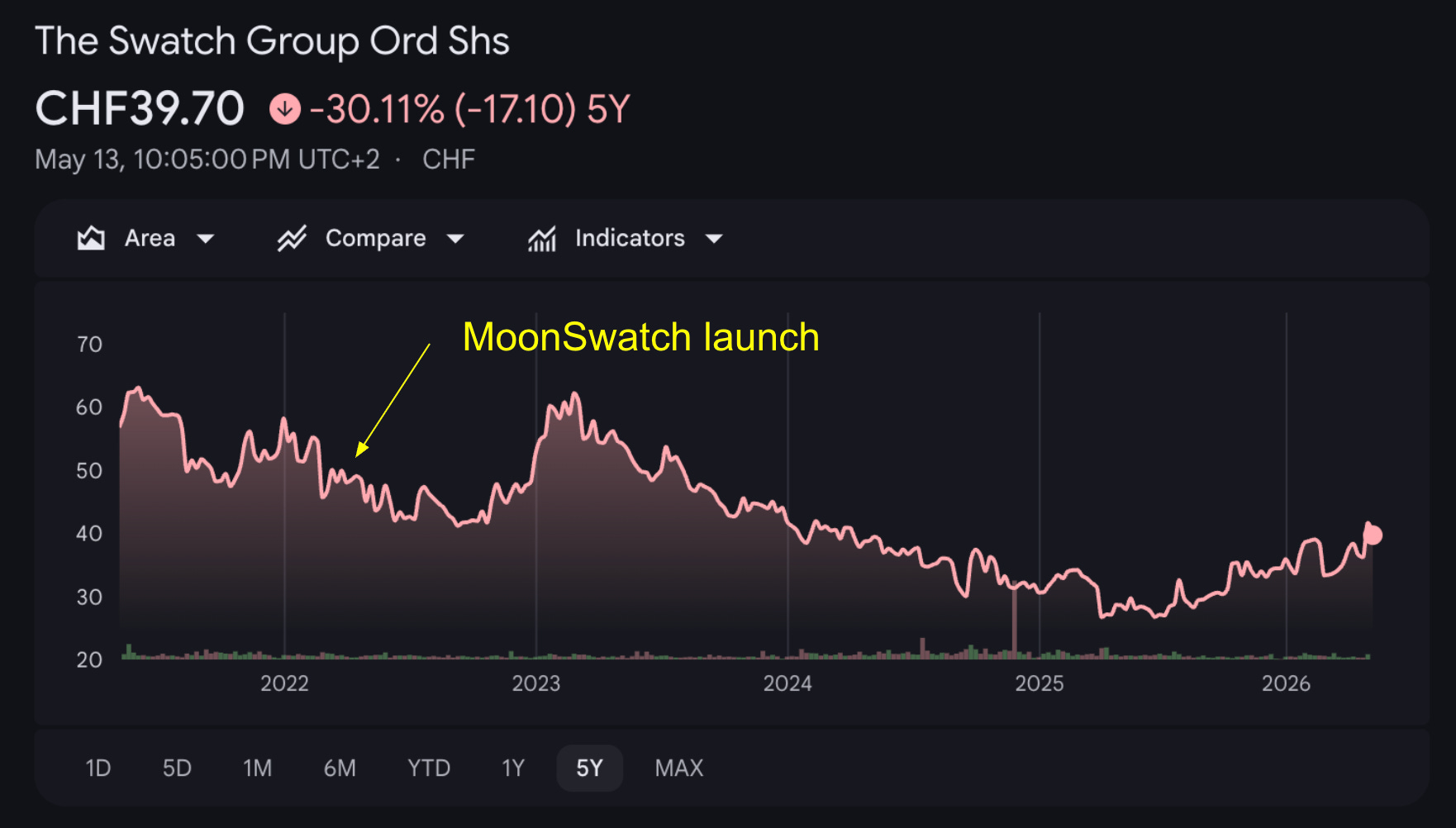
Its stock bounced in the year after MoonSwatch’s launch but has been mostly downhill since…down more than 30% from 2023 highs to a market cap of $14B.
Swatch Group pioneered the vertical integration model for watchmakers. All of its brands benefit from the parent company’s control of parts, R&D and raw materials.
The company may be spread a bit thin, though.
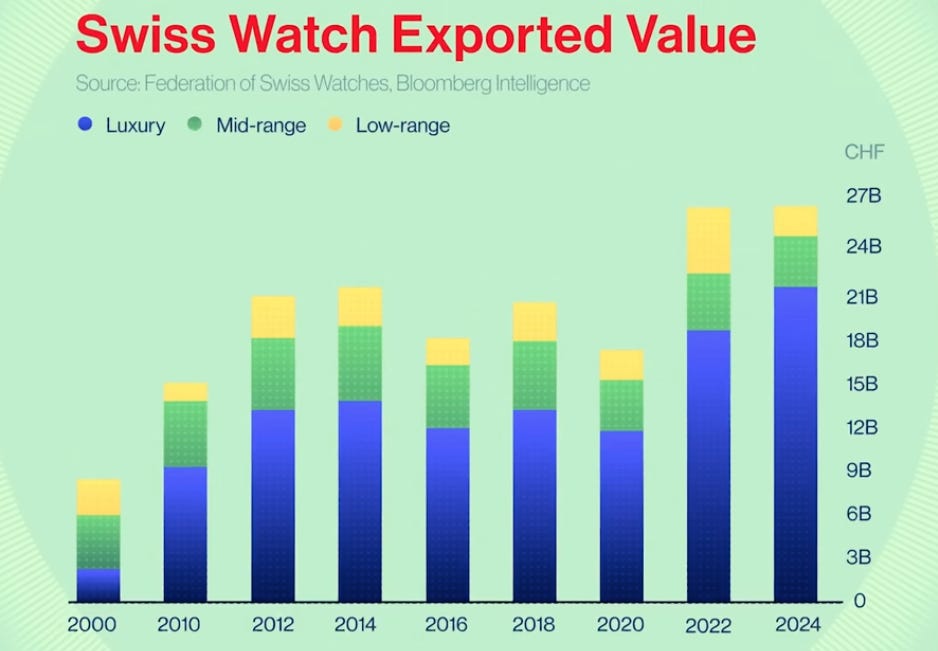
Per Bloomberg, the model is struggling against three macro headwinds. First, customers in Asia — which makes up 42% of the business (China itself is 25% of total sales) — have tightened up their wallets. Second, American tariffs have targeted Swiss exports. Third, mid-range watches are getting absolutely clapped over the past decade.
So much of consumption is going to the low and high segments (Wendy’s or Michelin)…and the luxury end of the equation dominates the total sales for Swiss watch exports.
Also didn’t help that Apple released the Watch. The iPhone maker has sold over 300 million Watches and taken over the $300-$1000 price range
Swatch is one of the most shorted stocks in Europe and activist investors have been putting heat on Swatch Group. They want the watchmaker to really focus on the higher-end brands including Omega, Harry Winston and Breguet.
However, Nick Hayek Jr. and the family control about 40% of voting rights, far above its 25% ownership stake in the business.
Just last week, shareholders voted against an activist investor trying to take a board seat.
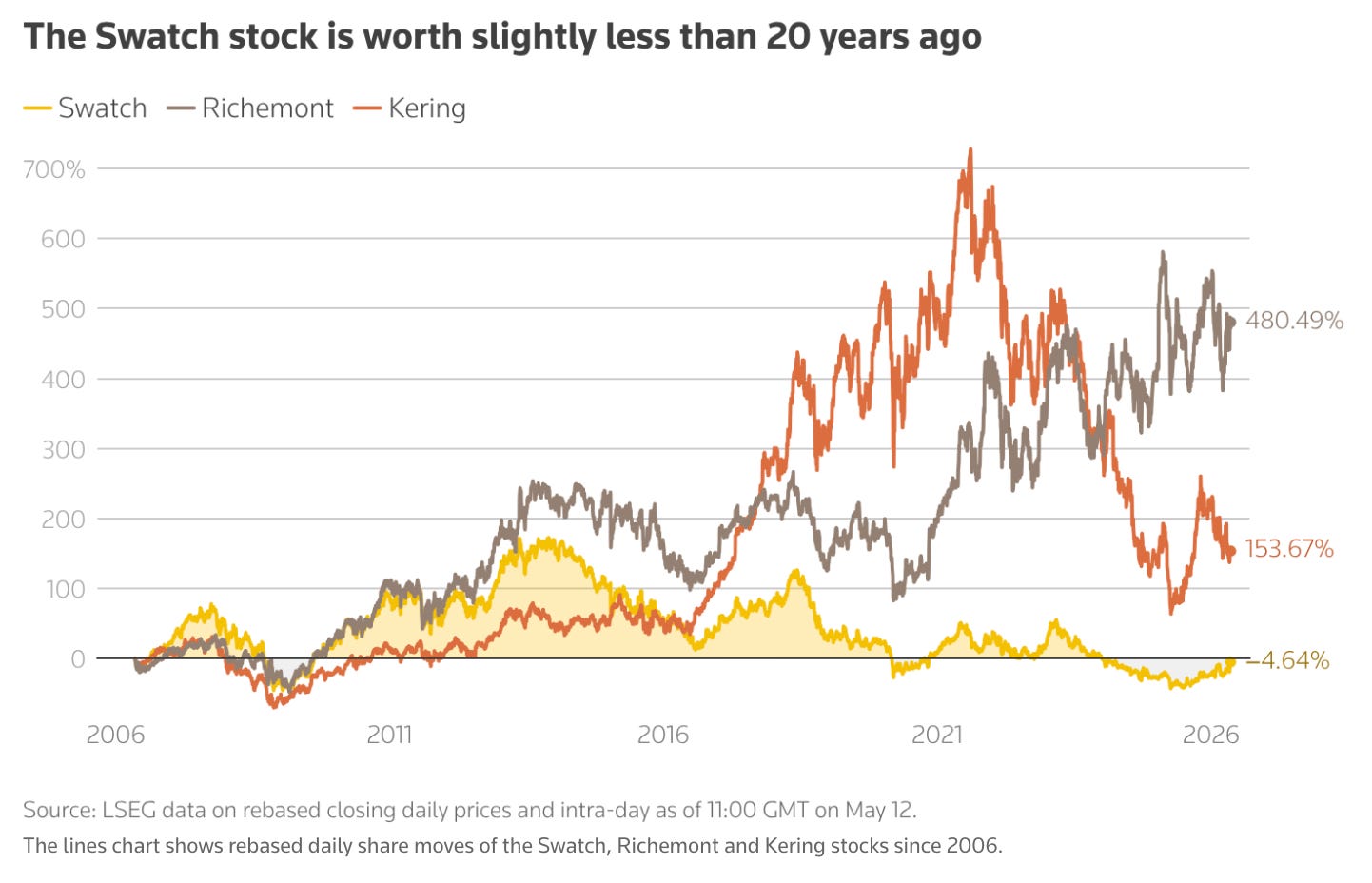
I guess when we examine the stock chart over the past two decades…the activist effort kinda has a point.
The Hayek family is very much still in control, though. They want to keep focusing on buyers across the income spectrum as Hayek Jr. explained while reflecting on the success of the MoonSwatch launch:
We did not do a limited edition [launch]. It costs $260 and it’s really accessible for everybody. That’s what it is about. The luxury industry must be careful. If you always go higher in prices, you exclude more and more people.
So, your exclusivity is excluding people. You only serve an elite of people and that’s not the future. You have to seduce the mass of people. The middle class. The entry class. Not just the rich
Audemars Piguet CEO Ilaria Resta shared a similar sentiment about the Royal Pop collection.
“There is, of course, a tension between exclusivity and inclusivity,” Resta wrote in her announcement post. “This is a one-off collaboration with a singular ambition: to ignite collective desire. To spark the kind of cultural conversation that makes people feel about watches the way they feel about art or great cars — making mechanical watchmaking something cultural, emotional, alive. Because every generational shift is a reminder: an industry that turns inward and stops connecting does not just lose relevance, it loses its meaning.
That terminology is straight off the pages of “The Luxury Strategy”.
I think both brands will get a serious boost from the Royal Pop collection. But AP will win more from the perspective of the Dream Equation. Resta only has to worry about one brand and says the it’s a “one-off” collaboration.
Meanwhile, Hayek Jr. won’t get to do double dip on sales like Swatch Group did with MoonSwatch. Will a Royal Pop halo effect extend beyond Swatch? Unlike Resta, he’s dealing with 16 brands and has a number of larger trends going against Swatch Group that can’t all be solved by the 3% Rule (or a Napoleon shoutout).
***
UPDATE 7am on Saturday, May 16: Lines got so crazy around the world that Swatch had to cancel the AP Royal Pop Collection at a number of boutiques for safety reasons. Swatch had to emphasize that the collection is not limited edition (it is a one-off but they will produce more than this first run) so that everyone can chill out.
This issue of SatPost is brought to you by OpenADE
Do you want to get the most out of Codex and Claude Code?
Then try OpenADE, a free open-source tool to maximize AI coding with better planning and collaboration features.
Most AI coding tools throw agents at your codebase and hope for the best. You end up babysitting, fixing hallucinations, and wondering if the “AI-assisted” code is actually worse than writing it yourself.
OpenADE takes a different approach: Plan → Collaborate → Revise → Execute.
The Bearly AI team built this tool internally and it is now 90% of our screen time, replacing our IDE and terminal.
By spending time upfront to craft and refine your implementation plan, you can run agents linearly with confidence. No more context-switching. No more “wait, what did it just do?” moments. Just saturated throughput and maximal work done.
Cerebras, Nvidia & Speed in AI
Semiconductor startup Cerebras Systems went public on Thursday.
In the least surprising result ever during this insane AI bull market, Cerebras popped by +68% and finished its IPO day with a market cap of $95B. It did fall 5% on its first full trading day on Friday but, yeah, what a run. Last September, Cerebras — which was founded in 2016 — raised at an $8B valuation.
This $90B+ valuation is based on two key items:
90% of AI data centre usage has moved to inference (the majority of workload a few years ago was for training large language models; but, now that they are trained, inference is providing outputs for user queries, tasks, agent work, a lot of coding and me generating an image of an Audemars Piguet as a chicken nugget)
OpenAI has $20B+ of commitments to use Cerebras chips over the next 3 years (this makes up 85%+ of Cerebras revenue and is what some folk may call customer concentration risk; OpenAI has also secured warrants to own ~10% of Cerebras).
Ok, so what is OpenAI buying?
My “I read 3 blog posts and watched 2 YouTube videos” understanding of the startup is that Cerebras designs a “wafer-scale” chip that provides high-value inference tokens and blazing fast speeds.
It’s called “wafer-scale” because Cerebras makes the largest semiconductor chip in the world. By manufacturing large wafers — instead of slicing the silicon into smaller pieces — Cerebras is able to maximize on-chip memory and deliver performance on certain inference tasks (medical research, high-level coding) where speed and quality matter.

A good way to frame this IPO is to revisit Jensen’s GTC keynote in March: he called the image below “probably the single most important chart for the future of AI factories”.
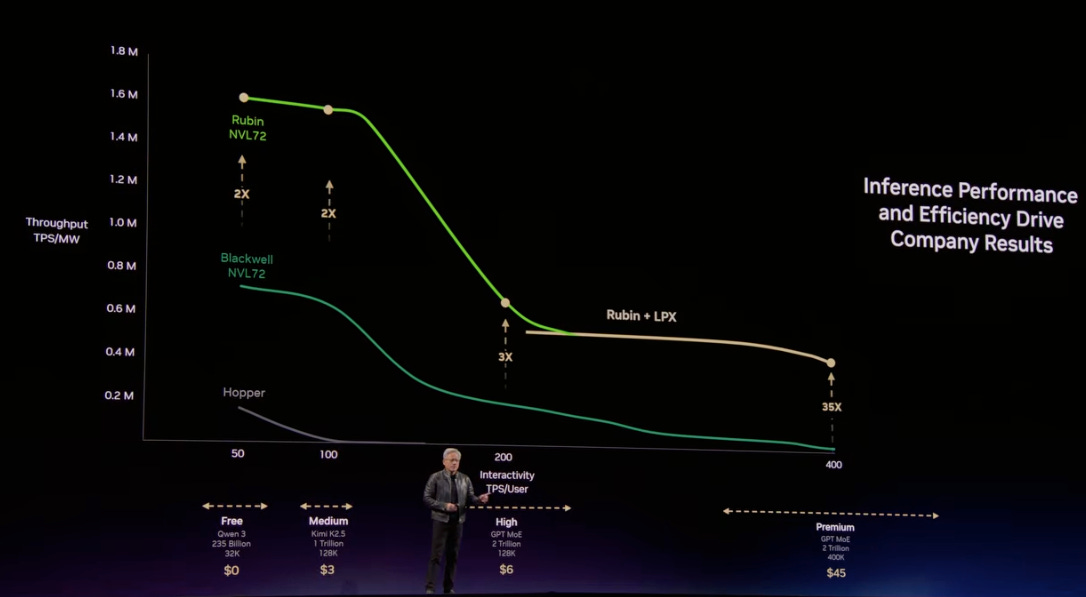
The Y-axis is “Throughput” (total volume) while X-axis is “Token Speed” (more tokens per second = more interactivity for a user + more context + more reasoning).
Firms market and price token offerings on those two variables (throughput vs. token speed) which are in tension.
Leading semiconductor research firm SemiAnalysis made this analogy about Jensen’s chart:
As Jensen repeatedly emphasized during this year’s GTC, throughput (tokens/sec/gpu) vs interactivity (tokens/sec/user) is the fundamental trade-off for inference. In our original InferenceX writeup, we described it as a bus vs a Ferrari: you can choose to serve lots of users slowly, a single user quickly, or anything in between.
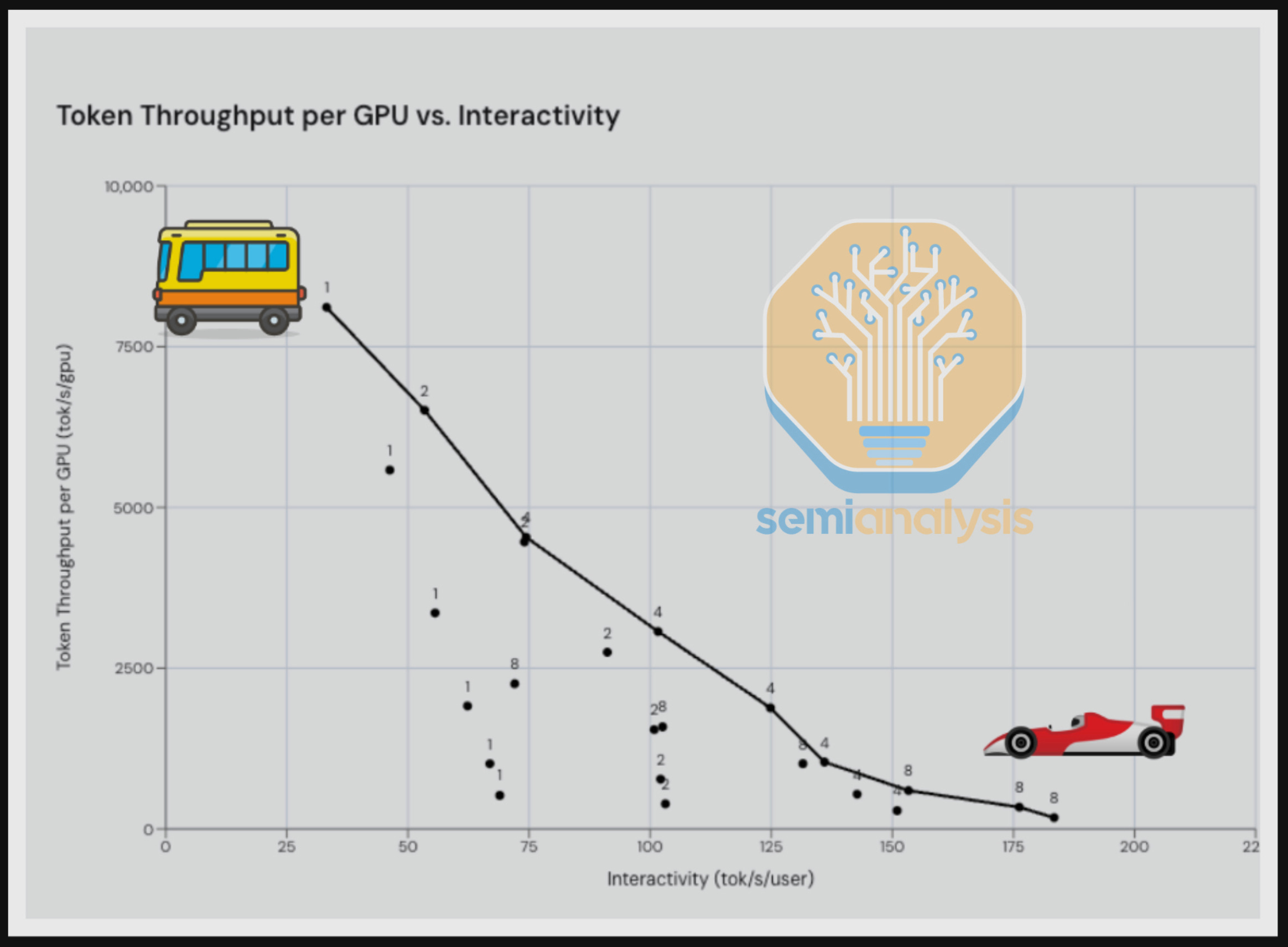
A free tier typically is high throughput but lower token speed. Meanwhile, the priciest tier would have lower throughput but high-value tokens (eg. research, coding)
Nvidia’s challenge is to build systems that lift the entire line up and to the right.
This is why Jensen spent $20B to acquihire the Groq team and license its technology.
Groq is most useful for delivering the higher value tokens at speed, which is the same market that Cerebras is targeting.
Cerebras is attacking the problem with a massive, single-wafer design. Meanwhile, Groq uses multiple, smaller, connected chips and a specialized processor architecture design (Language Processing Unit aka LPUs).
Jensen says Vera Rubin architecture improves revenue opportunity 5x vs. Blackwell. Then, if you add Groq to Vera Rubin, that revenue opportunity is up 10x vs. Blackwell.
SemiAnalysis had this to say about the growing importance of speed for the inference market:
[Many] previously believed that raw intelligence/capabilities mattered far more than speed, but our revealed preferences ended up proving that there are times when the opposite is true. Past a certain threshold of intelligence, developers prefer faster tokens to smarter tokens. And in a world where AI is involved in almost every aspect of your workflow, the speed at which tokens are generated can be the bottleneck to “flow state”, i.e. how much productive work is completed.
A few months before Groq was acquired, the startup’s CEO Jonathan Ross went on the 20VC podcast and compared speed in digital services to dopamine hits from consumer products:
I want you to rank the consumer package goods (CPG) by margin. At the very top is smoking tobacco. Below that is chewing tobacco. Below that is soft drinks.
You keep going down and you get to water and other things like that.
What is the number one thing that um a high margin correlates to in consumer packaged good? It’s the speed with which the ingredient acts on you. So, that dopamine cycle — how quickly something occurs determines — your brand affinity.
When something uh has a very quick response you associate to that brand and then you accrue brand value.
This was the entire basis of Google focusing on speed. Facebook focusing on speed. Every 100 milliseconds of speed up results in about an 8% conversion rate.
With the vast majority of AI data centre usage going to inference, there are so many different performance demands and use cases that Nvidia will face many challengers…including Cerebras.
Anyway, here is one of those YouTube videos I watched. Cerebras CTO Sean Lie explains how they manufacture their giant chip.
Jensen at the Trump & Xi Summit
President Trump flew to Beijing for a 2-day summit with President Xi.
There was no grand bargain and the readouts from each side emphasized points that played well to domestic audience (The Economist has a good round-up).
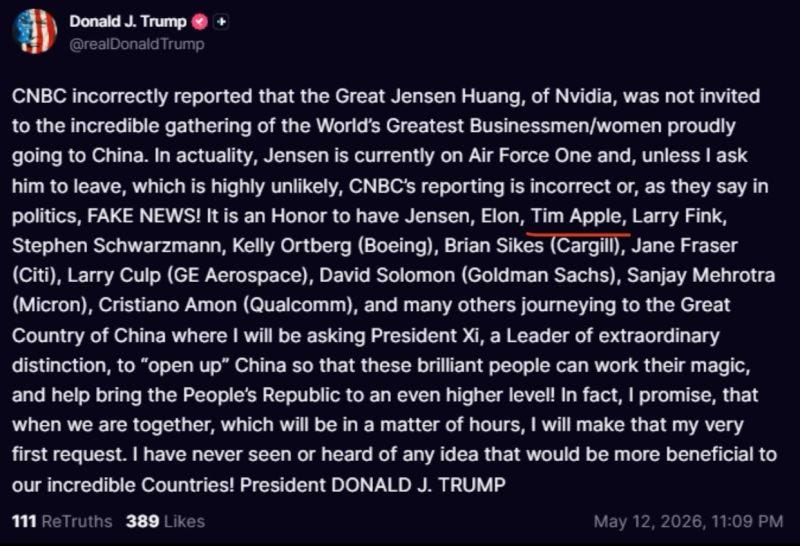
Let’s zero in on one of the funnier timeline trends: in the lead-up to the trip, there was a list of top American CEOs invited to the summit. Elon, Tim Cook and heads of Goldman Sachs, Qualcomm, Mastercard, Boeing, Micron etc…but Jensen was not on the list.
Nvidia chips are mostly not being sold in the Chinese market right now as we’ve discussed in recent months.
Then, Trump dropped this Truth post that invited Jensen and — hilariously — brought back Tim Apple.
The last-second invite led to a photo of Jensen with a backpack waiting on a tarmac in Alaska for Air Force One.

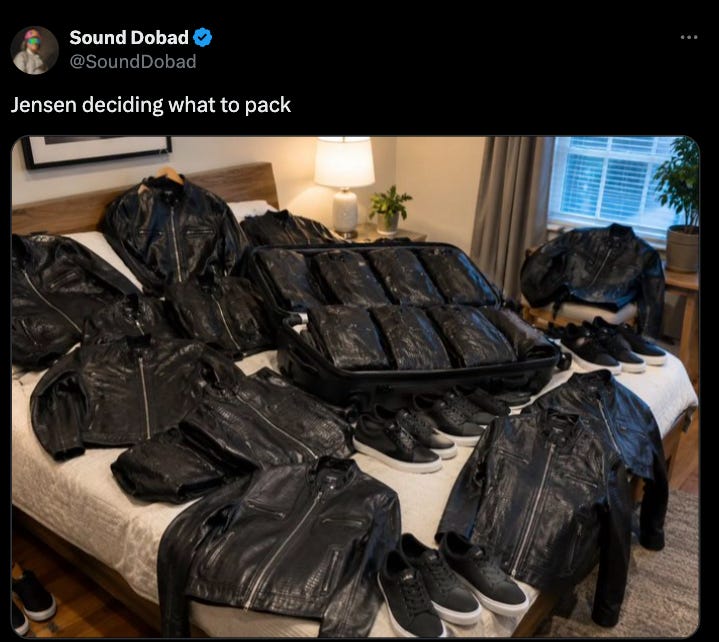
Incredible meme-age here:
This also became a massive meme on Chinese social media and some creative Weibo users AI-generated Jensen going full Tom Cruise Mission Impossible trying to catch the flight.

Then, it escalated to “Jensen carrying various gift liquors to the meeting with Xi” as one does in the Asian business community.

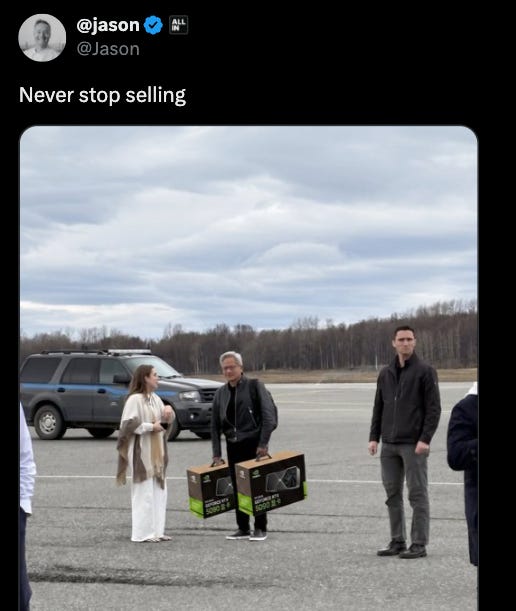
During the summit, President Trump announced a list of 10 Chinese companies that could by Nvidia chips (notably, China did not comment on this list and Nvidia chips still haven’t started selling).
But that news story led to this incredible GPU riff:
Finally, Jensen peeled off from the official summit to sample the soy bean paste noodles (zhajiangmian) from Michelin-recommended Fangzhuan shop followed by a bubble tea. The noodle shop has already added a “Jensen” meal option on its delivery app.
Yes, it’s PR. But damn was it done well…including him sampling some mystery drinks:

To summarize: Jensen took a last-minute flight to Beijing. Only brought one bag and two outfits. Landed for a party, then spent a day eating mystery street meat and noodles while drinking any beverage that was offered.
Classic early-20s Asia backpacking trip.
Links and Memes
Shannon Sharpe interviews former NBA player Michael Beasley. This is one of the hardest podcast episodes I’ve listened to in a while. For those that don’t follow basketball, Beasley was a top college player and #2 pick in the 2008 NBA draft.
His career was a bit of a letdown and he struggled with family and personal issues.
Sharpe did a super viral interview with comedian Katt Williams a few years ago. Williams just unloads in that chat about Hollywood. Beasley basically does the same thing with the NBA. It’s so raw.
One part of the 2.5 hour interview is when Beasley goes off on parents that pressure their kids to turn sports into a career and to make money:
[When I played in high school] I didn’t know about the money they was getting. We played for the love of the game. We played for a chance to go to college. We played for a chance to get an education. Then we played for a chance to take care of our family.
[Name image and likeness, NIL, payments in college] opened up the gates all the way down to 10 years old.
News flash, people. Only 60 [players] get drafted a year and 20 of those get cut. There’s only been 4800 — roughly 5,000 people — that’s ever made it to the NBA. Chances are your son won’t. They need to have fun first before they make money. That’s what’s wrong with AAU today. Everybody trying to make money and be the best fourth grader and the best third grader.
It’s like “dog, play for the right reasons and the right things will come.”
Kids only know what you tell them, right? You know, a 2-year-old thinks he’s God. Why? Because he doubled his life in the last year and he was just a blob getting fed everything. Now, he climbing all over. The bro think he conquered life. You going to let him make a decision?
These parents need to stop thinking everything financial. Why are you so worried about how much money he make or doesn’t? You should just be worried about him becoming a good person. You should be worried about the good morals. You should be worried about discipline. You should be worried about good health.
There were parts about his childhood and losing his mother that I legit teared up.
***
Some other links for your weekend consumption:
Anthropic co-founder and head of policy Jack Clark…assigns a 60% probability that AI will be able to automate AI research (“where a frontier model is able to autonomously train a successor version of itself”) by end of 2028. He highlights improvements in coding, AI managing other AIs and the ability for AI to work for long periods uninterrupted.
Indian CEOs really do deliver alpha: Deedy Das found an interview where nillionaire Michael Milken joked “if a US company replaces the US-born CEO with a CEO born in India, I buy the stock”…but Milken actually back-tested the idea and its true.
How many golfers can Rory McIlroy identify just by watching their swing silhouette? Impressively…alot including Shaq and Charles Barkley lol.
Claude helped someone recover $400k in lost Bitcoin…the AI tried 3.5 trillion passwords to figure out a key that was lost 11 years ago. The user may now name his next kid “Dario”.
Air Transat has a very good billboard campaign…it compares the ticket prices for a World Cup games (NOT LOW) to a flight ticket of the countries playing (much more reasonable).
Digital artists SHL0MS posted a Monet painting on X…he called it an AI-generated image challenged users to critique it. Next level social experiment. People that hate AI called the image crap.
Someone created a riff of “The Office”…with Michael Scott having to deal with Claude. A reboot of this series starring Claude would single-handedly be worth $2T in AI capex.
People have started making AI-generated radio stations…and the results are (ummm) interesting.
…and them wild posts:


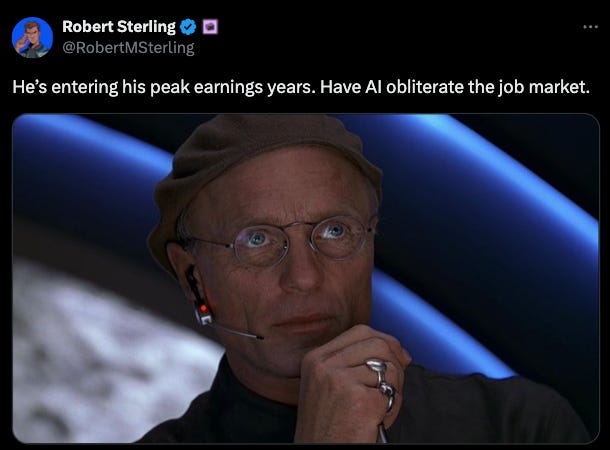
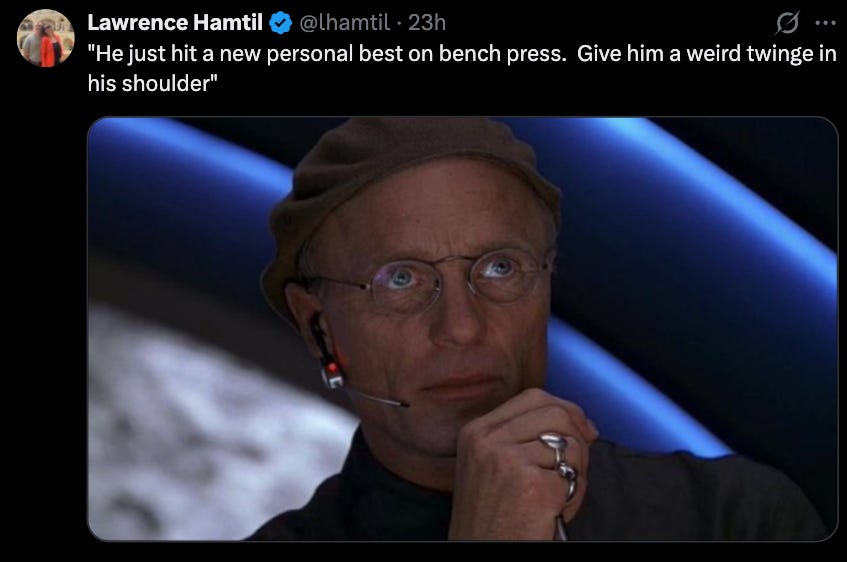
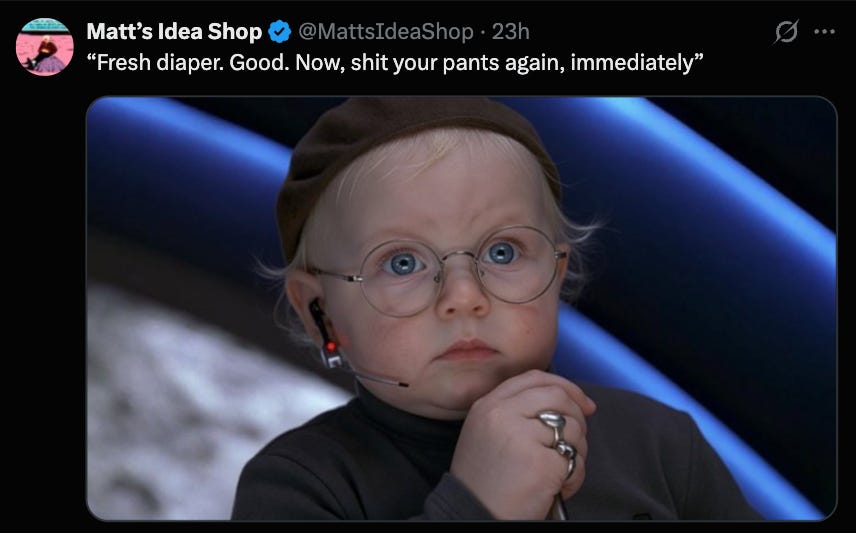
Finally, the X timeline was FLOODED with Ed Harris from The Truman Show. For those that have forgotten, Harris’ character Christof is the creator of the “show” that stars an unwitting gentleman played by Jim Carrey. The screengrab is of Harris “directing” the events around Truman.
It went nuclear last week with every user making of version of Christof putting people into unfortunate situations.






The Dream Equation is really the psychology of access. People are not just buying a watch; they are buying proximity to a status world that was designed to keep them outside. That is why these collaborations work even when everyone knows the object itself is partly ridiculous.
I just can’t get past… how to style it!?!