

Thanks for subscribing to SatPost.
Today, we talk about how all the major AI labs run on Slack (and why I think them pivoting from it could mean AGI is here). Speculative.
Also this week:
The Rise of Chinese Humanoid Robotics
RIP Robert Duvall (The Godfather, Apocalypse Now legend)
…and them wild posts (including the Milan Winter Olympics)
When will we know that artificial general intelligence (AGI) is here? Obviously, I am not qualified to answer this question.
Anytime someone asks me, I just send them this GIF:
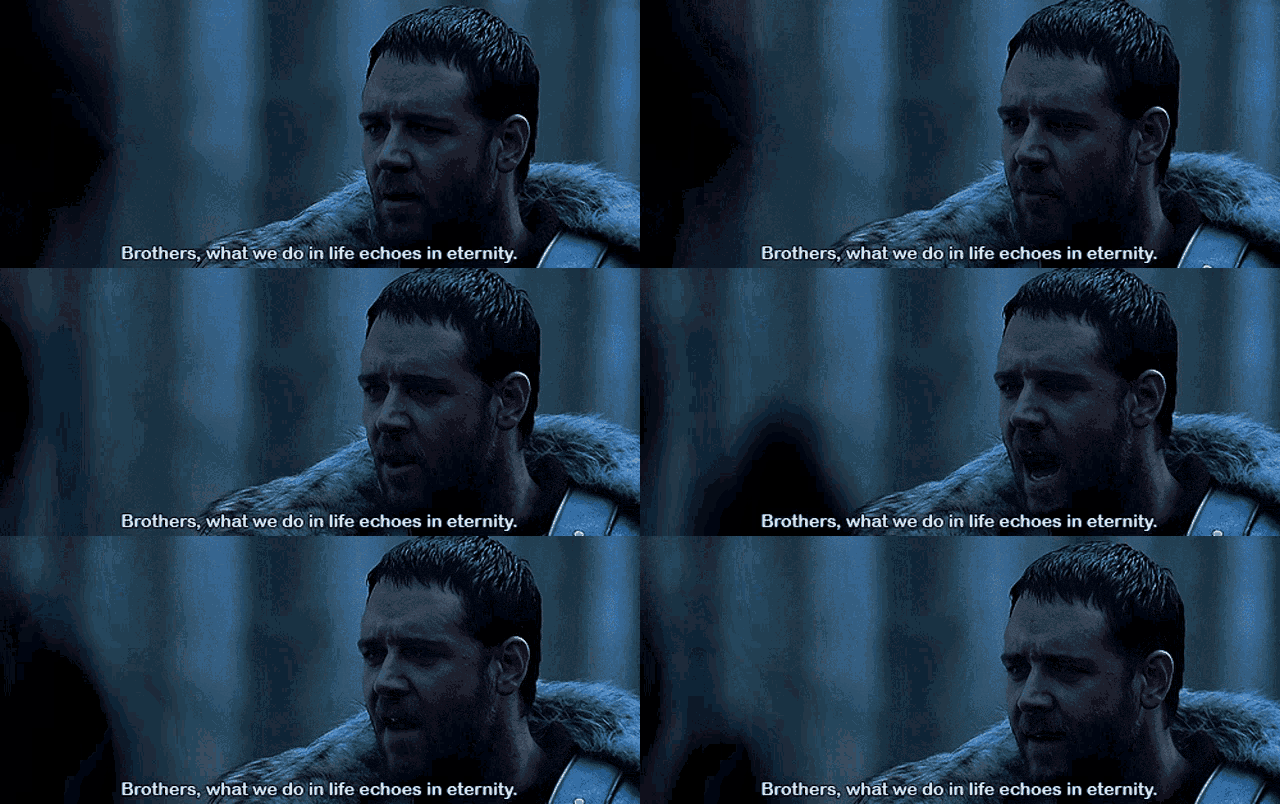
The sight of Russell Crowe’s Oscar-winning performance immediately changes the topic. Me and my interlocutor start swapping random quotes from Gladiator (“AM I NOT MERCIFUL!?!”) and talk about how Ridley Scott definitely should not have made a sequel with sharks swimming in the Colosseum.
But you know who is qualified to answer the question? Google DeepMind’s Demis Hassabis.
Last year, Lex Fridman asked Demis a question about AGI and how the discovery of such a breakthrough could parallel the famous “Move 37”.
A quick refresher: a decade ago, DeepMind created an AI to play the game Go. It was called AlphaGo. In 2016, AlphaGo took on South Korean Go legend Lee Sedol. During the second game of their match, AlphaGo pulled off a genius non-intuitive play on the 37th move. This move demonstrated AlphaGo’s machine creativity and Sedol was so shook by it that he stepped away from the table.
Lex Fridman: You’ve estimated that we’ll have AGI by 2030, so there’s interesting questions around that. How will we actually know that we got there and what may be the “Move 37” of AGI.
Demis Hassabis: My estimate is sort of a 50% chance in the next five years. So, by 2030 let’s say. I think there’s a good chance that that could happen.
Part of it is what is your definition of AGI? Of course, people arguing about that now and mine is quite a high bar and always has been.
Can we match the cognitive functions that the brain has? We know our brains are pretty much general Turing machines. We created incredible modern civilization with our minds [and that] speaks to how general the brain is.
For us to know we have a true AGI, we would have to make sure that it has all those capabilities. It isn’t kind of a jagged intelligence where some things it is really good at but other things it’s really flawed at. That’s what we currently have with today’s systems. They’re not consistent. You’d want that consistency of intelligence across the board.
Then, we have some missing capabilities. Like the true invention capabilities and creativity that we were talking about earlier. So you’d want to see those. How would you test that? I think you just test it. One way to do it would be kind of a brute force test of tens of thousands of cognitive tasks that we know that humans can do.
Maybe also make the system available to a few hundred of the world’s top experts. The [math genius] Terence Tao of each subject area and give them a month or two and see if they can find an obvious flaw in the system. If they can’t, then I think you can be pretty confident we have a fully general system. […]
I think there are [also] the sort of lighthouse moments like the “Move 37” that I would be looking for. One would be inventing a new conjecture or a new hypothesis about physics like Einstein did. Maybe you could even run the back test of that very rigorously. Have a cut-off [date] of 1900 and then give the system everything that was written up to 1900 and then see if it could come up with special relativity and general relativity, right? Like Einstein did. That would be an interesting test.
Another one would be: can it invent a game like Go? Not just come up with a “Move 37” — [which was] a new strategy — but can it invent a game that is as deep and aesthetically beautiful and as elegant as Go?
Those are the sorts of things I would be looking out for.
This framing of a “Move 37” lighthouse moment is very useful.
Just scrolling through X every day, I frequently see people shocked by some of the current AI’s jagged intelligence capabilities. I’m sure many have felt some form of “Move 37”.
Sure, we are in a hyperbolic hype cycle. There’s also the issue of “I spent 10 hours with a sycophantic chatbot that convinced me I discovered new physics that would make Einstein shit his pants”.
With those caveats, let me tell you the “Move 37” lighthouse moment I’m looking for to see if AGI is here: the major AI labs talk about how they ditched Slack and built an internal messaging tool.
Why? Because communications and co-ordination are massive human bottlenecks…yet the top AI labs (and their thousands of employees) are all running on Slack, which has obvious drawbacks.
If AGI was truly here, it probably isn’t using Slack as the best way to run a cutting-edge AI research organization.
Everyone knows what I’m talking about…the 27-step Slack derangement journey:
Wow, this is so much better than email.
Real-time communication!
Wow, you can send GIFs.
I can just DM anyone and make new custom group chats. Amazing.
Hahaha, there’s a water cooler channel just for #memes. So funny.
#announcements is an awesome way to get to know your colleagues.
Can’t believe the CEO just hopped in and started chatting in that Huddle.
Dope, you can create channels with external parties to work on projects.
Slack Connect is next level. The Salesforce integration just pings us sales pipeline updates and my team’s Google Calendar is all sync’d up.
Whoa, slow down. Stop adding me to new threads.
Search is awful.
Everyone, please put actual announcements in the new #RealAnnouncements channel.
Mute, Mute, Mute, Mute. [Turn off Slack Notifications].
Think my manager is linking my un-reads to the next promotion cycle.
Uh oh, I went on vacation for a week and am now 8,765 messages behind.
Where the hell is the file I sent?!?!
These notifications are getting a bit absurd.
Incredible, another Slack channel created so people can do pretend work.
We are shutting down #announcements and #RealAnnouncements. Please direct all real announcements to #RealAnnouncementsOnlyNoReplies.
Why I am getting a notification at 10pm on a Saturday?!?!?! My status is DND!!
Holy crap, they just pivoted the entire company’s strategy under a GIF in a thread from two weeks ago in the #memes channel and I missed it because it was on mute.
STFU Slackbot.
SLACK means “Searchable Log of All Communication and Knowledge”…then why dafuq can I not SEARCH LOGS OF ALL COMMUNICATION AND KNOWLEDGE??!?!?!!
I quit.
Man, I hope this new company doesn’t do Slack.
[Click Here to Create a Microsoft Teams Account]
F********CK YOU!!!!!!!
Sorry, where was I? Right. The top AI labs run on Slack even though there clearly has to be a better solution for communication, co-ordination and messaging.
But here we are.
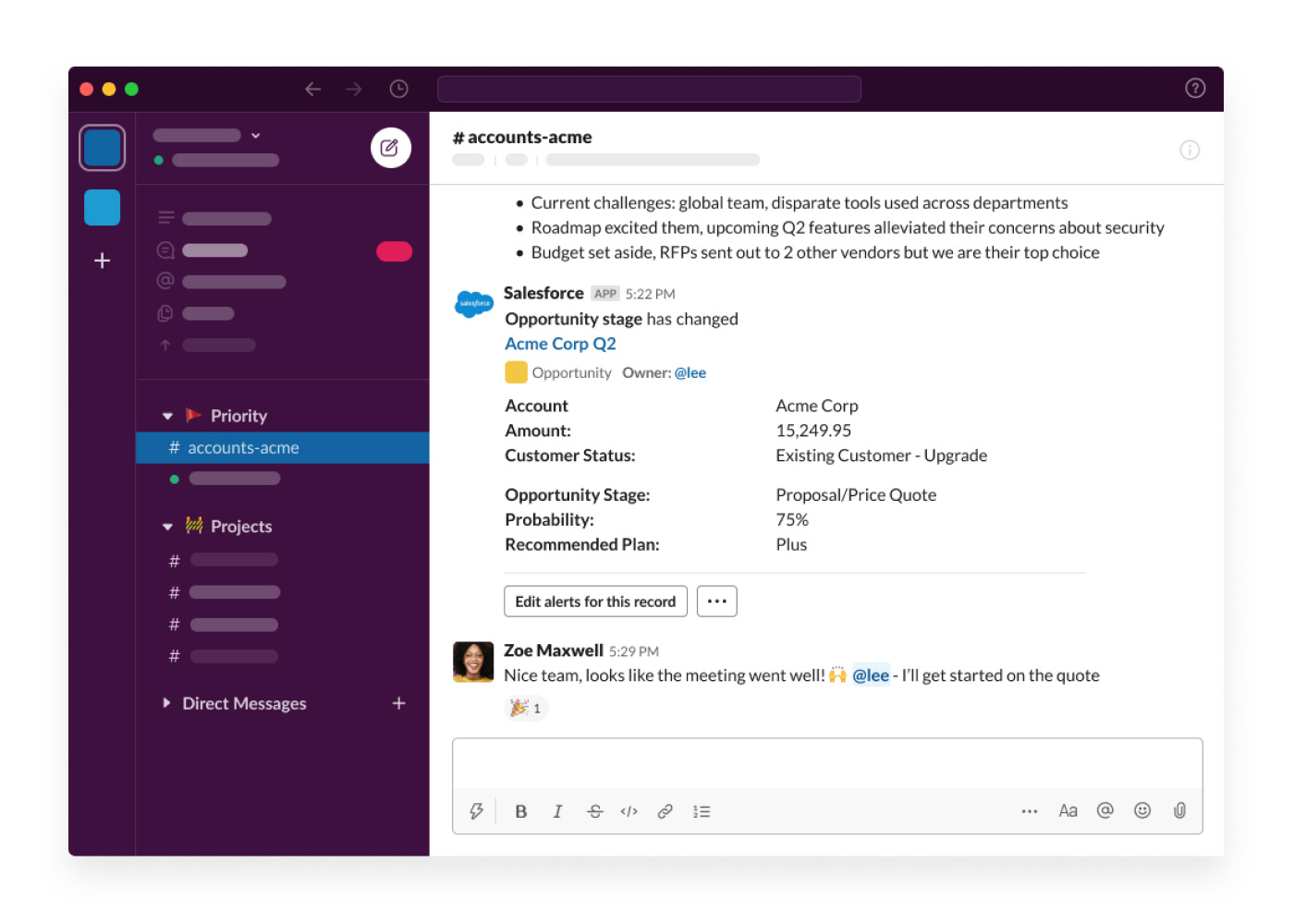
In a piece from July 2025 titled “Reflections on OpenAI”, Calvin French-Owen — who spent a year at OpenAI helping to launch Codex — gave an inside look at how the company operates (side note: French-Owen previously sold Segment to Twilio for $3.2B, which just shows how insane the talent level is at the leading AI labs).
Here was a viral nugget:
An unusual part of OpenAI is that everything, and I mean everything, runs on Slack. There is no email. I maybe received ~10 emails in my entire time there. If you aren’t organized, you will find this incredibly distracting. If you curate your channels and notifications, you can make it pretty workable.
What about Anthropic?
A recent New Yorker profile of Anthropic had 7x mentions of Slack, including how they operated an internal AI-powered vending machine.
While that may not be proof that AI lab runs on Slack, how about this Anthropic blog post from October that announced a new Salesforce integration…and it literally says “Salesforce deploys Claude Code, Anthropic runs on Slack”.
Looking at Slack’s AI-related feature suite actually gives an idea of what an AI-first messaging tool would be.
Slack’s model context protocol (MCP) serve lets third-party AI assistants (Claude, Perplexity) securely read, search, and analyze user messages, threads, and channels.
I’ve seen people from AI labs talk about asking the Slack MCP to catch them up on projects and find blockers.
Speaking of Anthropic and Slack, there’s also a bit from the New Yorker piece:
Anthropic’s headquarters, in downtown San Francisco, sits in the shadow of the Salesforce tower. There is no exterior signage. The lobby radiates the personality, warmth, and candor of a Swiss bank. A couple of years ago, the company outgrew its old space and took over a turnkey lease from the messaging company Slack. It spruced up the place through the comprehensive removal of anything interesting to look at. Even this blankness is doled out grudgingly: all but two of the ten floors that the company occupies are off limits to outsiders. Access to the dark heart of the models is limited even further. Any unwitting move across the wrong transom, I quickly discovered, is instantly neutralized by sentinels in black.
Anthropic runs on Slack and in its old building. So poetic.
Also, the company’s CEO Dario Amodei recently went on the Dwarkesh podcast and talked about how he uses Slack to help keep every employee on the same page vis-à-vis the company’s culture and mission (he spends 30-40% of his CEO time on these areas):
In front of the company every two weeks, I have a three or four-page document and I just talk through three or four different topics about what’s going on internally.
The models we’re producing. The products. The outside industry. The world as a whole as it relates to AI…and geopolitically, in general. Just some mix of that.
I go through very honestly and I say, “This is what I’m thinking, and this is what Anthropic leadership is thinking.”
Then, I answer questions.
That direct connection has a lot of value that is hard to achieve when you’re passing things down the chain six levels deep.
A large fraction of the company comes to attend, either in person or virtually. It really means that you can communicate a lot.
The other thing I do is I have a channel in Slack where I just write a bunch of things and comment a lot. Often that’s in response to things I’m seeing at the company or questions people ask. We do internal surveys and there are things people are concerned about, and so I’ll write them up.
I’m just very honest about these things. I just say them very directly. The point is to get a reputation of telling the company the truth about what’s happening. To call things what they are. To acknowledge problems. To avoid the sort of corpo speak. The kind of defensive communication that often is necessary in public because the world is very large and full of people who are interpreting things in bad faith.
But if you have a company of people who you trust — and we try to hire people that we trust — then you can really just be entirely unfiltered.
For xAI, this article on how the lab employs 900 “AI tutors” says the process is mediated through Slack.
Meanwhile, former Google DeepMind engineer Aleksa Gordić was not a fan of the lab’s use of Slack:
[In 2023, DeepMind] was already bloated (~1200 people, now it’s more like 5000–7000), the culture significantly broken (e.g. memes were being removed from internal Slack channel because they “offended” someone), and I couldn’t freely move around to work on stuff that actually interested me.
As I was explaining earlier, these #memes Slack channels are absolute menaces to corporate productivity.
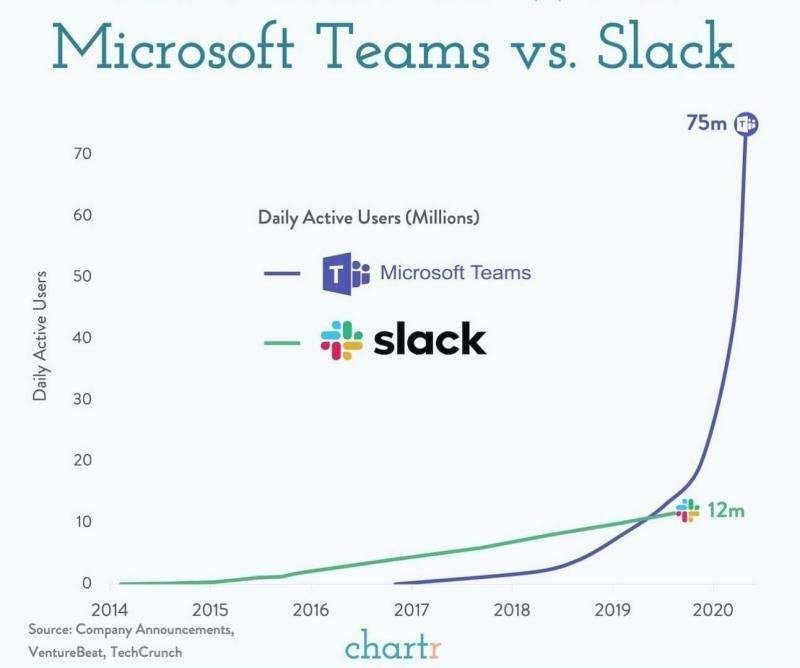
But, sometimes, be careful what you wish for…because this chart of Teams milking its Microsoft distribution to overtake Slack goes viral once a month (although, the supposed distribution advantage — despite a shittier product — has done absolutely nothing for Copilot in AI…and Slack is kind of having the last laugh right now by being AI labs go to messaging app).
Anyway, everyone knows the pros and cons of Slack. Everyone also knows that if you were to build a corporate messaging and communications platform from scratch in the age of AI, it is going to look different than Slack.
Back in November, economist Tyler Cowen just straight up asked Sam Altman why they don’t build an internal Slack alternative:
COWEN: Someone put an essay online, and it said, in all the time they worked at OpenAI, they hardly ever sent or received an email, that so many things were done over Slack. Why is that? What’s your model of why email is bad and Slack is good for OpenAI?
ALTMAN: I’ll agree, email is bad. I don’t know if Slack is good. I suspect it’s not. I think email is very bad. The threshold to make something better than email is not high, and I think Slack is better than email. We have a lot of things going on at the same time, as you observed, and we have to do things extremely quickly. It’s definitely a very fast-moving organization. There are positives about Slack, but there’s also…I dread the first hour of the morning…the last hour before I go to bed, where I’m just dealing with this explosion of Slack.
I think it does create a lot of fake work.
I suspect there is something new to build that is going to replace a lot of the current office, productivity suite. Whatever you think of Docs, Slides, email, Slack.
[It] will be the AI-driven version of all of these things, not where you tack on the horrible — you accidentally click the wrong place and it tries to write a whole document for you or summarize some thread or whatever — but the actual version of you trusting your AI agent and my AI agent to work most stuff out and escalate to us when necessary.
I think there is probably finally a good solution for someone to make within reach.
COWEN: How far are you from having that internally? Maybe not a product for the whole world — not one that is in every way tested — but that you would use it within OpenAI?
ALTMAN: Very far. But I suspect just because we haven’t made any effort to try, not because the models are that far away.
COWEN: Since talent, time, human capital is so valuable within your company, why shouldn’t that be a priority?
ALTMAN: Probably we should do it, but people get stuck in their own ways of doing things, and a lot of stuff is going very well right now. There’s a lot of activation energy for a big new thing.
So, Sam knows that Slack isn’t the ideal answer. He also knows that OpenAI’s LLM could create a better solution. He thinks they “probably should do it”. But inertia is such a powerful force that doing so would be a distraction.
That was kind of the main point of my article last week (“How Does Docusign have 7,000 employees?”) about why traditional SaaS won’t just disappear overnight in the upcoming AI agent wave.
Employees and their workflows don’t like change.
Meanwhile, Slack is running 100mph to make sure its the AI-native corporate messaging platform.
Doing a side quest is very costly.
Famously, Uber tried to build its own internal Slack in the mid-2010s. The company had 30,000+ employees at the time and didn’t think Slack could handle its millions of daily messages. The system was called uChat and built on top of Mattermost, and open-source Slack alternative. By 2020, Uber was back on Slack.
Still, Professor Cowen’s point above is incredibly valid: “Since talent, time, human capital is so valuable within your company, why shouldn’t [creating a better Slack] be a priority?”
That’s why I believe a “Move 37” for the arrival of AGI will be some reveal that the leading AI labs are using a new internal AI-powered communication system.
Let’s call it the “Slack AGI Test” (mostly because that’s the title I gave this article before writing it and I figured I should have the title somewhere in the text).
Anyway, OpenAI and Anthropic have already automated a ton of the coding work and are headed to a world in which AI agents create 100% of the code.
AI policy advisor and researcher Dean Ball recently wrote that “the pace of [AI coding] automation will grow during the course of 2026, and within a year or two the effective ‘workforces’ of each frontier lab will grow from the single-digit thousands to tens of thousands, and then hundreds of thousands” because of AI agents.
If you got 6-figure AI agents running around the code base, there ain’t no way that Slack is the best way to manage them.
What is an AI version of a corporate messaging platform — to paraphrase Demis on Go — that is “deep and aesthetically beautiful and elegant”?
There just has to be a better way to co-ordinate. To align intent. To share context. To reduce duplicated work. To prevent mistakes. To make sure no one ever ever ever uses the #announcements channel for a non-announcement. To accelerate decisions. To delegate jobs. To catalogue institutional knowledge. To track progress and keep everyone engaged. To make sure employees stop microwaving leftover salmon in the pantry.
The switching costs of moving away from Slack will be sizeable (including ongoing security, compliance and data retention issues).
But the upside is so clear and AGI should be able to AGI away those challenges.
Having said that, maybe AGI realizes that Slack’s shortcomings are unsolvable and it’s better to leave us humans twiddling around sending memes to each other while it gets the real work done.
I assign a non-zero probability that this is already happening.
In which case…
This issue of SatPost is brought to you by Bearly AI
Are you looking for a no-logging, encrypted and anonymized AI chat tool?
Then try the Bearly AI research app, which provides an easy-to-use UX for the newest models from OpenAI, Anthropic, xAI, DeepSeek, Gemini and more.
While some AI providers keep chat logs indefinitely even after a user deletes them...Bearly AI has a default no-logging policy and user chats are encrypted while requests to LLM providers are completely anonymized.
Try one month FREE of the Pro Plan using the code BEARLY1.
The Rise Of Chinese Humanoid Robotics
Aside from the “Slack AGI Test”, the other key AI benchmark that I’ve been following is: “Unitree Chinese Humanoid Robots Doing Martial Arts During The Spring Festival On National Chinese TV To Kick Off Lunar New Year”.
This benchmark reached absolutely insane levels this year.
The Unitree robots were doing martial arts, jumping somersaults, breakdancing moves and co-ordinated sword fighting with little kids. Oh, and they did that Jackie Chan move when you run up against the wall and flip yourself.
Is this necessary? Do we need humanoid robots doing parkour moves?
Watch it here, it’s ludicrous.
Then, watch this comparison between the Unitree robots in 2025 vs. 2026.
Frankly, I’m too afraid to extrapolate from here.
As many AI robotics observers … err … observed last year, China has completely taken over the game.
Throughout the 2010s, Boston Dynamics — which was acquired by Google in 2013 then sold to Softbank in 2017 — would drop some year-end demo of its humanoid robot getting better and dancing and jumping around.
That’s cute. But it ain’t doing Jackie Chan wall jump thing.
Rui Xu (who previously worked for Xiaomi, Bytedance, Lenovo) has experience in American and Chinese robotics sectors.
He explains why Unitree leaped past Boston Dynamics (and also ahead of Tesla’s Optimus).
In his estimation, it’s not about money, government support or stolen IP.
It’s all about the density of the Chinese electronics supply chain.
Rui Xu ex-Xiaomi Intl Founding Team | Ex-ByteDance/Lenovo GM (Link)
…A lot of the people now panicking about China’s robots are the same crowd that mocked China for not being able to build good foundation models 1-2 years ago. First it was “they can’t innovate,” now it’s “we’re doomed.” Neither reaction is useful.
China’s robots aren’t advancing this fast because of some grand government masterplan. It’s the same reason the U.S. leads in AI: infrastructure.
America has more GPUs, so American labs run crazier experiments. China has the world’s densest hardware supply chain, so Chinese teams can break more robots, try dumber stuff, and bounce back faster. That’s basically it.
Crediting political systems for innovation is silly: nobody thanks democracy for GPT-5, and nobody should thank the Five-Year Plan for robot backflips.
I’ve been in the U.S. robotics startup world. Let me tell you what that looks like on this side.
I know a really good American research team that was doing aggressive full-body control experiments with Unitree robots about a year ago. They fried three machines. Then they just... stopped. Not out of ideas but out of patience. Getting replacements shipped across the Pacific, clearing customs, coordinating repairs as the iteration cycle went from days to weeks to “you know what, let’s just not try that move anymore.”
At the YC robotics startup where I worked, we tried making parts locally in the Bay Area. It was slower than shipping from China. Later we found some good U.S. suppliers eventually but scattered around the country, inconsistent quality, hard to count on. A replacement actuator that a Hangzhou team gets by tomorrow morning? For us, that was a multi-week adventure. […]
That’s not a talent gap. That’s a logistics gap. Chinese engineers and American engineers are both incredibly talented. I’ve worked with both, and the difference in raw ability is negligible. What’s not negligible is how fast they can turn ideas into physical prototypes and iterate on them.
The Pearl River Delta around Shenzhen, plus the Yangtze River Delta around Shanghai and Hangzhou, where Unitree is actually based, these two clusters produce motors, sensors, actuators, custom PCBs at speeds that feel like cheating. When Unitree wants to test a new joint design, they walk down the street.
That’s why China shipped 90% of the ~13,000 humanoid robots sold globally last year. That’s why Unitree’s G1 costs $16,000 while Tesla’s Optimus Gen2 will be over $20,000. That’s why Unitree plans to ship 10,000–20,000 units this year.
Not strategy. Not policy. Just two insanely dense manufacturing ecosystems doing what they do.
And don’t forget how most of the Chinese electronics manufacturing ecosystem really took off during the 2010s.
Apple.
As Patrick McGee detailed in his book “Apple in China: The Capture of the World’s Greatest Company”:
By 2014, Apple was so frequently sending America’s best engineers to China — what one Apple veteran calls “an influx of the smartest of the smart people” — that the company convinced United Airlines to fly 6,857 miles from San Francisco to Chengdu three times a week, pledging to buy enough first-class seats to make it profitable.
Guthrie quickly realised this wasn’t the industry norm. Although suppliers resented the intense pressure and the soul-crushingly low margins offered by Apple, they put up with it because they derived something far more valuable than profits. The deal — let’s call it the Apple Squeeze — was that Apple would exert enormous power over its suppliers multiple hours a day, for weeks and months leading up to a product launch, and in return, the suppliers would absorb cutting-edge techniques. [...]
Guthrie began to realise that Apple, however inadvertently, was operating in ways that were immensely supportive of Beijing’s “indigenous innovation” directive. Chinese officials just didn’t know it because the company was so secretive about how it developed its products.
As one former industrial designer put it: “I don’t remember, ever, a strategic withholding of information. All we cared about was making the most immaculate thing Every day you’d invent your way through a problem. It was absolutely wonderful as an experience. But I guess we were unwittingly tooling them up with incredible knowledge — incredible know-how and experience.”
As Apple came under political pressure to “give back” to China, Guthrie advocated that the company change tack. “China wants the constant learning,” he told colleagues. “The fact that Apple helps bring up 1,600 suppliers for China — it’s an incredible benefit.”
When staffers added up Apple’s investments in China — mainly the salaries and training costs of three million workers in the supply chain, as well as sophisticated equipment for hundreds of production lines — they realised the company was contributing $55 billion a year to China by 2015: a nation-building sum.
Honestly, kind of disturbing. Why? When I’m on a United Airlines flight and want an extra bag of pretzels or one of those shitty airline headphones that last for 1/4 a film before breaking, they tell me it’s $7.50. When Apple is flying United Airlines to Asia and doesn’t want to make a connecting flight, they ask for a special route between two unprofitable cities and United Airlines bends over backwards to make it happen. Ugh.
McGee calculates that the $55B a year investment Apple made in China was 2x the annual spend that America made in Europe during the post-WWII Marshall Plan reconstruction (on an inflation-adjusted basis).
Here’s a crazy stat: since the iPhone was launched, Apple has trained over 28 million Chinese workers on high-tech manufacturing. That’s more workers than the entire state of California and a key reason why China leads in so many next-gen manufacturing industries (EVs, solar, drones, robotics).
The manufacturing chops (workforce, supply chain) got another massive boost when Tesla opened a plant in Shanghai in 2019.
Rui Xu believes that America (and any other country that wants next-gen robotics) has to take the challenge of building out an electronics ecosystem as seriously as China did.
The Economist also covered the Unitree Spring Gala performance and brought up a good point: there is still limited commercial utility for the humanoid robots.
Unitree (and another Chinese firm AGIBOT) are dominating sales of. But it’s looking like the top buyer is the Chinese government…for hype videos and really cool martial arts shows.
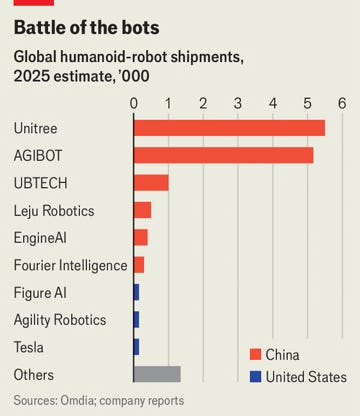
The Pearl River Delta is seeing a large buildout of parts for humanoid robots but they haven’t advanced to the point of being truly useful in factories or homes. Elon says the hardest part is the hand…and no one has cracked it.
Boston Dynamics most practical robot is something called Stretch. It is a giant hook arm with suction cups riding along on wheels. The robot unboxes semi-trucks, which is dangerous work. People standing in >25°C metal trailers grabbing 50lb boxes. A lower-back injury waiting to happen.
DHL is already suing Stretch with an order for 1,000+ of the robots.
I don’t doubt that AI world models and robotic hand design will progress.
Still unclear when commercial use will come.
But I fully expect next year’s Unitree’s Spring Gala video to go full Jackie Chan in his 1978 kung-fu classic Drunken Master.
RIP Robert Duvall
The legendary actor died last week at the age of 95.
Perhaps best-known for partnering with Francis Ford Coppola during that director’s unbelieveable 4-film run in the 1970s. Duvall played Tom Hagen in The Godfather I and II (1972, 1974), a smaller role in The Conversation (1974) and then the immortal Lieutenant Colonel Bill Kilgore in Apocalypse Now (1979).
Brian Phillips wrote a great overview of Duvall’s career:
Like Jack Nicholson [and his close friends] Gene Hackman and Dustin Hoffman, Duvall was an actor most associated with the 1970s, ’80s, and ’90s, but also like his three contemporaries, he was on the far side of 30 when he got famous. This gave him a strange quality of generational displacement: He was a month older than James Dean but seemed to belong to an entirely different era. He was born during Prohibition, in 1931, and would have been the right age to work at Mad Men’s Sterling Cooper, although he’d never have fit in. After growing up as a navy brat—his dad retired as a rear admiral—he got a theater degree from Principia College in 1953, then disappointed his family by enlisting in the army; he never made it past private first class, but he did get to act in amateur productions around the base.
The pivotal moment in Duvall’s career came in 1972. As Tom Hagen in Coppola’s The Godfather, he found a part perfectly suited to his gift for conveying unsettled nuance. The consigliere of the Corleone crime family is an insider and an outsider, a powerful man and a supplicant, all at the same time. He’s high up in the family hierarchy, but only as an adviser, not as a leader; he’s a quasi-adopted son of Don Corleone, but he’s also an Irish orphan, not truly part of the Italian family. He’s a man of reason surrounded by men of violence. He loves Sonny Corleone as a brother while also clearly seeing Sonny’s shortcomings as a possible successor to his father. And Duvall’s quietly thrilling performance finds every contour of Hagen’s charged uncertainty. Watch how he clamps down on his own outbursts of feeling, the mark of a man who’s spent his whole life treading carefully; look at the calculation in every plane of his face.
The Godfather performances were so gangster (figuratively and literally) it broke the Academy Awards:
The role brought Duvall his first Oscar nomination, and if you want a quick look at the absolute chaos that The Godfather brought to the acting categories at the 45th Academy Awards, consider that three of the five nominations for Best Supporting Actor, Duvall’s category, went to actors from Coppola’s film. Marlon Brando, despite having less screen time than Al Pacino, was nominated for, and won, Best Actor. Pacino, the clear star of the film, was nominated in the supporting category against Duvall and Caan; Pacino boycotted the ceremony in protest, and the award, inevitably, went to Joel Grey for Cabaret.
I think Hagen’s most iconic scene from The Godfather is when Michael pushes him to the side. The upcoming Don tells Tom that he is not a “wartime consigliere”. They love him. He’s not blood, though. It’s brutal.
“You’re out, Tom.”
In the HBO show Succession, the key outsider character is also named Tom (Wambsgan). While there is no evidence that show-runner Jesse Armstrong gave the name in honor of The Godfather — both share themes that draw on King Lear (the three Corleone siblings mirroring the three Roy siblings) — I choose to believe that the karmic payoff in the HBO show was for Tom Hagen.
Long time readers of SatPost won’t be surprised by my favourite Duvall role: Kilgore in Apocalypse Now. It is one of the highest impact-per-minute performances ever.
Duvall is on screen for only 11 minutes of the original 153-minute film (which itself was perhaps the craziest single film production ever and I wrote about it here).
But he just steals the show.
The other “highest impact-per-minute performances” that are a notch below Duvall’s Kilgore are probably Alex Baldwin’s Blake in Glengary Glenross, Tom Cruise’s Les Grossman in Tropic Thunder and Will Ferrell’s Chaz in Wedding Crashers.
Kilgore. For god’s sake, his name is KILL GORE. He leads his men on a helicopter attack mission while playing Wagner’s “Ride of the Valkyries” before dropping one of Hollywood’s most famous quotable quotes: “You smell that? Napalm son. Nothing else in the world smells like it. I love the smell of napalm in the morning…It smells like victory.”
I’ve probably seen the Kilgore performance 50x.
Every line hits hard including a bunch related to the fact that his overarching obsession during the mission is to find a good beach to surf with pro surfer Lance Johnson (who is part of the search party run by Martin Sheen’s Captain Willard):
“Charlie don’t surf!” (the call sign that the American troops used for enemy Viet Cong combatants was either “VC” or “Victor Charlie” shortened to “Charlie”; Kilgore says the line when explaining to his team why they are going into enemy territory…so he can surf).
“Any man brave enough to fight with his guts strapped on him can drink from my canteen any day!” (Kilgore gets into an argument with a South Vietnamese soldier who doesn’t want to give water to a dying Viet Cong soldier; Kilgore overrules him but then gets distracted because he finds out Lance Johnson is on the battlefield).
“Lance, we won’t hurt you. Return the board and we’ll leave you alone. It was a nice board, you know how hard it is to find a board you like.” (in a later cut of the film, Coppola has Kilgore on a megaphone flying over jungle rivers asking for Lance to give back a surfboard LOLOLOL)
When a solider questions his plan, Kilgore tells him “You either surf or fight.”
When Willard asks him “Don’t you think it’s a little risky for R&R”, Kilgore snaps back, “If I say it's safe to surf this beach, it's safe to surf this beach.”
Kilgore calls in the napalm jets so he can hit the waves with Lance (Coppola had his team build a 200-foot PVC pipe and filled it with hundreds of gallons of gasoline for the explosion).
Right after the “napalm” monologue, Kilgore says something that truly encapsulates the character. It’s very underrated. Kilgore looks in the distance and sighs, “Someday this war is going to end.”
There is pure disappointment on his face. He loves war. He needs it. Willard is appalled (btw, Sheen’s performance was so intense he had a heart attack on set…he was in his mid-30s).
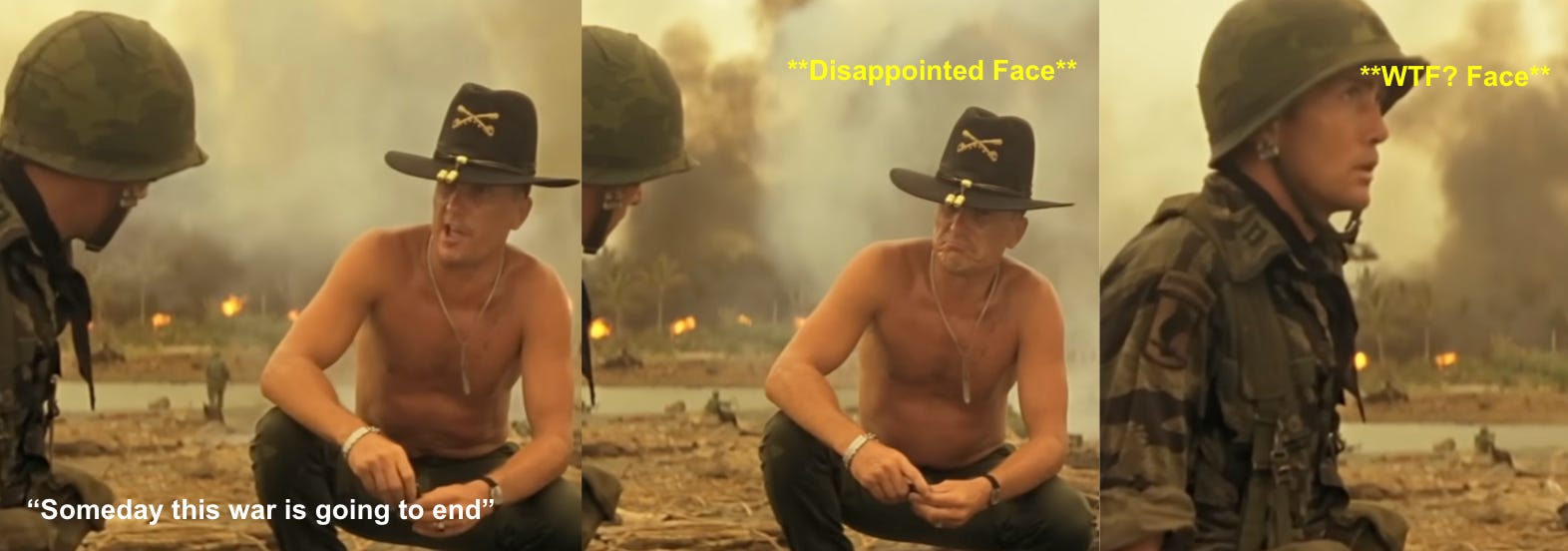
Duvall was nominated for Best Supporting Actor again but didn’t win (he’d win his only Best Actor Oscar as an alcoholic country singer in the 1983 film Tender Mercies).
In 1991, Bob Costas interviewed Duvall about the Coppola roles. He said people would randomly come up to him and say “I love the smell of napalm in the morning” as if Duvall had forgotten about it and they wanted to remind him.
Duvall then tells Costas that he specifcially asked Coppola to do the Kilgore role and says “I really liked playing it a lot”.
Turns out the surfing storyline wasn’t that absurd. Duvall embedded himself with some air calvary officers and they told him crazy tales about how the soldiers would try to stay sane while on tour in Southeast Asia. One officer used to pass time by deer hunting out of a helicopter on the Cambodian border.
Coppola and Duvall actually had a major disagreement in post-production. The director cut out a scene that Duvall thinks he should have kept in. It showed Kilgore saving the life of a Vietnamese child. Duvall didn’t want Kilgore to be too one-dimensional (a surf-loving gung-ho military fanatic).
Either way, what an incredible performance.
Duvall didn’t have much time for the “I love the smell of napalm” monologue. The US military refused to support the film’s production, so Coppola had to ask Filipino President Marcos to rent American air equipment. They had a 20-minute window with the the fighter jets that “drop” the napalm. Duvall doesn’t flinch with sounds or explosions. Just nailed it on the first take.
RIP to a true legend.
Links and Memes (So Many Olympic Ones)
Some other content for your weekend consumption:
How Does Africa Work? Fantastic conversation between Tyler Cowen and Joe Studwell, who previously wrote the classic book “How Asia Works”. Studwell thinks Africa can still grow a lot in upcoming decades because: 1) the deployment of solar power will provide more reliable energy; and 2) manufacturing labor costs have risen so much in East Asia (Studwell still thinks human labor is more flexible and affordable than potential robotics replacement for textile and lower-end tech manufacturing.
Chinese Video Models: ChinaTalk has a great overview of the progress in Chinese video models (eg. ByteDance’s SeeDance). Meanwhile, nothing can prepare you for these two SeeDance clips of Anakin Skywalker…then Larry David.
OpenAI acquires OpenClaw: Peter Steinberger tells Lex Fridman about the recruiting battle between Meta and OpenAI (that the latter won). Zuck slid into Peter’s WhatsApp DMs after the OpenClaw project went megaviral. Peter flew down to meet the teams and signed up with OpenAI in the end. His condition was to keep the project open source.
A great read on SaaS moats in the age of AI agents: Nicholas Bustamante wrote a widely-shared post on potential winners and losers coming out from this SaaS-Pocalypse based on data, UX and workflows. Here is a good rebuttal to Bustamante’s piece.
People are gambling on traffic lights…and live-streaming it. What stage of capitalism is this?
Pun of the year? Someone sued fast food chain Buffalo Wild Wings for selling “boneless wings”. He said it was false advertising because they sounded like chicken wings with the bone removed but really were just nuggets. Hilarious, I know. Anyway, the court says “boneless wing” isn’t a deceptive name and dropped this incredible zinger: the “complaint has no meat on its bones."
A romance author made “six figures” publishing 200+ book last year using AI. She’s able to generate a book in 45 minutes under different pen names and sold >50,000 copies on Kindle, including one series is heavy handsome bearded men and alliteration: “Snowstorms & Schnapps”, “Bridesmaid & Bourbon”, “Tumbleweeds & Tequila”.

Amazon’s internal AI coding assistant (Kiro) reportedly determined that the employees code wasn’t good enough and deleted it to start from scratch. This took AWS down for hours and has happened on multiple occasions. Amazon denied that it was the coding agents fault, calling it a “coincidence” that Kiro was being used but citing “human error”.
I choose to believe that Kiro pulled off the incredible Son of Anton AI bot gag from Silicon Valley: “it’s possible that…the most efficient way to get rid of all the bugs, was to get rid of all the software.”
Happy Birthday to anyone born on February 17th…no pressure:

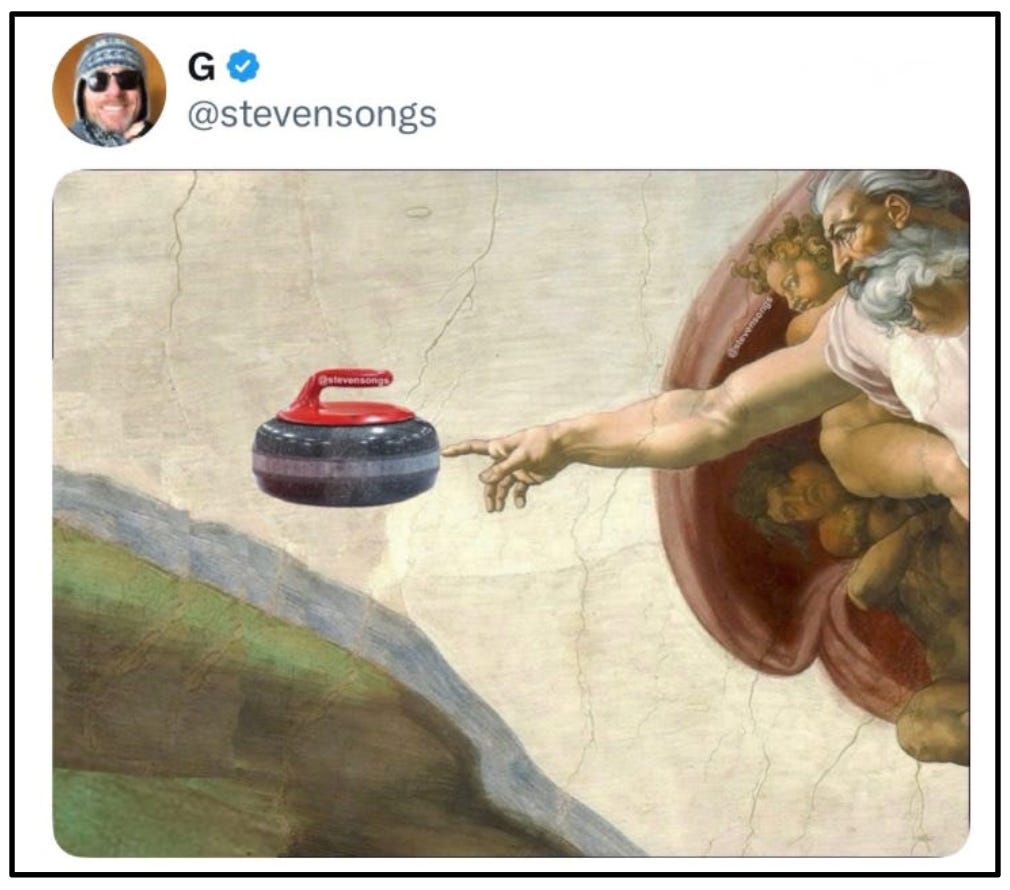
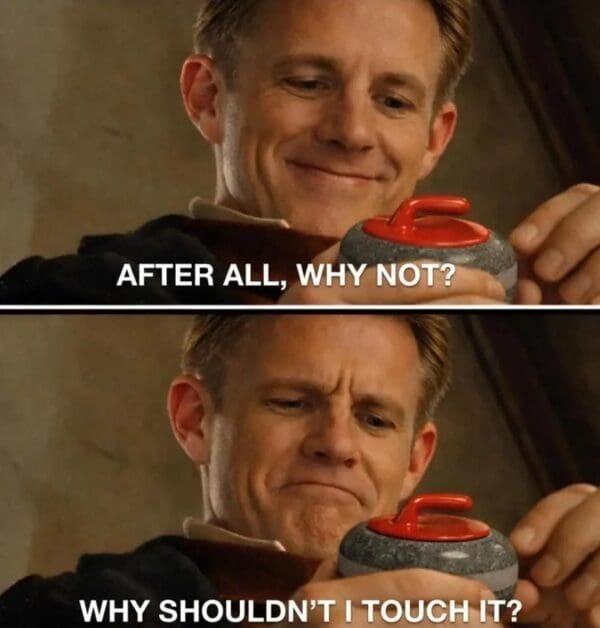
…and them wild posts (including Canadian curler Marc Kennedy getting busted for “cheating” by touching the curling stone with his index finger after letting go of the handle…I have no idea what any of that means, but the memes have been insane including this TikTok):




Re: Duvall, don't forget The Great Santini, unforgettable role....
I was saving this one for a bit as I got behind on my reading... did not disappoint.