
Thanks for subscribing to SatPost.
Today, we will break down the business of The Sphere (including my experience experiencing the Sphere experience).
Also this week:
Stanley Druckenmiller “Invests, Then Investigates”
McDonald’s CEO Viral Burger-Eating Snafu
…them wild posts (including DICK’s Sporting Goods)
A frequently used piece of online engagement bait is to post an image of an ornate medieval cathedral and caption it with “we don’t build anything beautiful anymore.”
One rebuttal — which I happily ascribe to — is to reply with an image of Las Vegas Sphere and say, “yes, we definitely do.”
Look, the latter might not be the Cathedral Notre Dame or La Sagrada Familia…or the Forbidden Palace.
But it’s still a different kind of marvel and incredible engineering accomplishment.
The exterior of the Las Vegas Sphere, known as the Exosphere, is a 580,000-square-foot LED display wrapping a 366-foot-tall, 516-foot-wide spherical structure.
This colossal screen is composed of 1.2 million individual "LED pucks," each containing 48 LEDs, to create a dynamic and high-resolution visual experience (translation: blows your got dang socks off).
The interior — which will will discuss later — is a whopping 5.7 million cubic feet.
Fly into or drive around Las Vegas and you can’t miss the structure, especially when the LED exterior is blasting an advertisement directly into your eyeballs and, from there, into your fingers to click on a purchase you don’t need.
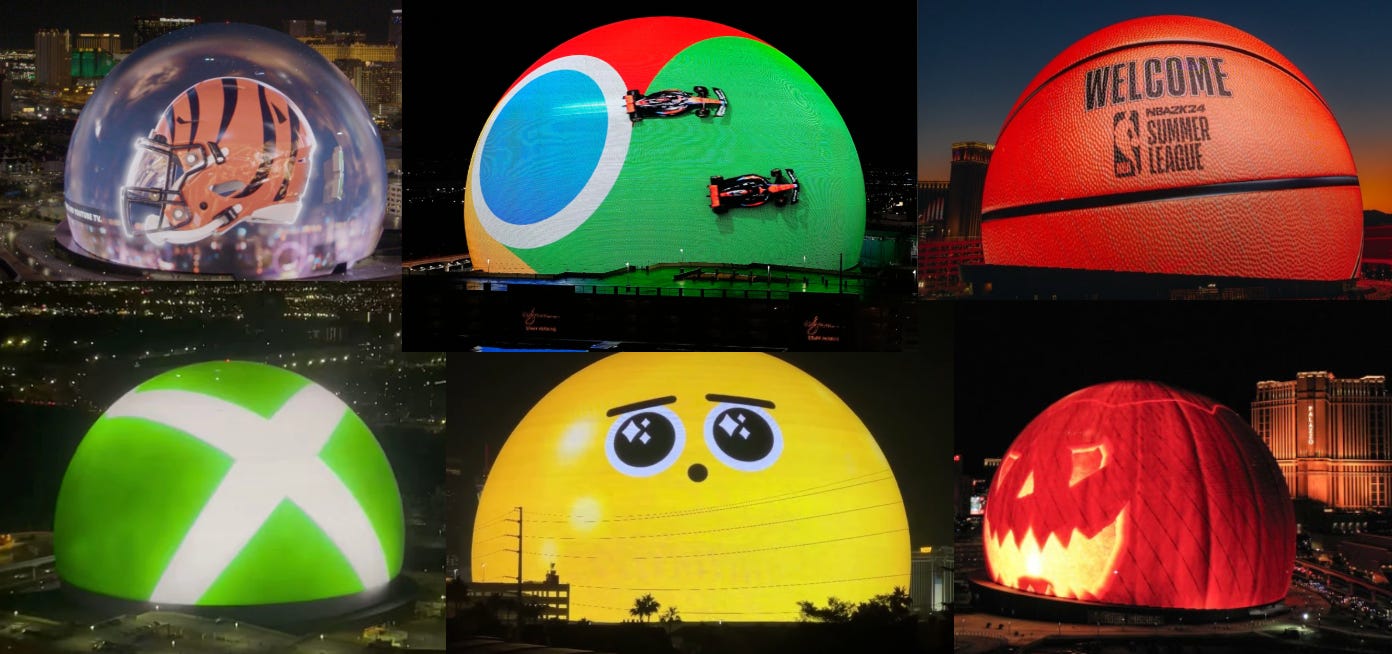
If you were to airdrop someone from the 15th century into the Wynn lobby and have them peak out the corner to see the Sphere, they would immediately shart themselves.
That’s enough visual stimuli to last a lifetime.
A recent example of the Exosphere at its best was during the debut of The Wizard of Oz last August. The classic 1939 film was adapted for the Sphere and the exterior made sure to let us know:
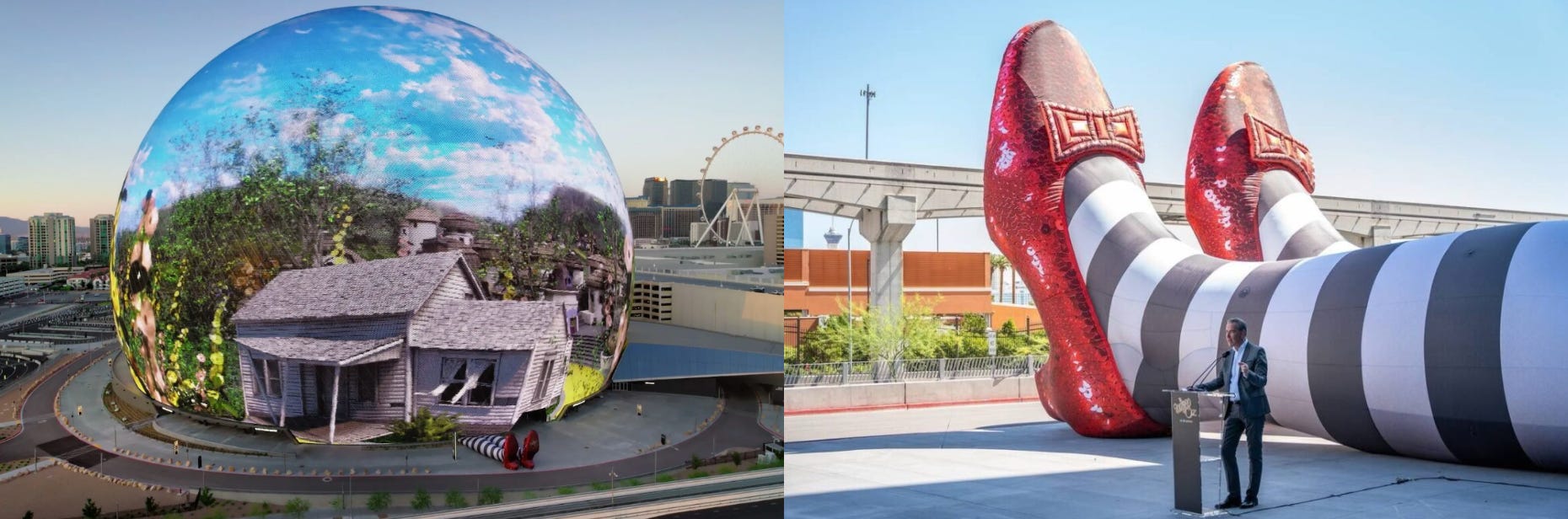
That’s just the outside.
James Dolan — the owner of Madison Square Garden, the New York Knicks and New York Rangers — spent $100m to make a version of the film fit for the Sphere’s interior (apparently, it’s official name is “Sphere” but it sounds way more natural to say “the Sphere”, so I’ma roll with that).
The bet has so far paid off: the Sphere has sold 2.2m tickets and pulled in total sales of $292m…with a stretch goal of clearing $1B…which is doable within the next year at the current rate of ~$2m a day.
Investors are loving it and the stock is RIPPING. Up 3x in the past year to a market cap of $4B. NOT INVESTMENT ADVICE.
This is a best case scenario for the Sphere because the megastructure was not cheap to build at $2.3B (specifically, The Wizard of Oz is owned IP that the Sphere can milk and sell viewers super-marked up concession stands during multiple viewings a day).
Since the launch of The Wizard of Oz, Sphere Entertainment has seen its market cap increase over 2x to $4B.
Will this business model work in the long-term, though?
We will find out…by walking through the project’s history (including my trip their last year):
Inspiration for the Sphere
An engineering masterpiece
How does the Sphere make money?
Mini-Sphere and a new business model
Inspiration For The Sphere
To understand why the Las Vegas Sphere exists, you have to understand the billionaire owner of Sphere Entertainment: 70-year old James Dolan.
And to understand James Dolan, you have to understand his father Charles.
In December 2024, the elder Dolan passed away at the age of 98 and The Hollywood Reporter highlighted his accomplishments as a “pioneering Cable TV mogul”:
Bringing cable to New York: Born in Cleveland in 1926, the elder Dolan spent his early-30s wiring cable in Manhattan high-rises because the buildings had a hard time receiving antenna signals. After wiring up a bunch of Manhattan buildings, Dolan developed the idea to attract new cable subscribers by creating exclusive programming (film, sporting events) that would flow through the wires. He cut a landmark deal with Madison Square Garden to exclusively broadcast New York Knicks and New York Rangers games.
Launching HBO: In 1971, Dolan teamed up with Time Inc. — a minority investor in his cable business (and one-time iconic media brand that has unfortunately turned into a clickbait laughingstock) — to launch HBO. Dolan dubbed the content device a “Home Box” and a colleague suggested, “Well, if it’s Home Box and we’re selling movies, why don’t we make it the Home Box Office.” That’s the start of how we got The Wire, The White Lotus, Deadwood, The Sopranos, Veep, Silicon Valley and 8-9 hours of Jeremy Strong doing Kendal Roy’s sad face in Succession.
HBO Flops, But Cable Business Explodes: After its launch, HBO only secured 10,000 subscribers in its first year. Which is fair…considering the fact that Kendal Roy’s sad face was still decades away. So, Dolan sold his majority stake to Time in 1974. He called the sale “demoralizing” but quickly refocused on the cable business. Under the brand of Cablevision, Dolan expanded cable service to New York suburbs followed by other leading American cities including Boston, Chicago and Cleveland. He’d later found American Movie Classic (AMC) in the 1980s as a production house for independent and classic films.
James was born in 1955. After graduating from SUNY New Paltz with a Communications degree, he joined Cablevision and gradually worked his way up through his father’s telecom empire.
The younger Dolan actually wanted to be a musician first
He couldn’t make a career of it…at the time.
Today, James is indeed the guitarist and frontman for JD & the Straight Shot but the band really only exists because he is…THE CEO OF A COMPANY THAT OWNS MADISON SQUARE GARDEN AND HE CAN DO WHATEVER DAFUQ HE WANTS INSIDE THE STADIUM.
The passing of the CEO baton from Charles to James took place with a sequence of corporate milestones in the mid-1990s:
1994: Cablevision and ITT (a conglomerate) acquired the Madison Square Garden (MSG) arena and ownership in the Rangers and Knicks from Viacom for $1.1B.
1995: James Dolan becomes CEO of Cablevision.
1997: Cablevision spends $650m to buy out ITT’s 50% stake in their 1994 transaction (they also took full control of New York’s Radio City Hall in the deal).
In the following decades, the younger Dolan added notable entertainment properties to the MSG portfolio including Beacon Theatre (in New York), Chicago Theatre (I’d hope that this is in Chicago) and The Forum (in LA, which it later to sold to Big Daddy Ballmer and the LA Clippers).
James is currently worth multi-Billy and controls some of the most important cultural institutions in America. But it was his father that laid all the groundwork. Based on the lyrics for one of his songs — which borrows from Bruce Springsteen’s “Born To Run” — James is very aware of how he was born on third base:
Dave, this company rips the bones from your back:
It's a death trap, it's a suicide rap.
You should have got out while you were young...
Because I have something to tell you: I'm Chuck Do-lan's son!
More broadly, James is a disliked in many parts of New York due to his hard-charging personality and business decisions. He frequently meddles in management of the popular Knicks and had high-profile beef with Knicks icons Charles Oakley and Spike Lee (there has also been blowback on Dolan’s use of facial recognition software to deny entry to MSG for people he doesn’t like).
All of this background is important because it provides the ingredients for the past decade of James Dolan’s life.
He grew up loving music, running a New York entertainment empire and living in the shadow of his father. If James wanted to truly make his own mark — but with the skills and knowledge he built since the 1980s — how could he do it?
Maybe by creating an entirely next-generation live music entertainment experience that is located thousands of miles away from his home base.
Enter the Sphere.
In 2016, James sold Cablevision to French telecom giant Altice for $17.7B. After all the paperwork settled, he had $1B in cash burning a hole in his wallet.
Dolan wanted to find a way to build up the MSG business with the funds.
Personally, I would have used the money to launch an AI-powered Air Fryer-Pizza Oven-Blender kitchen top product to take on SharkNinja. But Dolan had another (much more round-shaped) idea in mind, as he told Variety:
We had capital, and I wanted to create a growth strategy for MSG. And there was really no easy growth strategy available. Buying more venues didn’t interest us. You can’t buy any more teams. We didn’t really want to go into the promotions business, like Live Nation. But then the notion of changing the model that venues were operated with is what really spurred me on.
I’ve told this story: Madison Square Garden at the time was the busiest arena in the world, with something like 200 events annually, which still left us with 160 dark nights. And then you take a look at what were the most profitable out of the 200, and it’s the ones where we own the content — the Knicks and the Rangers.
So I wanted to disrupt the model so that I could keep the building busy 365 days a year, and wanted to own the content. How could I do that? It had just evolved that the technology was just blossoming at that point to where you could do something like the Sphere.
While noodling with a colleague, Dolan drew the image of a sphere with stickman inside.
The structure’s interior was inspired by Ray Bradbury’s “The Veldt”, a sci-fi short about a nursery with immersive walls that children used like a VR room:
It’s kind of amazing that Bradbury wrote that story in the ‘50s, and it really was about experiential media — and in the case of ‘The Veldt,’ in the home — and talked about crystal walls that turned into landscapes.
I mean, it was not dissimilar to what we’re doing [with The Sphere]. So, as we started to talk about what we could do technologically with the venue, ‘The Veldt’ came to mind right away. Could we create those kinds of experiences inside of the venue? I don’t think that we quite achieved Bradbury’s vision with it, and I don’t really want to completely achieve his vision, because in the end of his story, the parents get eaten by the lions. I think that would mean I would get eaten by the lions.
Construction on the Sphere began in Fall 2018. Dolan partnered up with casino giant Las Vegas Sands, which provided land near its Venetian Resort (PE firm Apollo later bought the Venetian for ~$6B in 2022).
The wildly ambitious project blew through its $1B budget and the final price tag was $2.3B. This overrun was a combination of rising construction costs during COVID and the fact that the Sphere was an insane engineering challenge.
Truly a “one-of-one” as we’ll see in the next section.
An Engineering Masterpiece
Almost exactly a year ago, I did a weekend trip to Las Vegas and — despite seeing 56,876 memes of the Sphere in the preceding 2 years — I was still shocked when confronted by this giant half sphere plopped a few blocks away from the Wynn and Venetian resorts (and, importantly, only a 14-minute walk from the nearest Benihana).
The animations on the Sphere’s exterior (aka the Exosphere aka the biggest screen in the entire world) are possible because of 1.2 million hockey puck-sized LED lights.
This system was designed by the same team that made the Burj Khalifa’s exterior lighting system.
Every viral visual (basketball, pumpkin, smiley face emoji) is actually more impressive from a distance. Why? Because the pucks are actually 8 inches apart and the lights don’t blend as well together until you’re further away.
The wow factor near the Sphere is the size itself: with a height of 366-feet (and width of 516-feet), the structure is taller than Big Ben (316 feet) or Statue of Liberty (305 feet).
Then, you enter the Sphere and prepare for your socks to be blown off.
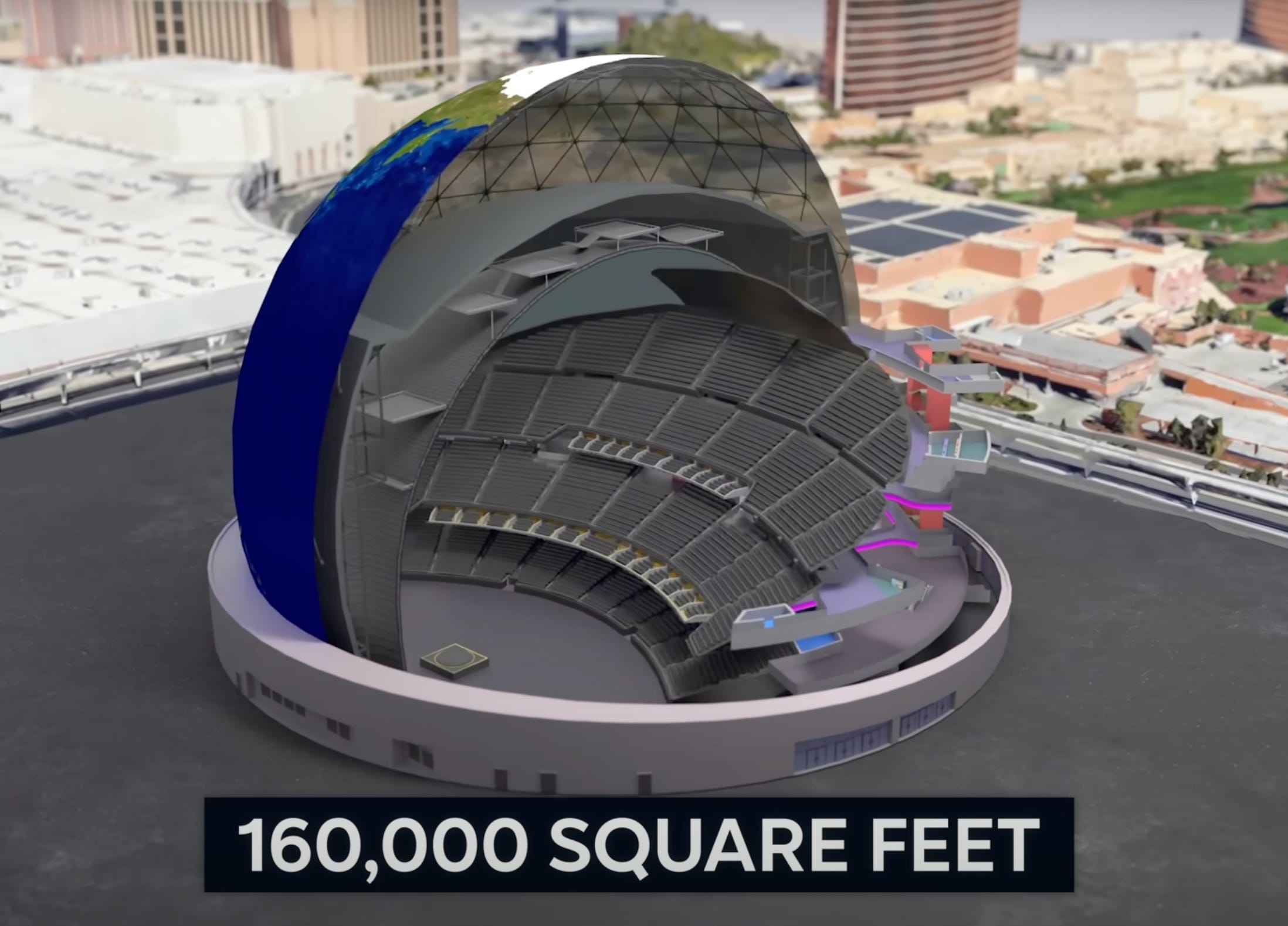
Recall that James Dolan is obsessed with music and one of his goals with the Sphere was to create the world’s most unique music venue (which was also why the City of Las Vegas was so keen on the project):
18,600 seats
167,000 speakers (that’s 8.4 speakers per person)
The world’s largest LED screen ever (160,000 square feet), which is 20x larger than the largest iMax screen (total of 256 million pixels).
The screen is made of LED tiles that bend above and behind the viewer’s head (the Exosphere display is still somehow is 3.5x larger than this LED screen).
Then there is the audio. Dolan’s favourite. The YouTube channels for MegaBuilds and Jared Owen have great breakdowns on the structure and explain how the sounds work.
Basically, the 167,000 speakers are behind the super-thin tiles of the LED screen.
Using the same principles as noise-cancelling headphones, the Sphere’s sound system can calculate — and target — which audio tracks point to which seating area.
The official name of the technology is “sound beaming” and it means that each of the 18,600 seats receive “headset sounds without the headset”.
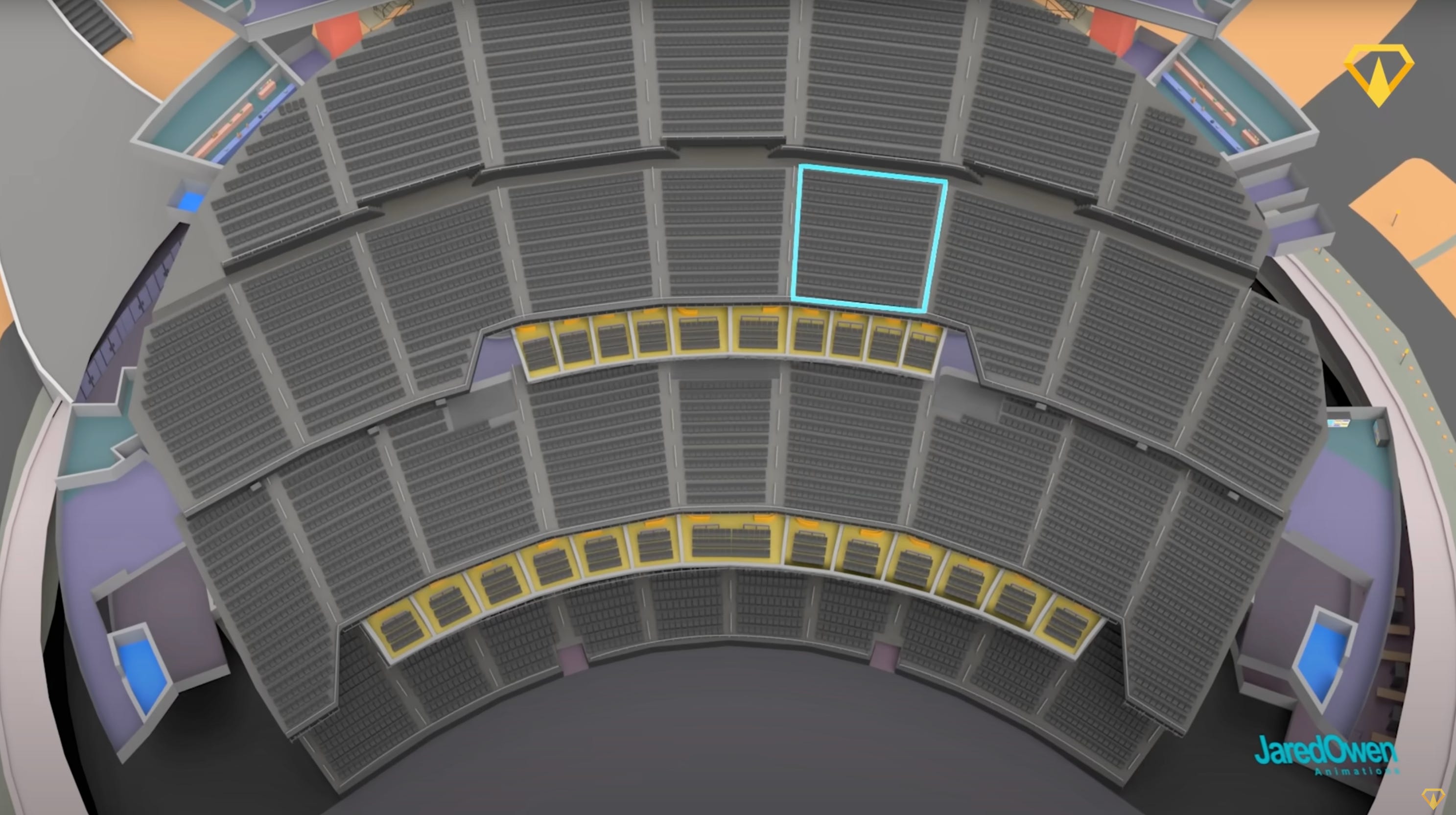
To flex the venue’s technology, Dolan knew he had to reach out to the right musical act and that’s why he approached U2 in the Fall of 2021 to become the opening attraction.
Willie Williams — U2’s creative director since the early 1980s — initially thought doing a show at the Sphere was a “terrible idea”.
U2’s iconic tours have been breakthrough custom sets from Zoo TV in the early 1990s (pioneering giant screens on stage) to the 360 Tour of late 2000s (360-degree stage for stadium shows).
They weren’t keen to build an act around the Sphere’s requirements. Domes are typically awful for sound. Also, Dolan’s team was asking them to fill the most ambitious audio-visual specs ever.
Ultimately, the idea of a residency (instead of a moving tour) appealed to U2 because of COVID travel uncertainty.
The Sphere resolved the “domes suck for sound” issue with its 167k speakers including one in each seat.
Every person got a “getting studio-quality sound” according to Dolan.
Meanwhile, the visuals were a collaboration with the world’s top creatives (Es Devlin, Marco Brambilla, John Gerrard and long-time U2 collaborator Brian Eno).
The amount of data created to fill the LED screen is mind-boggling, per Wallpaper:
there are 268,435,456 pixels…
…which is equal to 72 HD TVs
… which is equal to 12k screen resolution
…which means “every minute of content produced for Sphere is the equivalent of one hour of streaming television”
“With all the big stuff I’ve done for U2 and anyone else, we don’t start with the equipment, we start with the idea, and then figure out what we need to realize that idea,” Williams tells Variety. “And sometimes it involves big video, sometimes it doesn’t. Whereas here, the only given we had going in was the building — and a building that didn’t exist, and in fact isn’t finished now. So it was odd starting a show with hardware and with a space rather than the other way around.”
The band opened in October 2023 and its 40-show residency ended in March 2024.
We all saw the viral videos and the effort has since been replicated by Phish (April 2024), the Grateful Dead (May-August 2024, March-May 2025) and Backstreet Boys (July 2025-February 2026).
U2 wasn’t the only attraction to open with the Sphere.
Dolan tapped director Darren Aronoskfy to make a film to flex the audio-visual features.
The Aronoskfy project is called Postcard From Earth. The 55-minute film is like a nature documentary and tries to cover the earth’s timescale from a single-cell organism to pre-human nature to a space-faring society.
Packed with unbelievable visuals earth and space, the Sphere team had to design a special camera to fill the pixels on the 160,000 square foot wraparound screen (normal film cameras capture film for a flat rectangle).
The Sphere team initially tried welding together 11 cameras to create the right effect but it didn’t work.
Enter the Big Sky Camera: the 316 megapixel camera has a 165-degree view and shoots 18K film at 120 frames per second. The device requires 12 people to operate (comparable to the avocado-smashing operation at your local Chipotle) and each second of film it records is equivalent to 60GB of data (comparable to my collection of meme screenshots on my phone that I will never look at or use but will also never ever delete).
The film content is so baller that the crew has to view the footage in VR helmets while on set to capture the full field of view.
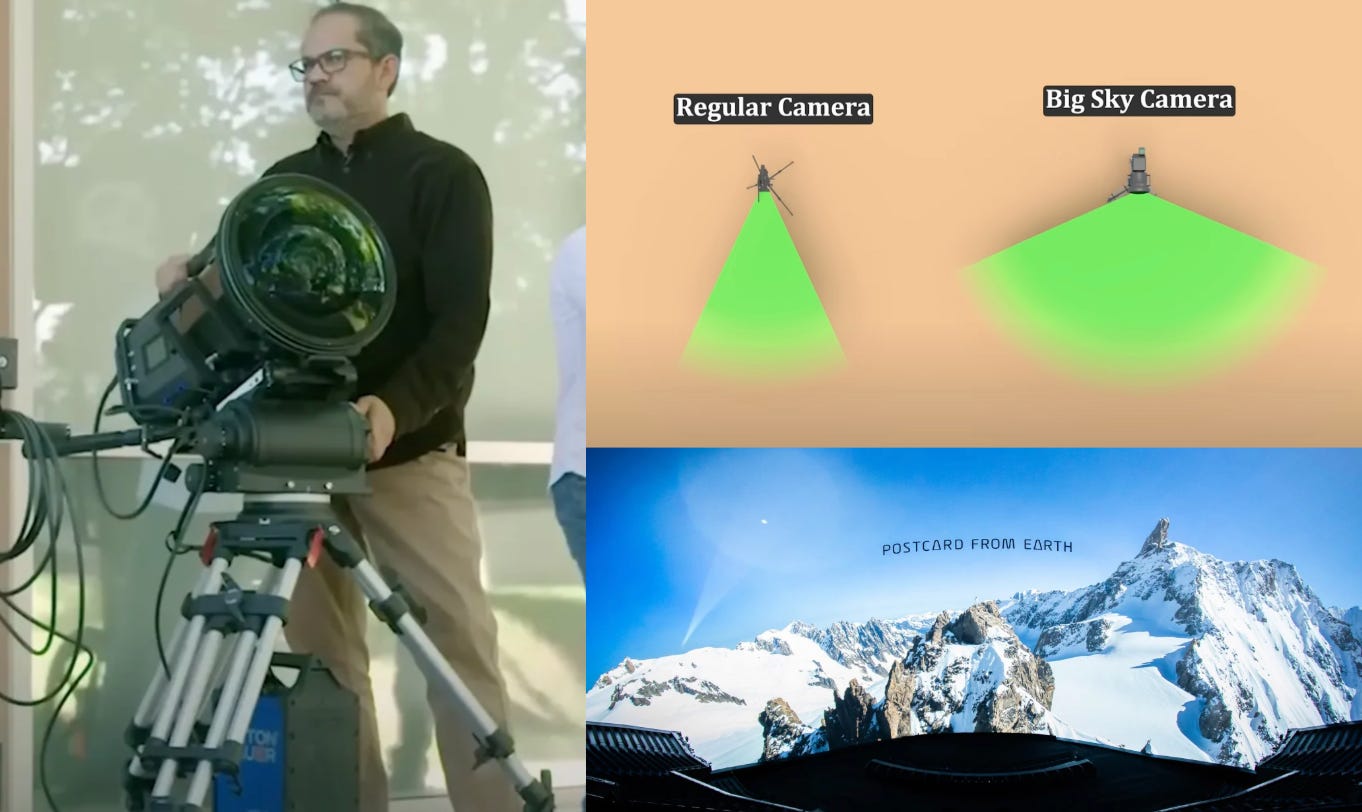
In addition to the Big Sky Camera, MSG built a quarter-sized replica of the Sphere in California called Sphere Studio to test and edit content.
We haven’t even mentioned seat haptics and 4D features (wind, smells) that are also at the disposal of people creating content for the Sphere. So, yeah, there I mentioned them.
The combined investment created arguably the world’s best audio-visual experience.
In the next section, we’ll discuss how Dolan has monetized his unique offering.
How does the Sphere make money?
The easiest way to understand the Sphere’s business model is to re-iterate a point that James Dolan made about Madison Square Garden:
…take a look at what were the most profitable out of the 200 [nights of events at MSG], and it’s the ones where we own the content — the Knicks and the Rangers.
Consider the U2 residency and Darren Aronofksy’s Postcard From Earth.
It’s estimated that Bono and the U2 Bros made $250m+ from the 40-show residency at the Sphere.
The majority of that figure is from ticket sales, which we can back into with some quick-and-dirty napkin math: 40 shows x 18,0000 people x $400 per ticket = $288m.
While the Sphere took a small cut at the box office (probably 10-15%), it made dough on merchandise and insanely marked-up F&B.
With Postcard From Earth, the Sphere gets to keep ticket sales (which are $100 each!!!) and that sweet sweet high-margin sweet sweet concession. I spent $200 on a t-shirt, two popcorns, two waters, Apple Cider, Wine and a blinky cup for my son during our Postcard From Earth visit.
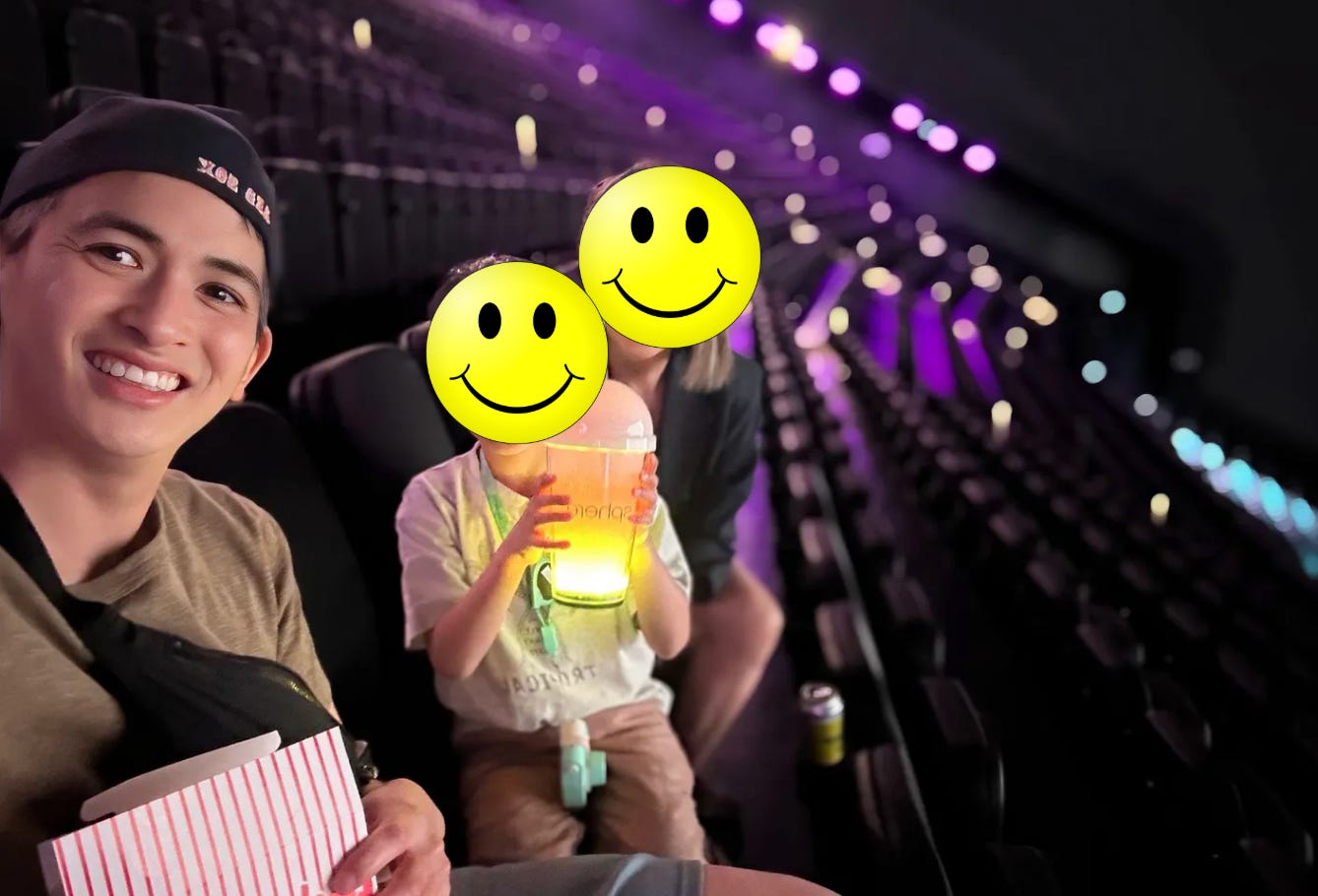
To make the film experience feel triple-digit worthy, ticket holders are encouraged to explore an atrium area with a giant holographic wall and five humanoid AI robots that allow guests to ask questions (“Hey Aura, what is the mark-up on the $18 M&Ms I just bought?”).
It was admittedly very very cool. IMAX on HGH, steroids and black market Chinese peptides. Head craning in every direction. AI could never.
An average audience size for the film is probably in the 5,000-range but the Sphere can play 4-5x a day…every single day. To date, they’ve sold 4 million tickets to Postcard From Earth for a total haul of $400m (compared to the film’s estimated budget of $80m).
According to Lucas Shaw at Bloomberg, the Sphere’s estimated tickets sales for 2025 reflect a split of 67% for films (including Postcard From Earth and Wizard of Oz) and 33% for live concerts (including Backstreet Boys, Dead & Company, The Eagles, Phish, Vince Gill, Zac Brown Band, No Doubt).
For more color, I looked at Sphere Entertainment’s quarterly earnings.
Let me pause a second to clarify Dolan’s empire.
It’s three three public companies:
Madison Square Garden Entertainment Corp (MSGE): It owns and operates venues including Madison Square Garden, Radio City Music, Beacon Theatre etc.
Madison Square Garden Sports Corp (MSGS): This entity owns the New York Knicks (NBA) and New York Rangers (NHL) franchises…and Dolan is considering splitting up ownership of those teams into two separate publicly-listed firms. Stay with me.
Sphere Entertainment (SPHR): This bad boy owns the Sphere and MSG Networks, regional cable and streaming networks.
Something that makes SPHR a bit hard to value is that its yolked to the dying cable industry and there’s been a lot of chatter for Dolan to spin off the debt-laden MSG Networks business.
With all that preamble, it is actually very straightforward to break down the Sphere’s financials from the recently released 2025 annual.
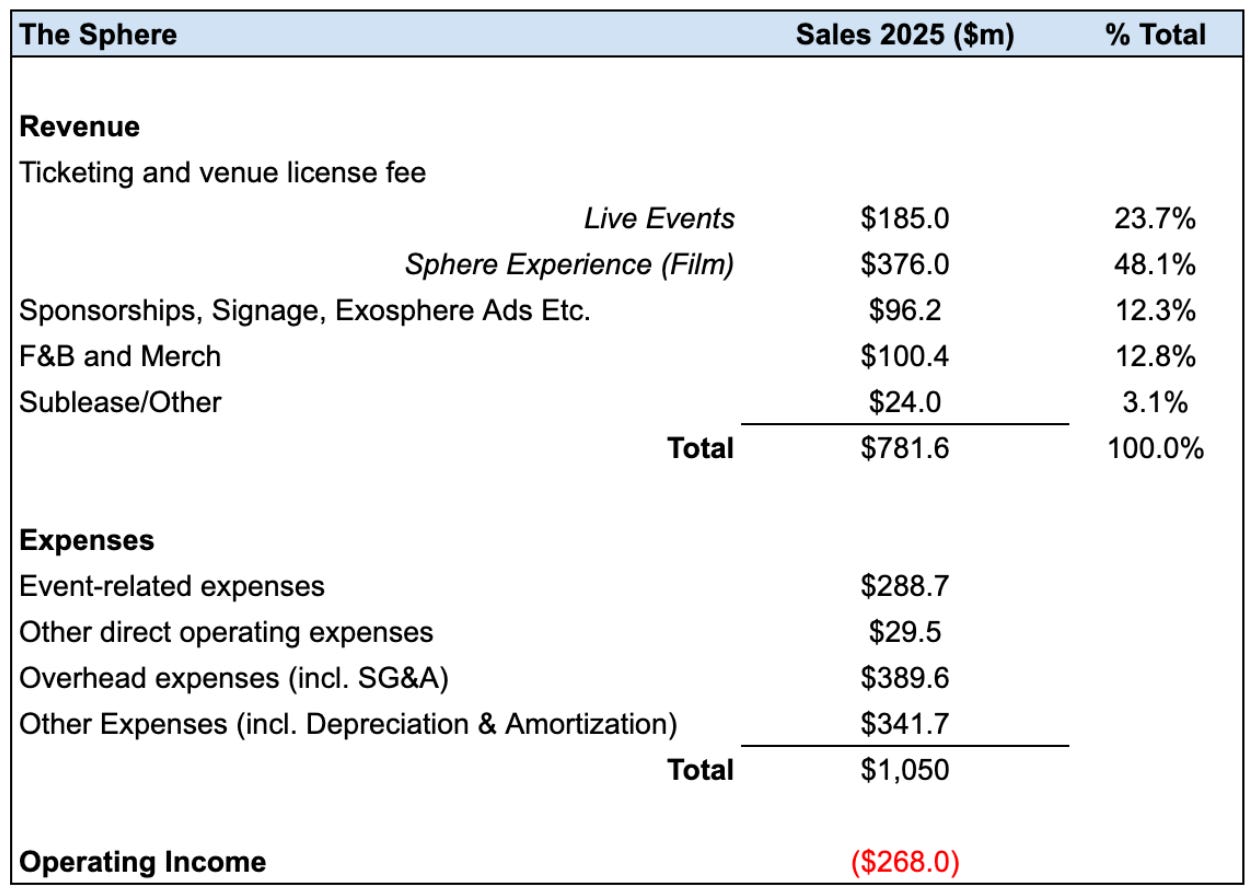
Sphere Entertainment doesn’t break out the film and live event segments. Let’s assume the aforementioned ticketing split of 67% film and 33% live concert.
Here is a breakdown of its $782m in 2025 revenue.
Films: 48% of total revenue
Live Events: 24%
F&B and Merchandise: 14%
Sponsorship and Exosphere Ads: 14%
Somewhat annoyingly, Sphere changed its reporting year end from June 30 to December 31. So, I wasn’t able to make a direct comparison but the 2025 sale of $782m looks to be up 30% from ~$600m in calendar 2024.
While the Sphere is still running at an operating loss (negative $268m in 2025), it would have been profitable without the significant depreciation expense ($341m).
Notably, Sphere’s Q4 2025 saw revenue jump 62% YoY while the quarterly operating loss declined from $108m to $7m.
The Sphere will likely be operating in the green soon and it’s riding some long-term cultural trends.
People are pining to share live experiences with other people and I don’t think LLMs will be able to recreate singing “I Want It That Way” with 15,000 other millennial Backstreet Boys super fans (fun fact: I saw the boyband when they randomly toured Vietnam in 2011 and sat next to AJ at an after-party at a Saigon nightclub).
The business is clearly improving and the formula for making Sphere a profitable venture is not complicated.
What is the Sphere’s long-term potential?
Here is how the Sphere wins:
Keep Las Vegas Sphere open 350+ days a year.
Sell 15,000 film tickets a day across 3 showings.
Sell Sphere blinky drink bottles at 5x markup
Have 100 days of musical acts a year playing in the evening.
Sell popcorn, M&Ms and 500ml bottles of water at 10x markups.
That’s about $1.5B in revenue right there (~2x the current business) and the operating costs wouldn’t change much from the current steady state.
While the live performances will grab headlines — including a Netflix rematch between Manny Pacquiao and Floyd Mayweather scheduled for September — it’s the films (and the owned IP) that will really bring home the bacon.
The Wizard of Oz is instructive and Dolan described it as “an important blueprint for our long-term vision”, per Deadline:
Blessed by Warner Bros and brought to the spherical venue by producers including Jane Rosenthal and technology from Google DeepMind, the new version has a running time of 75 minutes. Nearly a half-hour shorter than the 1939 original, the Vegas incarnation is able to squeeze in multiple daily showtimes, alternating with live musical acts like the Backstreet Boys and Phish. It is also highly interactive, with drone-controlled monkeys flying around the auditorium, tornado-simulating wind machines and bonus experiences in the merch-filled lobby.
[The Wizard of Oz at Sphere] is a wholesale rethink of the film — by necessity, given it is filling the largest screen in the world, a vastly different canvas than the rectangular ones in traditional movie theaters. Controversially, it used AI to refocus or restore characters cut from the original, and even integrated fleeting images of Dolan and Warner Bros. Discovery CEO David Zaslav in one black-and-white sequence.
Dolan is already working on another version of The Wizard of Oz which will presumably be even Spherey-er.
The Sphere’s next major film project is an extreme sports documentary titled From The Edge, to be made in partnership with the creators of the Netflix film Free Solo about superchad climber (and Mr. Taipei 101) Alex Honnold. From The Edge will show footage from various extreme sports.
Other top-tier directors are in talks to copy the Arronosky playbook, too.
James Cameron told The Town podcast that he’s interested in doing a project for the venue (The Wizard of Oz is Cameron’s favourite film ever).
I’m very interested because I like the Sphere as a format…and I’m looking for a way to actually do something myself. I want to see the decisions that they made [adapting The Wizard of Oz] around linear narrative with cutting to close-ups and medium shots and wide shots and how well that worked.
For the Trapital podcast, Dan Runcie and Tati Cirisan had a timely conversation on what other IP could do well at the Sphere.
The The Wizard of Oz as IP sets a high bar since it is globally known and nostalgic enough to get people off their butts and down to Las Vegas.
What about Disney’s Fantasia? Or Spielberg’s Jurassic Park? Or Nolan’s Interstellar? Or Cameron’s Avatar? Or Rob Schneider’s Deuce Bigelow: Male Gigolo?
Treat the Sphere as a theme park ride and bring the type of content people want to see at Disneyland or Universal Studios.
How about partnering with Netflix? The streamer is making a push into live events and in-person experiences. The Sphere could have done some crazy viewing / theme park experience for the Stranger Things finale (eg. re-create The Upside Down).
Or the Sphere could be a super-size version of Cosm (aka IMAX for sports bars).
A more macro question is Las Vegas itself. While the Sphere is pricey, almost everything in Las Vegas has reached “rip-off” levels since the major casinos went public and private equity started getting involved.

The Sphere spent $2.3B to try something new and it is a unique experience. However, its fortunes are obviously linked to Las Vegas tourism and those numbers have been on decline.
Tourism trends for Las Vegas are looking quite grim, per Slate:
Hotel occupancy has cratered. Rooms were only 66.7 percent full in July, down by 16.8 percent from the previous year. The number of travelers passing through Harry Reid International Airport also declined by 4.5 percent in 2025 during an ongoing ebb of foreign tourists, for familiar reasons. Canadians, historically one of the city’s most reliable sources of degenerates, have effectively vanished. Ticket sales for Air Canada jets flying to Las Vegas have slipped by 33 percent, while the Edmonton-based low-cost carrier Flair has reported a 62 percent drop-off. Dolan said that 10% of visitors to Las Vegas have visited the Sphere, so this is a macro trend to keep an eye one.
Canadian visitors were put off by “51st State” talk and could very well bounce back in years to come.
But one worrying trend is that young people aren’t as interested in Las Vegas. Keen travellers can jet off to anyone in the world and get their exact fix on any budget (don’t need the fake Vegas Eiffel Tower when you can get the real thing for cheaper).
Gambling is now a smartphone swipe away. And the Gen-Z/Gen Alpha generations aren’t very interested in booze and those $5k bottles of Grey Goose at Hakkasan.
The Sphere does have global expansion plans, though. Some geographic diversification can help mitigate the risk of further Las Vegas decline.
Having completed the structure and proven a business model, MSG is licensing the design plans for the Sphere — including 5,000 seat “mini-Spheres” — around the world and selling them its owned IP.
A notable arrangement struck between Dolan and Abu Dhabi’s Department of Culture and Tourism (DCT) last July. The DCT pays an initiation fee and covers the cost of construction, with the Sphere team overseeing the project. Once the structure is built, the Sphere receives other revenue streams:
annual franchise fee (for 25 years)
an ongoing fee for operational services
content royalty with an annual fee based on a specified percentage of total ticket sales
Tourism authorities in Saudi Arabia and South Korea are also considering mini-Spheres (London’s Mayor turned down the attraction “due to significant light intrusion, potential harm to human health and amenity for residents, and concerns about the project's high energy use and sustainability”).
In January, the State of Maryland struck a deal with Dolan to bring a mini-Sphere to National Harbor, about 15 minutes from downtown Washington, DC. It will receive $200m in state, local and private incentives with a completion date around 2030.
How much could these mini-Spheres make? I’m just going to put my finger in the air and guess that a fully operational mini-Sphere will spit off $25-50m a year for the Sphere parent (that sweet sweet high-margin licensing and royalty fee).
There is also a secondary benefit for live acts: all of the investment they put into creating a Sphere-specific product can take the “show on the road” to other sites. This could be a further inducement for top-tier artists that have taken on the residency model (eg. Harry Styles doing 30 shows at MSG or Beyonce setting up a shop in a handful of cities and having fans come to her).
With the Sphere more established, the venue could also take riskier shots with the musical acts…not just guaranteed older tickets (eg. Grateful Dead, Phish, Eagles, Backstreet Boys).
Assuming that Sphere Entertainment can get 10 built, that’s a solid $250-500m a year with many sites not requiring a 9-figure upfront investment from Dolan.
Firing on all cylinders — like the cast of 2008’s Tropic Thunder — and you’re looking at a $2B a year business ($1.5B in Las Vegas directly owned + up $500m a year from mini-Spheres around the world).
In the grand scheme of things, the Sphere probably tops out at a $10-15B market cap.
Still impressive considering the rocky start.
Perhaps more importantly for Dolan, the project is definitely something he can call his own (away for Charles’ shadow). And, who knows, maybe people will be posting an image of the Sphere in a few decades with the caption “we don’t build anything beautiful like this anymore.”
That’s priceless.
Today’s SatPost is brought to you by Bearly.AI
Why are you seeing this ad?
Because I co-founded an AI-powered research app called Bearly AI. And I really like putting blue buttons in this email.
If you press this blue button below, you can save hours of work with AI-powered tools for reading (instant summaries), writing (ChatGPT) and text-to-image art (literally type some text and get a wild image).
It’s all available in one keyboard shortcut (and an iPhone app).
Stanley Druckenmiller “Invests, Then Investigates”
Investing legend Stanley Druckenmiller went on the Morgan Stanley podcast at the end of January (and the episode was published last week).
Druckenmiller’s views on business and investing have been sought after for decades.
He spearheaded the trade that broke the Bank of England, when George Soros’ Quantum Fund made $1B by shorting the British Pound in 1992. He also has an insane track record with his own Duquesne hedge fund returning an average of 30% a year over a 30-year stretch (without a single down year).
Soon, two people that worked under him will hold the most important finance-related jobs in the White House (Scott Bessent is currently the Treasury Secretary and Kevin Warsh has been nominated to be the next Fed Chair).
Let’s chat about two things from the podcast. First — and not investment advice — Druckenmiller talked about his current portfolio. He’s long Japanese and Korean equities on its AI and long-term manufacturing potential. Long copper because of tight supply and the AI trade. Long gold because of geopolitical uncertainty. Short US treasuries. He says he changes his mind every few weeks…so keep that in mind.
Second, he provided a breakdown of his recent Nvidia trade. It made 6x over 2 years, profiting $1B+ before exiting the position in 2024.
This trade is an example of Druckenmiller’s philosophy to “invest, then investigates”.
Basically, put some skin in the game because it forces you to study up on the position (Disclaimer: the strategy works really well when you’re one of the greatest investors ever and have incredible intuition…less so when you are me and bough an animal-themed NFT because it looked funny and an anonymous Reddit post 47 replies down in a thread said it was “the most guaranteed 100x you’ll ever find”).
Still worth studying Druck’s thought process and here is how it went down:
In early 2022, he started seeing Stanford students switch from crypto to AI projects.
His “superstar” analysts brought this to his attention and he asked around Silicon Valley network about AI.
Druck wanted to make an AI investment and his partner said Nvidia (Druck bought “enough to get hurt or make some money”…forced him to keep track).
ChatGPT launches two weeks later...immediately realizes “enormity” of opportunity and Druck doubles the position.
He listened to a Morgan Stanely macro analyst call and they mentioned that AI is bigger than any macro trend...Druck (after experiencing ChatGPT) doubles the position again.
By early 2023, he’s fully bought into AI as a “massive massive change”. Pattern recognizing on previous major tech changes in his career, Druck knows Nvidia will keep running for at least 2-3 years as the rest of market catches up and re-rates.
He holds the position even as his tech-expert investor network sells Nvidia for the quick profit.
Druck intends to hold long-term but sells it all in 2024 at $800 a share. He got in at $100-$150 and says he couldn’t handle the rapid rise. It was too successful of a trade. Nvidia quickly runs to $1,400 and he “felt sick” selling. Says his biggest mistakes are always “selling too soon”, but that’s just part of game of investing for him.
Druck then drops this incredible bar: “My advantage is not IQ, it’s trigger pulling.”
Definitely check out the entire episode.
If you’re looking for more timeless Druck, then check out my 40-minute interview with the legend in 2021. Massive shoutout to my friend and former colleague RJ Assaly for setting up the chat. Such an honor.
This was my fave exchange:
ME: Why don’t you short Dogecoin?
STAN: I don’t like putting campfires out with my face.
Funny note: I had just moved to a new place before the recording. Lighting for my camera was off and the USB cord on my mic fell out during the chat. The sound totally jagged but I kept the mic up for optics… and this gentleman Jonathan Smith called me out on it hard in the YouTube comments LOL:

McDonald’s CEO Viral Burger-Eating Snafu
I’m guessing many of you have seen the video of McDonald’s CEO (Christopher Kempczinski) eating the new Big Arch burger.
Kempczinski has been actively posting on his Instagram account because in 2026, it behooves public-company CEOs to go direct to the audience and show their “authentic” side.
Since taking over as CEO in 2019, Kempczinski has been clocking ~$20m a year so it’s not a huge ask all things considered.
BUT DAMN! Who the hell thought it was a good idea to let him post the Big Arch burger review.
It was a very unenthusiastic review all things considered.
Bro just mailed it in and did NOT look like he wanted to be eating the Big Arch:
It’s overly staged (the fries are pointing outward (no one does that) and forced (he claims “I don’t even know how to attack it”)
He calls the burger a “product” … which is kinda funny tbh.
Exclaims that the burger has “patties, sauce, some lettuce — there’s so much going on with this burger”…which is literally table stakes.
He said “that’s a big bite for the Big Arch” and it was literally a nibble.
“Going direct only works when it’s authentic,” writes Lulu Cheng Meservey about the clip. “Really kills the mood if it feels like the CEO’s blinking in Morse code.”
Here’s the thing. You put Trung Phan in front of that burger and I am going to town. Yes, I know. McDonald's is awful for you. I can't help myself. I've probably had the Big Mac + Two Cheeseburgers + 6 Nuggets + There Will Be Hell To Pay On The Dumper Tomorrow AM Combo at least 100x (half of which was after the bar at 2am).
Naturally, a bunch of other fast food CEOs jumped in the fray. Burger King. Wendy’s. A&W. (Thankfully, nothing yet from Arby’s or Taco Bell).

The internet cooked Kempczinski for a solid 72 hours and a running theme was that he was the canonical “manager that doesn’t actually care about the brand and who’s skill is rising to the top of bureaucratic organizations”.
He may love the product…but his CV is also MBA Brand Management 101: Duke —> Brand Manager P&G —> Harvard Business School —> Boston Consulting Group —> 8 year PepsiCo —> 7 years Kraft Heinz —> 11 years McDonald’s.
Honestly, that’s the CV you want to run a Fortune 100 consumer brand: McDonald’s is the 65th largest company in the world with 44,000 locations, $26B annual sales and a $233B market cap.
It’s rare to have founders still running these kind of things. The board’s really paying him to keep the trains running on time, not social posts. He’s trying whatever. It’s funny. Keep eating burgers bro. Give me more potential engagement.
Speaking of founders, Ray Kroc — who started as a franchising agent for McDonald’s before snatching it from Richard and Maurice McDonald in the 1960s— went founder mode on burgers. He used to drive unannounced to burger locations and eat a few a day. He’d then go through his competitor’s trash cans to find burger wrappers and gauge sales.
Dude loved burgers. Then, he really loved burgers because he realized it was the best way for him to buy land and make sure his tenants (McDonald’s operators) could sell a product that paid his rent.
McDonald’s is still having the last laugh, having outperformed peer fast food brands in the past 5 years including:
McDonald’s: +60%
Chipotle: +37%
Yum! Brands (Taco Bell, Pizza Hut, KFC): +52%
RBI (Tim Hortons, Burger King, Popeyes Louisiana Kitchen): +13%
Wendy’s: -63% (yes, minus 63%, oof...although the Wendy’s social account did call McDonald’s CEO “McNibble”...which is objectively funny)
Oh, and Mickey Ds ($233B) is worth nearly 2x all of them combined (CMG $49B + YUM $44B + RBI $33B + WEN $1B = $127B).
As for Kempczinski, someone found another video of him eating a Big Mac and Big Mac McChicken…and he is fully redeemed in my eyes for earnestly describing the burgers as if it was a wine tasting: “visual appeal”, “tempered cheese”, “beef notes” and “different mouth feel”.
Then, the piece d’resistance: his latest Instagram post is about how he’s been asking Gemini to pitch new product ideas and it suggested McRib Nuggets (!!!) and more Korean sauces. Look like McDonald’s stock has an AI narrative now and we all know about it because of the viral attention his Big Arch stunt has created.
Kempczinski learned a thing or two from HBS. Congrats, we all got played like fiddles.


Links and Memes
Some other links for your weekend consumption:
While the burger chains were fast-food posting away…cookie brand Crumbl discovered the ever-present downside of social media food posting.
Japan’s public transportation is so good….you get sightings of GOAT baseball players and Crown Princes.
The DoW severing its relationship with Anthropic…did not have to happen the way it did and Dean Ball is very concerned on the long-term implications for the AI industry and political process.
How 168 Spaniards conquered the Inca Empire…a fascinating 6-part podcast series from The Rest of History on Francisco Pizarro taking on Emperor Atahualpa in the mid-1500s.
Two Asian doctor parents had 5 doctor kids…masterclass in Asian Household Family Maxxing.
Anthropic is on the craziest revenue ramp…in the history of B2B tech. It’s annual run rate went from $10m (2022) to $100m (2023) to $1B (2024) to $9B (2026) to a run rate of $19B (as of March). Could very well be $30-40B by end 2026.
Apple dropped a $599 laptop called MacBook Neo…with 8G memory, 252G storage, 13-inch screen and A18 chip. It’s $499 for students and will probably wipe a significant part of Chromebook and Windows OEM business (Asus, Dell, Lenovo). MKBHD with a solid 8-minute overview.
…and here them wild posts (including DICK’S Sporting Goods running an app promotion that shot it to the top of the Top Downloaded Free App charts next to Claude, Gemini and ChatGPT):


I've gone down the rabbit hole reading about the Sphere since it first opened (U2's performance was AMAZING!!), and this is one of the best since it brought up James' father, whom I didn't know anything about except Cablevision.