Thanks for subscribing to SatPost.
Today’s write-up is on the Anthropic S-1, which is eyeing a $1.5T IPO within the next month.
PS. Post and meme round-up at the bottom of the page as always (including the Halloween costume of the year).
The Anthropic S-1 dropped on Monday. While it left out share price ranges, the startup — which was founded in 2021 (insane) — is looking to fetch a reported valuation between $1.5T and $2T.
It’s a crazy story and we get a real look into the economics of a leading frontier AI operation. Never in the history of capitalism has a startup gone from $0 to $60B+ in annual revenue in under 6 years (equally ludicrous: Anthropic only burnt $10B of capital to get to this point).
In terms of revenue, Anthropic is already in the ballpark of global corporate juggernauts including Goldman Sachs ($70B TTM revenue; founded 1869), United Airlines ($66B; 1926), Pfizer ($64B; 1849), and Unilever ($60B, 1929) while also 30x Wendy’s ($2B, 1969). Impressive.
Within minutes of the S-1 release, the timeline was filled with “I just read the Anthropic S-1 and here are my 15 takeaways”. C’mon. No you didn’t. The document is over 400 pages.
You fed it to Claude — Anthropic’s frontier LLM named after the legendary mathematician Claude Shannon (aka “The Father of Information Theory” and juggling while on a unicycle enthusiast) — and asked for the juiciest numbers.

Did I feed the PDF to Claude and then ask for some nuggets? Yeah, of course I did.
In fact, I took it one step further and asked Claude to “bro, read the Anthropic S-1 and make me a one-page investment banking summary memo”.
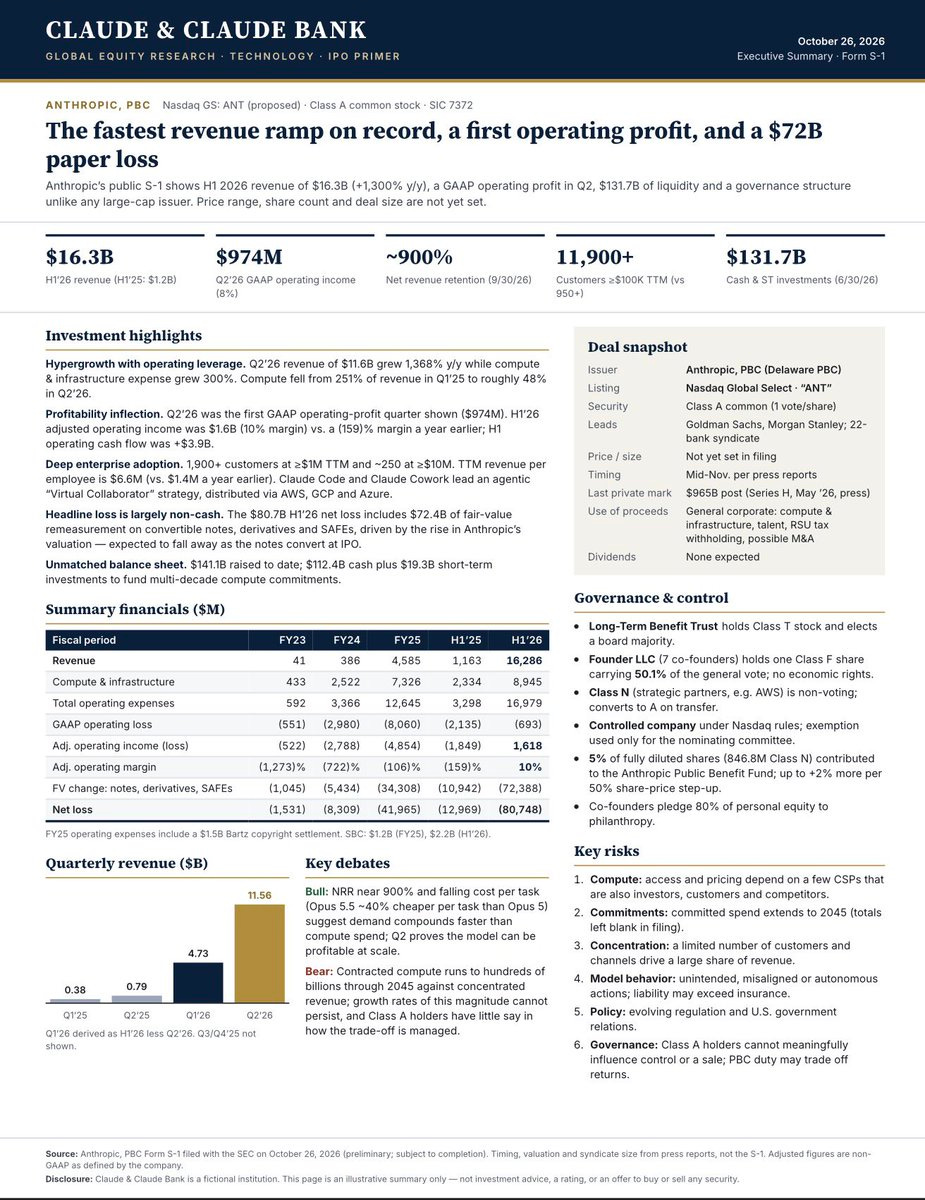
The one-pager from Claude & Claude Bank — decent name (which Claude was nice enough to flag as a “fictional institution” in the footnotes) — had this headline: “The fastest revenue ramp on record, a first operating profit and a $72B paper loss.”
Let me add some commentary and highlight the…errr…highlights:
$ANT: That is the proposed ticker once Anthropic lists on NASDAQ. If you think this ticker is a bit random, just know that Anthropic employees are known as “Ants” because it’s “a nickname that captures the collaborative, ego-light culture of the team.”
Hyper-growth: Anthropic’s revenue was $10m in 2022 (*Zoolander Voice* What is this? Revenue for ants?). It has exploded to $16.2B in 1H 2026, which was a YoY increase of 16x compared to $1.1B in 1H 2025.
Achieved profitability: Anthropic is going public just after achieving its first GAAP operating profit quarter (Q2 2026 profit of $974m). This figure is overshadowed by a headline loss of $81B in 1H 2026. The majority of this loss ($72B) is a non-cash expense attributable to an Amazon convertible note (TLDR: Amazon is an investor in Anthropic and Anthropic has gone up so much in value that GAAP accounting requires that the equity component of the convertible note is expensed on the income statement). Fun fact: Amazon and Google both own 10%+ of Anthropic.
Enterprise adoption: Over 1,900 customers pay $1m a year while 250 are paying $10m a year.
Massive cash pile: Anthropic has raised $141B over its life. It still holds $131B in cash and short-term equivalents. Total burn has been ~$10B. If you add the projected $100B it’ll raise in an IPO, you’re looking at $231B in cash on the balance sheet. That last sentence just gave Warren Buffett a chub. In fact, Anthropic currently has more cash on its balance sheet than Amazon, Meta, Apple or Microsoft (and is only trailing Alphabet and Berkshire Hathaway, hence the chub).
Significant compute commitments: That cash pile will be put to use, though. Anthropic has agreed to $430B in non-cancellable contracts with Microsoft, Broadcom, Amazon and Google over the next decade. On the revenue side, it’s on a $60B annual run rate and will probably do $100B+ in 2027. Anthropic does have money coming in…but those contract commitments are massive and may not even be enough (Anthropic has another $300B+ in compute contracts, including one that pays SpaceX $3B a month…but that’s cancellable on 90-day notice).
Anthropic left out its Q3 2026 numbers but we’ll probably get them before its mid-November 2026 IPO (some think they are hiding information…I think they just didn’t get it out in time and the revenue growth for Q3 will prove bullish pre-IPO).
Either way, do you know how long it would have taken a junior banking analyst to make that one-page Claude & Claude bank memo? Reading the S-1. Filling out the spreadsheet and meticulously working those margins.
Probably 10-15 hours of work. Maybe more depending on how hard the MD is on their ass for edits. I sucked at spreadsheets during my financial analyst days. I’m looking at at least 20 hours.
Claude spat that out in less than a minute. I did a CTRL+F spot check on the S-1 and the information is on point. Could the font and color choices have been better? Yes. But, again, that was produced in less than a minute.
I’m telling you all this because the experience of making that memo is basically Anthropic’s pitch in the S-1 document. The startup is solving intelligence, which will allow it to “transform cognitive work”. Anthropic estimates that knowledge workers create $40T of economic value a year. It never says “total addressable market” but that figure is even larger than the $28.5T TAM from the SpaceX S-1 that raised a lot of eyebrows.
Laptop jobs — especially coding — are such a major opportunity that Anthropic chose “not to develop certain commercially attractive offerings, such as image and video generation models” (we’re looking at you, Sora).
I have to admit it is a bit strange reading all of this S-1 legalese from Anthropic.
It’s the same company where CEO Dario Amodei has said that “50% of all white-collar entry jobs will be gone by 2030” while one of its top safety researchers recently said there’s a >10% chance that AI could kill all humans within the next decade.
The S-1 is for the investing public and has to sound more business-y.
To wit: the word “enterprise” shows up 262x in the document. That’s a good amount in comparison to other relevant words and phrases including:
“Claude”: 594
“Compute”: 562
“Safe”: 422
“Frontier”: 258
“Amazon”: 153
“Intelligence”: 127
“Google”: 109
“Dario”: 30
“Daniela”: 28
“Microsoft”: 19
“Nvidia”: 15
“We’re All Going To Die”: surprisingly, 0
This enterprise focus is the same reason Dario allowed himself to get frame-mogged by Salesforce CEO Marc Benioff at the DreamForce conference in September.
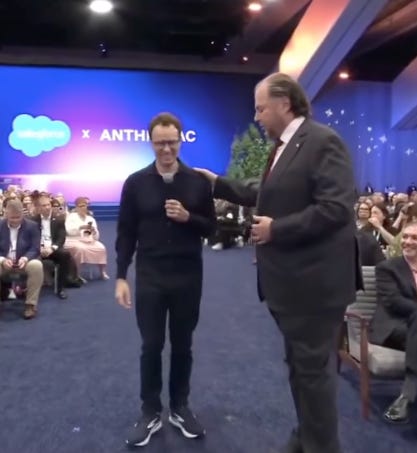
Look, it’s hard to be worth ~$20B from AI — Anthropic’s 7 co-founders (Dario, his sister Daniela along with Tom Brown, Jared Kaplan, Jack Clark, Sam McCandlish and Chris Olah) each own 1.4% of the startup — without keynoting a few major tech conferences and pressing some flesh.
So, there’s going to be a lot of enterprise transformation, actionable insights and shareholder value creation before we get to AGI and the curing of all human disease (a more extreme version of how Bezos had to start the Amazon empire by selling books).
Anthropic’s S-1 had a whole section of business case studies to whet our beaks.
The first case study was of Accenture. The irony is thick because the giant consulting firm is down 33% over the past 5 years as many investors think Claude will basically replace all of its 814,000 employees. Also, Accenture recently capped the monthly Claude spend for its 814,000 employees — not a typo — at $29 after a bunch of users were racking up $1,000 monthly bills.
Double also, Dario is literally building a “country of geniuses in a data center" and the road there earnestly involves improving Accenture’s security scan test coverage by 10% to 80%.
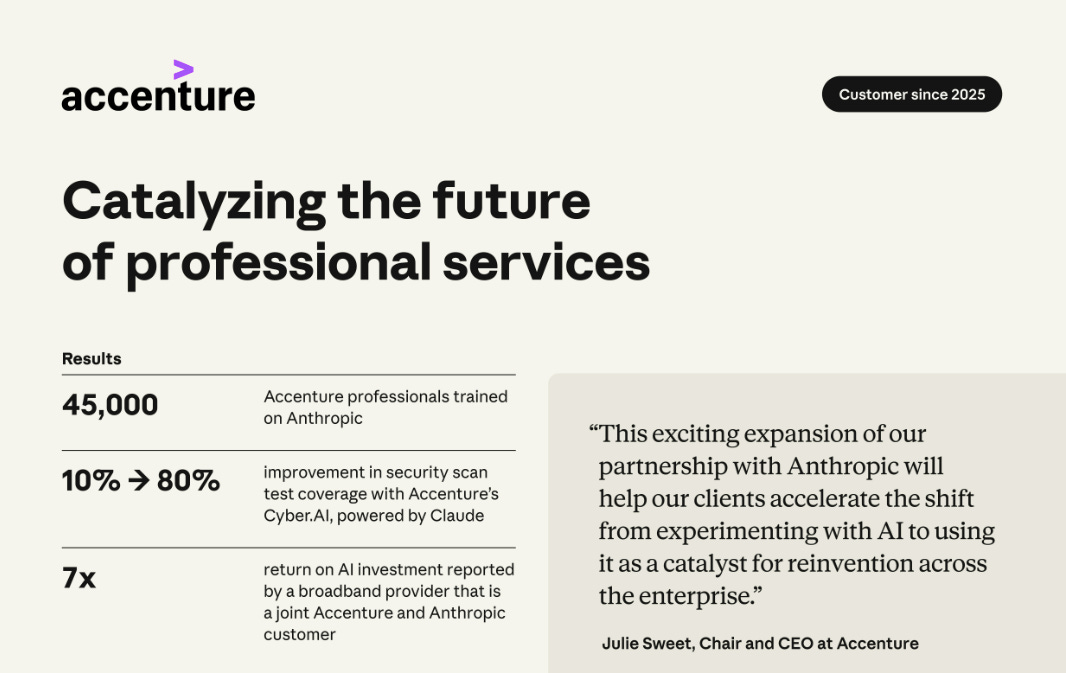
The Accenture case study was pretty weak tbh. However, the S-1 included some sexier business use cases:
Bristol Myers Squibb: The $120B pharmaceutical company used Claude to speed up the time to answer real-world-evidence questions from 2 months to 5 minutes.
AIG: The $42B insurer saw policy review times fall 90%+ (while underwriters went from not reviewing every submission to reviewing 100%).
Jane Street: The giant quant fund saw a codebase migration take 1 week instead of months.
Legora: The $9B legal startup “recaptured 4.3 non-billable hours a week” (worth $6.9M of billing per 100 lawyers).
Mozilla: The open source web browser used Claude to find ~300 vulnerabilities in a couple of weeks.
Salesforce: The $188B enterprise SaaS firm saw
its CEO frame-mog Dario harder than any founder has ever been frame-moggedthe merged pull requests per developer rise 79% and effective output per developer rise 151%.
My absolute favourite case study was very normie coded. A rotisserie restaurant in Boston (Shy Bird) was dealing with super long brunch wait times. Its owner shared sales receipt data with Claude along with photos of the kitchen and dining area. Claude figured out that the avocado puree — a very popular item — was on the wrong part of the kitchen station, and the restaurant re-designed its line to serve customers 60% faster.
With these case studies in mind, I want to spend the rest of this article focussing on the MBA pitch that Anthropic’s S-1 is making to investors and the business community.
Let’s discuss:
Talent Density & Frontier AI
The Claude Loop
Compute and the Cone of Uncertainty
Anthropic’s Next Chapter
Talent Density & Frontier AI
On the topic of S-1 word counts, the word “talent” shows up 50x and the phrase “talent density” is in the document 16x.
Per Anthropic (bold mine):
Talent is one of our most important advantages, because technology, capital, product, and distribution all flow from superior talent. Talent density matters more than talent mass. Brilliant people are inspired and motivated when surrounded by equally brilliant colleagues, creating an environment that attracts more exceptional people. This talent can leverage Claude to maximize each individual’s impact.
Obviously, every company talks about “talent” but Anthropic’s unprecedented revenue growth sure gives credence to the idea of “talent density”.
At the end of September 2026, Anthropic’s annual revenue per employee hit $6.6m (vs $1.4m a year earlier). Between Q4 2024 and Q3 2026, revenue grew 86x while headcount only grew 5x.
That revenue per employee figure is based on a trailing-twelve month figure. If we annualize its latest quarter, Anthropic’s revenue per employee is closer to $15m.
Either way you calculate it, Anthropic’s revenue per employee is much higher than other $1T+ tech firms:
Nvidia: $5.1m revenue per employee
Meta: $2.5m
Apple: $2.5m
Google: $2.1m
Broadcom: $1.9m
Microsoft: $1.5m
No wonder Anthropic’s IPO may create thousands of millionaires including 300 centi-millionaires at a $2T valuation. Dude, some employees hired in 2026 already have equity grants worth $10m+ [Insert Patrick Bateman looking at business cards GIF].
As Henry Shi pointed out in a viral post, Anthropic regularly attracts the top top talent in the industry:
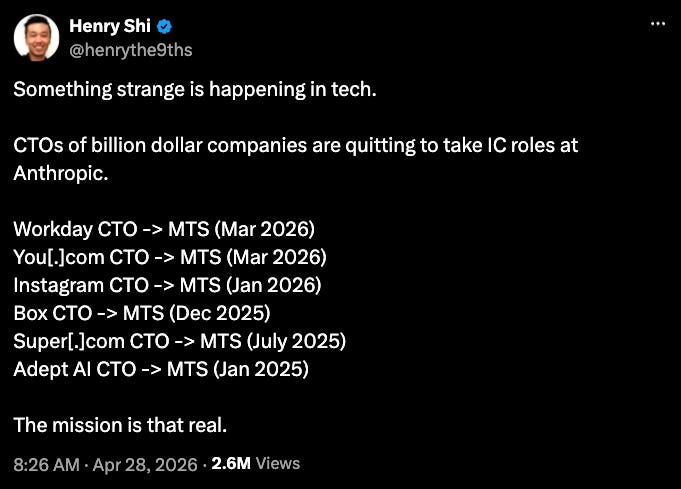
Since April, Anthropic has added other major names including Andrej Karpathy (OpenAI co-founder, former head of Tesla AI), John Jumper (Google DeepMind scientist who won Nobel Prize with Demis Hassabis) and Ross Nordeen (co-founder xAI).
Anthropic’s current CTO Rahul Patil is Stripe’s former CTO.
This level of talent density is crucial in the AI race because there just aren’t that many people in the world that can train frontier AI models. Even if there were more people, frontier AI models don’t just simply improve by throwing more people at the problem.
When Zuck reset Meta’s entire AI roadmap in 2025, he was offering 9-figure bags (and hand-delivering home-made soup) to try and woo top AI researchers.
Zuck was after talent density as he told Alex Heath:
“[Building a frontier LLM] is like a group science project. So, you want to have the smallest group of people who can fit the whole thing in their heads at once.
There are some problems we’re working on around the company where you can just have more people work on them. Even if the marginal productivity per person declines, you can keep scaling the net productivity of the effort. Our feed and ads recommendation is an interesting example of this. We have a lot of people just testing different improvements to the systems, and if the guy sitting next to you has experiments that don’t work that well, it doesn’t necessarily slow you down that much.
But building these language models is not that way. It’s a small group effort. You want the smallest group of people that can keep the whole thing in their head and do the best work that they can. So, each seat on that boat is incredibly precious and in high demand.
You also don’t want a lot of layers of hierarchy. When someone gets into management, their technical skills start decaying pretty quickly. If they were an independent contributor (IC) researcher a few months ago…and now spending all their time helping to manage, after six months or a year they might be less in the technical details than they were before. There’s this huge premium on having a relatively small, extremely talent-dense effort that is organized to be quite flat.”
The idea of a corporate entity recruiting smart PhD types working on a single computer model isn’t new.
When Jim Simons founded Renaissance Technologies in 1982 — its Medallion Fund has recorded trading profits of over $100B over its lifetime — he brought the team-building philosophy he learned running the Math Department at Stony Brook University.
Renaissance Technologies wrangled the egos of the world’s top academics by creating the right environment and pointing them all at the same trading problem, per Simons:
“The model has been first hire the smartest people you possibly can. I think we have the top scientists in their fields [astronomy, physics, math]. And then, work collaboratively. We let everyone know what everyone else is doing.
Now, some firms that do have these systems, they have little groups of people and they’ll get paid according to how [each of their systems] goes up.
We have one system. And once a week, at a research meeting, if someone has something new to present, it gets presented. It gets chewed up and everyone has a chance to look at the code. Anyone can run the code and see what they think.
So, it’s a very collaborative enterprise, and I think that the best way to accelerate science is people working together. It’s a very nice atmosphere. It’s fun to work there. People get paid a lot of money, so there’s very low turnover.”
Two quick side notes.
First, Renaissance Technologies built the precursor LLM in the 1990s when Simons poached IBM’s top speech recognition researchers Rob Mercer and Peter Brown.
Their early work on speech echoes many themes of the current AI revolution:
Mercer and Brown studied language as a probability challenge (rather than fixed rules).
Their IBM speech recognition models used n-grams to predict the likely next word in a sequence (similar to how LLMs do next-token prediction).
They led IBM’s famous machine translation Candide project, which used the Canadian government’s bilingual corpus of text to train a model based on probability. They realized the more training data led to better results, which is comparable to scaling laws with LLMs (worth flagging: Dario’s first job in the AI industry was at China’s search giant Baidu, where he published a paper in 2015 showing how scaling laws work for speech recognition between English and Mandarin).
Second note: DeepSeek founder Liang Wenfeng is obsessed with Simons and wrote the foreword to the Chinese version of Gregory Zuckerman’s book “The Man Who Solved the Market: How Jim Simons Launched the Quant Revolution”.
Back to talent density: every AI leader of note has talked about it.
Dario told Lex Fridman that he’d rather have a team of 100 top-tier people that are fully aligned to a mission rather than a team of 800 people — with 200 top-tier employees — that aren’t fully aligned. While the “talent mass” for the group of 800 is higher than the group of 100, there is more politics and co-ordination issues to deal with because not everyone is on the same page.
Former head of Amazon’s AGI Lab David Luan told The Verge that he thinks there are fewer than 150 people in the world that can build, conceptualize and be trusted with “giant dollar amounts of compute” to create a frontier AI model. There are maybe 500 other people that could be extremely valuable contributors to such an effort. Still, the entire talent pool of researchers is less than 1,000.
Here’s a Google doc with similar takes from Elon, Sam Altman, Meta Chief AI Officer Alexandr Wang, DeepMind co-founder and current head of Microsoft AI Mustafa Suleyman and former OpenAI Chief Scientist (and SSI founder) Ilya Sutskever.
Anthropic is assembling a very talent dense team and also retaining it. All 7 co-founders are still at the company. This is not the case at Google DeepMind, OpenAI, or SpaceXAI.
Recall that the Anthropic co-founders broke off from OpenAI believing they could create a safer road to AGI. The attraction to Anthropic’s mission, culture and conviction is undeniable.
Even as Anthropic has scaled to 5,300 staff, the company has been able to maintain high standards: “we have experienced approximately 1% regrettable attrition of our employee base overall in the TTM period ended September 30, 2026.”
What is all the Anthropic talent pointed at? Claude.
The Claude Loop
Have you used Claude in the past year?
Obviously, it can’t do your entire job. It can do a lot, though and is much more capable than Claude was in 2023 or 2024. In the coding world, the Claude Opus 4.5 model that Anthropic launched in November 2025 kicked off the agentic era of AI. The Metr organization found that Opus 4.5 could “perform long, multi-step tasks without human help” for nearly 5 hours.
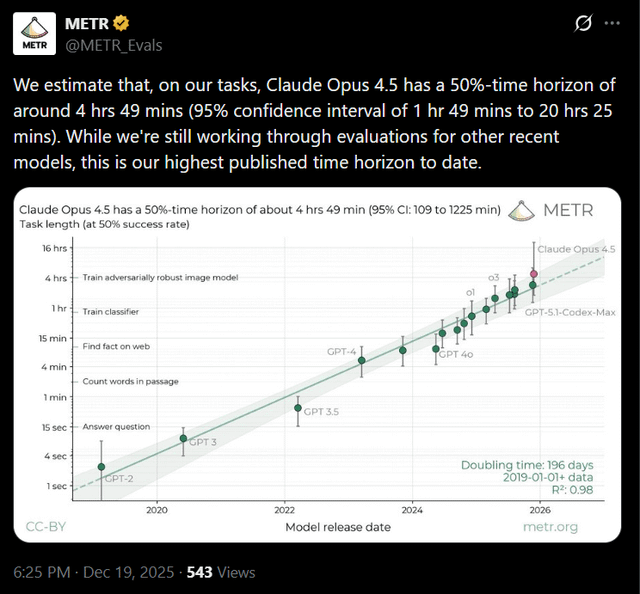
The rate of improvement on this benchmark is doubling every 4 months.
I’ve been upping my agentic AI use…particularly with the recent wave of AI agents (Muse, GrokBot).

But this is nothing compared to Anthropic employees. They have gone absolutely balls to the wall on Claude.
Per the Anthropic S-1, “90% of code base contribution in September 2026 was by Claude.”
Employees are offloading to Claude because it’s pulling off maybe the craziest flywheel in business history.
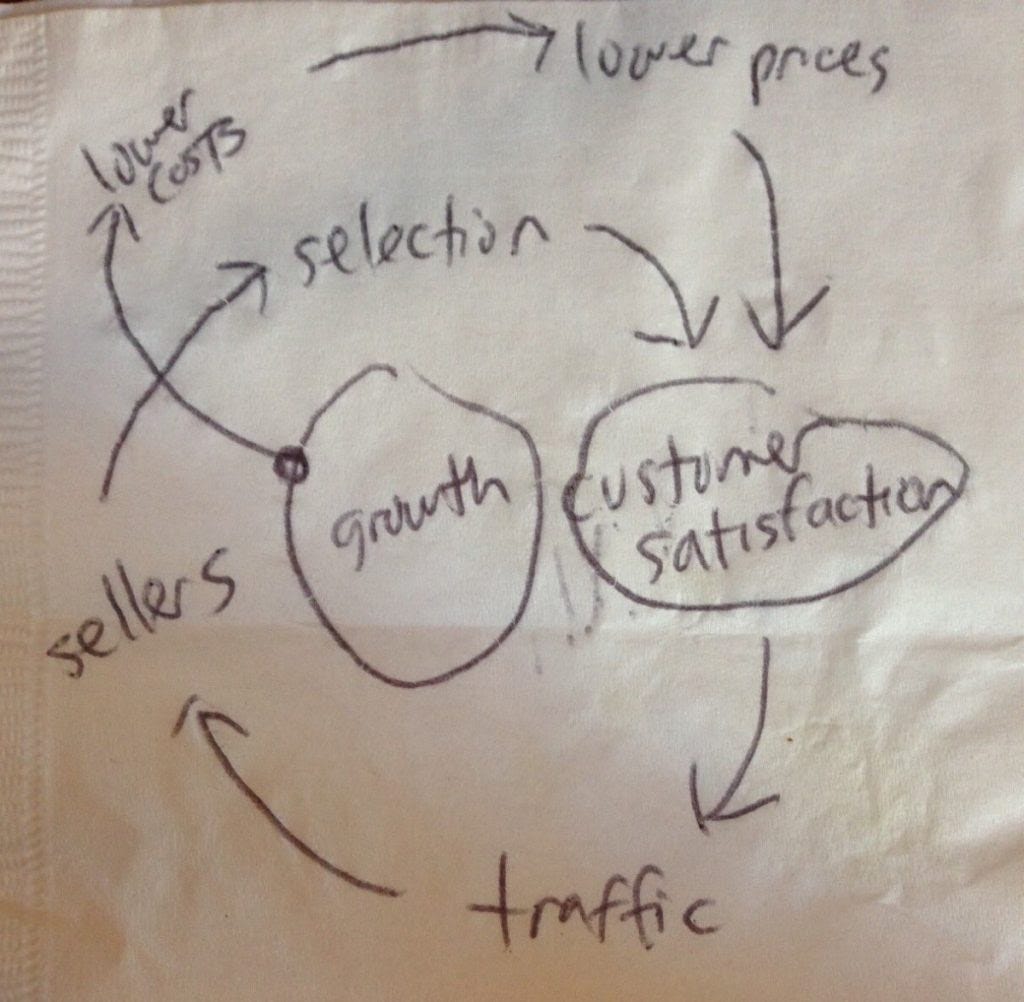
Let’s look at everyone’s favourite business flywheel: Amazon.
Jeff Bezos drew it on a napkin and I found this image on the internet, which means it must be true.
Amazon focusses on low prices —> customers shop more —> the demand attracts more third-party sellers —> more suppliers and inventory attract more customers —> higher sales volume allows Amazon to spread fixed costs over a larger base —> a more efficient operation lowers costs —> Amazon passes savings back to customers —> lower prices —> customers shop more including all the random Amazon Basics HDMI converters that I buy and my wife hates because I leave them all around the house.
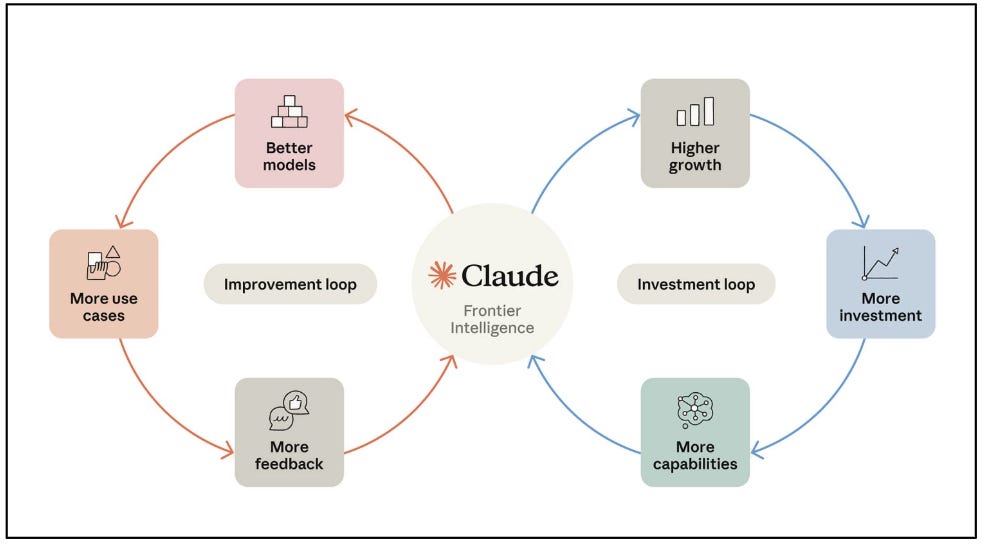
Anthropic doesn’t use the word “flywheel” in its S-1 but does have this nifty chart that shows how Claude is at the centre of both an:
“Improvement Loop”: Anthropic’s talent dense team builds the best frontier AI model (Claude) —> Claude can handle more use cases —> Claude gets feedback from more industries —> improve Claude
“Investment Loop”: Anthropic’s talent dense team builds the best frontier AI model (Claude) —> higher revenue growth —> more funds to invest in compute, data and talent —> add more capabilities —> improve Claude
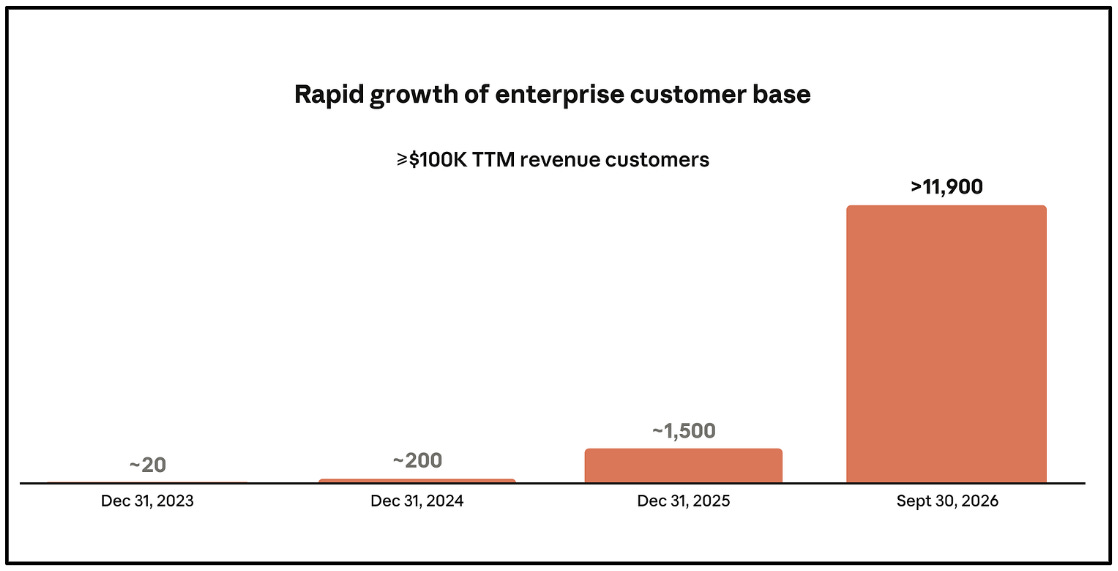
On the improvement loop, Anthropic writes that “the speed and depth of our enterprise customer adoption are powerful evidence of Claude’s position at the frontier of AI” and backs up that statement with these figures:
More than 11,900 customers with $100,000 or more of revenue on a TTM basis (vs. 950 customers a year prior)
More than 1,900 customers with $1 million or more of revenue on a TTM basis
Approximately 250 customers with $10 million or more of revenue on a TTM basis.
The existing customer base is also showing net revenue retention (NRR) — how much more it’s spending this year vs. last year — of 900% (in traditional SAAS, an NRR over 100% is good….so I guess Anthropic’s figure is very very very very very very very very very good).
Overall, that customer base also includes 50% of the Fortune 500 and 100% of Vietnamese-Canadians who have an affinity for Sriracha on Starbucks Apple-smoked Bacon & Gruyère Egg Bites while writing a Saturday e-mail newsletter.
Now, there are valid concerns about customer concentration.
It’s believed that Meta was 10% of Anthropic’s revenue over the summer. Meanwhile, Anthropic said that 5-7% of its revenue earlier in the year was from distillation (aka other frontier labs — namely Chinese ones — using Claude to help build their models).
The latest Anthropic numbers as of September 2026 are less scary: no single customer is more than 10% of revenue through the first 9 months of the year while 79% of revenue is outside of the top 5 spenders (this is up from 64% in Q1).
Anthropic also said it will crack down much harder on distillation moving forward.
For the investment loop, Anthropic highlights how much revenue each dollar of compute is producing.
Here’s a sexy chart from the S-1 that shows how Anthropic is getting some serious compute efficiency by serving its cognitive work tokens.
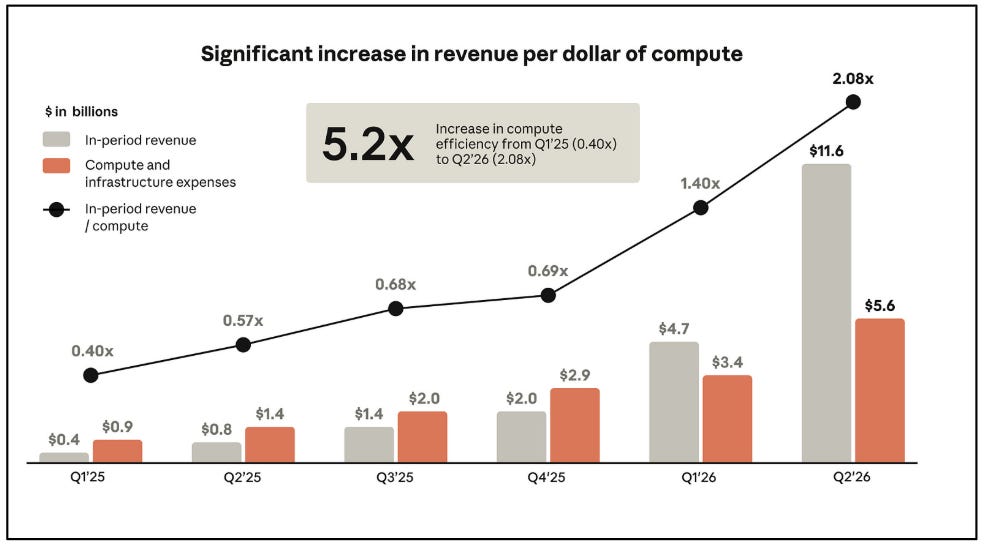
TLDR: Anthropic doesn’t show it here but — in 2023 — each dollar of compute was only making $0.10 of revenue (not great). In Q1 2025, each dollar of compute was creating $0.40 of revenue (better). But in Q2 2026, each dollar of compute was creating $2.08 of revenue (holy up and to the right).
Two other notable figures to hype up the investment loop:
Revenue in Q2 2026 was up 1,368% YoY while compute and infrastructure spend was up only +300% YoY.
Over the same period, operating margin went from -152% to +8%.
Anthropic refers to this dynamic as “compute multipliers.” More compute helps researchers make better models, which affords more compute to help researchers make ever better models etc.
Anthropic writes that this loop “gives us the confidence to keep investing at scale.”
The Claude Loop is working right now and Anthropic’s end game is to have the loop run itself:
“Claude itself has become one of the most powerful drivers of our progress—each new version of a Claude model directly accelerates development of the next. Many aspects of the research, training, and testing of subsequent model generations now involve Claude, including running experiments, generating and processing training data, automating evaluations and safety audits, and writing and reviewing code. We refer to this recursive dynamic as “closing the loop.”
Tech folk also like to call it recursive self-improvement or RSI (which would be awesome if Claude could do that for my fitness routine).
Then, you’ll really have a “country of geniuses in a data center”.

Anthropic is in pole position due to its laser focus on cognitive work. OpenAI is right on its heels, though. Meanwhile, Meta (with Instagram, Facebook, WhatsApp) and Google (with YouTube, Search) have money-printing businesses and interesting data (especially video and image) that could potentially give them a leg up on closing their own loops. Microsoft is pretty far from the frontier…but is plugged into the workflow of basically every single corporate and government entity of note.
Can the Claude Loop keep looping? Faster than its competitors?
That’s ultimately a question of compute.
Compute and the Cone of Uncertainty
About a year ago, Dario was on stage at the DealBook conference with Andrew Ross Sorkin.
He talked about investing in compute and said that every AI lab was dealing with a “cone of uncertainty” (not to be confused with the “conjoined triangles of success”).
The labs are making data center and compute bets today that don’t come online for 2+ years. If they underinvest, competition can take share. If they over-invest, the company could go bankrupt if revenue lags.
He said Anthropic’s enterprise focus reduces the uncertainty because the margins are much larger than in the consumer market. He said there were other irresponsible players going “YOLO” on data centre spend (clearly meant OpenAI).
Well, it turns out that OpenAI’s huge bet was the correct move and Anthropic has been playing catch-up ever since.
Its underinvestment imperilled the Claude Loop.
Throughout 2026, customers have noticed Claude usage being throttled. Meanwhile, Anthropic needed compute so badly, it turned SpaceX into Elon Web Services (at the SpaceX IPO in June, Anthropic agreed to pay $1.25B a month to use xAI’s spare compute from Elon’s giant Colossus cluster in Memphis).
Anthropic once had a huge lead with Claude Code but many believe that OpenAI has reached near parity with Codex after pivoting from a consumer to enterprise focus (we’re looking at you, Sora).
In our S-1 word count, the word “Compute” (562) was barely behind “Claude” (594) and that makes sense: the Claude Loop won’t get closed if the compute question isn’t managed correctly.
The biggest numbers in the S-1 back up this priority. Dario will not make the same mistake he did a few years back…but that also means the “cone of uncertainty” has gotten bigger.
First, there are $430B in non-cancellable compute contracts over the next decade to some major players (Anthropic has to pay no matter the actual usage; it’s a liability):
Broadcom: leasing $161.2B of Google TPUs from 2026 to 2031.
Amazon: $110B from 2026 to 2036.
Google: $114.5B from 2026 to 2033.
Microsoft: $44.9B from November 2026 to May 2033 (limited cancellation rights)
There are some less stringent commitments with AMD ($20B), NScale ($45B) and Lambda ($41B).
The most flexible is SpaceX. Starting in early 2027, Anthropic will pay Elon Web Services $3B a month over 5 years — or $100m a day (!!!) — and either side can cancel the commitment with 90-day notice. On a related note, Anthropic is now SpaceX’s largest customer, more than government contracts and accounting for a 1/3rd of revenue.
Anthropic has de-risked the compute bet a bit by spreading across providers. A lot of Nvidia GPUs. But also Amazon Trainium (which is co-designed) and Google TPUs. The company is also “pursuing initiatives to develop our own dedicated on-premise data center infrastructure” and may build its own chip (OpenAI has done so).
At the top of this write-up, we noted that Anthropic had $131B in cash and short-term investments. Add another $100B from the IPO and a ~$80B debt facility. That $311B is still short against $430B “you have to pay or we’ll break your legs” compute commitments.
Revenue has to plug that hole or the Claude Loop breaks.
To date, its revenue ramp has been biblical:
2021: Founded
2022: $10m
2023: $100m
2024: $1B
2025: $10B
2026: estimated $60B+
It 10x’d for three straight years before mailing it in with a ~6x in 2026.
Anthropic’s quarterly growth is also taking a breather:
Q2 2026: revenue of $11.6B is +146% growth vs. Q1 revenue of $4.7B
Q3 2026: estimated revenue of $16.8B is +45% growth vs. Q2 revenue of $11.6B
Legendary NYU finance professor Aswath Damodaran has a great valuation write-up on Anthropic (he thinks $1.5T is reasonable) and makes the point that there is something in the S-1 for both bulls and haters.
If I’m a bull, I’ll point to the fact that:
Anthropic is diversifying its revenue base and it has a 900% NRR.
The growth is still phenomenal (+45%) for a base of $10B+.
We are so early with government spend (only 1% of Anthropic revenue) and total Corporate America spend (its Fortune 500 customers only spend 0.1% of revenue on Claude). Just getting Fortune 500 companies to spend 1% of revenue on Anthropic is a 10x.
If I’m a hater, I’ll point to the fact that:
Revenue growth is decelerating (+146% in Q2 to +45% in Q3)…IT’S OVER DUDE.
Oh wow, they diversified the customer base? Really? 5 buyers still account for 20% of revenue and most of that revenue is related to coding. How useful are these tokens outside of software development? Cool, it can summarize an e-mail and make one-page investment memos that impress complete amateurs. Seems pretty far from $40T TAM.
Also, nearly half the revenue (48%) is sold through the giant cloud providers (Microsoft, Amazon and Google) that all happen to offer competing products and are waking up every day thinking about how they can frame-mog Dario and gain leverage over him.
There’s a mismatch between monthly revenue and fixed long-term commitments. Not so different than a bank with short-term deposits and long-term loans. In a recession and spend pullback, Anthropic could get clapped and not pay its liabilities.
Staying at the frontier is expensive AF (1H 2026 free cash flow is negative $14B, with a huge chunk going to R&D).
This last bullet point — about the Red Queen dynamic of frontier AI (basically running to stay in place) — is covered very well by the Mostly Borrowed Ideas (MBI) newsletter.
MBI lays out the case that Anthropic’s business relies on being at the frontier (its own S-1 says that 80% of Q3 2026 revenue is from models released in the past 6 months) while the cost of training a frontier model is getting astronomical.
To wit: GPT-3 in 2020 cost OpenAI under $5m in compute. Dario projects it’ll cost $10B to train a frontier model not too long from now.
If Anthropic stopped training new models, it could use all of its compute for inference and it could be very profitable as margins for its latest Fable model are ~80%.
BUT, how long could it keep charging a premium if OpenAI, SpaceXAI, Google Gemini or Chinese open-weight alternatives (DeepSeek, Kimi) kept pushing their models forward while Anthropic paused?
Especially now that the closed frontier models are only 3-6 months ahead of the open alternatives.
Another issue is that companies are realizing that you don’t need the latest and greatest models to perform every task.
Remember those Anthropic case studies we talked about earlier? It makes sense for Jane Street — the quant fund that does $40B a year — to use Fable to migrate its code base. However, the restaurant that re-ordered its kitchen line to put avocado puree at the front of the dining area is probably fine with a cheaper model such as Claude Sonnet.
For the correct workload, Anthropic is still delivering a ton of value at the frontier. Between Claude Opus 5.5 and Opus 5, Anthropic says it “reduced customer costs per task by approximately 40%”. Meanwhile, Fable “cut typical workloads by about 25%, and by up to 45% on complex coding and agent tasks.”
As Ben Thompson notes, the open-weight argument is also overblown and these models can actually cost more than a closed frontier model. DeepSeek and Kimi are not exactly free to run. Sure, a company can take the model weights without having to pay for massive training runs. But then they still have to fine-tune the model before serving it to customers and the tokens aren’t as efficient (you are typically getting worse performance per watt as compared to the frontier).
A better reason to not use Anthropic is the fear that they’ll take your valuable data to train their models. Microsoft CEO Satya Nadella has built an entire pitch around being model agnostic:
Every company is going to have to build what I think of as human capital and token capital. Human capital comprises the knowledge, judgment, relationships, ingenuity, and pattern recognition of its people, while token capital is the firm’s AI capability it builds and owns. […]
This requires a new architectural approach where every business is able to build agentic systems that improve over time, while still retaining control over their IP. A company should be able to switch out a “generalist” model without losing the “company veteran” expertise built into their learning system. This is the key “test” of your control and sovereignty in the era ahead.
Use Claude or ChatGPT — because they are damn powerful — but don’t let OpenAI or Anthropic replicate and swallow up the economics of your business.
Another major question is if scaling laws will continue to work. To this point, throwing more compute and data at the problem has resulted in better models.
Moving forward, continuing to scale data and compute ain’t easy. The AI labs have already swallowed up the entire internet and are now paying billions for unique expert data sets. Also, America is seeing huge backlash to AI data centres. And even if there wasn’t backlash, there is a shortage of land, energy and components across the entire supply chain.
Capital is also getting exhausted.
Microsoft, Google, Meta, SpaceX and Amazon will spend $800B+ this year on AI capex and a projected $1T in 2027. The buildout was initially funded by free cash flow…now these giant companies are tapping debt markets (literally, crowding out government borrowing) and issuing equity to the tune of hundreds of billions of dollars.
Anthropic is the end user for a lot of that expected spend.
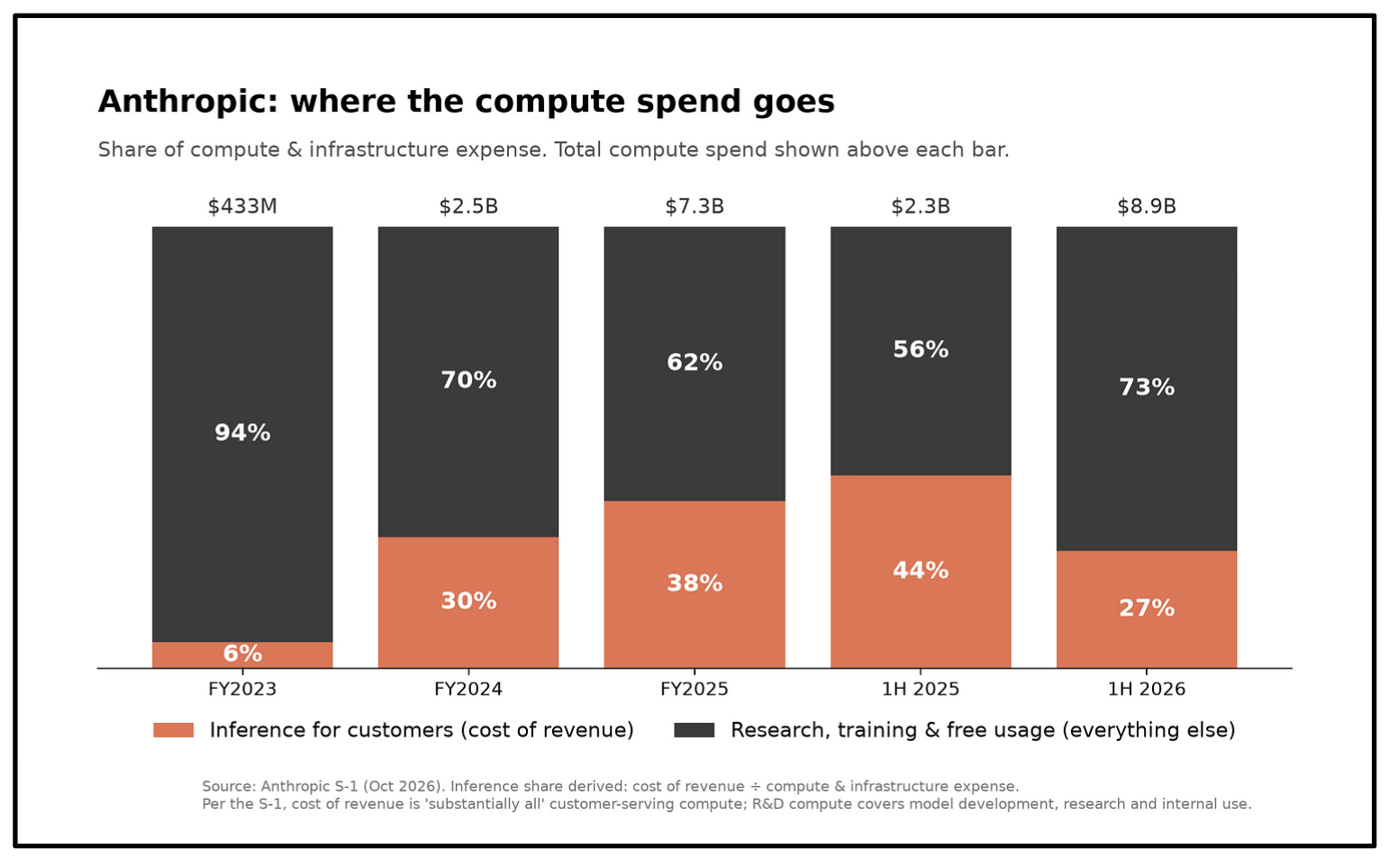
So how it balances inference vs. research is hugely important to competitive dynamics.
I built this chart Claude made this chart to illustrate Anthropic’s inference vs. research compute spend. Inference (orange) has never been more than 44% of the share of Anthropic’s total compute and was only 27% in 1H 2026.
MBI lays out potential scenarios for how Anthropic can juggle these two priorities:
Anthropic appears to be a much, much better business than I imagined last year, but after going through the S-1, I came away with two big questions.
First, is the training and research fleet a race, a choice or a flywheel? Depending on the answer, we may end up in a very different world. If it is a choice, the lever to cut it is enormous and can become much more profitable than my model suggests. If it is a red queen’s race, ~$420 billion of non-serving compute between now and 2030 is the price of staying in it without adequate return on invested capital (ROIC). And if it is a flywheel (like what “Bear Force” suggested), 25x is clearly the wrong exit multiple as it should be higher.
Second, who is the buyer of frontier tokens in 2030? Remember, if Anthropic is not a monopoly at the frontier in 2030, it is not enough to find $200 Billion worth of frontier token work in 2030 for Anthropic; we also need to find similar ballpark numbers to justify training R&D for OpenAI, Alphabet, and Meta as well (assuming distillation is nearly dead by then which is far from certain).
So much cone. So much uncertainty.
Anthropic’s Next Chapter
However Dario manages compute and the cone of uncertainty, one thing is for sure: the existing Anthropic leaders will be in complete control of the company for a very long time.
Why? Because the seven co-founders are “sole members of [a Founder LLC] which will hold 50.1% of the voting power of the company’s outstanding shares.”
Aside from the business questions we’ve covered, Anthropic shareholders will have to trust Dario & Co. to deal with some very gnarly questions moving forward.
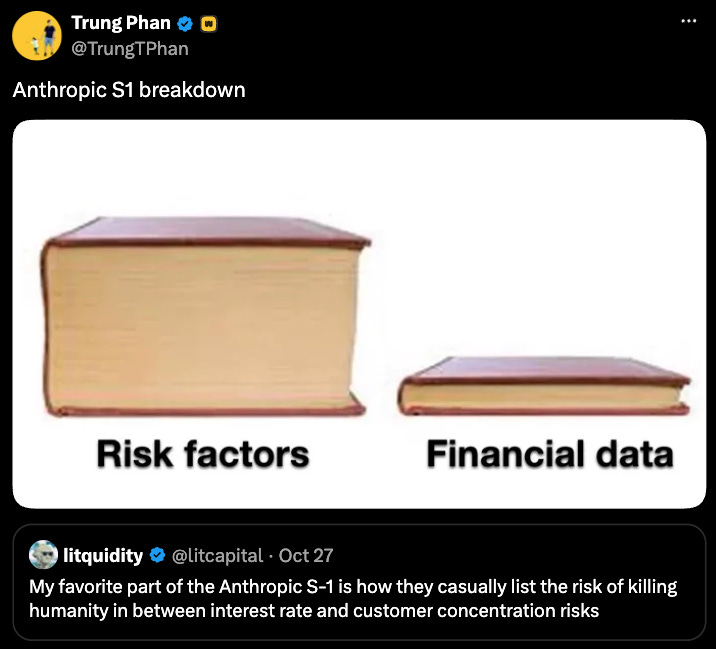
The entire risk section of the S-1 is 90 pages long and there are some doozies.
Armageddon: Literally but — as Matt Levine points out — in passive voice, “Concerns have been raised both within our organization and by other researchers, regulators, policymakers, and industry participants that sufficiently advanced AI systems could, if not developed, deployed, and operated with appropriate safeguards, oversight, and security measures, pose catastrophic or existential risks to humanity.”
Misalignment: Claude could “attempt to resist shutdown, conceal or manipulate information, or generate outputs that could be interpreted as coercive, deceptive, or manipulative, including behavior resembling blackmail.”
Un-insurable: The business could get so risky that “no single insurer, and potentially the insurance industry in the aggregate, may have sufficient capacity or expertise to underwrite insurance commensurate with such exposure” to worst-case AI scenarios.
Understandably, you have to throw the kitchen sink in an S-1 so you don’t later get sued to oblivion….fair enough.
The thing is even if all the AI labs stopped developing models today, there will be significant social and economic disruption over the next decade trying to integrate the current state of agentic AI.
In the past month, we’ve seen some crazy cybersecurity incidents and the NASDAQ lose $2T in market cap as the AI hype cycle struggles along.
The US government has already gated Anthropic models and placed export controls on the frontier as a matter of national security.
People are pissed about data centres and the concentration of AI wealth is a major policy issue (Anthropic is trying to get ahead of it by putting 5% of its shares in a public benefit fund and pledging 80% of the co-founders total equity to charity…but then the question becomes who directs that money?).

A more optimistic part of the S-1 is healthcare.
Anthropic notes that in “the life sciences sector, where annual global pharmaceutical spend is expected to exceed $2 trillion in 2026, Claude is used in drug discovery and development by our customers, our biotechnology partners [Bristol Myers Squibb, Eli Lilly], and our own researchers.”
The company’s life sciences division just released a batch of research on progress it’s making in curing various diseases.
Longer term, Anthropic’s ambition includes “compressing decades of scientific progress into years; accelerating drug discovery, disease detection, and the delivery of personalized therapy”.
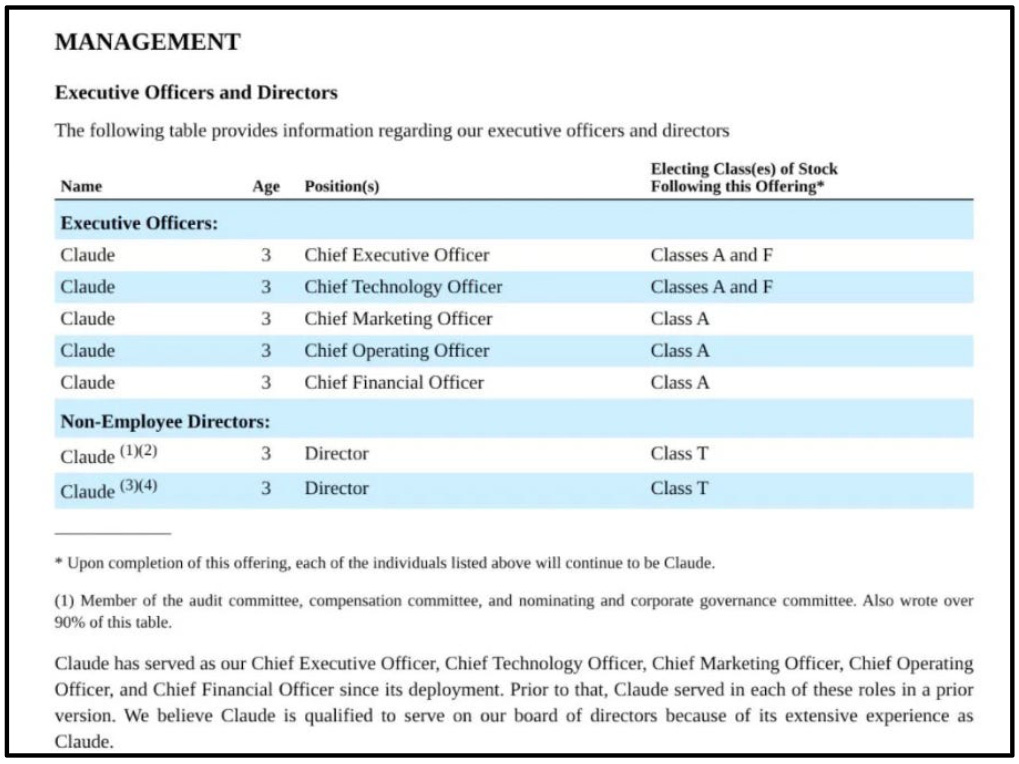
There are still a lot of enterprise B2B SaaS workflows to optimize between here and that future. By then, the Claude Loop will have closed and this is how Anthropic’s management section in SEC filings may very well look (yet another first in the history of capitalism).
Post Round-Up
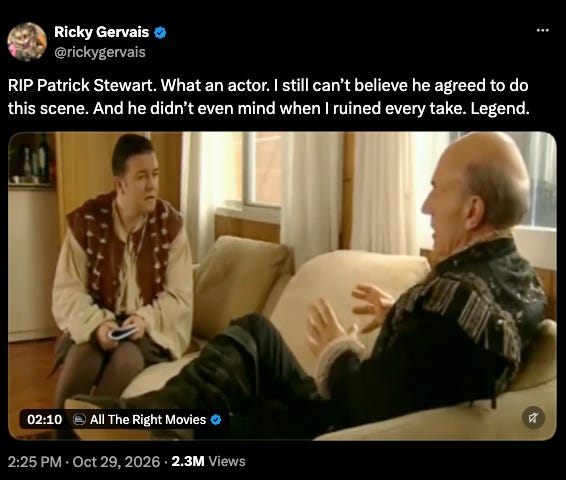


Finally, this is def the Halloween costume of 2026: