

Thank for subscribing to SatPost.
Today, we are talking all things World Cup including:
FIFA’s ticketing fiasco
Freddy The Viral German Fan
The Science Behind World Cup Grass
Why There Are So Many French-Born Players At the World Cup
Also this week: La Sagrada Familia, Claude Fable and SpaceX’s $2.1T IPO.
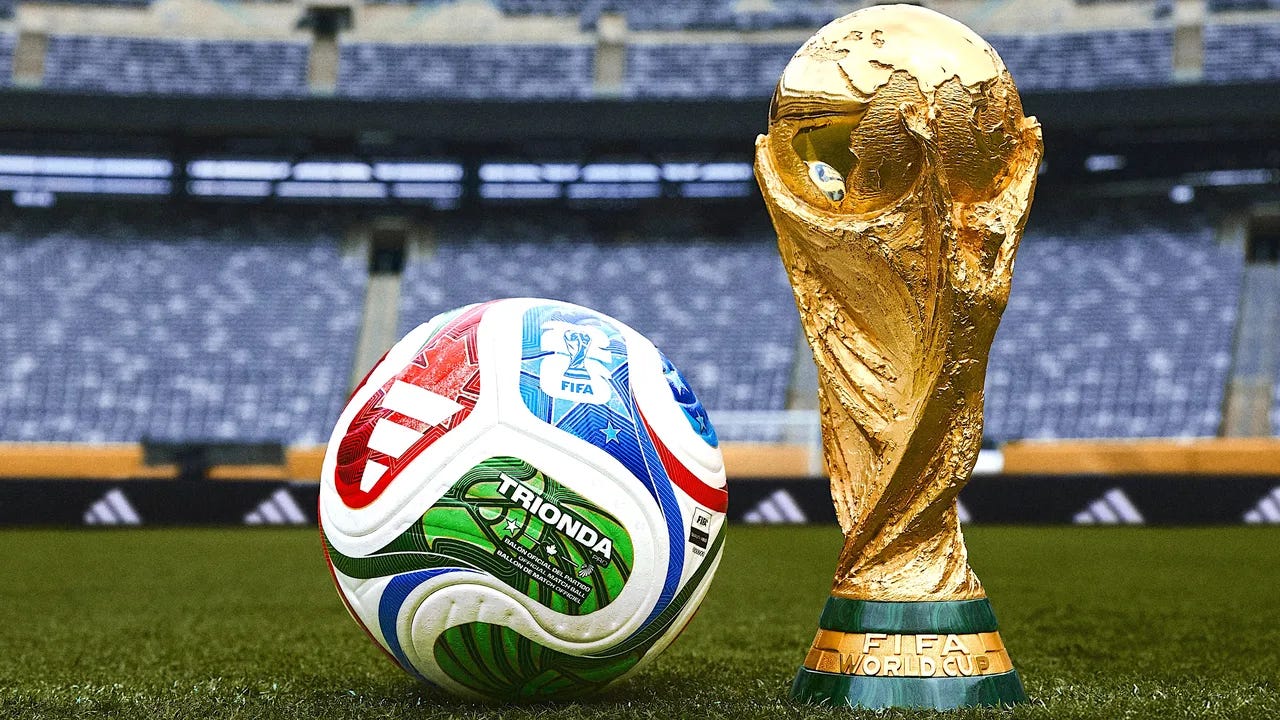
There’s a kebab place I order from a few times a month.
Awesome transaction.
Massive chicken shawarma plate for $18.
I know it’s good because the website to order pick-up is the jankiest piece of crap in the world and the credit card payments always glitch. Doesn’t matter. We deal with it since the food slaps so hard.
The FIFA World Cup 2026 is a macro version of this dynamic: I’ll muddle through an absolute dogshit user experience in the ticketing portal because I want to chug the World Cup Kool-Aid.
I am clearly not the only person taking the deal.
Over the next month, the FIFA World Cup 2026 will host 104 matches with 6 million available tickets across 16 cities including:
America (Atlanta, Boston, Dallas, Houston, Kansas City, Los Angeles, Miami, New York/New Jersey, Philadelphia, San Francisco Bay Area, Seattle)
Mexico (Guadalajara, Monterrey, Mexico City)
Canada (Vancouver, Toronto)
Some UX snafus were probably expected as this was FIFA’s first year taking over the ticketing platform. That’s fine. However, it is also a mess because FIFA (shocker) is showing next-level greed and the ticket-buying experience has been incredibly hostile to fans.
Here are some stats to provide context, via The Economist (thank you for the charts):
FIFA 2026 ticket prices are 2x Qatar 2022 and 4x USA 1994 (adjusted for inflation)
the cheapest group stage ticket at launch was $200 and the cheapest Finals ticket was $2,030
the official ticketing platform does dynamic pricing (95 of 104 matches have seen a price increase; average hike of 34%) and FIFA takes a 15% cut on resales (from both the buyer and the seller)
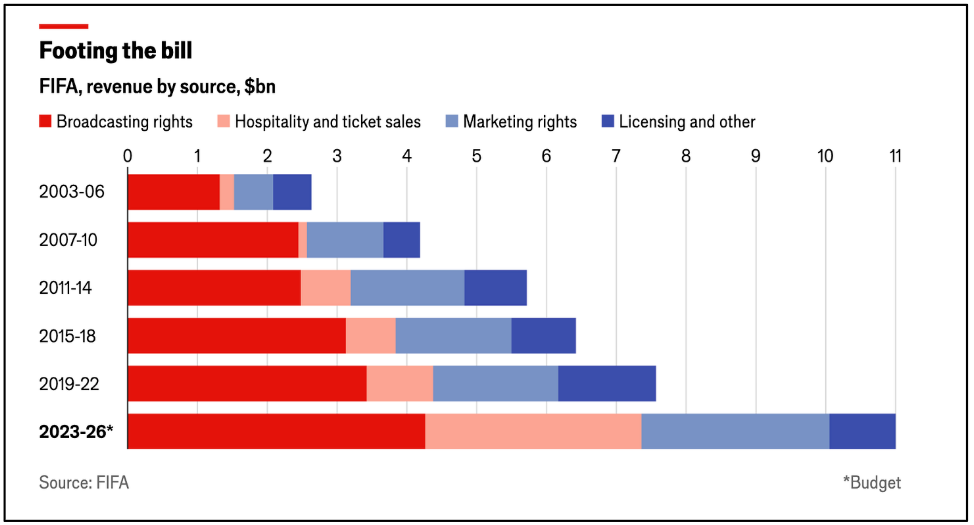
FIFA plans to make $3 billion from tickets in 2026 vs. $1 billion in Qatar 2022
$3 billion on tickets is equal to Qatar 2022’s revenue from broadcast rights (these rights are the tournament’s cash cow; $4 billion expected in 2026)
from 2022 to 2026, the ticket revenue is projected to rise 3x while broadcast revenue is up only 1.3x
the most expensive team to follow is Brazil: estimated $3,800 to see all 3 group stage games (followed by Portugal, Scotland, USA and Argentina).
Overall, FIFA expects revenue to hit $11B, an increase of +38% from the $8B made in Qatar 2022.
I get it. It takes money to throw these massive events and organizations are welcome to make a profit…even if FIFA is a non-profit.
FIFA argues that its platform is built to combat bots and scalpers. If someone is going to collect surplus funds from the wild demand, it might as well be FIFA. Why? FIFA head Gianni Infantino says much of the funds will go back to over 100 football programs around the world to grow the sport and keep the tournament going strong for decades to come.
But, people, this is FIFA we are talking about. Decades of corruption and scandals. Greedy cash grabs and a recent history that saw massive bribes paid to sway votes for the host countries including South Africa 2010, Russia 2018 and Qatar 2022 (the major 2026 controversy is currently around visas and travel bans).
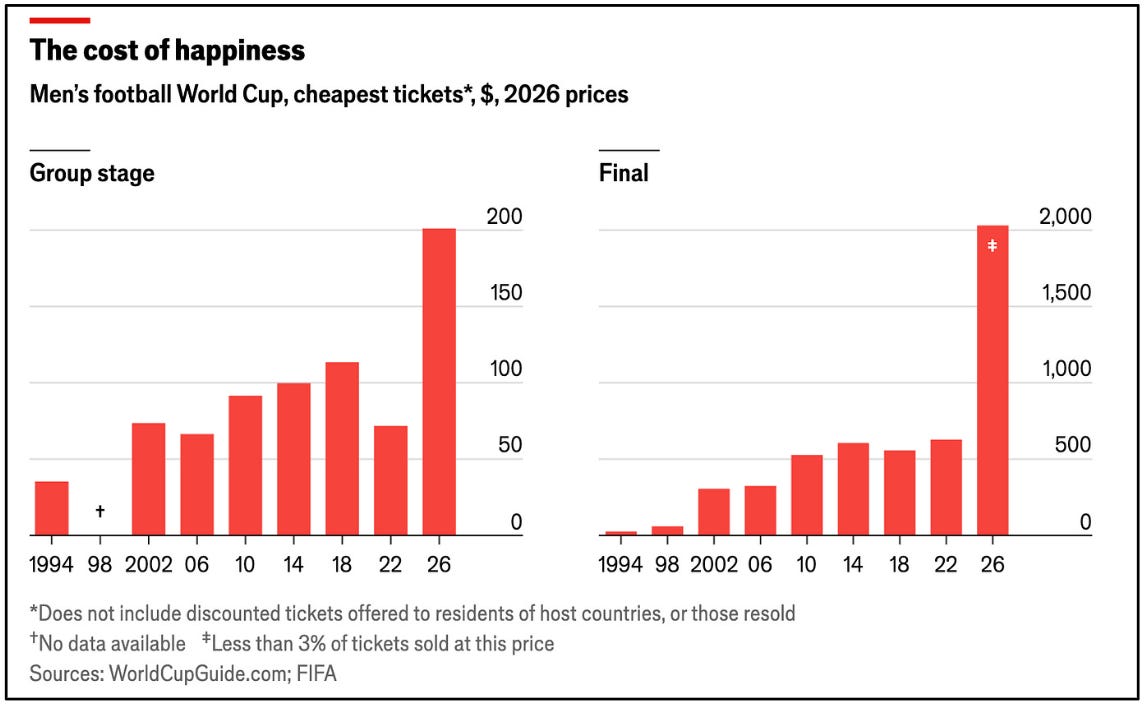
FIFA has historically been fine to underprice tickets because this isn’t the main revenue driver. In previous tournaments, around 10-15% of total revenue has come from tickets while the balance is from broadcast, marketing and licensing.
Here’s a relevant anecdote from the WSJ:
Back in 1994, FIFA was the one pulling back the reins on pricing. The U.S. Soccer Federation president at the time, Alan Rothenberg, who oversaw local World Cup organizing, had proposed selling every ticket to the final at the Rose Bowl for $1,000, but FIFA slammed the brakes.
“They said they didn’t want to upset their fans,” Rothenberg said.
However, the American live events market is a different beast now.
Coachella. Super Bowl. Taylor Swift Eras Tour. US Open. Backstreet Boys at the Sphere (worth it).
Or the recent Knicks vs. Spurs games at Madison Square Garden.

The World Cup is on another level. It’s the most popular global sporting event and over 5 billion people are expected to watch some part of the tournament in 2026.
No wonder FIFA is targeting ticket revenue in 2026 at 27% of total revenue (and 75% of the 104 games will be in US cities and those juicy media markets).
FIFA isn’t hiding its motivation. The 122-year old international football body said fees for the World Cup 2026 are “aligned with North American industry trends across various sports and entertainment sectors,” in a big middle finger statement addressing the controversial pricing strategy.
Infantino went on CNBC to explain the price outrage and his messaging was muddled. On the one hand, he acknowledged that the North American market is a huge revenue opportunity but also said he wants to grow the audience of the game by making it more accessible.
Ok, you can milk everyone. But that approach also means turning off new fans and pissing off existing fans. Not the growthiest move.
To reiterate my earlier point: go make a profit if you’re delivering a service and/or product people want.
Just don’t be an asshole about it. I haven’t even mentioned what FIFA did to the hotel industry. They reserved tons of rooms for sponsors and personnel…only to cancel large blocks at the last second. Some hotels got screwed because they haven’t been able to resell the rooms. Meanwhile, many fans that potentially wanted to go had decided not to months ago because of high room prices due to artificial scarcity.

I don’t know how many of you readers have tried the FIFA website. Thing is abysmal. Due to “dynamic pricing”, a common buying experience has been:
click on a match
see a listing for a price in one section
get excited for a potential seat at an acceptable price range (which leaves enough money to buy a bunch of $24 Coors Lights once in the stadium)
click on the seat and go to a new page with a higher price or a worse seat
if you grit your teeth and click “buy”, you might be hit with an error message at checkout and have to do the entire process again…which often ends in higher price
throw in misdirected links, rate limits and faulty emails for good measure
The pricing and platform UX issues are just Act III of FIFA donging of fans over tickets.

The Athletic has a timeline of FIFA’s ticketing train-wreck and it started well before 2026:
Lack of information: FIFA usually gives a 2-year lead time so people can plan around the massive event. Not this time. The 2026 World Cup was awarded in 2018. Fans didn’t find out about ticketing options (match, price, seating) until October 2025, 8 months before the tournament started. Less time to plan and the buying experience was super suss as we’ve discussed.
Botched launch: When the sales process started on October 1, there was a long queue to buy tickets and many users were booted off the site even after waiting for hours.
Crypto scam (lol): FIFA sold a crypto token that gave buyers the “Right To Buy” a FIFA ticket. This was separate from the ticket price itself. Many users bought the token (jesus, what a grift) only to later see the marked up price and declined their “right to buy”. They didn’t receive a refund. FIFA likely made “tens of millions of dollars” from the scheme.
The crazy part is that FIFA was already headed for juicy ticket sales without all these extra shenanigans.
It’s the highest match count ever: World Cup 2026 has 48 teams and 104 matches vs. Qatar 2022 with 32 teams and 66 matches.
Also, stadiums in this World Cup cycle (65,000 to 90,000 seats) are much larger than Qatar (mostly in the 45,000 to 60,000 seat range).
You know what else FIFA had going for it to sell tickets? Shakira. After creating a GOAT sporting song (“Waka Waka”), she did the opening ceremony with her song “Dai Dai” along with a cast of international talents including Burna Boy, Belinda, Danny Ocean, J Balvin, Lila Downs.
For Canada’s first game, Michael Bublé and Morissette also got into the action.

C’mon, FIFA.
Y’all were already set up to eat. Don’t be so greedy.
FIFA should have skipped the dynamic pricing and drummed-up scarcity. Just post a clear price and reduce fees on the resale market (15% for the buyer and seller is crazy).
Do that and maybe the haul is $2.5 billion in ticketing revenue instead of $3 billion.
That’s still a record and more than 2x Qatar and you got happier fans.

Instead, FIFA created a bunch of bad will and there were 180,000 unsold tickets on the resale platform in the days leading up to the tournament’s official kick-off between Mexico City and South Africa on Thursday.
While that unsold figure is only ~5% of the group stage’s total seats, we’re not even accounting for other secondary markets.
Also, there is a skew between popular and unpopular games. Some matches could potentially see 10-15% of the seats empty. That’s a bad look for FIFA, which is why many internet sleuths are pretty sure FIFA is dumping tickets on SeatGeek and StubHub (both of these resellers deny having a direct relationship with FIFA’s ticketing program).
FIFA is trying to salvage its greedy play and to get more butts in seats.
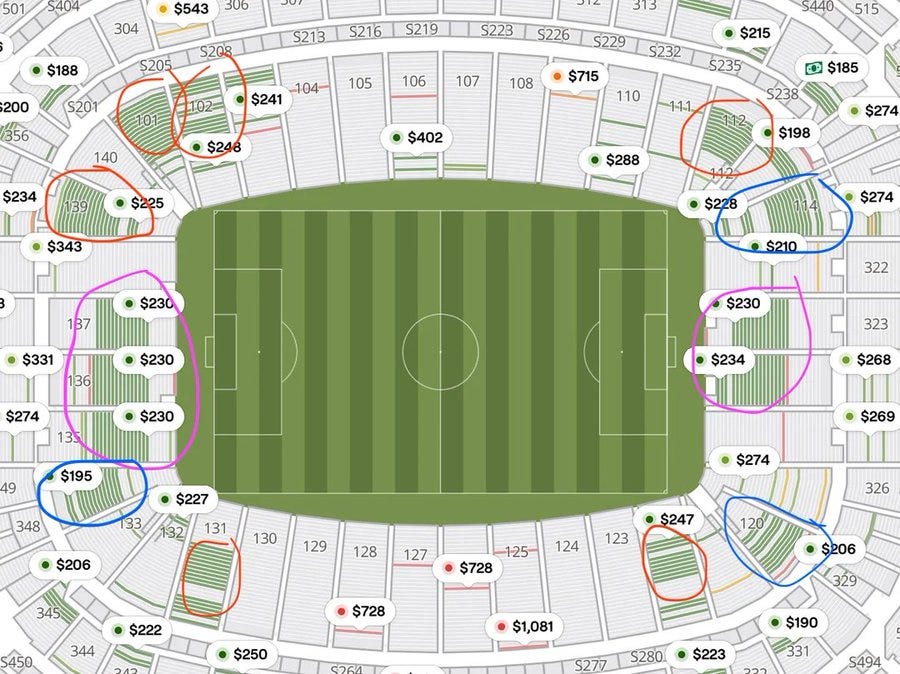
Economist Florian Ederer took a snapshot of a SeatGeek stadium chart (see below) to illustrate what may be happening:
I believe we now have evidence of FIFA’s World Cup ticketing shell game: FIFA is colluding with third-party resale platforms for its own supply management.
Look at this SeatGeek map (secondary market!) for Saudi Arabia vs Cape Verde. The circled areas are not random single resale tickets, but large, contiguous blocks of seats: entire rows and swaths in sections 101/102, 112/113, 119/120, 134–137, 139,
...
The blue circles appeared weeks ago, then the purple blocks suddenly showed up a day or two ago, and the red blocks seem to have appeared recently too.
That’s not what ordinary fan or even commercial scalper resale looks like who resell pairs, fours, and scattered seats. Instead, this looks like inventory being dumped in bulk onto secondary markets, at prices below FIFA’s official site.
Why doesn’t FIFA just lower prices on its own site Probably because official price cuts could trigger refund demands, chargebacks, or consumer-protection headaches from fans who already bought at much higher prices.
Instead FIFA keeps official prices high, avoids openly admitting the market-clearing price is lower, and moves unsold inventory through third-party resale platforms instead.
Official prices are indeed dropping.
Over the past month, the FIFA resale platform has seen average ticket prices decline by 20% with most resellers set to lose money after taking into account those egregious transaction fees.
Sportico also tracked FIFA’s ticket release schedule and it certainly looks like the organization is trying to manage the inventory like a MFer.
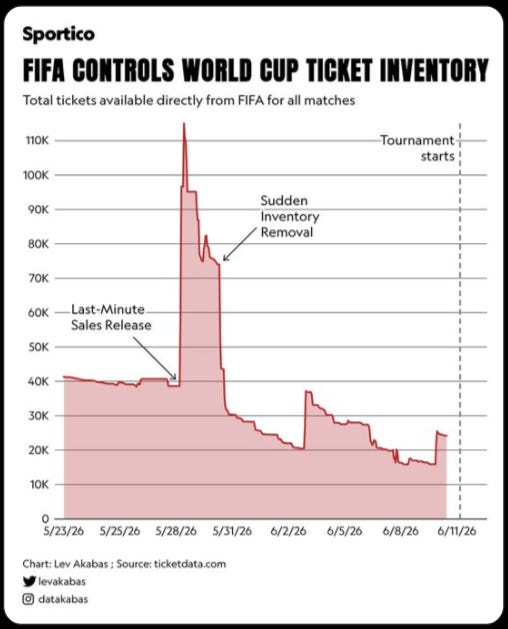
The situation got so silly that the attorney generals of New York and New Jersey subpoenaed FIFA and will investigate its ticketing practices.
Responding to the initial outcry, FIFA threw the tiniest bone possible: it made 1,000 tickets available for some matches at a cost of $60. A fraction of the total seats and many fan groups think it’s a publicity stunt.
And yet.
I will be buying from the FIFA resellers market.
The UX and portal sucks. But that chicken shawarma plate is so god damn good. Ugh.
This issue of SatPost is brought to you by Bearly AI
Are you looking for a no-logging, encrypted and anonymized AI chat tool?
Then try the Bearly AI research app, which provides an easy-to-use UX for the newest models from OpenAI, Anthropic, xAI, DeepSeek, Gemini and more.
While some AI providers keep chat logs indefinitely even after a user deletes them...Bearly AI has a default no-logging policy and user chats are encrypted while requests to LLM providers are completely anonymized.
Try one month FREE of the Pro Plan using the code BEARLY1.
Freddy: The Viral German World Cup Fan
The week before the World Cup started was a perfect example of the “ugh, FIFA is so suss but let’s just roll with it” vibes.
One of the first viral moments was a video of the Spanish team arriving in Chattanooga, Tennessee for training.
The internet being the internet, there was a flood of snark saying how the Spanish players would be let down by the city (many chirped: “I feel bad for the Spaniards”).

In response, a bunch of Chattanoogans started posting photos of the city and damn it is gorgeous (also, don’t think Europeans understand how much money there is in American high school sports…because the “high school” that Team Spain stayed at looks like Hogwarts).
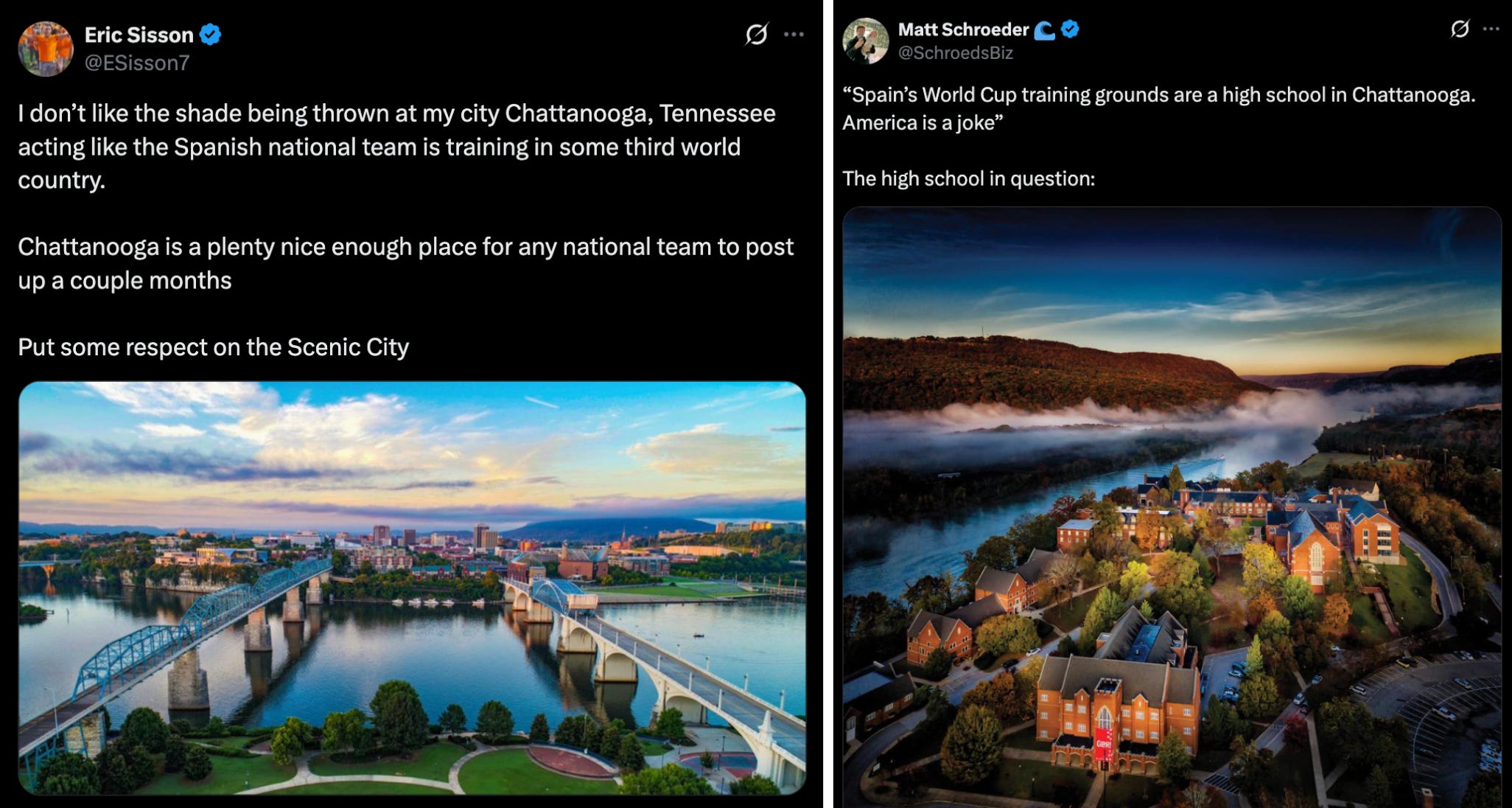
Shortly after, a German fan named Freddy completely took over the timeline and became the archetype of “European tourists discovering America is pretty awesome”.
He landed on the East Coast and an early hit was of him tubing in the Chattahoochee River in Georgia.
Then, Freddy started his road trip and has been driving through the Southern states including Tennessee, Florida, Louisiana, Alabama.
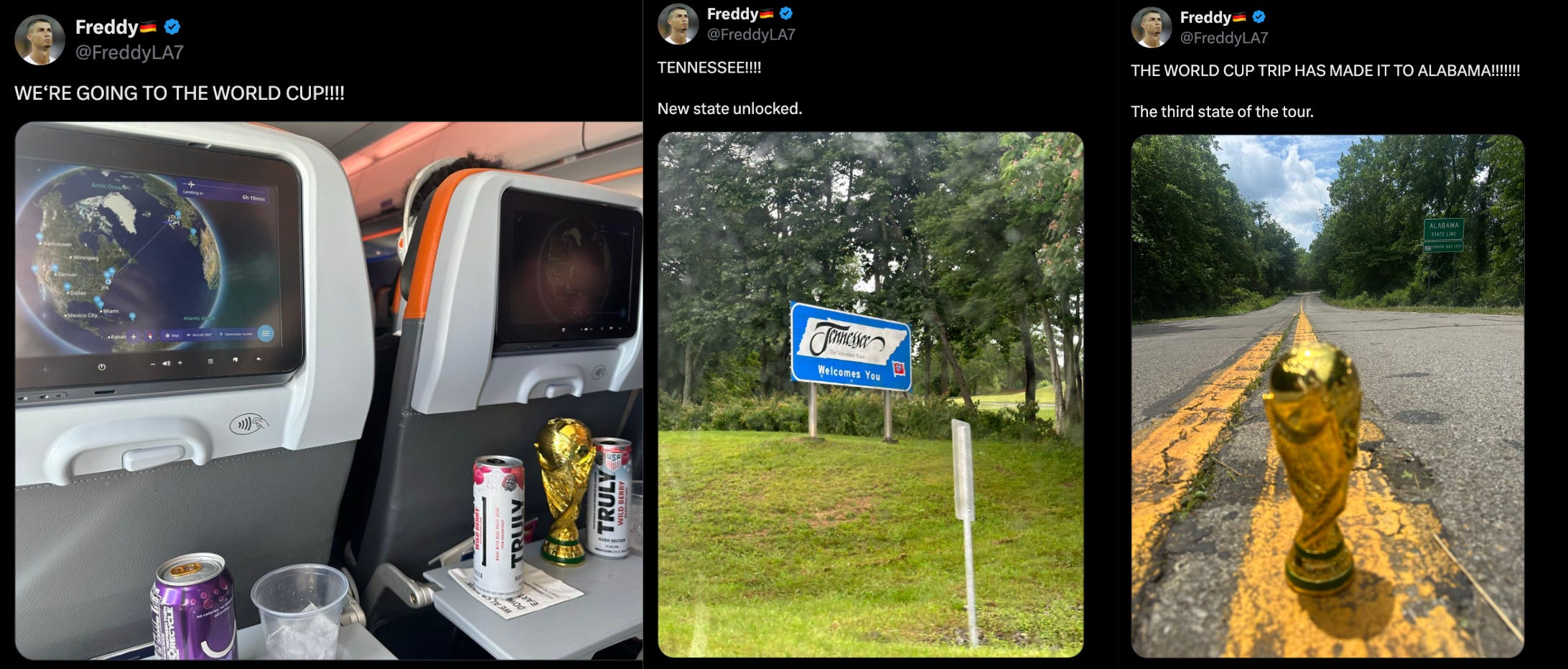
He’s posting photos of the drive and it’s become a full-on food tour. A popular reply reads, “If you want to hate America, watch the news. If you want to love America, drive across it.”
Incredible content with Freddy’s follower count growing from 10,000 to 500,000 as he plays an internet-age version of Alexis de Tocqueville trying to understand this young democracy known as America through Waffle House, Chili’s, Wendy’s and Bass Pro Shop.
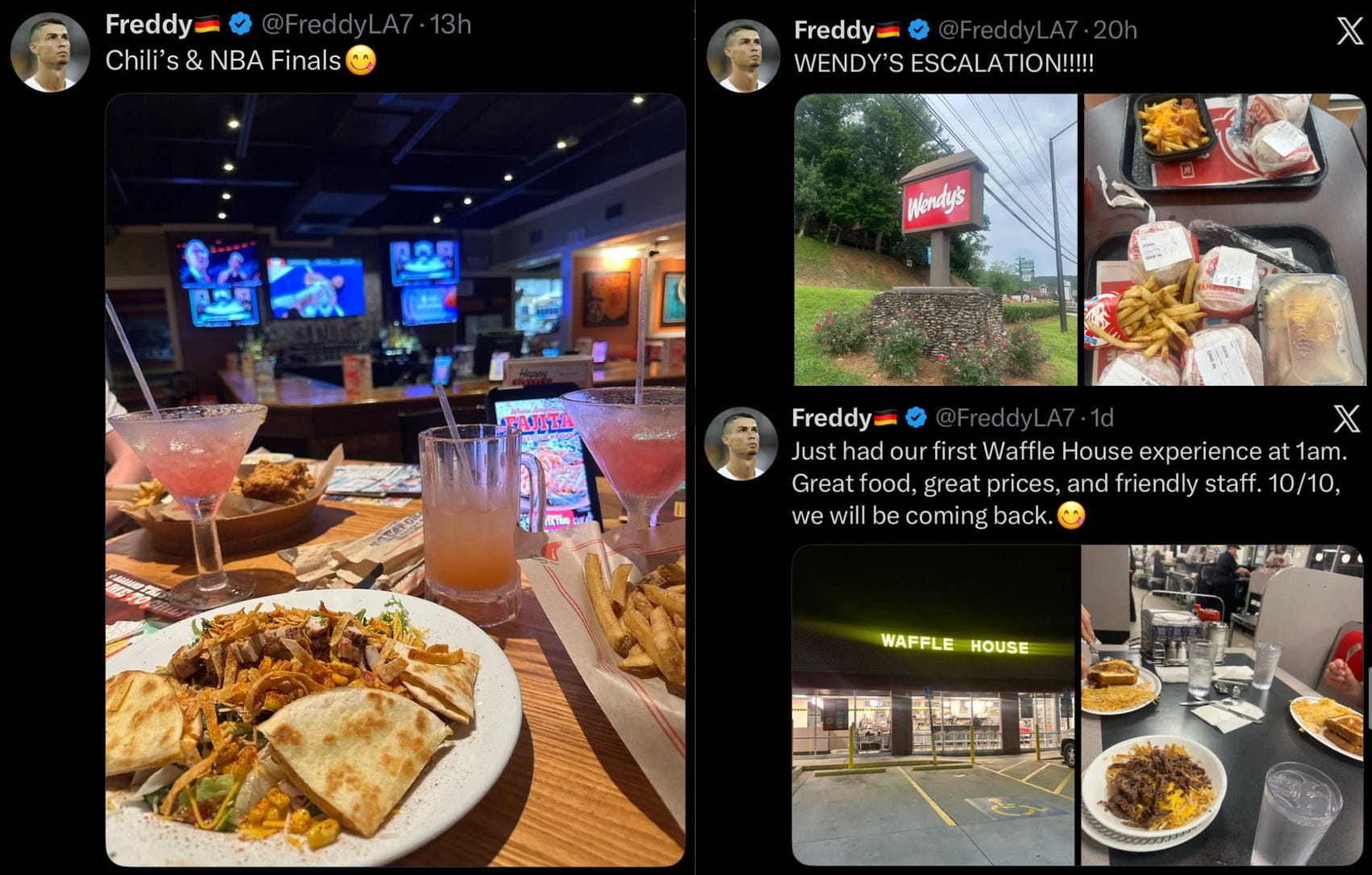
People were blowing up his replies to try Buc-ee's, the cult chain that doubles as a gas station and country store.
He would eventually…but first Freddy was awed by the Auburn football stadium, which hosted a friendly match between Argentina and Iceland (you know damn well Messi scored a goal a few minutes after they subbed him in).
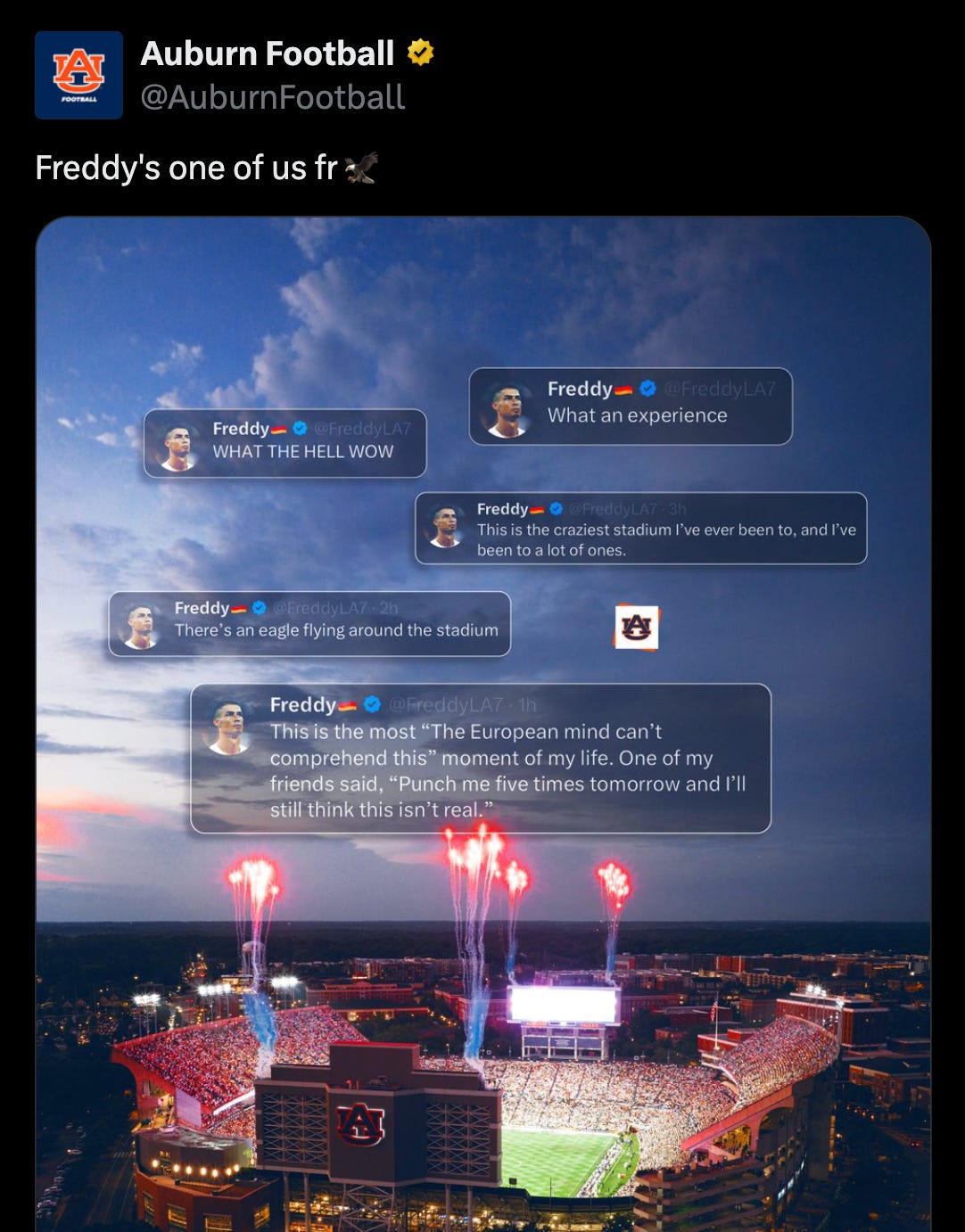
Our protagonist Freddy rolled up to Buc-ee’s after the game and immediately lost his mind.
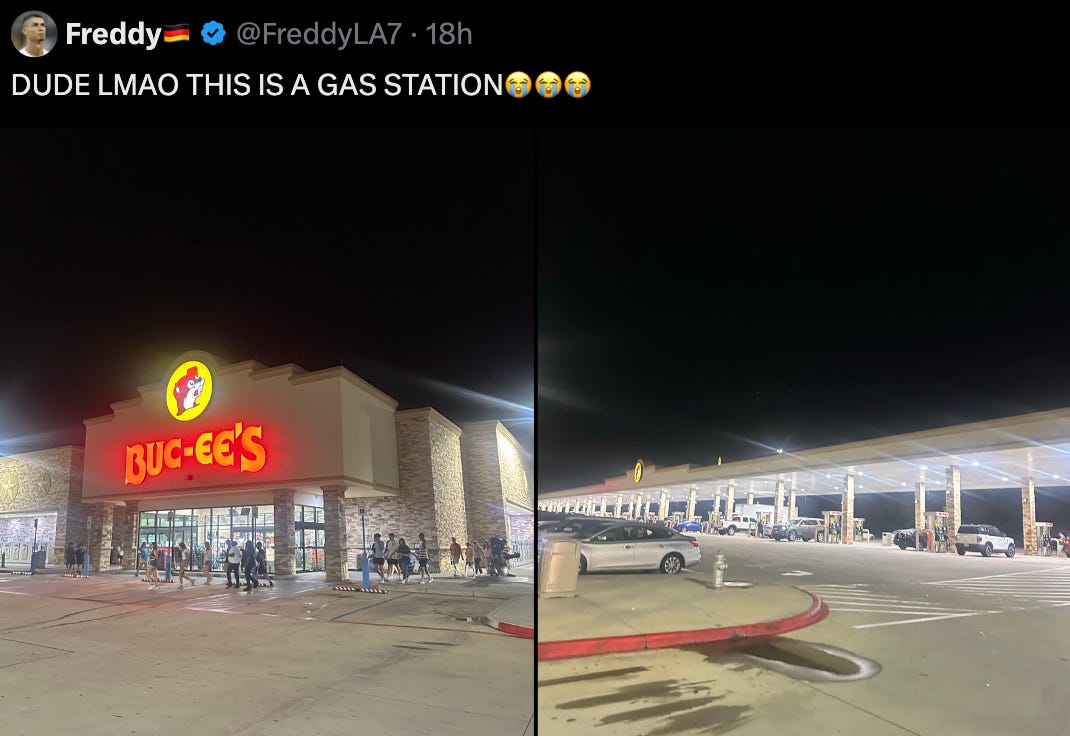
Nearly every American in the quotes and replies was ready to extend citizenship.


Foodwise, there was only one way for Freddy to top his run…and he found it:

Everyone on the timeline wants a piece of Freddy. On Friday, the New Orleans Saints gave him a tour of their stadium. On Saturday, Freddy will be staying with legendary NFL player JJ Watt…because of an exchange on X. Incredible.
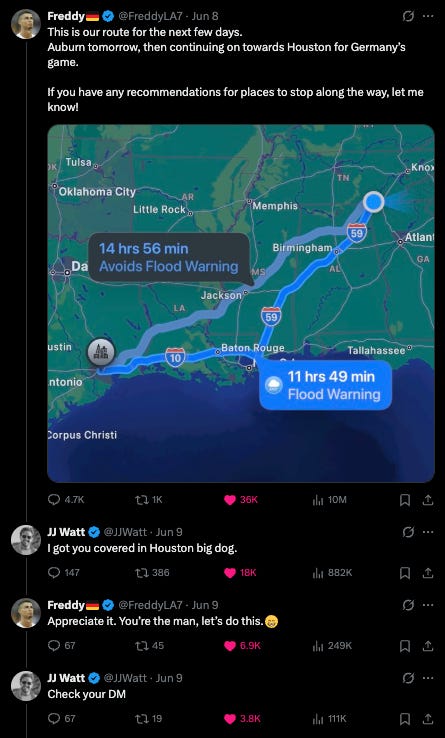
Oh, and in another post…he said that “The best discovery of our road trip has been a musician called Ella Langley.” Then, this happened.

I’m so invested in this hero’s journey. At this point, I expect Freddy to starting for one of the two final teams at Met Life Stadium on July 19th. Or maybe even take over for Gianni Infantino.
Anyway, Kansas residents are pumped that Algeria picked their town as the training site while the timeline has since uncovered many other World Cup tourist fans road-tripping America…and food has stayed a consistent theme:


The Science Behind World Cup Grass
There’s another running joke related to the post I shared up top: “The Spain national football team has arrived in downtown Chattanooga for the FIFA World Cup”.
One of the top quote re-posts reads: “We are witnessing new sentences that have never been uttered before.”
Over the next month, expect more random nationalities in obscure cities leading to “new sentences.”
Here’s another new sentence for you: The 2026 World Cup had a major challenge with grass and FIFA hired grass scientists from the University of Tennessee and Michigan State University to design a solution.
PBS Newshour interviewed Tennessee grass science expert Dr. John Sorochan and some notes on what he invented:
they made a modular hybrid turf (95% grass / 5% synthetic fiber) that is easily rollable, transportable and installable
each field has 20 million synthetic fibers sewn into dirt (the grassroots intertwine with fibers to prevent field from tearing)
all 11 stadiums in US host NFL teams…8 of those had to do special conversion of astroturf fields (Atlanta, Boston, Dallas, Houston, LA, NY, Seattle)
5 stadiums have a dome (eg. BC Place in Vancouver) and scientists developed special UV grow light machines to help maintain grass in those structures
grass in the Southern US and two Mexico locations (Monterrey, Guadalajara) need grass species for warm and humid temperatures (“Bermuda grass”)
Northern US/Canada and Mexico City need grass for cooler climates (“Kentucky bluegrass”)
scientists built special machines to test player foot impact and ball bouncing effect (reduce injuries and make sure ball movement consistent)
grass sods were grown on plastic so they spread horizontally, making it easier to roll and transport
So many new sentences.
French Players Dominating the World Cup
The two betting favourites to win the 2026 FIFA World Cup are France and Spain.
France’s roster can only take 23 players…which is why there are 75 other French-born players playing for other countries.
So, in total there are 98 French-born players at the tournament, which is equal to an absurd 8% of the total (with 48 teams, you’d expect each to have ~2%).
This was the same situation at Qatar. For the 2022 tournament, there were 137 players playing for a country other than the one they were born. France sent 38 of these players (more than Spain, Brazil, England, Germany and Argentina combined).
How does this work?
FIFA eligibility rules allow players to play for other countries based on “clear connections” (eg. citizenship and parental lineage). Many of the French players on other national teams are playing for former French colonies in Africa:
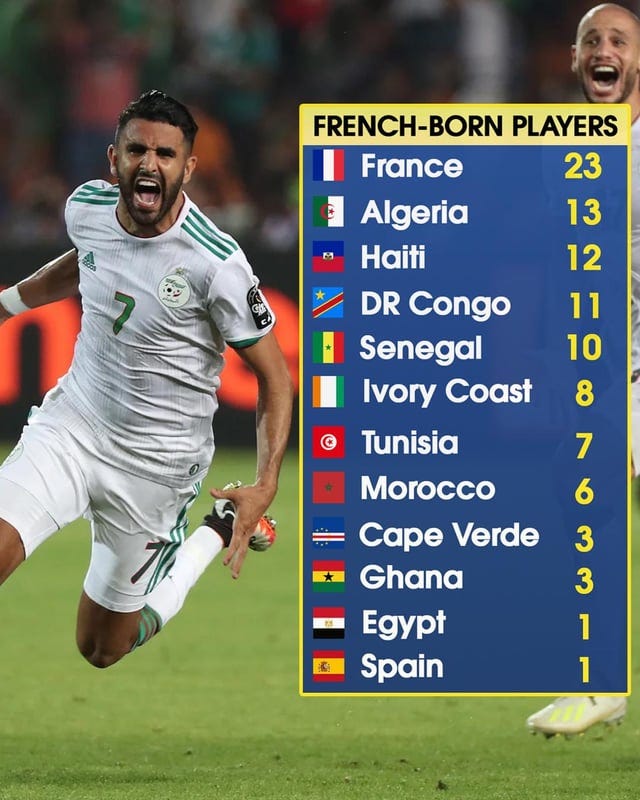
This is the 6th straight World Cup where France has had more combined players (French national team + other national teams) than any other country.
How did France become such a global football powerhouse? Per Vox, the story dates back to French policies set in the decades after WWII. France needed to rebuild but was short on manpower. So, it brought in millions of workers from Eastern Europe and its African colonies (more migrants went to France than any other European country in the period).
In the 1960s, even more immigrants arrived (including from the Arab World and the Caribbean). In the same period, France failed to qualify for a number of World Cup tournaments. So, the country launched the French Football Academy to better train and scout talent (it became among the world’s best).
Many immigrants (or children of immigrants) have gone through the French football program. When France won the 1998 World Cup, it was led by Zinedine Zidane (Algerian parents) and Patrick Vieira (born in Senegal).
Today, the French roster doesn’t have enough slots for all the players, so they join other national teams. Meanwhile, France’s brightest star is Kylian Mbappé — during the country’s 2018 World Cup winning run and again in 2022 — has parents from Cameroon (dad) and Algeria (mom). A majority of France’s roster has a strong link to Africa.
The French team’s African make-up has become a social flashpoint with common criticism that the immigrant players are “French when we win” but “immigrants when we lose”.
Some Other World Cup Links
Finally, my “be realistic” prediction is for Brazil to win the World Cup. I really got into the tournament in 2002 for the OG Ronaldo’s incredible comeback (after a disastrous 1998 finals loss against France). I did his goofy triangle haircut that summer but, thankfully, this was before Facebook and there is no photo evidence of it.
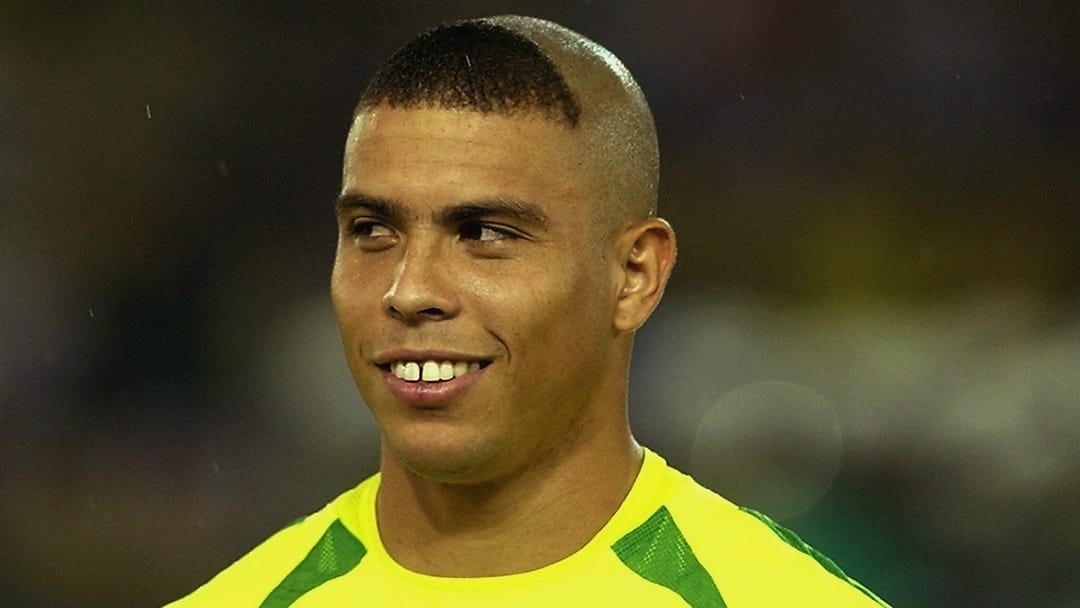
Some other links to scratch your World Cup itch:
More on Ronaldo 2002: Brian Phillips has a great podcast series from 2022 based around 22 famous World Cup goals. His episode on Brazil’s Ronaldo is a banger. (The Ringer)
“Why isn’t the U.S. better at soccer?” Nate Silver says there are too many other popular sports and the best athletes gravitate to American football, basketball, baseball etc. (Silver Bulletin)
“The Airline Analyst Who’s Getting Paid to Watch Soccer”: Dean Seal profiles a network planning analyst for American Airlines. During the World Cup, he’s watching every game and tracking results for where team fans may commute. An example: “Japan’s fans are showing a high propensity for travel, so Sagan increased flights between their group-stage outings in Dallas and Monterrey, Mexico.” (The Wall Street Journal)
La Sagrada Familia: 100 Years After Antoni Gaudi’s Death
Speaking of new sentences that have never been uttered before…
…Pope Leo XIV was in Barcelona and held mass at La Sagrada Familia on June 10th to celebrate the 100th anniversary of Antoni Gaudi’s death and the event included a drone show of the legendary architect’s face and a paraphrase of one of his most famous quotes: “To do things right, first you need love, then technique.”
While some commenters felt this was the “Disney-fication” of theology, I have literally zero thoughts on that. All I know is that the entire 5-minute end sequence — including a lightshow and fireworks (!!!) — was out of control. Looked like Christopher Nolan directed it. Watch it.
La Sagrada Familia is probably my favourite building in the world and here is an 80-minute deep dive solo podcast I did on the Basilica.
TLDR: Gaudi was 73 when he died on June 10, 1926. He had spent over 40 years working on La Sagrada Familia while completing only 1/4th of the entire Basilica.
Gaudi’s method for designing it was genius: he hung movable weights on strings and let gravity do the work of showing the proper angles and force vectors for his nature-inspired look. He then flipped the model upside down to see how to build the columns and arches.
Also inspired by forests and sea life, Gaudi said, “there are no straight lines or sharp corners in nature.”
In the final years of his life, Gaudi was solely focussed on the project. His diet was lettuce leaves dipped in milk. I repeat: his diet was leaves leaves dipped in milk.
Gaudi slept inside the Basilica on a simple cot…if he slept at all…which he didn’t really.
He died after getting hit by a tram while walking around Barcelona. His clothes was so ratty — underwear held together with safety pins — that passersby thought he was homeless.
The city held a massive funeral for him with 30,000 people packing the streets.
While 75% of La Sagrada Familia was unfinished, Gaudi left enough plans (models, drawings) for future generations.
La Sagrada Familia was largely dormant between the 1930s-1960s (Spanish Civil War, World War II, early Cold War).
Meanwhile, some of Gaudi’s designs were so ahead of his time that it required the development of aeronautical design software to complete his vision.
Gaudi once remarked that “my client” — referring to God — “is not in a hurry”.
There is still work to be done but a major milestone was completed in February: workers installed a cross on top of La Sagrada Familia’s Tower of Jesus, making it the tallest church in the world (172.5 meters or 566 feet). The cross was lit up for the first time during the celebration with Pope Leo XIV.
That cross is also the tallest structure in Barcelona. But Gaudi intentionally capped the height because “human creation should not pass God’s work.”
The Montjuïc Hill in the southwestern part of Barcelona is ~570 feet.
Anthropic Launches & Throttles Claude Fable
In early April, Anthropic came out with a new frontier model called Claude Mythos.
The $960B AI startup didn’t release the model to the public.
It said the cybersecurity implications were too serious. Anthropic allowed organizations (eg. CrowdStrike, JPMorgan, Nvidia) to use the model to find and patch bugs.
While Mythos was undoubtedly strong, many observers noted that Anthropic was doing “fear porn” as marketing.
“OH GOD, WE’RE BUILDING SOMETHING SO POWERFUL IT MIGHT DESTROY THE WORLD. PLEASE GIVE US $50 BILLION TO BUILD SECURITY AROUND THE MODEL WE ARE BUILDING THAT MIGHT DESTROY THE WORLD.”
The company also had a shortage of compute and couldn’t even serve Mythos to the public if it wanted to.
Fast forward to early June. Anthropic put new guardrails around Mythos and released it to the public as Claude Fable. Professor Ethan Mollick shows it can do some very interesting tasks as highlighted by Professor Ethan Mollick.
The capabilities are very impressive but Anthropic made two decisions that really pissed off the AI community:
It instituted a mandatory 30-day data retention policy (unsurprisingly, Anthropic says this is for security reasons…as they want to see how the model is being used)
For certain queries around biomedicine and AI research, Anthropic would push users down to its less-capable Opus 4.8 model (in the case of AI research, it made this downgrade without notifying the user)
One biomedical researcher (Derya Unutmaz, MD) couldn’t even ask basic biology questions because Claude’s memory knew that he was a biomedical researcher. Even some math questions were throttled.
Again, there are certainly security concerns. Anthropic believes many leading Chinese labs are using its Claude models to build their own. I also get the decision from a competitive standpoint.
But from a user standpoint, getting downgraded to a dumber model without being told is…not great.
AI policy expert Dean Ball has a thorough take:
My last observation re: Anthropic’s secret sabotage safety policy, is that it undermines actually good safety policy. How?
1. First, it is very plausible to describe this as anti-competitive behavior (even if you are maximally sympathetic to Anthropic here you must admit this), and it is behavior being justified in the name of AI safety. If you believe, as I and many Anthropic staff do, that it may end up being critically important to relax antitrust enforcement so that the frontier labs can cooperate and collaborate on some areas of AI safety, Anthropic just undermined the case for that in a large way.
2. Overall, this massively and profoundly raises the status of the argument that AI safety has been hype to justify monopolistic behavior by labs. I continue to believe AI safety is a real and serious issue that is growing in importance rather than diminishing. If you agree with me, this incident is a setback, maybe a serious one.
3. As I have observed elsewhere, Anthropic’s official corporate policy is structurally identical to the fact pattern alleged against them by the Department of War. I still think DoW acted both falsely and wrongly in that fight, but it is no longer possible to defend Anthropic with a full throat after this incident.
4. This raises the case for heavier handed regulations. Anthropic is making an awfully good case here that their products ought to be treated as utilities, and thus that their alignment practices should be a matter of public policy rather than private property. I am starkly opposed to this sort of state power grab, but Anthropic is doing more to justify it than anyone else.
5. Thus, significant damage has been done to a community and entire approach to AI governance. It was done unilaterally by Anthropic, likely motivated largely by self-interest and justified within the internal psychology of the firm through the lens of safety.
I suspect this is fixable in the economic and legal senses for Anthropic, but I fear the trust that has just been broken, and the goodwill extinguished, will take very much time to repair.
Anthropic ultimately backtracked on the “we will kick you down to a less capable model without telling you because we can, kick rocks” and will now flag any model changes.
Then things got crazy.
Dario wrote one of his long blogs. This one was titled “Policy on the AI Exponential”. It covered regulation, tax policy and social safety nets in case of AGI.
One passage read: “The government should have the power to block or deter deployment of the model if it is determined, in light of third-party assessment, to present unacceptable risks. This power must be scoped to the above four specific risks and there must be protective measures against political favoritism or arbitrary decisions.”
And, um, on Friday night…the US Government determined that Claude Fable was too much of a national security risk to be used by foreign actors. It issued an export control and Anthropic decided to turn the model off in America too.
More to come…but check the replies in its post…tons of people were mid massive coding projects and plug got pulled.


Links and Memes
Tom Brady launched a coconut water brand. Thought he went too far with the brand’s name (“Good Nut”) and tagline (“It’s a delicious mouthful”). But he is sourcing it from glorious Vietnamese farms, so I’ll def be enjoying Good Nut.
Apple unveiled Siri AI. It’s supposed to be more conversational version of the 16-year old product — that has literally not changed — and integrates user context (photos, contacts, calendars). The WWDC 2024 version of Siri AI was pure vapourware. However, the new Siri responses in the demo actually take a while, which means Apple learnt its lesson after getting fined over false advertising for the previous Siri. Ben Thompson thinks Apple is still uniquely well-placed to win consumer AI because of its hardware (the user context is key even if the demo was underwhelming).
SpaceX went public on Friday. It jumped +19% on its first trading day and closed with a market cap of $2.1 trillion. Elon’s net worth now makes him the inaugural member of the “cuatro-commas” club and the IPO made an estimated 4,000+ new millionaires at the 24-year old rocket/AI/social media company.
…and a them wild posts:



In 1982 my mom bought me a bus tour + 10 days hotel plus tickets for 5 games including England beating France 3-1. I(I paid her back from my summer job. Think it was £250). In 1994 now living in SF I went to LA for a weekend, saw 2 games, Stanford for a group game & a 1/4 and Dallas for the Brazil v Netherlands (best game of the tournament). If you add up everything I have ever spent on the world Cup, I am sure that I will be spending more taking my wife and 2 kids to Levi's stadium to see Paraguay take on the mighty Turkey. And the tickets I can't believe I paid $350 each for are selling on StubHub for $500!
That's why FIFA is getting away with this shit
funny. 2 years back, western europeans were carping about high inflation and how they are not able to heat their homes and feed the kids...and here i see them paying nose bleeding prices for a 'lifetime' experience (nobody forced anyone to go) and posting up on social media.
what was the saying? panem et circenses... yep