

Thanks for subscribing to SatPost.
Today, we will talk all things Disneyland: history, design psychology and how Disney’s business model is ruining the experience.
Also this week:
Michael Jordan’s Wild NASCAR Ride
Apple at 50
…and them wild posts (including Kit Kat)
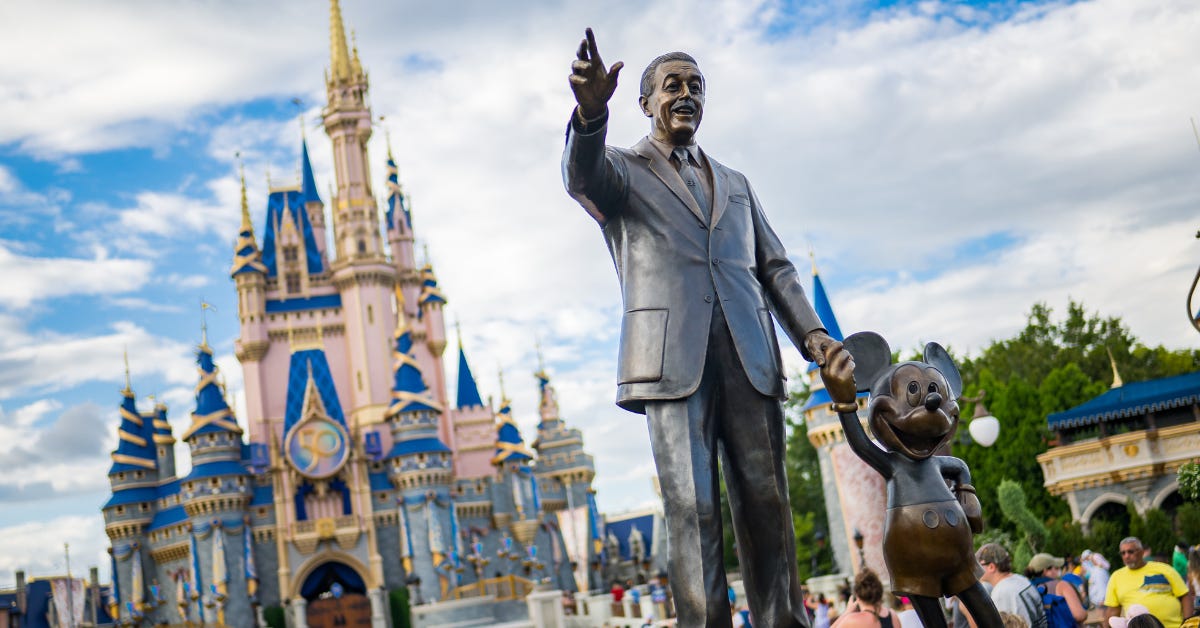
In the summer of 2023, I knocked off a key parenting milestone: my wife and I took our son to Disneyland in Anaheim, California.
The last time I went was in the late-1990s with my parents.
So it was definitely a full circle moment that made me appreciate my parents a ton more. They did it with four kids. Completely outnumbered. A 1:2 ratio. My wife and I were reversed. A 2:1 ratio.
It was still a zoo, though.
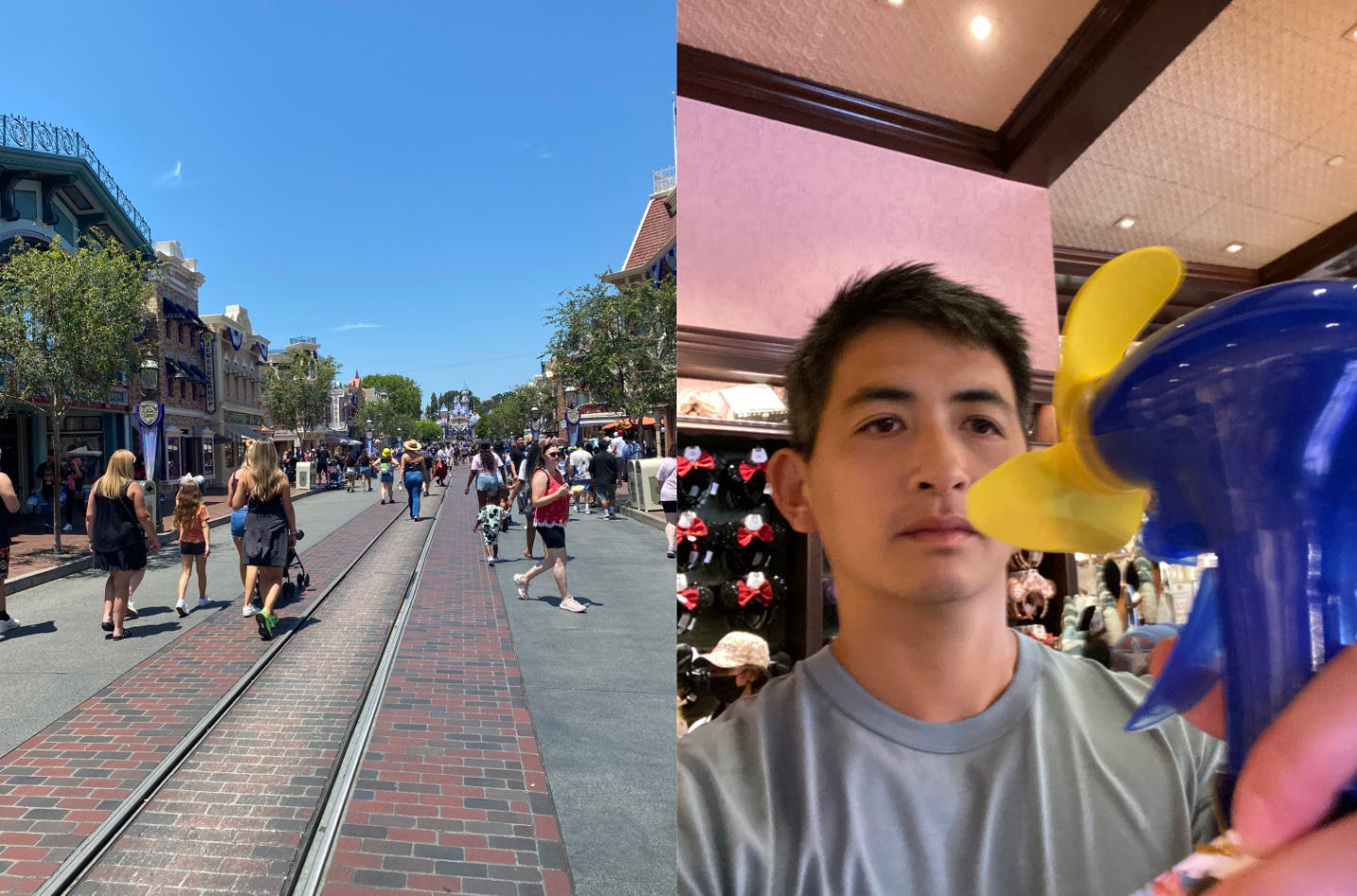
We waited in long lines. We got scorched by the sun (I didn’t do us any favours by being hungover). We bought overpriced bottles of water and random swag (hello, $30 Misting Spray Fan). And I legit chuckled every time a Disney employee rang up a bill, as I did the gross margin calculation in my head (comically high).
I want to revisit the trip because Disney recently named a CEO.
Josh D’Amaro officially succeeded Bob Iger for the top job on March 18th.
This was the second time Iger has passed the baton. The first time was to Bob Chapek in February 2020. Iger handed the business off to Chapek literally as COVID was kicking off. That’s Texas Hold ‘Em equivalent of getting dealt 2-7 off-suit. It was a fraught relationship and Iger came back in November 2022.
A through line between Chapek and D’Amaro is that both led Disney’s theme park division, which has become the undisputed cash cow for the company.
The trip I took to Disneyland coincided with a flippen-ing of Disney’s entire business model between four key pillars: Parks & Experiences (including Cruise Ships), Studio Entertainment (Film), Media Networks (ABC, ESPN, Disney Channels, FX etc.) and Direct-To-Consumer (aka Streaming aka Disney+, Hulu and ESPN+).
Over the past decade, Disney’s Parks & Experiences division has gone from 18% to 57% of Disney’s operating profit. In 2025, that was nearly double the combined operating profit for cable TV, streaming and film at 32% (the remainder was Consumer Products aka merch aka you’re probably drinking from a Marvel or Star Wars coffee mug rn) .
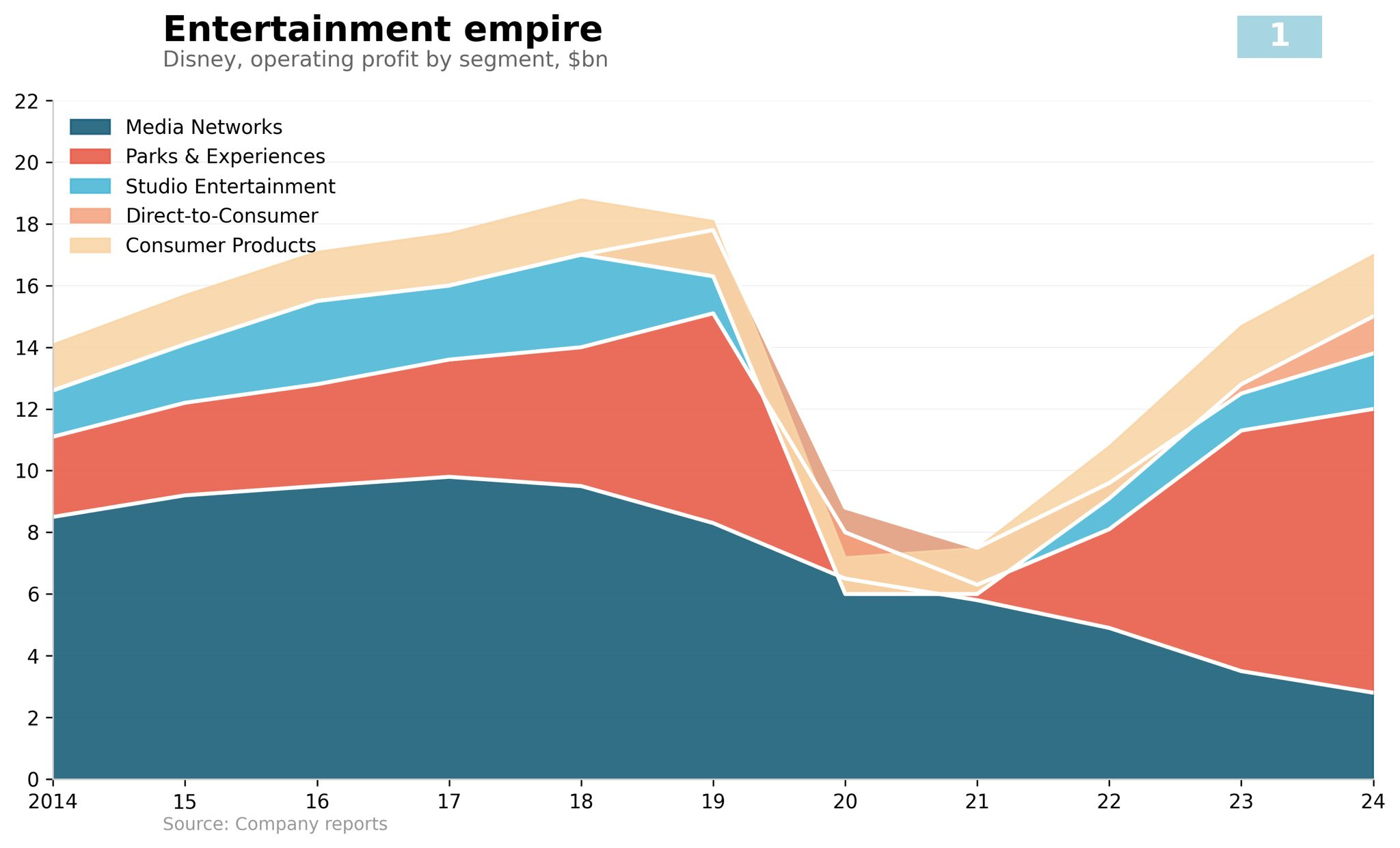
Parks & Cruises is putting up these numbers while being only a ~1/3 of Disney’s $94B revenue. The division is floating Disney’s entire transition from dying cable TV assets to streaming….which has been a bumpy ride.
Since the Iger-to-Chapek handover, Disney’s market cap has declined by ~50% to $170B.
Can D’Amaro turn it around? He needs to milk theme parks and cruises. But the milking is already getting out of control and turning off park attendees. How much more can he milk? It’s a dilemma.
A Disneyland dilemma if you will.
To see how we got here, let’s discuss:
Disneyland’s origin story
Imagineering and psychology of park design
The gnarly cable TV-to-streaming transition
How much can Disney milk theme parks?
The beginning of Disneyland
The year is 1954.
Walt Disney is 52-years old, a pioneer of film and animation with some of the most classic Hollywood works under his belt: Steamboat Willie (1928), Snow White and the Seven Dwarves (1937), Pinocchio (1940), Fantasia (1940), Dumbo (1941), Bambi (1942), Alice in Wonderland (1951) and Peter Pan (1953).
With so much success, Walt had tired of the Hollywood studio life while his older brother Roy — who co-founded The Walt Disney Company in 1923 — ran daily operations.
Walt was a world-builder and wanted to use his capital, reputation and creative energy to create the next big thing: a theme park.
Why? There were a few reasons as detailed in Neal Gabler’s 2006 book Walt Disney: The Triumph of the American Imagination.
First, Walt had been unimpressed by the many amusement parks he visited with his daughters over the years. The amusement park concept had taken off in America at the turn of the 20th century in Coney Island, New York. In the following decades, the attractions remained the same: thrill rides and games. Disney was turned off by the dirtiness of a typical amusement park and hated how operators tricked guests (or “marks” as they called them) into rigged park games.
Second, Walt was a pioneer in adapting storytelling techniques to new mediums (animation, film, and TV), and the physical world seemed like the next logical step. His park would not only be for entertainment; it would be for immersing visitors into entire worlds.
Third, he wanted to build something that was alive. A film or TV episode is done when it’s done. A park can always be improved and updated. Walt — who worked on Disneyland until he died in 1966 — said of his theme park project, “Disneyland…will continue to grow as long as there is imagination left in the world”.
To make his dream a reality, Walt tapped professionals from the Stanford Research Institute and sent his team around the world to find the best ideas.
Per Gabler:
[Even if] there was no antecedent, in its planning the park had been the beneficiary of a host of forces and influences — the Edenic European gardens, like Tivoli, that Walt had visited; the expositions and fairs, like the Century of Progress in Chicago in 1933, the New York World’s Fair in 1939, and even the Chicago Railroad Fair; historical re-creations, like Knott’s Berry Farm, Greenfield Village, and Colonial Williamsburg, all of which Walt had seen and enjoyed; and, what may have been the most important influence of all, California architecture itself.
Walt was born in Chicago and grew up on a rural farm in Missouri. In his early-20s, he moved to California, and the influence of the state on Disneyland is understandable when one considers the region's geographic diversity.
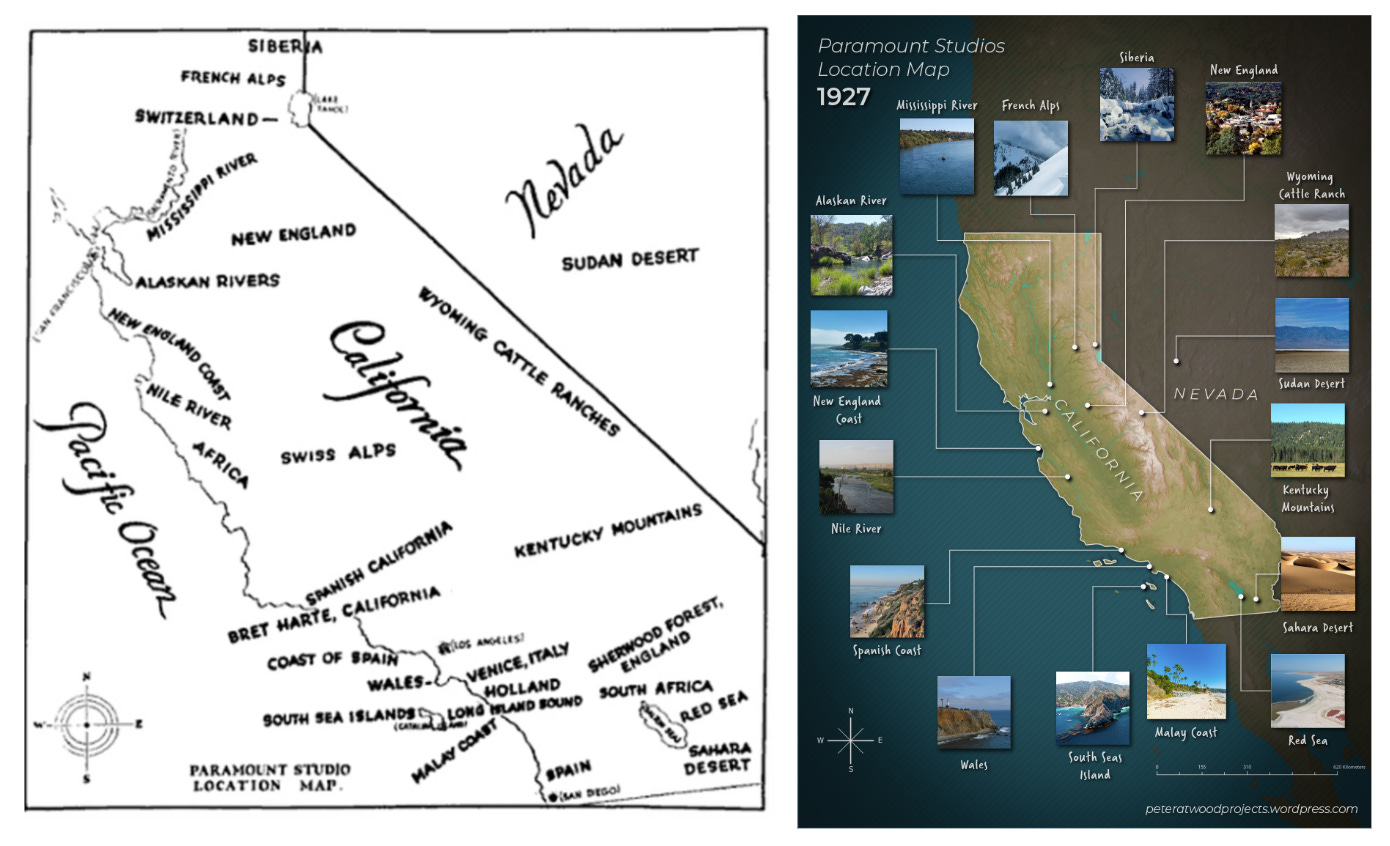
In 1927, Paramount Studios created a famous map of California that showed how different parts of the state could be used as stand-ins for filming sites from all over the world.
Below is a photo of a map and an image from cartographer Peter Atwood, who overlaid on-the-ground photos of each location (e.g., Southern California is "Spain", the Nevada border is "Wyoming Cattle Ranches", the coast near LA is "Venice").
Having one type of setting next to a completely different type of setting is not unlike what Disneyland would become with neighbouring worlds all occupying one plot of land.
Walt's plan for Disneyland was truly ambitious, and most amusement park veterans scoffed at the idea. However, Walt was undeterred and ultimately chose people from within his Disney empire to complete the project. This approach worked because Walt's team understood the power of Disney intellectual property (IP) and storytelling.
The skepticism from “experts” also meant that traditional lenders wouldn’t touch the project.
“I could never convince the financiers that Disneyland was feasible,” Disney remarked. “Because dreams offer too little collateral.” (in 2026, Walt could have called it an “AI-powered theme park” and easily raised $1B pre-seed).
So, how did Walt get the money for Disneyland?
Among film moguls, Walt was the first to recognize the potential of the small screen and he struck a genius partnership with ABC in the early 1950s to fund his park.
The TV network desperately needed content to compete with CBS and NBC. Walt agreed to a 3-year deal to make shows for ABC if the network would:
Pay for the production of the shows
Buy $2m worth of a 10-year bond
Guarantee a $4.5m bank loan
Walt diverted ~$5m ($61m in 2026) of the funds to build Disneyland. The budget eventually ballooned to ~$17m ($207m), which Walt financed with his own funds, park sponsorships and additional help from ABC (Walt’s shows — including one he hosted called “Disneyland” — were smash hits).
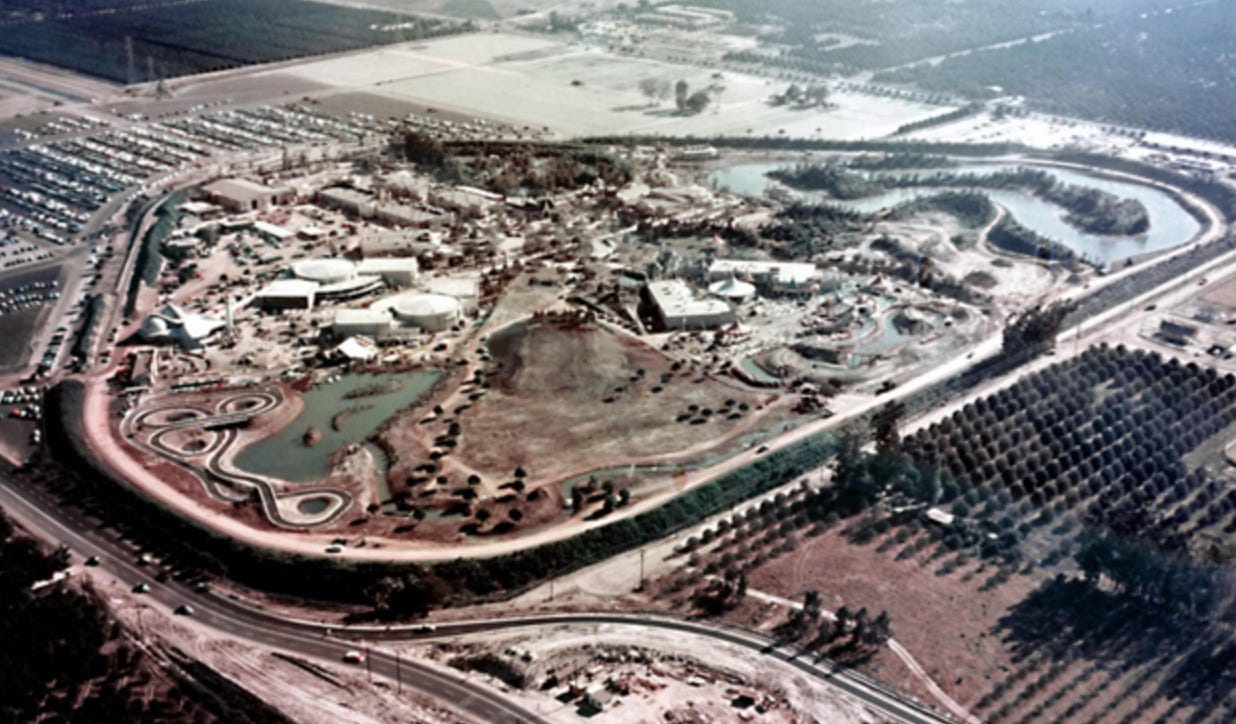
On July 14th, 1954, Walt broke ground on a plot of land in Orange County for his future theme park. The area was chosen for its affordability (outside of Los Angeles), its mix of weather (low rainfall and low humidity), and its infrastructure (which was good for transportation).
Disney gave his team a one-year deadline to build a park with five themed worlds. The first version of Disneyland combined American nostalgia and heritage (Fantasyland, Main Street USA, Frontierland) with excitement and visions of the future (Adventureland, Tomorrowland).
There was something for kids and parents alike.
Having set up a new company — separate from the studio — to create Disneyland, Walt had total control over all decisions. He regularly walked and inspected every inch of the park.
Disneyland officially opened to the public on July 17, 1955, a year after Disney’s self-imposed deadline. The first day was mayhem. Nearly 30,000 guests descended on the park. There was a massive traffic jam. Long lines everywhere. A lack of water. Unfinished attractions.
The early snafus proved to be a minor speed bump. The one-millionth guest visited Disneyland just two months after its opening. Disney had built his world in the physical world and guests loved it, as explained by Gabler.
The reason the visitors felt so good…was that Walt Disney had painstakingly conceived of his park as ordered and harmonious. Disneyland had no ambiguity, no contradictions, and no dissonance. The layout and the way guests were subtly directed to destinations, the cleanliness, the efficiency with which crowds were queued up to wait for attractions, the weather, even the sounds of the park—all contributed to a sense of absolute well-being.
The business world was slower to catch on.
After visiting Walt, a young Warren Buffett was able to buy 5% of Disney for $4m back in 1966. He flipped it for a 50% gain the next year. At that original $80m valuation, Buffett would later say of the deal “at Disneyland, the $17m Pirates of the Caribbean ride would soon open…imagine my excitement, a company selling at only 5x rides” (we need to bring back this valuation metric).
Buffett called Disney a “unique asset” and that’s all from the brain of Walt.
One of the most striking examples of Walt's complete control was the creation of a berm — a raised hill barrier — around the entire park. No one from the outside could see in, and no one from the inside could see out. When you are in Disneyland, you are truly in another world.
Fast forward to 2026, Disneyland has since added three more lands to the original five: Critter Country, Mickey's Toontown, and Star Wars: Galaxy's Edge (then, in 2001, they opened the neighbouring Disney California Adventure Park with Marvel, Pixar and a bunch of California-themed areas).
The ideal guest experience remains the same even after all the additions. Upon entering the park, each person is still greeted by Walt's original vision inscribed on a plaque: "Here You Leave Today and Enter the World of Yesterday, Tomorrow, and Fantasy."

Imagineering and the psychology of park design
The greatest portmanteau ever is "turducken" (a combination of turkey, duck, and chicken, which I would really like to have for Thanksgiving one day).
The second greatest portmanteau ever is "Imagineering" (a combination of "imagination" and "engineering"). In 1952, Walt Disney borrowed the term — which had been coined by OG industrial firm Alcoa in the 1940s — to create Walt Disney Imagineering, the group responsible for bringing Disneyland to life.
There are now over 2,000 Imagineers creating the rides and experiences for the 140m+ people who visit Disney’s 12 theme parks every year (in Anaheim, Florida, Paris, Tokyo, Shanghai and Hong Kong).
That’s ~60% of all global theme park visits and almost 3x ahead of second-place finisher Universal Studios (we haven’t even talked about Disney’s 8 cruise ships that — based on how many Instagram ads my wife gets — I will soon be experiencing).
In his 2016 book titled The Imagineering Pyramid, Louis Prosperi breaks down the Imagineering process and skillsets required for the job. There are obviously the creative disciplines (illustration, art direction, writing, music and sound design, interior design, lighting design, and architecture). But equally important are the engineering experts (structural, mechanical, electrical, and industrial).
Below are 3 key concepts from the Imagineering process and how they influence guest psychology:
“Art of the Show”
Remember: Disney does theme parks, not amusement parks. Think of a stage play or a film scene. In either case, every prop and actor has a purpose. Similarly, Disney parks are designed as a show.
Prosperi writes about the Imagineering philosophy called “art of the show”, which calls for “design elements [to contribute] to the story or [help] to create a natural visual segue from one themed land to another.”
Here are some examples:
Engage all the senses: Film has sound and sight. But not taste, smell or touch. Disney parks engage the latter two senses in very strategic ways.
Smell: To utilize the power of smell — which is the sense most-connected to memory formation — a Disney Imagineer literally invented a machine called the Smellitzer to emit lab-created scents which pair with the surrounding attractions. Main Street smells like vanilla. The Pirates of the Caribbean ride smells like salty sea air. Pooh’s Adventure smells like honey. Haunted Mansion smells like burnt wood. The drink carts smell like me overpaying for a $10 bottle of water.
Touch: There are various ways to transition between scenes in a film (jump cut, blank screen etc.). At a Disney park, you can literally feel the ground change (eg. gravel to smooth cement) as you walk between different worlds.
Never show how the sausage is made: According to legend, Walt was once walking through Disneyland and saw a cowboy from Frontierland in the Tomorrowland area. He was pissed. Every world has to be consistent or the guest would lose the sense of magic. As a result, Disney World in Florida was built with 392,000 square feet of underground tunnels (utilidor system). This area was for employees — referred to as “cast members” (keeping with the idea of a “show”) — to change, eat, rest and take out garbage without disrupting the themed experiences.
Worlds kept separate: Each world at a Disney theme park is designed to prevent a guest from seeing or hearing another part of the park (similar to how the berm surrounding Disneyland prevents outsiders from looking in and vice versa). A great example: when the Tower of Terror was built in Florida, Imagineers made sure it wouldn't stand out when viewed from Epcot (the view shows the tower blending in with the Morocco pavilion).

Visual Communication
A film technique that Walt really leaned on was set building. To quickly communicate a story or achieve a desired action, every building structure in Disneyland is built to a specific proportion (eg. 5/8ths of the real size):
Forced Perspective: Imagineers use this technique to make buildings appear larger and taller than they actually are. From a distance, Cinderella's Castle looks larger than life because the bricks at the top are smaller than those at the bottom.
Wayfinding: Disney utilizes large structures (Epcot, Magic Mountain, Cinderella's Castle) to draw guests' attention and builds roads along these lines of vision to move people around the park. Known as "weenies," these structures have to be both large enough to be seen and interesting enough to attract.
“Plussing”
According to Prosperi, Walt always asked his team “how could we plus it?” Every part of the park could be made better and the process of “plussing” is used to constantly improve the experience.
The grass really is greener: Disney World's sidewalks have a reddish hue, which helps make the color of the grass "pop". This is because red and green are complementary colors (i.e. opposite ends of the color wheel), and the contrast makes both the sidewalk and grass appear brighter.
Accentuated sounds: The horses wear special horseshoes with a polyurethane coating, which makes a louder "clopping" sound when they walk down Main Street.
Before and after: While a Disneyland trip might only be a weekend, the experience lasts way longer. Disney hypes of anticipation of the trip by sending guests reminders on the lead-up to their arrival. And there are professional photographers all over the park to snap photos for long-lasting memories (PhotoPass lets you view the photos for free online … or, pro-tip, you can just screenshot them if you don’t want to pay for high-res).
Small details: Look at the Cinderella statue in the left frame below. It looks normal from an adult's perspective (top). But from a child's lower perspective (bottom), Cinderella is wearing a crown.

That’s the tip of the iceberg.
There is incredible thought put into the park and now the rest of the company is weighing down on the magic.
The gnarly cable TV-to-streaming transition
Let’s revisit the four main legs of the Disney empire:
Parks & Experiences (includes Cruises)
Media Networks (Cable)
Studio Entertainment (Film)
Direct-To-Consumer (Streaming)
Parks is on the rise while consumer Products — mostly buying Disney IP merch (think Spider-Man or Lilo & Stitch pajamas) at a Disney Store or Uniqlo — has been pretty steady Eddie for the company over the years.
It is cable, film and streaming that are causing major friction.
First, Disney’s linear TV business is getting clapped by cord cutters:
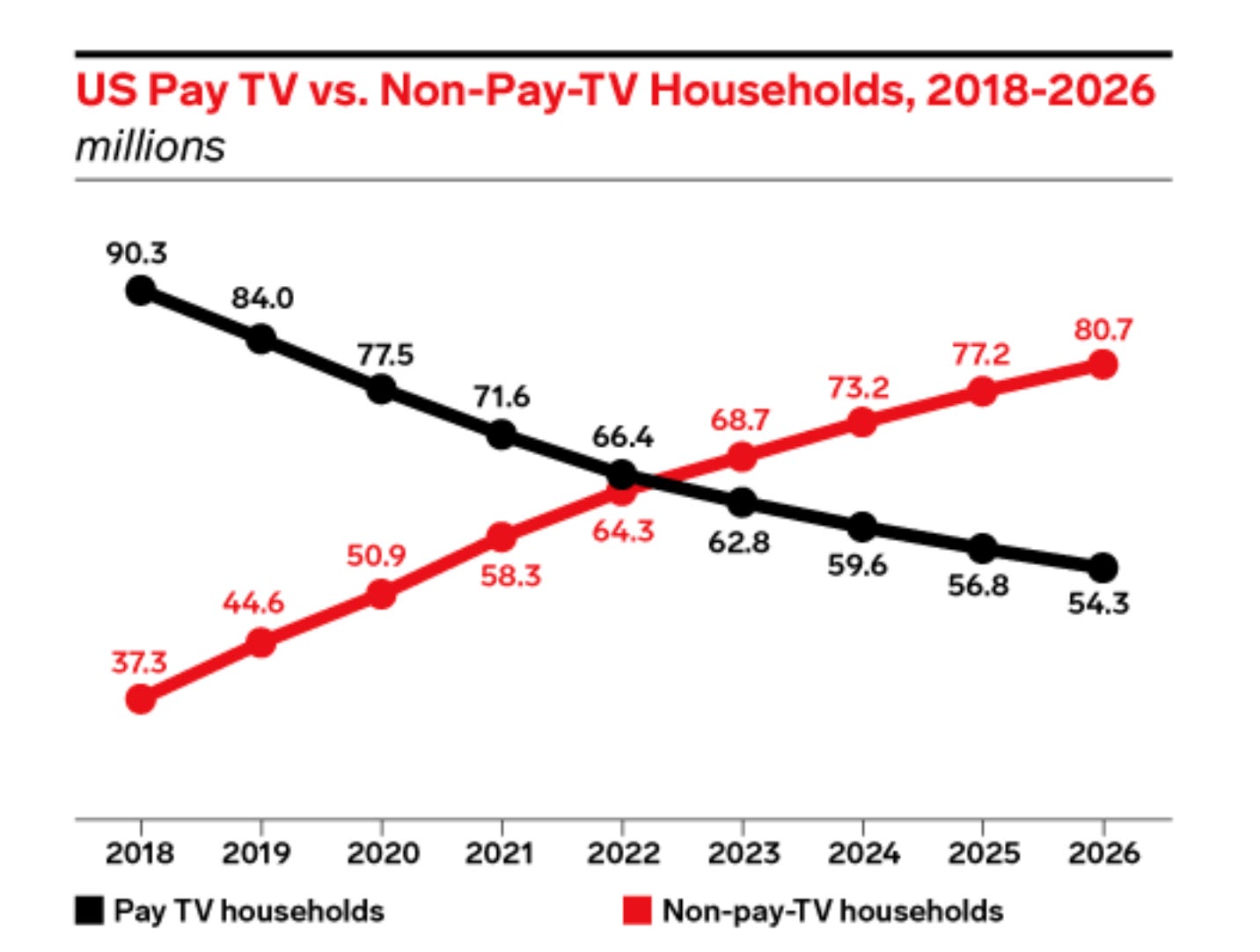
On the positive side, the studio and movie theatre business is a big fish in a small pond.
Global box office hit $9B in 2025, which was up only slightly from the prior year (and still below pre-COVID highs).
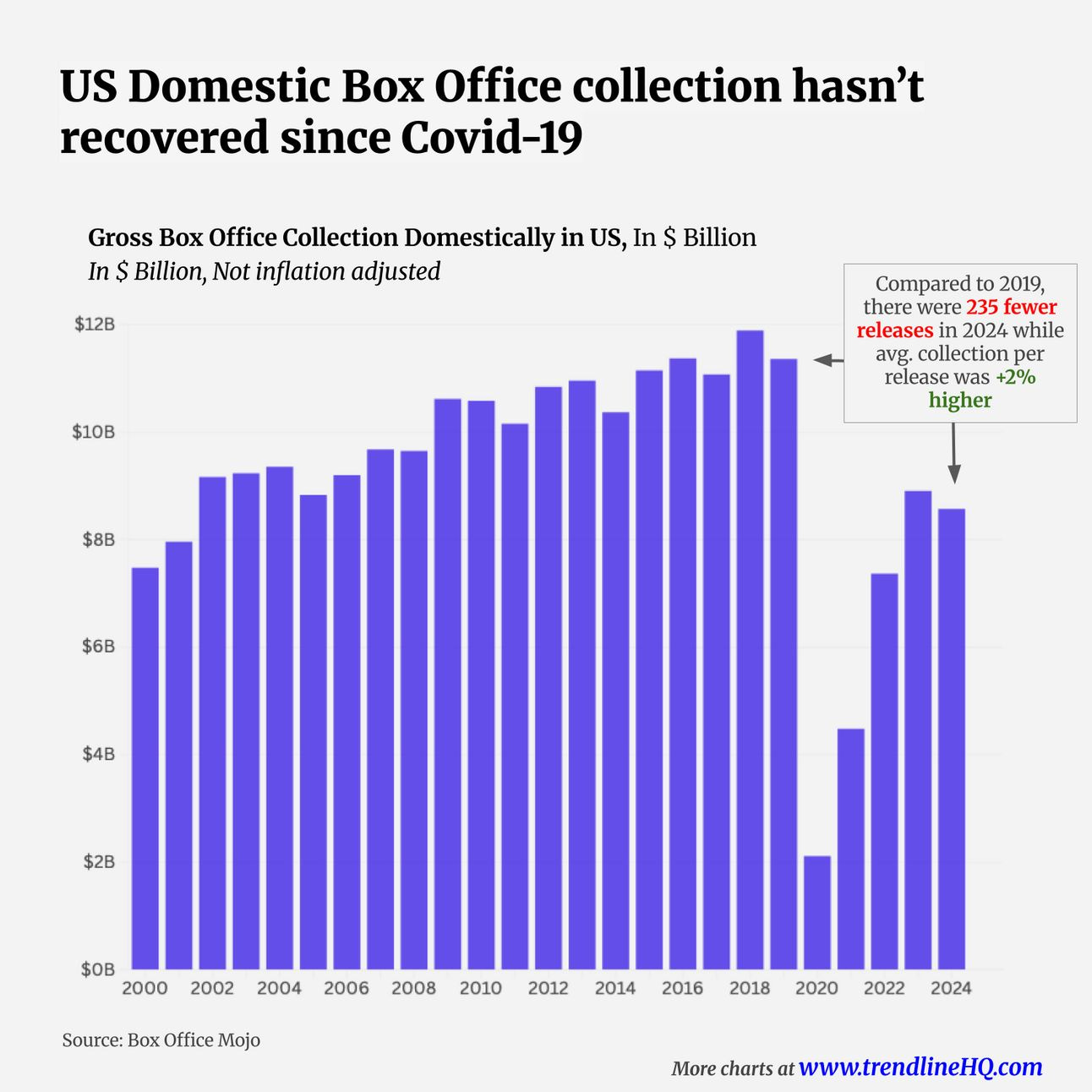
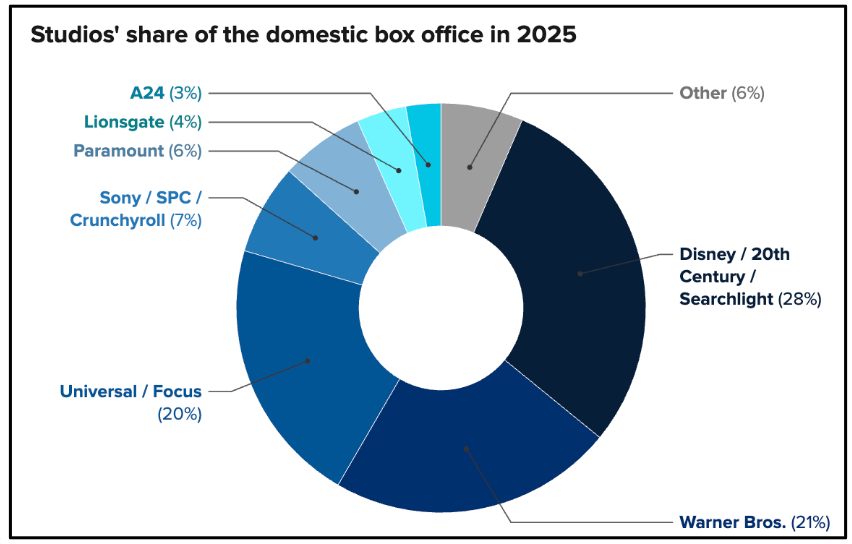
However, Disney (and 20th Century Fox, which it owns) took 28% of the 2025 box office on the strength of Zootopia 2, Avatar 3 and live-action Lilo & Stitch.
Disney looks to repeat the performance in 2026 by sucking on the teat of IP from Marvel (Avengers: Doomsday), Pixar (Toy Story 5) and Star Wars (The Mandalorian and Grogu).
Then there is the direct-to-consumer streaming business with Disney+, Hulu and ESPN+.
We’ll focus on Disney+, which launched right before COVID and went gangbusters.
Y’all remember this wild chart:

The timely product launch was doable because of BAMTech, the MLB’s streaming arm. Disney had invested in (and ultimately acquired for a total of ~$4B) the pioneering platform, which lives-streamed the first MLB game in 2001. BAMTech later went on to power HBO Go as well as streaming for the NHL and PGA. Without it, Disney would be in deep doo doo in the streaming age. The ~$100B it spent on Fox, Marvel, Star Wars and Pixar wouldn’t have a direct-to-consumer (DTC) offering during the wild days of early COVID.
However, the Disney+ run from 0 to 100 million subscribers in a blink was a bit of a mirage.
Up until the start of 2025, Disney+ counted 20-30m users from Indian streaming service HotStar. Disney spun it off to the telecom arm of massive Indian conglomerate Reliance and now owns 37% of Jio Hot Star.
Here are the current ballpark streaming numbers (which are annoyingly hard to pin down):
Netflix: >300m
Amazon Prime: >200m
Disney+: 132m
HBO Max: 128m
Paramount+: 79m
Hulu: 64m
Peacock: 41m (this has to be fake)
Apple: >40m
ESPN+: 24m
Let’s put double counting aside and say Disney has 200m+ across its main apps (Disney+, Hulu, ESPN+). The company’s direct-to-consumer (DTC) business is clearly a player and — for families — an absolute staple streaming subscription.
The good news: the DTC unit is now operating at profit. The unit hit an operating income of $1.3B on revenue of $24.6B in 2025. As Iger noted in one of his final earnings calls, that is an improvement from a loss of $4B three years ago.
That’s an operating margin of 5%…which leads us to the bad news: cable was literally one of the greatest business models ever and it is headed to oblivion.
Not before it reminds everyone why it’s such an insane business, though.
Between affiliate fees and advertising, Disney’s linear networks division delivered $2.9B in operating income (more than 2x the streaming business) on only $9.3B of revenue (about ~1/3 of streaming’s revenue) with a juicy operating margin of 30%.
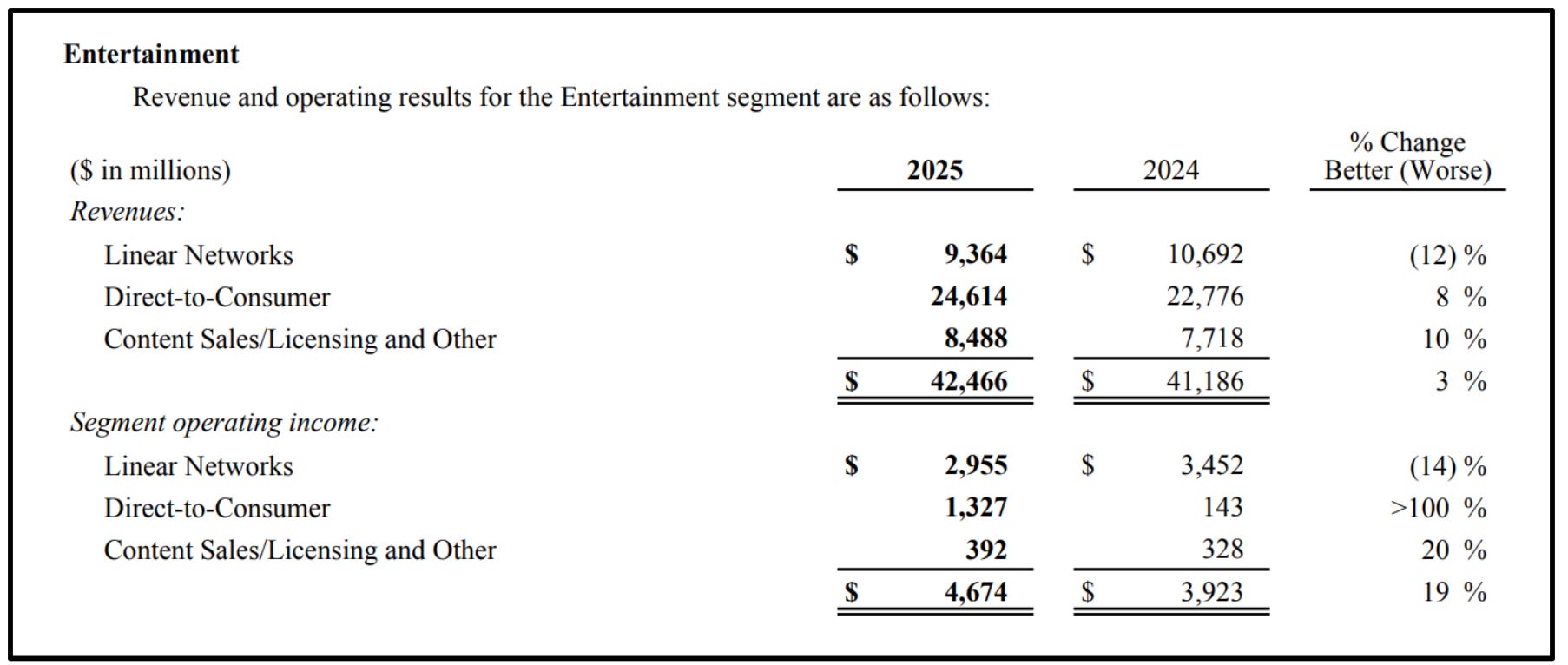
Since the year Disney+ launched, the linear networks segment has seen its operating profit sharply decline (while still maintaining a healthy ~30% operating margin):
2020: $9B
2021: $8.4B
2022: $8.5B
2023: $4.1B
2024: $3.5B
Disney’s streaming business is basically trying to replace this dying cash cow. The challenge is made harder by the fact that the linchpin of the remaining cable business is sports…and the cost of sports rights are going through the roof.
The NFL is the most important player and has all the most negotiating power and is fragmenting the market across old cable (CBS, NBC, ABC, ESPN) vs. Big Tech (Amazon, Apple, Netflix, YouTube).
To Disney’s benefit, the NFL doesn’t want Big Tech to have too much leverage and it pulled off a nifty move that super-aligned incentives with Disney: the NFL took a 10% stake in ESPN ($3B of $30B valuation) and, in exchange, ESPN acquired key NFL media assets including NFL Network and NFL RedZone.
The streaming business faces headwinds from the fact that people are getting subscription fatigue and the “why dafuq are they hiking streaming prices seemingly every month” fatigue.
Look at this insanity.
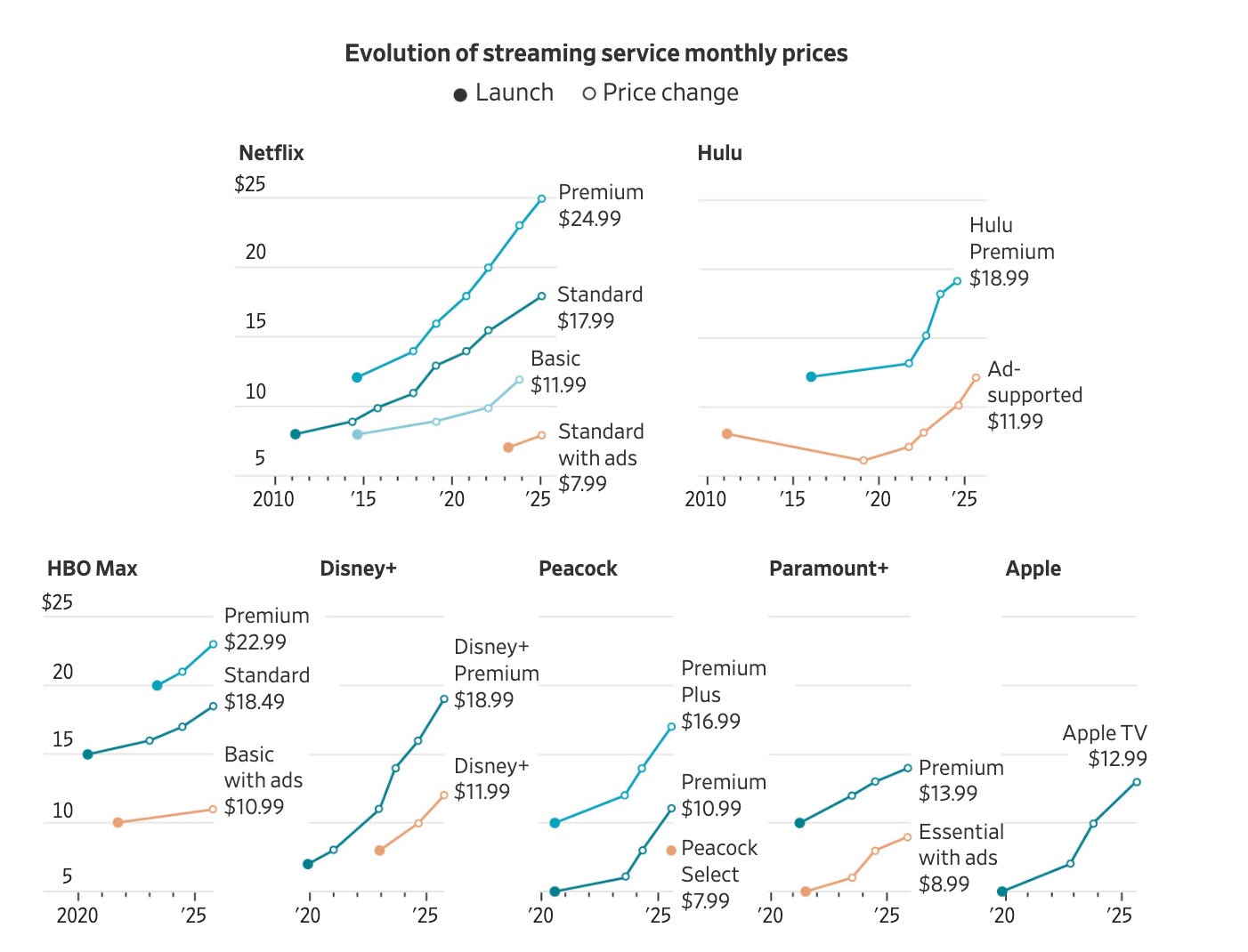
Netflix is clearly the streaming winner and best-in-class tech operation. It played the 2010s perfectly by licensing content, creating its own IP and raising debt against an inflated stock price to buy even more content (and pulled the rug on password sharing after letting my entire Fantasy Football league use my brother’s colleague’s cousin’s login password for years).
In 2025, Netflix achieved $13B of operating profit on $45B revenue (29% operating margin).
That’s the North Star for Disney+ and in the ballpark of Disney’s peak cable TV bundle money printer.
A best-case scenario for Disney’s direct-to-consumer segment is a well-priced bundle of Disney+, Hulu and (must-have sports) ESPN reaching 300m-350m subscribers.
It’s not clear if that goal is reachable and also not clear if that goal gets Disney to 10x its current $1.3B operating profit on streaming.
The cable TV-to-streaming media transition has been so gnarly that Disney’s market cap is flat over the past decade…worse consider the money printing that has taken place.
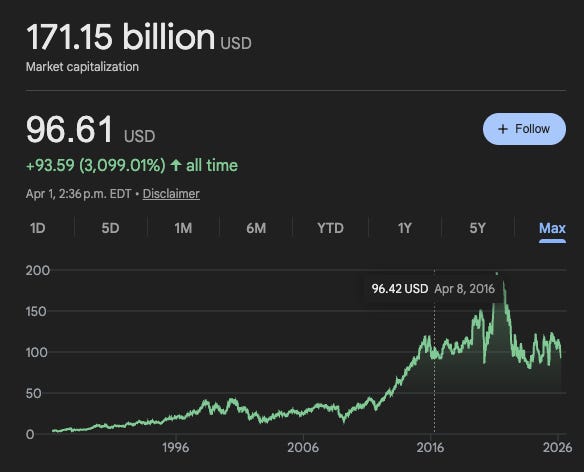
And that’s why we’ve seen Disney go full Parks & Cruise-Maxxing.
How much can Disney milk theme parks?
As linear networks have been pissing away while streaming is still only producing operating profits for ants, Disney’s Parks & Experiences division has been laughing.
Recall, it’s gone from 18% to 57% of Disney’s operating profit over the past decade (and hit a record $10B of the company’s total operating profit of $17.6B in 2025).
An hour in the park and you immediately know how they’ve been able to boost operating margins.
My social media-addicted brain posted this tweet while shopping at the Main Street emporium during my aforementioned Disneyland visit:

In response to the meme, an industry insider sent me a message and said Disney had a concept known as “The Disney Wallet” that informs its pricing decisions:
So, Disney has forever had this concept known as the “Disney wallet”. This is their rough estimate of how much a visitor will spend in park on a given day.
This has 2 huge consequences: they try to sell/upsell you as much as possible before you arrive bc that doesn’t (seem to) affect how much you spend in a given day
2nd: to the point of your tweets, they optimize for margin on what you buy in park, they have always had crazy pricing on sunscreen and digital cameras back in the day. They really want you to buy high margin products
The design of Main Street is particularly devious.
Black asphalt with no shade. People just getting air fried.
Lo and behold, the street is lined with commerce and every store you walk into just blasts the AC.
I avoided the marked-up sunscreen but bought this stupid misting fan for $30. Then some Dasani Waters for another $20.
Thinking about the margin on those items made me sick. Although, the capitalist in me appreciated Disney’s hustle. Captive audience and all that jazz.
Here is one piece of evidence that seems to confirm the idea that how much someone pays before entering the park has no impact on how much they spend while inside the park: entry ticket prices at the higher-end have gone up bigly.
Over the past decade, the price of a one-day ticket to Disneyland is basically flat for the lowest tier $99 in 2015 to $104 in 2025 (these tickets are less flexible and are often blocked from weekends, holidays and other high-traffic days).
However, the price for the highest tier to enter the park is up +126% from $99 to $224 over the past decade:
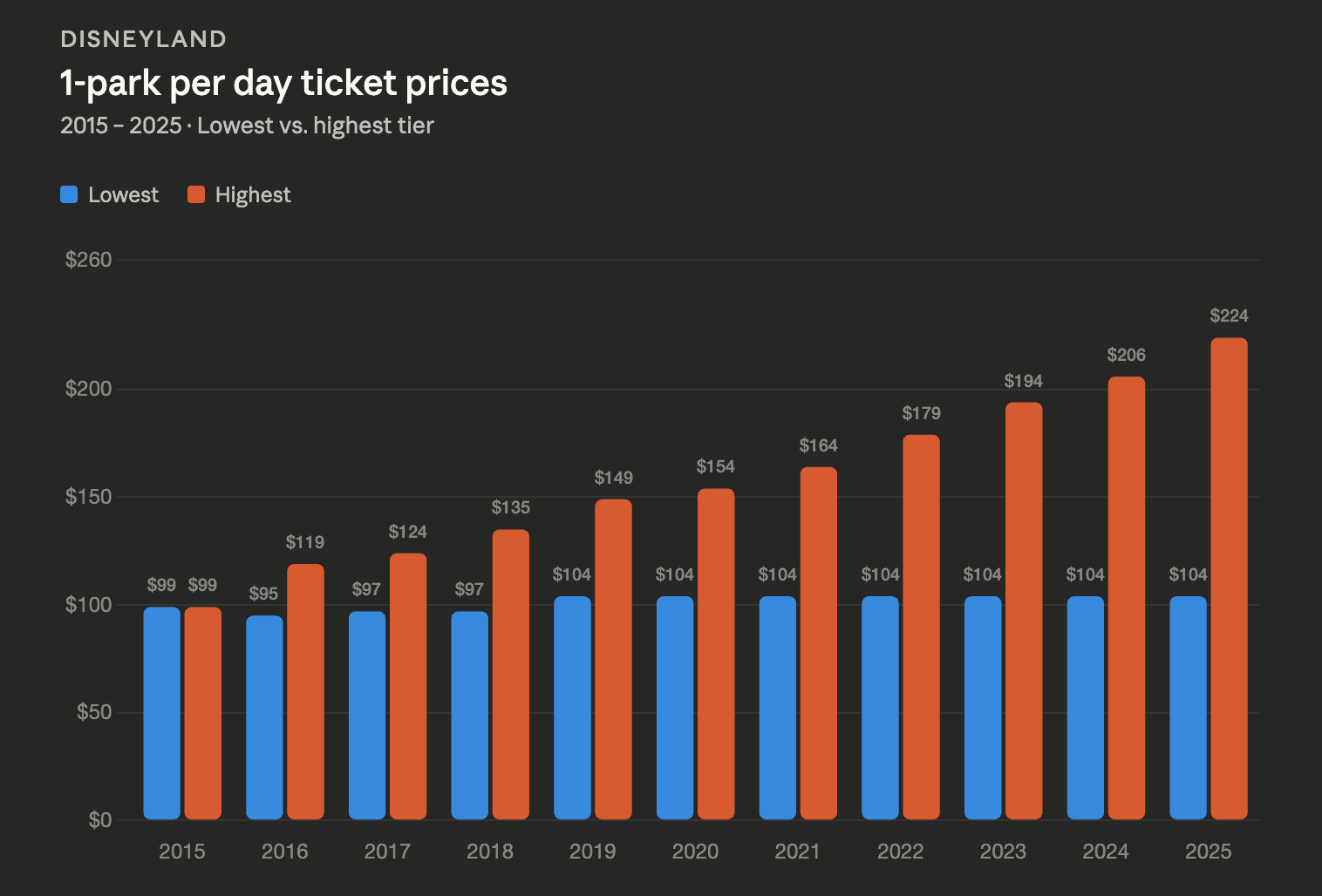
That’s just to get into the park.
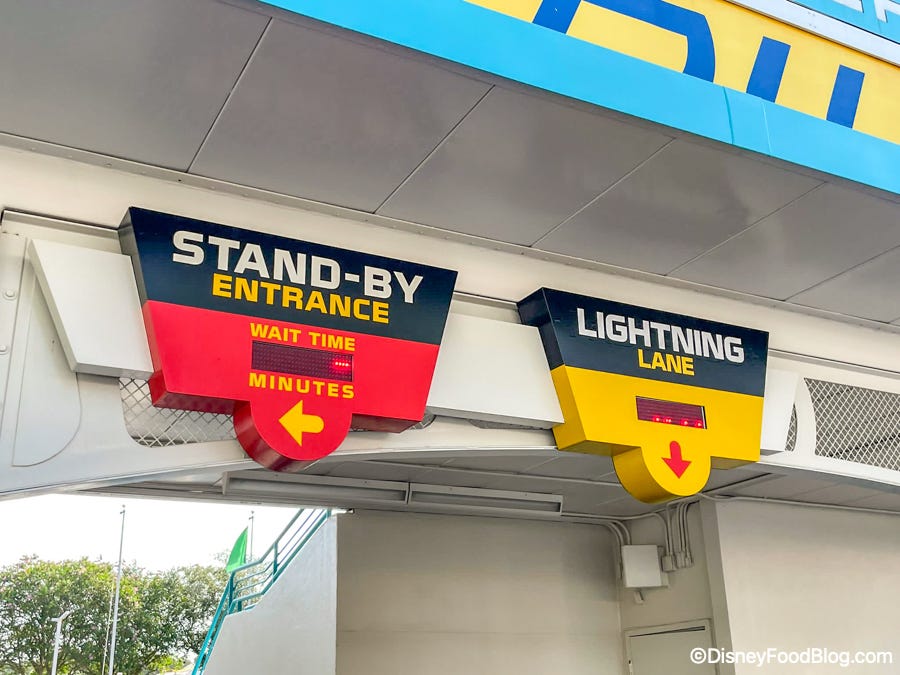
In October 2021, Disney released the Genie+ subscription. For $15-20 a day, park attendees could skip long ride lines and use the expedited Lightning Lanes by scheduling times (the entire program has rebranded to Lightning Lane).
There used to be a free queueing system called FastPass. Now, this “pay-to-play” — including paying $25 per person per ride to skip every line (and up to $449 for unlimited skips all day) — creates a class system at Disneyland.
It’s savage…and of course I paid! Need to limit them wait times, fam.
A lot have come to the same conclusion with estimates that 40-50% of visitors to Disney theme parks pay for some level of Lightning Lane action.
This is basically pure 100% margin for Disney.
You’re probably wondering, “Uh, if 1/2 the park attendees are paying to cut lines, doesn’t that kind of defeat the point?”
Yes.
Jason Cochran writes in Frommer’s about the weird dynamic between standard line, Lightning Lane and the standby line:
Because so many Disney guests are paying for “faster” lines, those purchases actually ensure that the “fast” line is as busy as the old-fashioned free line used to be. The longest line could be the paid one.
If most of those Lightning Lane customers agreed not to give Disney the extra $30-or-so per person every day, then the Standby line would actually be the much swifter choice.
There are occasions when Lightning Lane truly is fast, but in many of the same cases, the Standby line was short enough to have sufficed, too.
Plenty of posts from eyewitnesses back up the claims of colossal mathematical issues with oversubscription to the Lightning Lane program at Disneyland Resort in California as well.
If an attraction has to close down for any length of time during operating hours—something that can happen multiple times a day on the most complex rides—then the customers who had planned to use Lightning Lane during that period invariably come swarming back as soon as the ride has reopened.
But when the Lightning Lane swells, Disney staffers are forced to limit the number of Standby customers at the merge point even more strictly in order to clear the crowds. And that makes the regular wait time inflate even higher.
Disney doesn’t promise customers that Lightning Lane lines are shorter, but the parks do tell guests that buying Lightning Lane access helps “save time in line.” That’s technically true, but it’s also clear that Standby would be faster if there were no Lightning Lane. Standby got slow because of Lightning Lane—the “cure” causes the disease.
Disneyland, the Happiest Place On Earth…to wait in lines after you paid not to wait in lines.
Due to an internal leaked Slack chat, it’s now public that the Lightning Lane program made Disney “$724 million in pretax revenue between October 2021 and June 2024 at Walt Disney World alone” per the Wall Street Journal.
That figure is easily in the billions across all parks and up to Q1 2026.
In the same piece, the WSJ notes that the cost for a family of 4 — including on-site hotel — was $4,266 in 2024, a 32% increase from 5 years earlier pre-COVID (and outpacing inflation)
The median family annual vacation budget is ~$5,000 and this tension was laid bare in a New York Times piece titled “Disney and the Decline of America’s Middle Class”.
This doesn’t even take into account how Disney is increasingly catering to “Kidults”, groups of adults that frequent the theme parks without kids. Adult-only lounges. Exclusive events. Special nostalgic collectibles and merch.
It’s become a meme that many of these guests go into debt to get a taste of that Disney theme park magic.
Honestly, I get adults-only doing a random fun trip but frequenting Disneyland as a kidult is kind of weird and doesn’t jive with the park dynamic Walt originally laid out of family fun.
On its earnings calls, Disney talks about the balance of staying affordable for the middle class. But, as we’ve discussed, the rupture in the rest of its business make theme parks the easiest money levers to pull.
While prices at rival parks (Universal Studios) and smaller alternatives (Cedar Fair, Six Flags, Sea World) have also gone up, Disney has become the face of relentless theme park price hikes.
Aside from the class system, so much of the Disneyland experience is now being intermediated by smartphones.
My wife and I were constantly checking the app for Lightning Lane notifications and ride openings.
We didn’t get lost in Disneyland. It was just heads down buried on the screen.
Go here. Ride this. Go there. Ride that. Go there. Buy $30 misting fan. Get on the train. Ride this.
One more thing worth flagging is that Parks & Experiences becoming the engine for Disney also creates a perverse incentive on the creative: IP stagnation.
As discussed on The Town podcast, theme parks and cruises are in the brand management business. They don’t create new ideas. They are meant to squeeze every dollar out of existing IP.
And Disney is milking its IP portfolio as hard as it can be milked.
That’s why we have Toy Story 5, Avengers and The Mandalorian & Grogu all set for massive 2026 releases (after Avatar and Zootopia — which has a massive area in Disneyland Shanghai — in 2025).
It’s harder to make money back on a new and fresh film idea if it can’t be monetized by Parks & Experiences.
However, people may eventually get bored of the IP and that impacts theme park attendance.
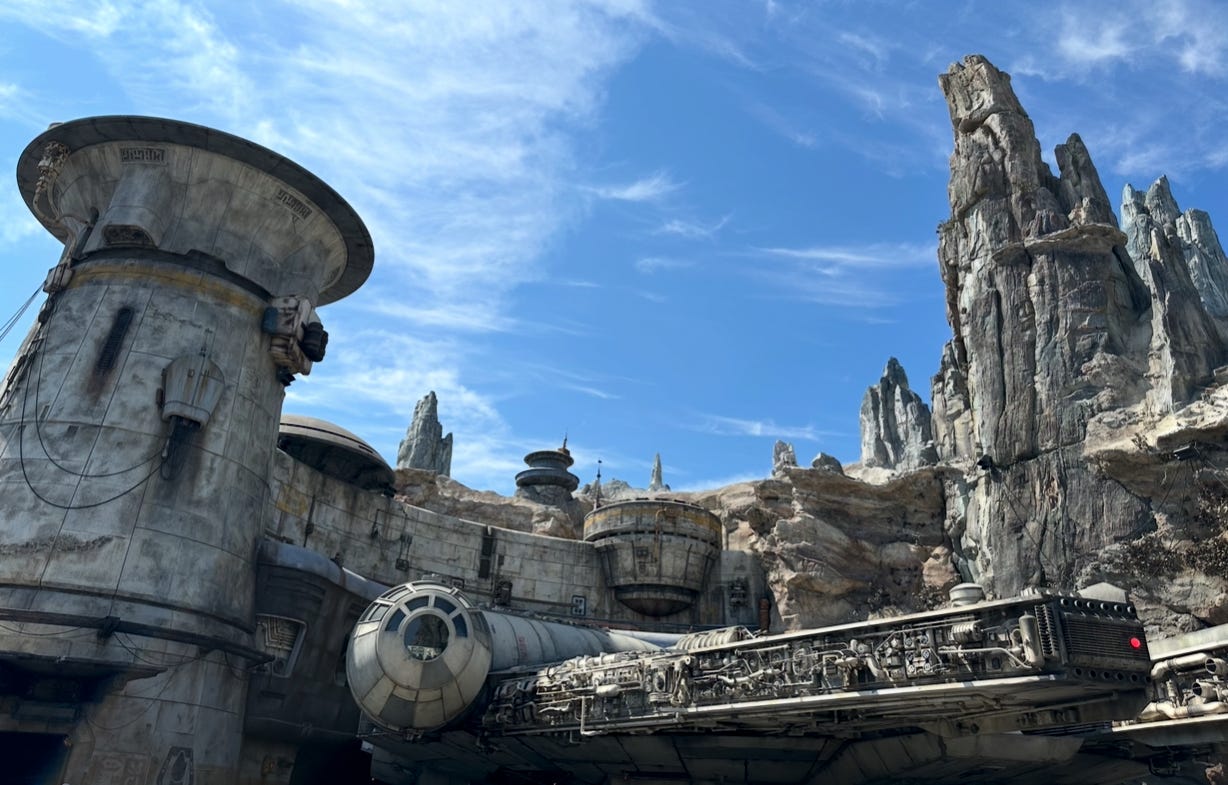
In fact, Disney recently announced it’s expanding the Star Wars section of Disneyland to focus on the original Luke Skywalker trilogy. It had spent $1B to build the section around the latest Rey-and-Kylo Ren storyline, but the cultural impact of the newer trilogy has clearly dissipated.
Final Thoughts
A year after Disneyland’s opening in 1956, Walt drew up his famous business diagram showing how each part of his empire (TV, merch, books, music, films, Disneyland etc.) all reinforced each other.
In the centre of the diagram was “Creative Talent of Studio Theatrical Films” while “Disneyland” was tucked at the bottom.
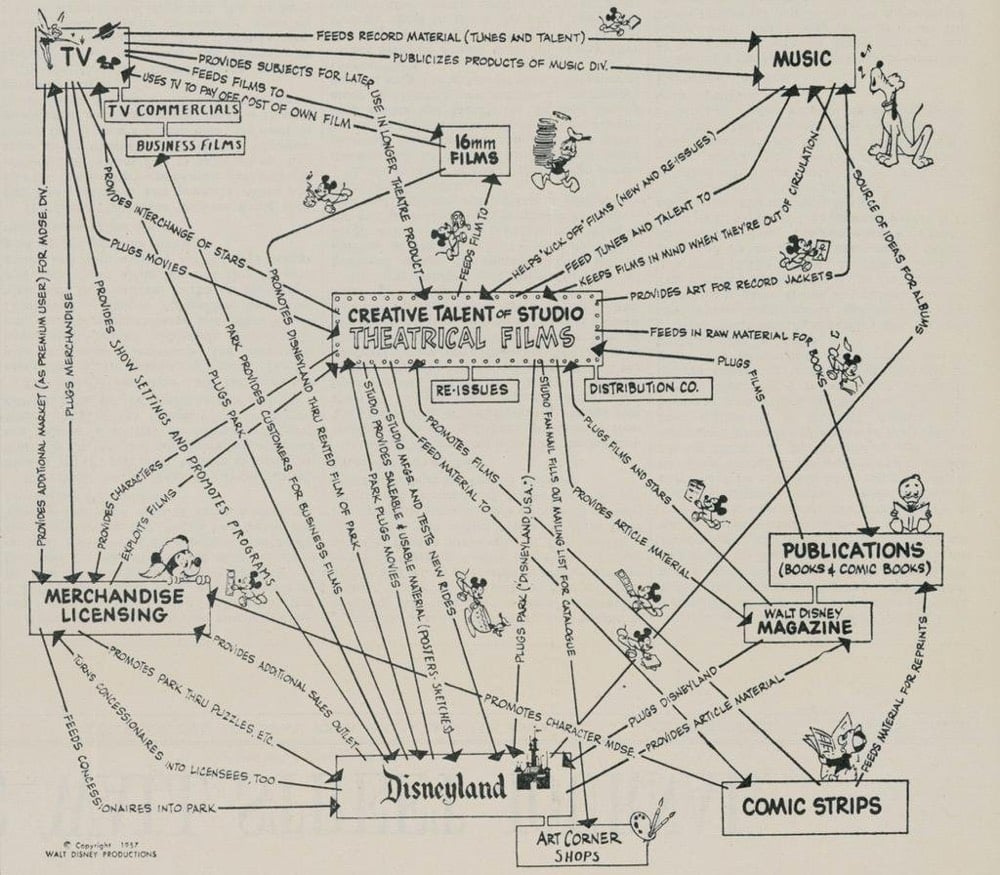
Walt obviously didn’t know it at the time but does seem fitting that Disneyland is the base foundation of the image that is now a $170B entertainment giant. Shockingly, Walt makes no mention of streaming, GenAI or prediction markets, which is why I don’t really trust business plans (speaking of up-and-coming business lines, D’Amaro’s first weeks as CEO included OpenAI suddenly shutting down AI video platform social platform before Disney could even invest its $1B commitment…and Disney’s $1.5B investment in Fortnite took a hit as the gaming platform shed 1,000 employees and said its engagement is falling).
The past 5 years have been a case study in the drawbacks of Disneyland becoming the true centre of Disney’s gravity:
A very visible class system.
An experience mediated through a screen.
The constant nagging feeling that you can’t pay for your kid’s college because of the three corn dogs you just bought.
I spent the middle third of this piece writing about Walt’s original vision and the Imagineers because the current pressure of the cable TV-to-streaming transition is really impacting the magic of the immersive Disneyland experience.
Walt Disney hated that early-1900s amusement parks turned attendees into “marks”.
A similar vibe is happening at Disneyland, Disney World and probably the Cruises (I will report back when I inevitably have to go).
Even so, Disney’s parks offer a product people clearly want. As I wrote about in my business breakdown of The Sphere, the IRL experiences will only get more important in the age of GenAI. We all want the 5-sense experience.
When I went to Disneyland, it was hot and there were long lines. The park tried to sell me something every ten steps. And like a sucker, I paid for most of the stuff on offer.
My memory of the experience is still net positive.
Disney, you got me. Just like you got my parents 25 years ago, when they brought our family of six to Disneyland.
Now that I have gone as both a child and parent, I can say that Walt Disney’s plan to make something for the entire family definitely works (we actually went back to Disneyland a year after that trip in 2023 to do all the Star Wars rides and it was sick…especially because I wasn’t hungover).
I think the power of nostalgia will drive Park attendance for at least one more generation. It is not just the nostalgia of Disney IP, either. It is the nostalgia of “we’re going to Disneyland” itself.
But how many under-20s will care in 30 years? How many will even experience Disneyland as price creep keeps creeping? My kid probably will. But his kids? TBD.
Josh D’Amaro — who has committed $60B over the next decade to the Parks & Experiences division — will have to deal with these questions as Disneyland celebrates its 70th anniversary later this year
Will he take the Walt route to “plus it” or keep the current trend of “milking it”?
Today’s SatPost is brought to you by Bearly.AI
Why are you seeing this ad?
Because I co-founded an AI-powered research app called Bearly AI. And I just bought the most random overpriced swag at Disneyland and need to shill these AI-powered tools for reading (instant summaries) and writing (ChatGPT) that will save you hours of work.
It’s all available in one keyboard shortcut (and an iPhone app).
Michael Jordan’s Wild NASCAR Ride
MJ was my favourite athlete going up.
Watching him hit the “GAME 6” shot against the Utah Jazz in 1998 was a highlight of that period along with buying $37 of candy at 7-Eleven and playing 8 hours straight of Goldeneye on N64 with my buddies.
He retired from the Chicago Bulls then came back then re-retired from the Washington Wizards in 2003.
Everyone knows that Jordan is a psycho competitor. And every few years there would be new stories that came out about his psycho competitiveness.
A stand-out piece was in by Wright Thompson in ESPN about Jordan turning 50 in 2008…specifically how he was watching Lebron’s rise:
The announcers gush about LeBron, mentioning him in the same sentence with Jordan, who hears every word. Those words have an effect on him. He stares at the TV and points out a flaw in LeBron’s game.
“I study him,” he says.
When LeBron goes right, he usually drives; when he goes left, he usually shoots a jumper. It has to do with his mechanics and how he loads the ball for release. “So if I have to guard him,” Jordan says, “I’m gonna push him left so nine times out of 10, he’s gonna shoot a jump shot. If he goes right, he’s going to the hole and I can’t stop him. So I ain’t letting him go right.”
For the rest of the game, when LeBron gets the ball and starts his move, Jordan will call out some variation of “drive” or “shoot.” It’s not just LeBron. He sees fouls the officials miss, and the replays prove him right. When someone shoots, he knows immediately whether it’s going in. He calls out what guys are going to do before they do it, more plugged into the flow of the game than some of the players on the court. He’s answering texts, buried in his phone, when the play-by-play guy announces a LeBron jump shot. Without looking up, Jordan says, “Left?”
At the time, Jordan was minority of the Charlotte Bobcats (later Hornets).
His tenure as NBA owner was not good.
Not on the court anyway. Charlotte sucked and — sorry to UConn fans — Jordan burnt a large part of his management reputation drafting Adam Morrison.
But off the court he minted.
In 2008, Jordan bought the Bobcats from BET founder Robert Johnson for ~$300m and only put up $25m while financing most of the rest with debt. In 2023, he sold his majority stake at a valuation of $3B to hedge fund manager Gabe Plotkin for a nice-and-clean 10x.
Well, MJ is back to making serious ownership moves…this time in NASCAR.
CBS dropped a great interview last week on Jordan’s ownership of the racing team (23XI Racing) that he co-founded with NASCAR champ Denny Hamlin.

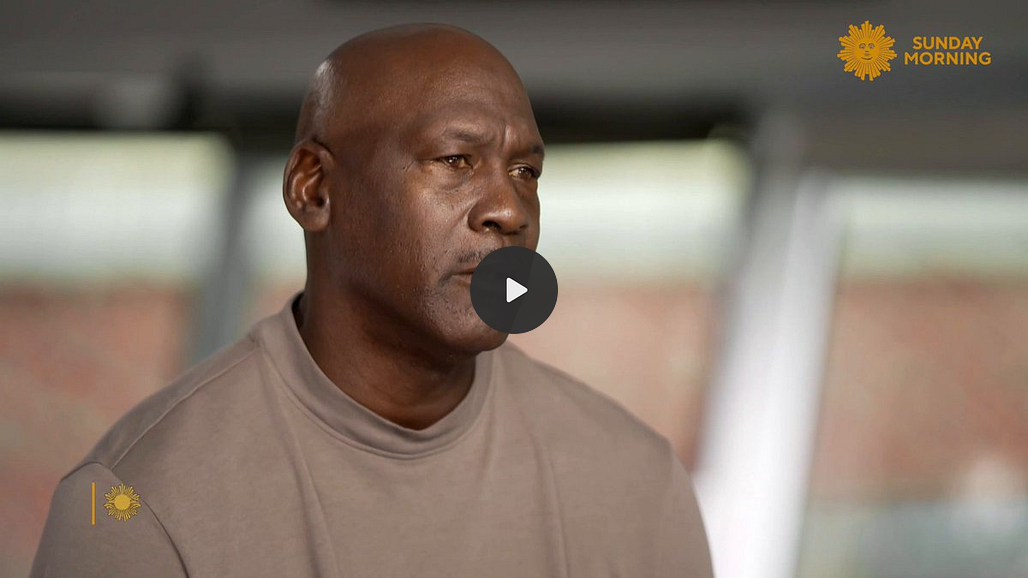
The founding story is awesome.
MJ had been buddies with Hamlin for years. One day, Hamlin saw a fake article saying him and MJ bought a Nascar team.
Sends it to MJ and MJ says: “Not real, but if you want to make it real, let me know.”
They did in 2020 with Jordan putting an estimated $40m into the racing team.
The 63-year old Jordan tells CBS’ Gayle King that he still wants to play pro hoops but can’t so channeling competitive drive in racing: “I’m cursed with this competitive gene. Anything I do…if it’s getting dressed, I have to get dressed before my wife.”
Hahahahahhahahahhhaha. Incredible.
He’s also channeled that competitive gene into an anti-trust lawsuit against NASCAR, which has basically been a family-owned business started by Bill France Sr. in 1948 and now operated by the France Dynasty.
Jordan sued NASCAR for monopoly practices over its “charter system”. NASCAR controlled the charters, which were like tickets allowing race franchises to participate in the league. The France family could revoke the charter and impact racing and earnings opportunities.
In December, NASCAR settled with Jordan by making the “charters” permanent for 15 teams. The France family could no longer revoke them, thus losing a lot of their anticompetitive leverage.
To put a cherry on top, 23XI Racing is dominating the 2026 NASCAR calendar.
Time for Jay-Z to update that verse from that song with Kanye about people enjoying a vacation in Paris: “Psycho, I'm liable to go Michael. Take your pick, Jackson, Tyson, Jordan, Game 6.”
Apple at 50
Steve Jobs and Steve Wozniak founded Apple on April 1st, 1976.
Wild it’s been 50 years.
Two quick thoughts and a video.
First, Forrest Gump has the greatest angel investment in Hollywood history. In the 1994 film, Gump and Lt. Dan get in touch with Steve Jobs and Steve Wozniak about 6 months before the April 1976 lauch. In the real timeline, the first angel check in Apple came from Mike Markkula in 1977. He put in $250k for ~1/3rd of Apple…so, a $750k valuation.
I’m guessing Gump got at least $100k in there. Either way, he was minted at the $1.8B IPO in 1980. By the mid-1990s, Markkula had sold his entire stake before Jobs comeback.
Gump is a loyal dude so probably sold everything when Jobs was booted in 1985.
On the other hand, he thought Apple was a fruit company and is financially illiterate…so Gump is likely still holding that stake, which is now worth $300B+ (my calculator broke trying to figure out the ROI).Second, Apple’s first CEO was…Michael Scott. Can’t make this up. He was also the CEO at Apple’s IPO in 1980 with 5.6% of the company (vs. Jobs at 15%, Markkula at 14% and Wozniak at 7.9%). Scott left a year later and became a renowned gem expert. Markkula took over as CEO followed by John Sculley. Jobs was never CEO until Round 2. Interestingly, Jobs played a clip of The Office during his legendary iPhone launch event in 2007…not sure if it was an easter egg but maybe?
Speaking of Jobs second round with Apple…someone recently dug up an incredible 15-minute video of Steve Jobs addressed Apple campus in 1999 (a former Apple software engineer named Akira Nomaka with <300 followers on YouTube posted the clip).
It was 2 years after Jobs took the interim CEO then full-time CEO job at Apple and brought it back from near bankruptcy.
The iBook laptop was selling like hot cakes and Apple was BACK!
But Jobs didn’t want his staff — decked out in the most 1999 California dad fit you could possibly imagine — thinking the job was done:
“A lot of people have declared our turnaround officially complete and you would have to say that’s true. We’ve had 7 consecutive profitable quarters. We made $200M last quarter. That’s a lot of money! And we’ve got great products. But, you know…I never looked at it that way. The reason I came here had nothing to do with turning Apple around. Because that’s about the company. And I know we all love this company. But what we love even more is putting these great products out into the world and seeing people use them.”
Jobs also talks about rebuilding the entire Apple organization and bringing everything in-house. Says Apple was the only company that “gave a shit” about making good computers by vertically owning manufacturing, hardware, software and marketing (unlike Compaq, Dell and Microsoft).
He then goes full Babe Ruth and calls his shot: “I think we will really do some awesome stuff in the next few years and make Apple truly great. Not just within our industry but the kind of company that is a great leader period in the world."
Of course, Apple ripped off the greatest run in product history over the next 11 years: iPod, iPhone, iPad, Apple Pencil.
He was so pumped about shipping 5m iBooks and Apple's market cap is ~$15B ($6B sales in 1999).
Now, Apple sells 400m devices a year and it's worth $3.8T ($420B sales in 2025).
Can it thrive in an AI world and survive another 50 years? A lot of the company’s secret sauce — which took decades to implement — is in this video.
Links and Memes
OpenAI acquired TBPN. The livestream show (5 days a week, 3 hours a day) is co-hosted by Jordi Hays and John Coogan. The duo built an incredible tech media brand by not hating everything about tech. Both were investors and startup founders themselves. Business version of ESPN partnering with Pat McAfee. While the viewership numbers aren’t huge, they mastered clip distribution on X and basically everyone in tech follows the feed (especially fun to see if you get a shoutout). Nailed the vibes with an exceptionally valuable audience.
The deal is $100m+. TBPN was eye-ing $30m in ad revenue this year. It’ll shut down the ad business and the 10-person operation looks to also be helping with OpenAI comms and marketing. OpenAI literally just raised $120B+…so they can afford it (likely a lot of stock).
Ted Merz explains how they have a fantastic diversity of guests that traditional media isn’t fast enough to book. Really really smart game-plan. Good podcast with Jackson Dahl talking about how they used ideas from traditional broadcast TV and luxury brands (and here’s a good chat with Travis Kalanick).
Some more great content for your weekend:
SpaceX just confidentially filed its IPO. It’s looking to raise $75B and a $1.75Tn with a June listing. SpaceX recently merged with xAI and is forecasting $20-25B in sales this year (primarily Starlink). Based on how insane AI fundraising has been, it’s kinda incredible SpaceX has only raised $12B. Max Olson has a deep dive on SpaceX’s internal operations and Elon’s approach to manufacturing that gives it a massive edge.
AI is less polarizing than social media. Interesting study from Financial Times showing how business models push different outcome: “Social media companies make money from attention, which in practice means rewarding sensationalism and inflammatory content…AI companies are competing to serve customers who are paying for accurate, objective and, well, intelligent, tools that deliver factual information, often for business-critical purposes.”
How to take on deepfake scammers. Scam baiter hops on a Zoom call with what looks to be a scam crypto operation. Wants to prove guy is doing a deepfake video and asks him to “put three fingers in front of your face”. Comedy ensues.
Fruit Love Island…is exactly as it sounds like. The reality show Love Island but with AI-generated fruit characters instead of humans. It apes the show with 1-minute clips and the account AI.Cinema021 has over 3m followers. Just absolutely demented and, yes, I’ve watched dozens of them.
“Solving the Strait of Hormuz Blockage”…very interesting article from Austin Vernon on how long it would take the world to rework economies around long-term disruption to 20-30% of oil, fuel, liquified natural gas and fertilizer the transits the Strait.
…and here them wild posts.
Actually, let me tell you about Kit Kat. It’s the most popular chocolate brand in Japan. The name sounds like the Japanese phrase “kitto katsu” (roughly translates to “sure to win”). Japan KitKat has 300+ flavours including matcha, taro, wasabi, soy sauce, miso and (my absolute fave) banana with those legends from Tokyo Banana.
Why am I telling you all of this? Because the two wildest memes in the past week were related to:
Kit Kat: About 12 tons of Kit Kats (~440k bars) were stolen in transit from Italy to Poland.
Japan X meets American X: The North American X timeline was flooded with Japanese posts after X flipped on an auto-translating feature from Grok. Japan actually has to most daily active users on X. It’s legacy from Twitter days. Japanese users were always able to communicate a ton within the 140-character limits using Japanese characters. Further, Japan’s internet culture has long supported anonymous accounts and niche fandoms which jives well with the X network. Know Your Meme has a good breakdown of how the Japan/America X crossover happened…it started with Japanese users loving American BBQ and the bro-fest between users went wild after that.
The internet being the internet…of course the racists on both sides of the Pacific showed up…but let’s keep this memes this week PG-13:


Now that Kit Kat heist action:


Tiger Woods flipped his SUV in another DUI-related car accident (not alcohol; painkillers):


…and here a few more:


$4M not, 5% of Disney for $4B
Perfect post from start to finish. Genuinely a joy to read!