

Thanks for subscribing to SatPost.
Today, we will talk about the very controversial launch of the Ferrari Luce EV.
Also this week:
IMAX’s random business line
The Pope’s AI Encyclical
…and them wild posts (including FB Marketplace)
The Ferrari Luce was unveiled on Monday.
It is the luxury carmaker’s first all-electric vehicle and its first 5-seater. Starting at $640k, the car was created in collaboration with LoveFrom, the design firm run by Jony Ive, Marc Newson and dozens of former Apple employees that were bored of making the exact same smartphone (except with a slightly better camera) every year.
The internet is full of cynical trolls (*raise my hand*), so obviously the backlash was intense and immediate. We just went through this with the Audemars Piguet and Swatch collab.
But you don’t have to listen to the cheap seats.
Listen to Luca di Montezemolo. The Ferrari legend spent 28 years at the luxury carmaker including as Chairman during its modern “Golden Age” — from 1991 to 2014 — when its F1 team crushed and the brand became very exclusive.
He shared these thoughts when Italian media asked him about the Luce:
I don't like commenting from the stands. When I was in the game, it annoyed me when people did that. I think for now, the electric Ferrari could have been avoided. But clearly Ferrari made huge investments in plants and the car itself for their own reasons. Maybe Porsche's lesson is useful for reflection.
If I said what I really think, I'd harm Ferrari. We're risking the destruction of a myth. I'm very sorry about that. I hope they at least remove the Prancing Horse from that car. This is definitely a car the Chinese won’t copy.
Wow.
WOW!
Luca. Tell us how you really feel.
Best part is that Luca says, “If I said what I really think [about the Luce], I’d harm Ferrari”…but is so obviously annoyed that he proceeds to say what he really thinks lol.
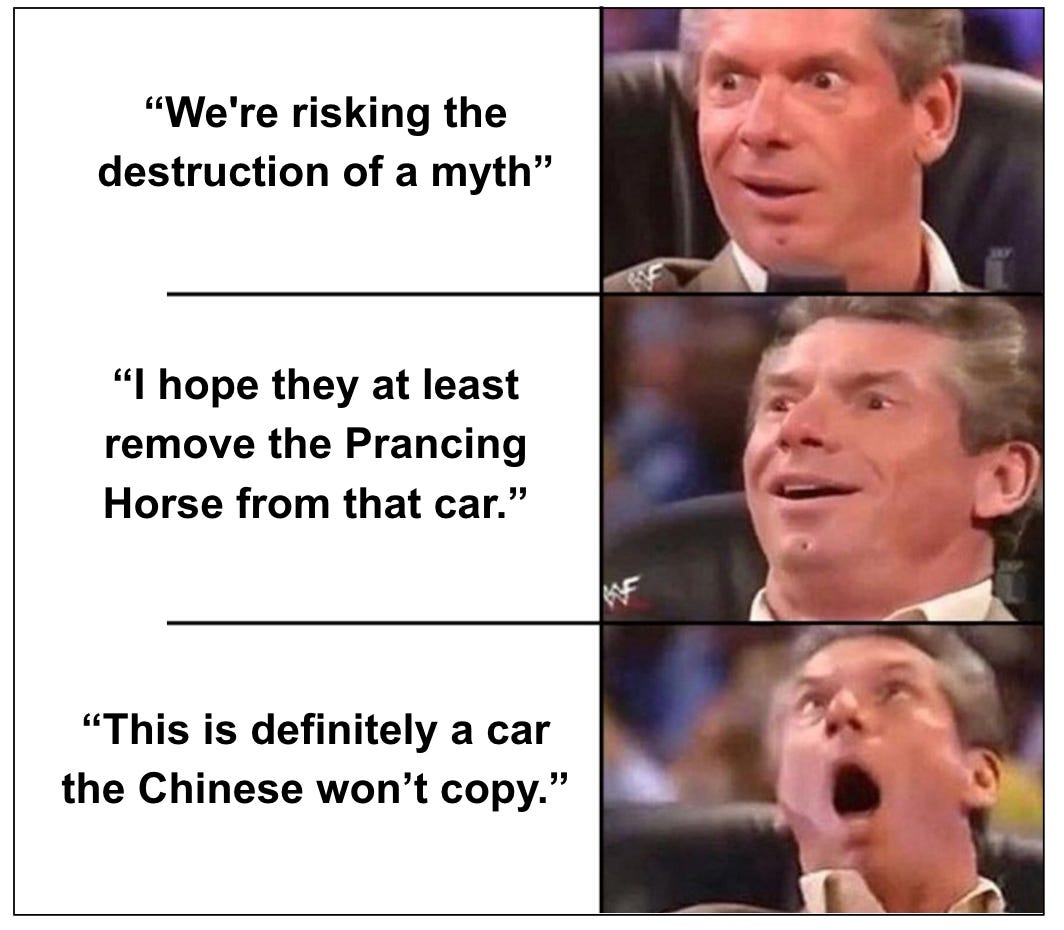
To be sure, Luca’s not exactly an unbiased observer. In 2011, he said Ferrari would “never” build an EV because he doubted the technology and preferred hybrids (which Ferrari has done). He also had an acrimonious split with its management and is on the board of Ferrari’s British rival McLaren.
However, the market channeled Luca’s disappointment with Ferrari’s incredible ticker (RACE) falling 8% the next day. It’s since recovered a bit and the market cap is $60B.
The initial reaction across tech and the auto world was largely negative, even as most of the people (*raise my other hand*) taking potshots will never own a Ferrari. Hell, the only time most of these people might even walk into a Ferrari dealership is because they had a massive kebab plate for lunch and really had to take a dump while walking down the street and it was the nearest storefront (*raise both my hands*).
Ferrari is one of the most iconic brands in the world, though. You don’t have to own one of its cars to love the Prancing Horse. There are 900 million F1 fans and Enzo Ferrari is a GOAT in the racing world and among luxury car brands.
In a pretty slick promo video with Lewis Hamilton and Charles Leclerc, Ferrari’s head of marketing Enrico Galliera knew what was coming with the Luce launch: “We’re going to have some great lovers. And a lot of haters.”
Sure enough, top comments on the YouTube video deliver on that promise: 1) “The boldest thing [about this Luce video], is leaving the comments open.”; 2) “I wonder if Lewis imagined that after joining Ferrari he would be asked to promote the iPhone car”; 3) “Blink Twice if you're in trouble”; and 4) “Oscar Worthy Performance From Lewis and Charles”.
But here is the reality: Ferrari only sold 13,640 cars in 2025. They don’t need to sell many Ferrari Luce EVs (Luce is Italian for “light”) for it to make business sense. There will be buyers and I imagine management baked a little bit of margin into that $640,000 price tag.
To see how this might play out, let’s cover these topics:
Ferrari Luce’s Backstory
Luce’s Design: Polarizing Exterior, Beautiful Interior
The Luxury EV Market is Hurting
Aiming for Tech and Chinese Buyers
Ferrari Luce’s Backstory
Two quotes help provide context on the Ferrari Luce journey.
First is from Enzo Ferrari, who founded the Ferrari racing team in 1929 (and first production Ferrari was 1947): “I don't sell cars; I sell engines. The cars I throw in for free since something has to hold the engines in."
Second is Ferrari’s current CEO Benedetto Vigna: “We are not an automotive company. We are a luxury company that is also doing cars.”
Any fully electric Ferrari would have courted controversy because it strays from Enzo’s engine-centric heritage.
But aggressive EU emission rules in the late-2010s meant that every carmaker had to have an EV strategy.
When Ferrari Chairman John Elkann — who is heir to the Italian Agnelli family’s fortune (the Exor family office owns Stellantis, The Economist Group, Juventus) — reached out to LoveFrom on an EV project in 2019, the EU was preparing to mandate that all new cars sold by 2035 had zero emissions. Two years later, they signed an official partnership.
The mandate has been loosened and low-volume automakers (eg. Ferrari) have certain carve-outs, but the die was cast: Ferrari was going to make an EV.
Ferrari spent over $200m creating a 42,500 sqm “e-building” so it could manufacture much of the EV stack in-house including drivetrains, motors, axles, and battery packs Located at its historic HQ in Maranello, the project broke ground in 2022 and was completed in 2024.
Elkann had collaborated with Marc Newson on a Ferrari luggage in the early-2010s and met Jony Ive in Milan during the launch of the Apple Watch in 2015.
Since then, the Apple Watch has sold over 300 million units and Elkann believes it is probably the best example of “an analog product being reinvented digitally” (I will say that cigarettes to vape pens were pretty crazy too).
By the time Ferrari and LoveFrom started talking, Tesla had proven the market for EVs and did so from a tech-first angle.
The EV play is very risky for Ferrari because it is a luxury brand and luxury brands have to be carefully managed.

Last year, the Wall Street Journal wrote about “Wild Economics Behind Ferrari’s Domination of the Luxury Car Market” and I updated some stats to illustrate the point:
Since its IPO in 2015, Ferrari’s market cap has increased ~7x to $60B.
In 2025, it only sold 13,640 vehicles for $8B (average of ~$587k a car).
The luxury positioning is why Ferrari has a 30% operating margin while Volkswagen has an operating margin of 5% (VW sold 9 million vehicles in 2025 and its market cap is still less than Ferrari: $54B).
That’s comparable operating margin to Apple (32%), Hermès (40%) and LVMH’s leather goods segment (35%).
German carmaker Porsche IPO’d in 2022 and tried a similar luxury playbook but is down 1/3 since then, to a market cap of $49B. It sells way more cars as compared to Ferrari (279,449 in 2025; total sales of $42B and average of $151k per car) and is having difficulty transitioning to EVs (we will talk more about this, which is probably why Luca called it out in his Ferrari Luce roast).
As with any luxury brand (Ferrari’s former CEO compares itself to Hermès), Ferrari tightly controls supply based on this saying from founder Enzo Ferrari: “Ferrari will always deliver one car less than the market demands.”
Ferrari restricts who can buy its vehicles with waiting lists and prioritizes existing owners (owners refer new owners to get on the buying ladder).
The top models such as LaFerrari (F80 and Enzo beforehand) are now reserved for customers that own multiple vehicles, bought one in the past 3 years and are active in the Ferrari community (”the algorithm [to select car buyers] has grown more sophisticated...to include the events customers attend, whether they take part in Ferrari’s racing program, whether they have had heritage models restored in its classic-car workshop, and many other variables”.)
This luxury setup means many Ferrari cars keep increasing in value (a well-preserved LaFerrari can sell for $3.8m on secondary markets).
Not only does Ferrari sell few models, its customer base is repeat buyers (“Ferrari sold approximately 81% of its new cars to existing Ferrari owners and 48% to buyers who currently own more than one Ferrari”) and 88% are males. One (admittedly kinda suspect source) says the average Ferrari owner is 51 with annual income of $1m+.
These customers made an emotional connection to Ferrari as a petrol-powered car manufacturer.
The Luce is courting new customers (it expects 80% of Luce owners to be first-time buyers, which impacts exclusivity) and it isn’t built around an engine (which breaks nearly a century of heritage).
On the popular Netflix series Drive to Survive, F1 pundit Will Buxton made the point with a banger quote: “There are two religions in Italy: the Catholic Church, and there is Ferrari”
Going away from that tradition is very challenging for a luxury brand.
But if Ferrari had to go EV — and, as they say, EVs are really “smartphones on wheels” — then tapping Ive and Newson is a reasonable decision to make the transition.
***
Luce’s Design: Polarizing Exterior, Beautiful Interior
Jony Ive named his design firm LoveFrom in honor of Steve Jobs, who said one of the ways to express appreciation for humanity was “the acting of making something with a great deal of care and love”, per NYT.
LoveFrom apparently charged $200m a year for top clients and I’m guessing Ferrari falls into that bucket (other clients include Airbnb, Moncler, Christie’s Auction House, King Charles III on his Coronation Emblem and OpenAI, with the startup acquiring Jony’s separate AI hardware startup “io” for $6B in equity).
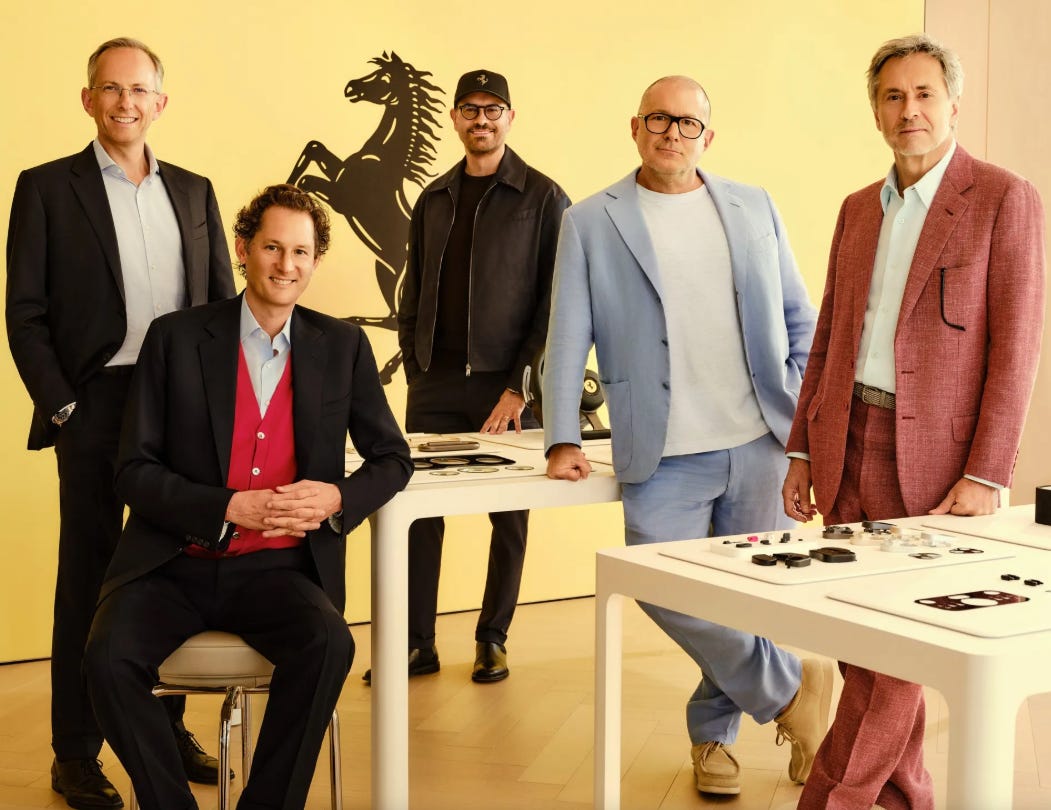
Despite the negative Luce reaction, there is no question LoveFrom put care into the Ferrari project.
Jordan Golson has more details on the origin of the Luce:
Before LoveFrom drew a single line, they spent six months on research. They presented Ferrari with four books — substantial, rigorous volumes printed in both Italian and English, left page and right page, covering philosophy, design history, the cultural significance of Ferrari within Italy, the relationship between human attention and physical interaction.
These weren’t mood boards. They were arguments — about why certain assumptions held, why others didn’t and what first principles should govern the design of a car interior in 2026.
Ive and Newson had brought a car to production. But Ive did spend half a decade trying to make the Apple Car work including a self-driving vehicle that looks like a 1960s Fiat van with no steering wheel.
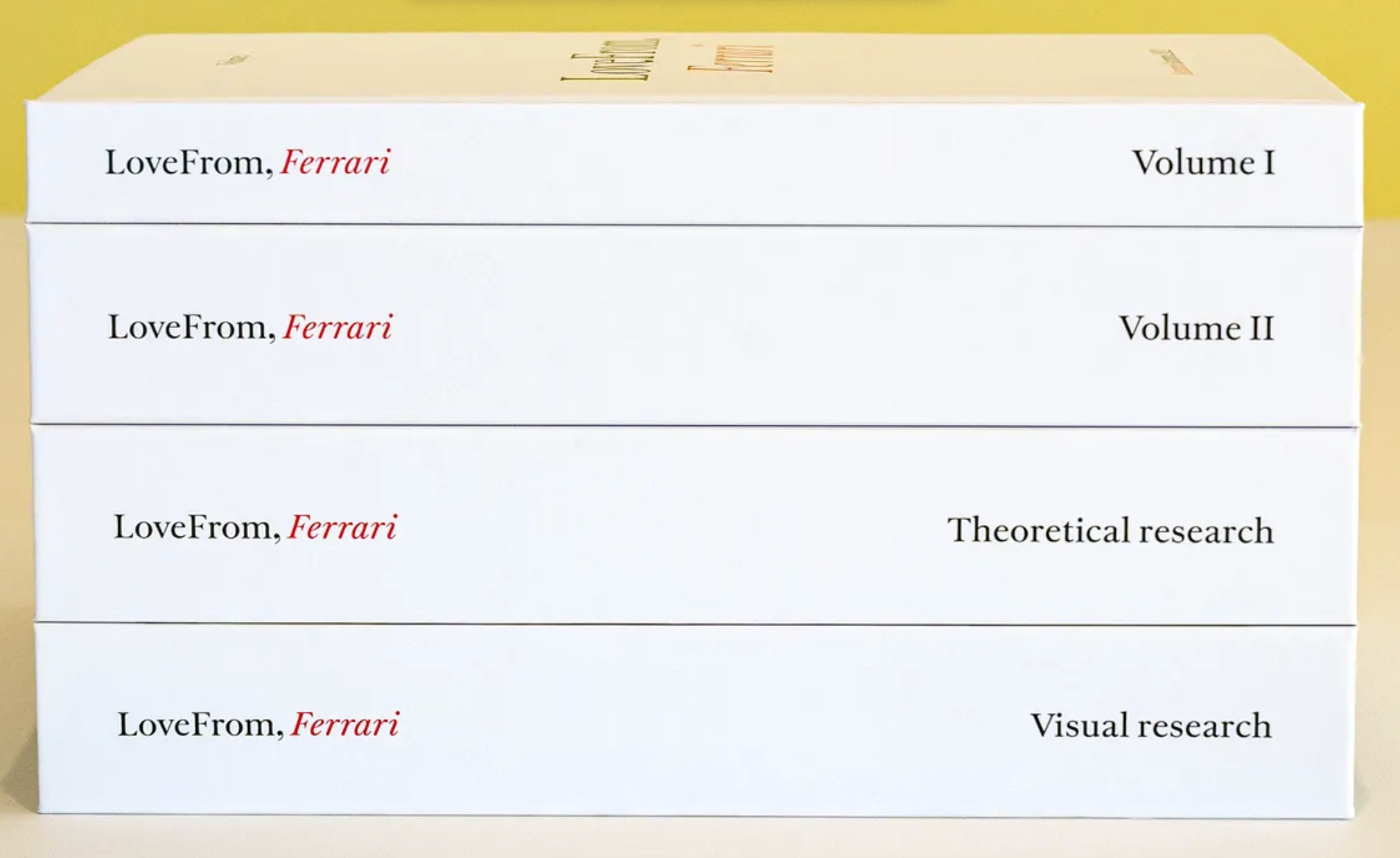
Ferrari’s e-building provided the chassis, drivetrain, battery technology and suspension. LoveFrom designed the interior and exterior.
In February, the Luce’s interior and interface were unveiled in San Francisco (a foreshadowing of the vehicle’s minimalist techy look and future target market).
Ive — the man who pioneered multi-touch screens — created a driving experience that was all about tactile touch including handles, knobs and toggles.
“[Apple developed touch as] a general-purpose interface that could be a calculator, that could be a typewriter, could be a camera, rather than having physical buttons,” Ive told Golson. “To use touch in a car is something I would never dream of doing, because it requires that you look at what you’re doing. Touch was seen as almost like fashion. It was the most current technology. ‘We need a bit of touch.’ And, ‘You know what we’re going to do next year? We’re going to have an even bigger one.’ That’s just the wrong technology to be the primary interface.”
Jobs and Ive believed the tactile experience unwrapping was “theatre”, which is why they literally patented the iPhone box. The equivalent “theatre” experience on a traditional Ferrari is the iconic roar when the engine turns on. For decades, Ferrari has designed the engine intake and exhaust to make a specific dick-measuring sound.
How do you create “theatre” with an EV?
To start the Luce, LoveFrom created a special key fob with digital yellow ink that “transfers” to the gear shift and turns the car on. They also created a sound signature. A device captures the audio of the drivetrain starting and amplifies the vibration using a special algorithm that pumps a “musical sound” through speakers playing inside and outside of the car.
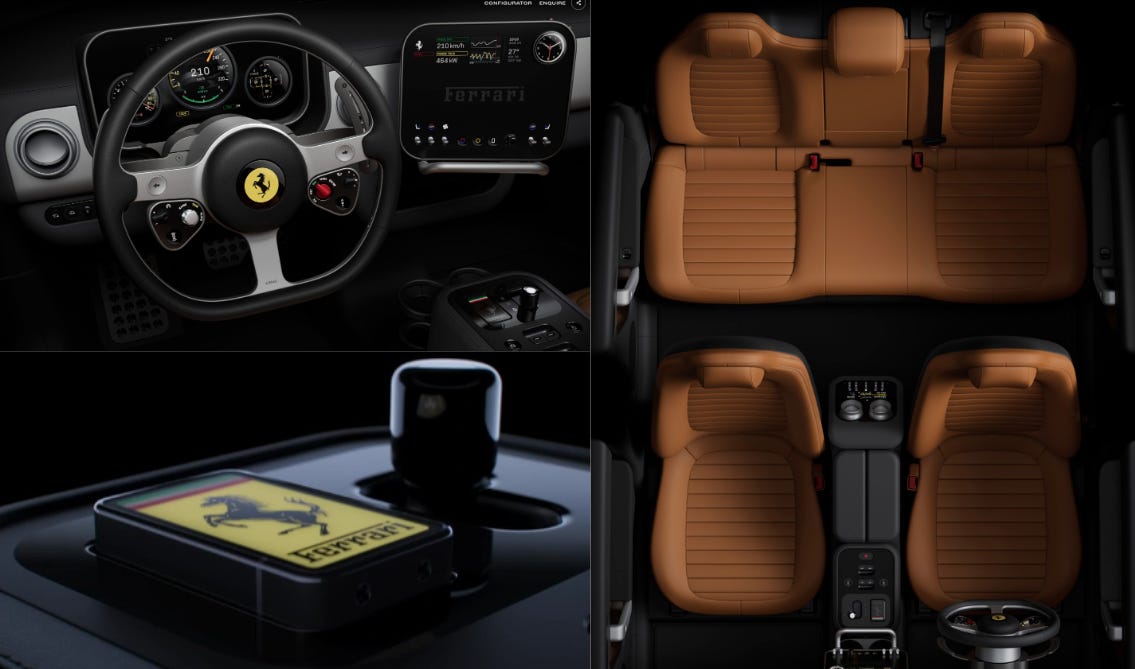
Ferrari didn’t demo the starting sound at the launch event. My guess is it is really meant to be an “in-person” experience and a flaccid engine sound — as compared to the typical ICE engine roar — would have been even more fodder for internet trolls.
But, boy, did Ferrari show everything else on the official website: “Ferrari-engineered engines and advanced drivetrain afford a radically new architecture that uniquely combines extraordinary Ferrari performance with the luxury of spaciousness.”
But what dafook? That looks nothing like a Ferrari. Giant wheels. No curves. Same side profile as every EV on the market. It looks nothing like a muscular Italian race car.
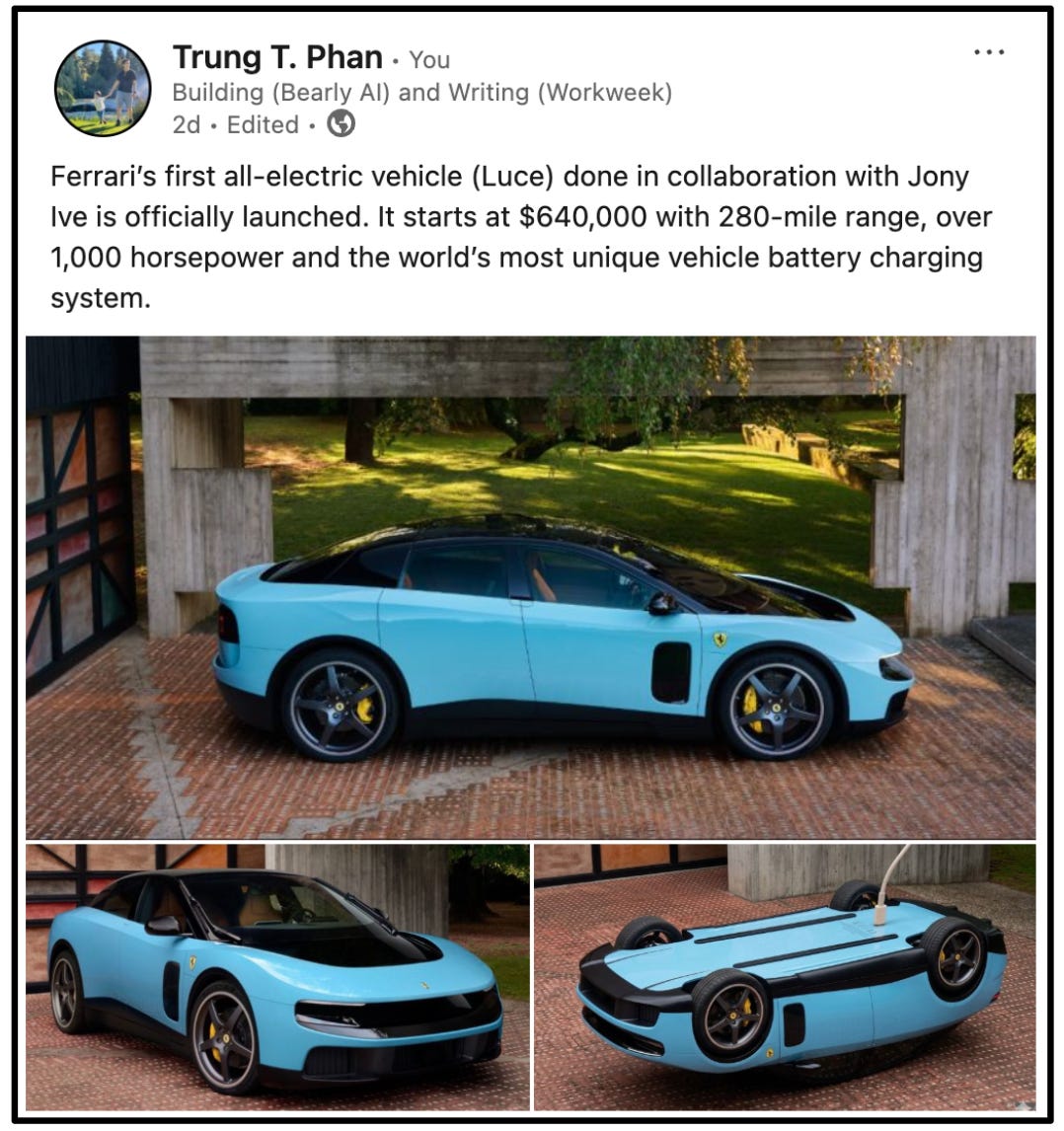
The basic specs with European delivery by Q4 2026 and US delivery expected in Q2 2027:
Range: 280 miles (expected EPA)
Peak charging speed: 350kW
122 kWh battery
1,035 horsepower
0-60mph: 2.4s
Weight: 4,982 lbs
Front motors spin to 30,000 rpm, rears hit 25,500 rpm
197.9 inches long, about as long as a Tesla Model S
Almost instantly, dozens of netizens burnt every lake in North America to create AI-generated mock-ups for other Ferrari EVs.
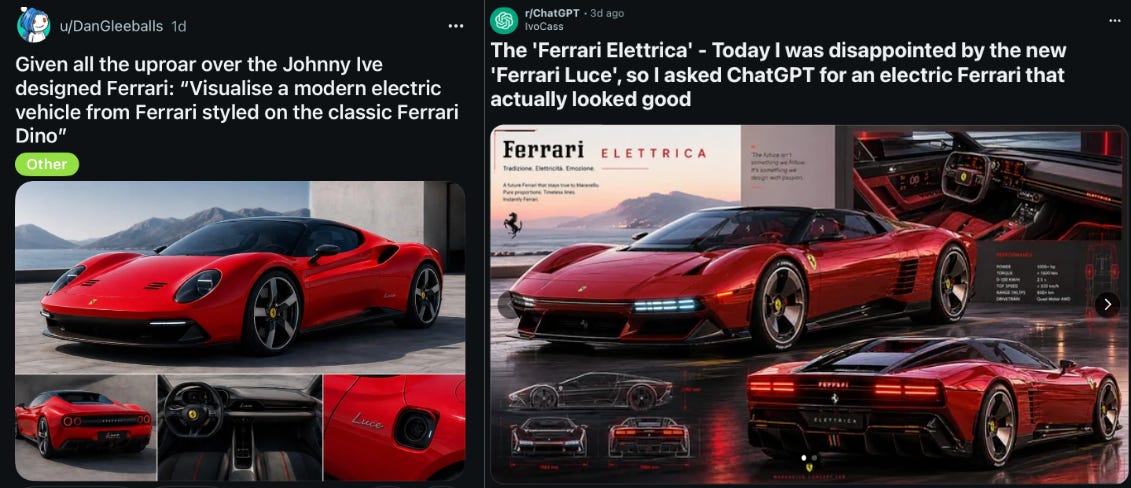
Italy’s Transport Minister piled on:
“Electric, outrageously expensive (550 thousand euros!) and, from an aesthetic point of view, it speaks for itself... It looks like anything but a car from the Prancing Horse. And this is supposed to be ‘innovation’? Who knows what [Ferrari founder] Enzo Ferrari would say... ,”
I’d highlight two reasons why the Luce looks the way it looks.
First, LoveFrom probably only agreed to do the project if it had significant editorial control. The Luce has more than 60 patents and dozens of new pieces — many specially designed with Apple’s long-time partner Corning — were created in-house to make a “singular design language” uniting “the exterior, interior and interface with clarity and refined simplicity throughout.”
Apple was not a democracy either.
As M.G. Siegler points out, the Luce’s all-glass roof sure does look like another Jony Ive classic from the top view. That Corning glass is the hero for both.

A second reason for the Luce’s design is just physics. EV platforms have such different constraints as compared to internal combustion engine (ICE) vehicles. Sticking a massive battery into a Ferrari frame (and keeping decent performance) isn’t really possible. Maybe Ferrari could have done it with its Purosangue SUV but even that’s a stretch…and Ive isn’t signing up for that
Cleo Abram interviewed Ive and Ferrari’s Chief Design Officer Flavio Manzoni for the launch and Manzoni dives into the challenges of designing an EV:
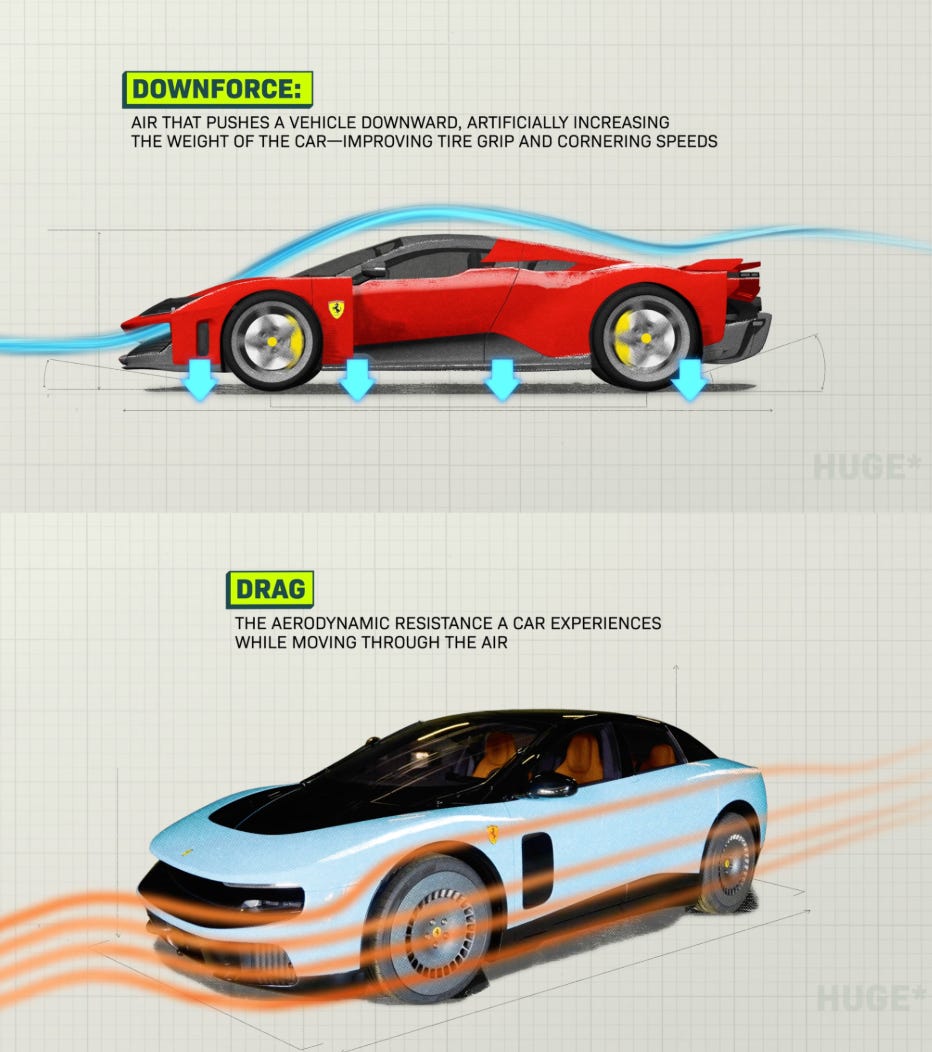
Normally, when we design another type of Ferrari in terms of aerodynamics, the main objective is the downforce. The car must be stuck on the ground…[The main objective for an EV] is the drag coefficient. The parameters are totally different. [The EV] must be like a kind of solid object, very pure. The body’s side must be almost continuous. Almost flat. Even the wheels must be flat.
A Ferrari EV has that heavy-ass battery so it doesn’t have to worry about downforce to keep the vehicle low and “stuck on the ground.” However, battery efficiency is crucial…and the drag coefficient is particularly important when driving at high speeds.
Abram created these useful graphics showing the different points of focus between an ICE Ferrari and an EV Ferrari.
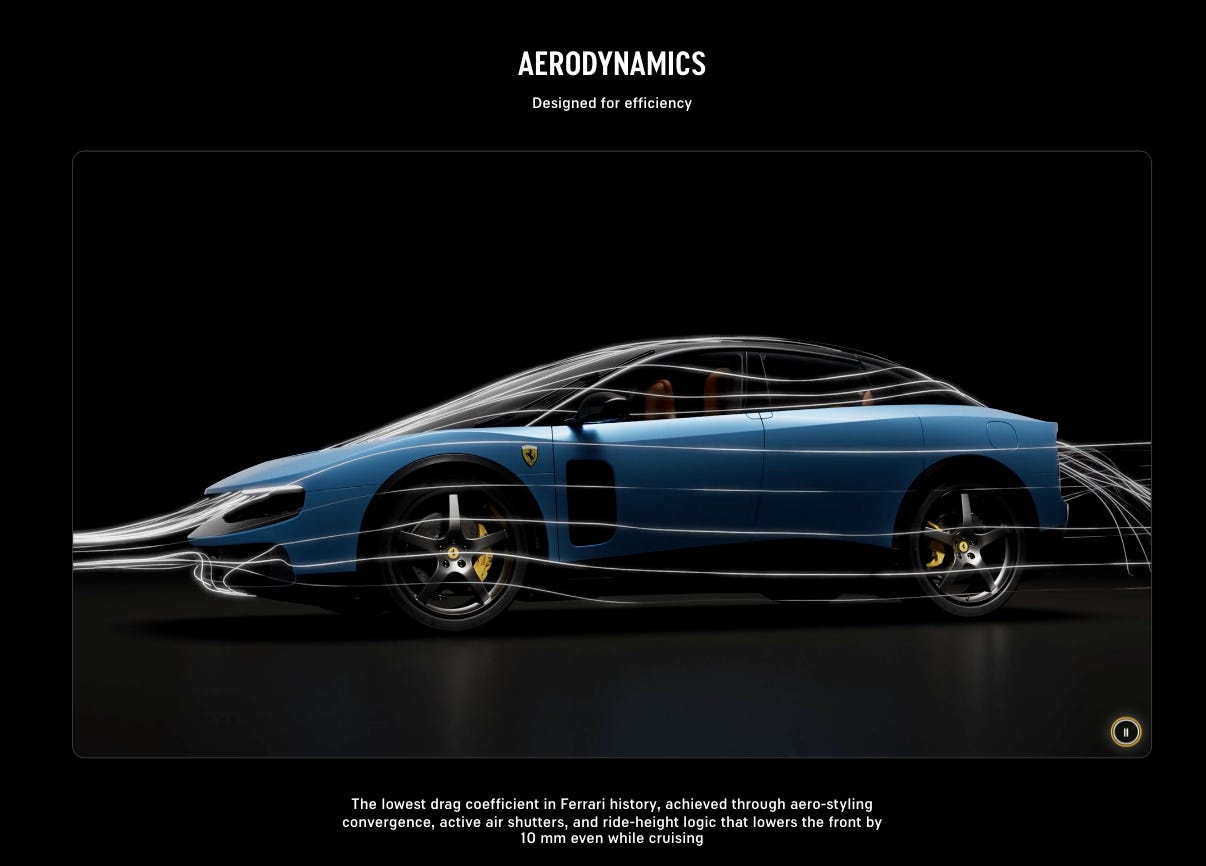
The Ferrari Luce website makes the aerodynamic look a central selling point: “Designed for efficiency” and “The lowest drag coefficient in Ferrari history” (it better be at $640,000).
Somewhat ironically, Enzo Ferrari once said, “Aerodynamics are for people who can’t build engines.”

Anyway, Marques Brownlee also toured the Ferrari Luce and made a similar observation about how the constraints of an EV dictate design:
I’m trying to figure out what is happening because I think everyone would agree if they had just taken one of the older Ferrari designs everyone loved and just made that electric, [the launch] would have gone a lot better.
Unfortunately — with today’s battery tech — that just wouldn’t be a good car. There’s a reason why you don’t see a bunch of small two-door electric sports cars driving around today. There’s not enough space. The battery wouldn’t be big enough. The range would be terrible. The center of gravity would be too high. It just wouldn’t be a good Ferrari.
If they want to go electric, they’ve got to go bigger. Like SUV bigger, which they already know is going to make a lot of Ferrari people mad.
So, [Ferrari had] a choice. They can either try to keep it kind of Ferrari-ish, but it still has to have a pretty smooth coefficient of drag and not be too aerodynamic.Or they can just totally throw that out and start fresh and that’s what they did. That’s what they did when they collaborated with Jony Ive and Marc Newson and their design firm, LoveFrom. As far as I can tell, they’ve never designed a car before, ever. This is literally their first try. […]
The outside does…kind of look like a BYD knockoff of a Ferrari.
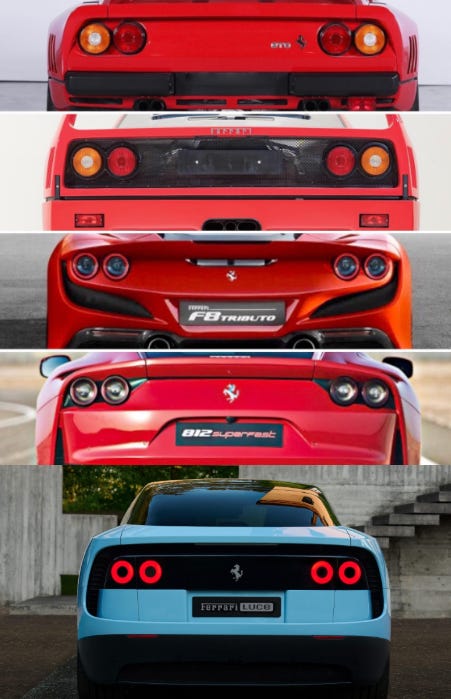
The Luce’s rear lights are one of the few design elements the EV shares with other Ferrari whips.
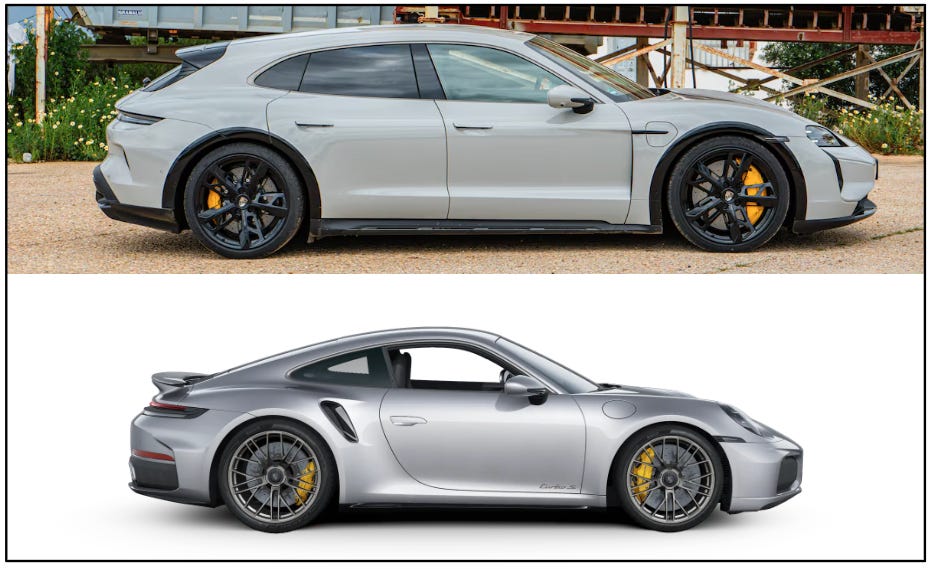
Porsche’s EV adventure is quite instructive here.
The Porsche Taycan EV was built to share some of the same design language as the iconic Porsche 911.
The Taycan is a 4-door and much longer, though. We know the reason. Because there is a large-voltage battery in the floor of the vehicle. Porsche even cut segments out of the battery (the cutouts are called “foot garages”), so that it could mimic the low sports-car seating of the OG Porsches while people are inside.
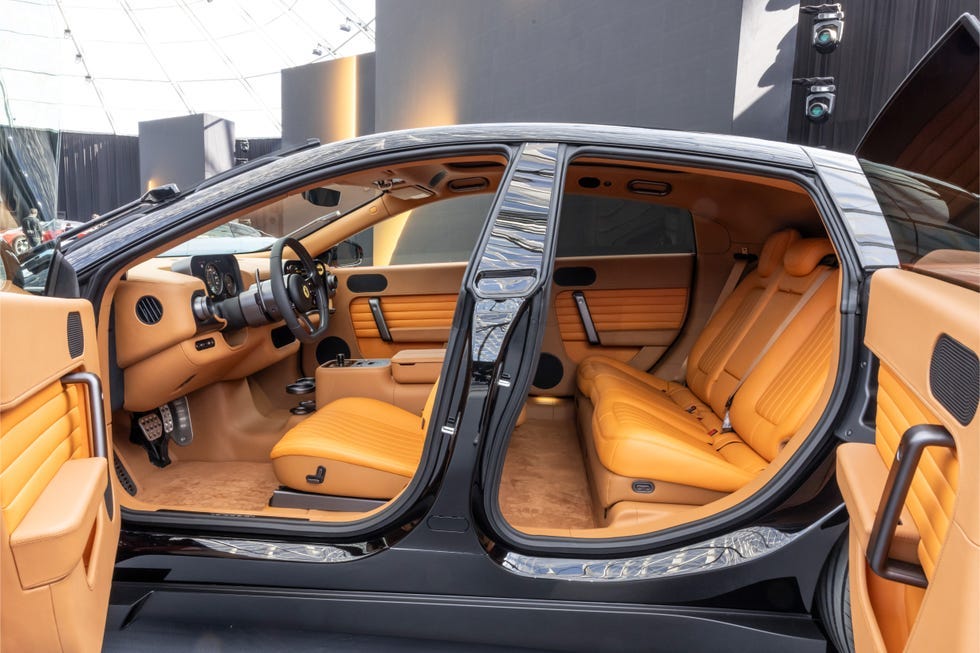
Speaking of interiors, MKBHD says that LoveFrom knocked it out of the park with its seats and tactile controls. This seems to be a consensus across the board from all the Luce reviews I watched.
The glass, metal and high-quality leather look truly luxurious. Rolls-Royce or Maybach style (which is very un-Ferrari).
Without a transmission, the Luce is not only Ferrari’s first 5-seater but also its most spacious car ever. It better be at $640,000.
Do you know how much scrolling of the X timeline I could do with these suicide doors and these roomy backseat?
“It is not that we’re taking away something,” Ive tells Cleo Abram. “But we’re adding a new choice, which in some dimensions is unambiguously better. And in other dimensions you will understand them in terms of what is lacking. Perhaps it was reckless of us to do that, knowing that we will in some people’s eyes be destined for failure. But I think we also love these absurd challenges.”
This isn’t Ive’s first consumer electronics rodeo. He knows the good and the bad. His team was responsible for two of the most egregious charing ideas ever (bottom-charging port on Apple Mouse and sticking Apple Pencil into iPad port).
LoveFrom knew criticism was coming and the luxury EV market is even more challenging than when they started the project.
***
The Luxury EV Market is Hurting
There was an exchange on the r/CarTalkUK subreddit that I think did a good job of articulating the Ferrari Luce bear case:
gazchap: [What] are you getting for your £440,000 [$640,000]? It’s not as if you’re getting an engine with lineage going all the way through the annals of motorsport, and all of the expertise and knowledge that Ferrari’s engine design team can muster.
It’s some batteries, which will be identical to other cheaper EVs. Some electric motors — which may have something special to them (but it’s unlikely) — and the rest is just stuff that is artificially scarce and only valuable because of it.
What an absolute travesty of a car, from concept to execution.
Nomad624 I would have hoped the electric Ferrari would be the CHEAPEST in the lineup. Electric propulsion is simple and once your battery is good, the rest is cheap and simple. Plus given emissions targets, they should have expected this to ship a lot of units. The lack of “specialness” due to the lack of an engine would have justified a lower price. But instead they did the opposite and made it look like a wooden Ikea toy.
While Ferrari is the best in the world at building engines, it is a new player to battery technology. Ferrari has no authority in this domain yet it’s charging 10x the price of EVs with comparable propulsion tech (e.g. Tesla and premium-end Chinese EVs).
It is very aggressive positioning.

To compound the issue, the EV luxury market is facing serious headwinds. A major reason why is that the battery platform lends itself to the business cycle of consumer technology like a smartphone. At the high end, this leads to rapid depreciation as compared to a luxury car with traditional engine.
An EV battery today is much better — on range, charging speed, lifespan — than an EV battery from 5 years ago. This will also be the case in 5 years with major innovation on the horizon: solid-state batteries (which will replace the flammable liquid electrolytes found in lithium-ion batteries powering current EVs and all consumer tech).
Looking at every Ferrari built since 1947, over 90% of these 300,000+ vehicles are still on the road (Enzo would be proud). On a very related note, Ferrari has a robust secondary market with many older models still appreciating in price.
In comparison, the luxury EV market has been absolutely bodied in the past few years with poor resale values and manufacturers forced to scale back plans.
Here are some details from Wired:
[Sales] of the seemingly much-anticipated electric Mercedes G-Class SUV have been poor. Actually, that’s an understatement. They’ve been woeful.
And it’s not the only e-flop from a legacy automaker…Porsche has cut back its plans for EVs amid soft sales of its electric Macan SUV and Taycan models. Indeed, depreciation on the Taycan is so eye-watering that some Porsche dealers have supposedly refused to take their own brand’s performance EV from owners looking to offload or upgrade. […]
“The transition to EVs is not just a case of putting a battery in a vehicle,” says Peter Wells, a business professor and director of the Center for Automotive Industry Research at Cardiff University in Wales, UK. “Large premium EVs require very large batteries to match anything like the performance of typical ICE versions, and this increases their price.”
And after the February closure of its Belgian factory, Audi’s Q8 E-tron has been discontinued. The shuttering of the Brussels plant, says Audi, was due to a “global decline in customer orders in the electric luxury class segment.” […]
Volkswagen’s luxury marques, including Porsche, Bentley, and Lamborghini, are reassessing their EV strategies. Porsche has scaled back plans for an all-electric lineup following a 49 percent decline in Taycan sales. Bentley has pushed back the launch of its first EV from this year to next, and extended its gas-engine phase-out deadline to 2035. Lamborghini has delayed its Lanzador EV until 2029 at the earliest.
The luxury EV segment is hurting all while total EV sales are booming.
Between 2020 and 2025, the EV share of new car sales grew from 4% to 25% (there were 20 million EVs sold last year with China leading the way). By the 2030s, this share is projected to grow to 49% of all new car sales per the International Energy Agency (IEA).
Ferrari’s former head Luca di Montezemolo specifically called out Porsche as a cautionary tale and for good reason, per Carscoops:
It turns out that Porsche’s aggressive push into the world of EVs has not paid off the way the company hoped…[In September 2025] Porsche made the sudden, but not unexpected announcement, that its new flagship SUV, currently known as the K1, will not launch as a fully-electric model as originally planned and instead debut with combustion and plug-in hybrid powertrains. Porsche also confirmed that range-topping versions of the next-generation 718 Cayman and Boxster will be offered with combustion engines, despite the new models originally being designed exclusively as EVs.
The move is meant to stabilize margins, but it also makes clear that the brand’s earlier electric strategy was both too costly and out of step with what its customers actually wanted.
I know some of you are thinking, “But Trung, Porsche produces 20x the amount of cars as Ferrari. They aren’t even playing the same game.”
Fair.
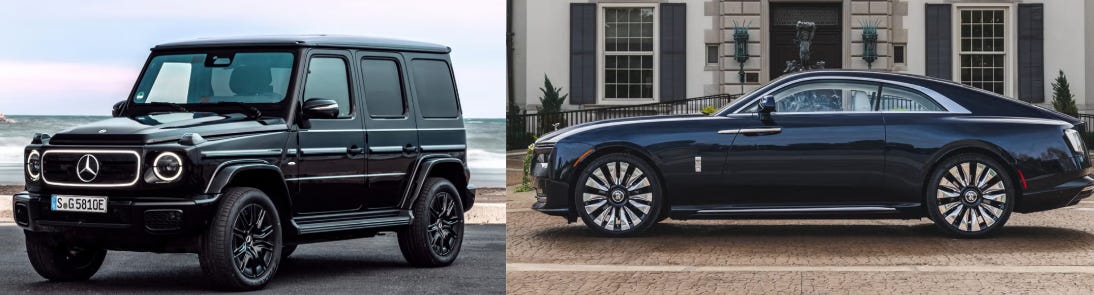
So, let’s look at an ultra-luxury peer: Rolls-Royce. The legendary British car and engine manufacturer launched the EV Rolls-Royce Spectre in 2023. Starting at $400,000, the car saw strong demand out the gate. But the early momentum didn’t hold and, just a few months ago, Rolls-Royce scrapped its “goal to go all-electric by 2030”.
The crazy thing is that one of EV’s signature features — near-silent and low-vibration driving — is a hallmark of Rolls-Royce. They pad the F out of the car so the comically-rich passengers can sit in the back in peace. But they still want that fresh V-12 engine
Conversely, Ferrari is all about the noise.
While Western luxury brands are flubbing the EV market, China is dominating. A classic example of leapfrogging technology. China’s industrial base never developed around internal combustion engines. The country turned into a manufacturing powerhouse with the rise of smartphones and the related supply chains (batteries, microcontrollers, chips, software know-how) were an ideal match for EVs.
There are a number of 6-figure luxury EV options in China.
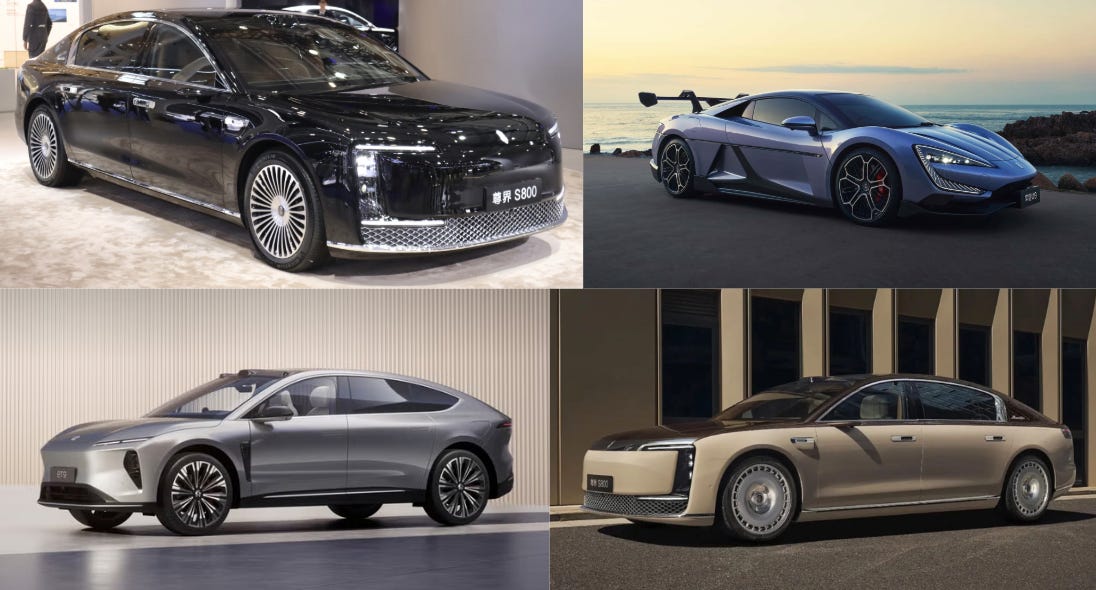
Perhaps unsurprisingly, China’s newfound affinity for EVs is a bull case for Ferrari Luce and its $640,000 price tag.
***
Aiming for Tech and Chinese Buyers
Luxury car blogger and Ferrari collector Tim Burton (aka Shmee150 on YouTube) whipped up a solid 30-minute video with his notes from the Luce unveiling.
He says that Ferrari expects 80% of Luce buyers to be new to the brand.
That’s a big deal. Ferrari’s list system means that 60-80% of its vehicle sales in recent years have gone to existing owners.
Burton says Ferrari’s messaging is that current owners do not have to buy a Luce to stay in good standing. Existing criteria (How many Ferraris do you own? How many events do you attend? How much mileage is actually on the cars?) are more important.
I’ve seen a few forums where Ferrari owners are a bit skeptical that Ferrari won’t care if they pass on the Luce. So, game theory wise, I bet a lot of petrol-head Ferrari owners (*my hand not raised*) will bite the bullet.
But who will be the majority of these new buyers?
Burton says the tech rich are a key market. If that’s the case, Ferrari may have lucked into a jackpot. The Luce was delayed by two years and will hit the market right as upcoming IPOs for Anthropic, OpenAI and SpaceX will create 16,000 new millionaires.
“[The Luce] is for somebody maybe with more of a tech background who wouldn’t have even considered buying a Ferrari,” Burton said of his experience at the Luce event. “They have a Tesla or maybe they’ve had a [Porsche Taycan] and this is something that’s even more luxurious. Generally speaking, if somebody had a smartwatch on their wrist, they liked [the Luce]. If they had a traditional watch on their wrist, they didn’t like it.”
That take echoes what Ferrari Chairman John Elkann told the Financial Times:
I think there will be people who will be compelled by it, who know the subject matter, and others who might be disappointed. And then there are people who couldn’t care less about cars or about Ferrari, but are interested because this is a very, very novel and interesting way of putting all these technologies together.
So, if I’m a 25‑year‑old founder of a technology company, or if I’m interested in all energy‑related subjects, or if I’m interested in being able to drive a car that is different because I’m compelled by things that are new and different — that whole world, which is far bigger than our current customers, might find it interesting.
Ferrari has been moving in a younger direction in recent years. Between 2022 and 2024, the share of new buyers who were millennials (under 40) went from 30% to 40%.
With that in mind, it makes sense that two of the biggest launch media reveals were from the tech world and not the automotive world: Cleo Abram (8m subs) and Marques Brownlee aka MKBHD (Brownlee has 1.2m subs on his AutoFocus YouTube channel but his original tech review channel has 21m subs).
The Luce is also less loud than the other Ferraris. While loudness is the point for many, younger generations have also shown an affinity for quiet luxury. Think Hermès or The Row rather than Gucci or Louis Vuitton.
As hinted in the previous section, the other target market for Ferrari is China.
Mainland China, Taiwan and Hong Kong account for 12% of the Ferrari’s sales, up from 6% pre-COVID. Women make up 26% of those sales…by far the highest share for any country in the world.
Comparatively, just Mainland China accounts for 20-25% of sales for Hermès and LVMH.
China has seen a steady rise of ultra-high net worth individuals (UHNWI) — of which there are more than 121,000 people worth $30m+ — over the past few decades and they’ve become an anchor buyer for the world’s top luxury brands.
I know because I have personally benefitted from this trend. Not from actually owning luxury goods. But I can now walk into any luxury store in the world wearing basketball shorts, flip flops and a backwards Vancouver Grizzlies cap without getting hassled by security. Why? They can’t risk insulting me on the 0.0000000007% chance I’m a Chinese billionaire.
Anyway, Ferrari has been in China since 1992 and made some custom vehicles for the market over the years.
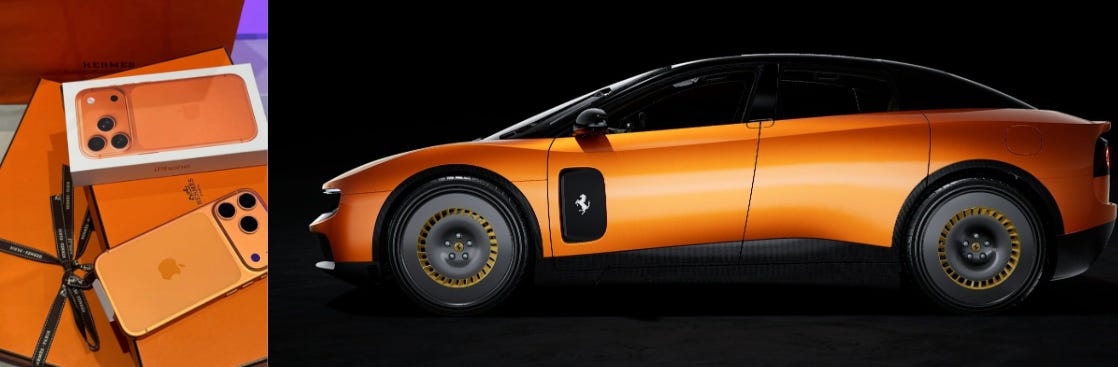
But there is room to grow. Just so happens that the iPhone is probably the best-selling Western product in China ever. China makes up 15-20% of iPhone sales every year and over 300 million units have been sold in the country’s history. In Q1 2026, Apple sold a record $26B of iPhones and a major reason was the Cosmic Orange colorway looked Hermès-esque.
Meanwhile, in 2025, over 50% of new car sales in China were either EVs or hybrids. If everyone is getting an EV, the ever-present status games mean that a $640,000 price tag from Ferrari (!!!) is instantly desirable. It’s a Veblen good.
Long-time tech analyst Robert Scoble makes a similar observation about the Chinese buyer:
[The new rich in China] want to stand out. Often they are running factories or tech companies where most of the engineers have Teslas or one of the new Chinese brands. How do they stand out?
Roll up in [a Luce].And now you understand why the design of this car is so ugly. Ferrari doesn't want its traditional consumer to buy it. And didn't want a mind-blowing aggressive design that would make its traditional customers pissed that it was "going electric."
It's all about trying to regain share in China.
Also worth noting that in China (and East Asia broadly) the UHNWI are often driven around in Rolls-Royce, Bentleys and Maybachs. As with most EVs, the Luce looks to be an everyday car and is really the first Ferrari made for chauffeuring (all that trunk and frunk space slaps, too).
To summarize: very rich people + very much want EVs + very much want to flex on each other + Ferrari is a top luxury carmaker + Jony Ive = I bet 30%+ of Luce sales will be in China while the top-selling colors are orange and Ferrari red (side note: Ferrari also caps the % of its vehicles it will sell to one region, so 30% might be aggressive…although EV markets a different game than ICE as we’ve discussed).
Ferrari is probably fine with that.
Even better that the OG petrol-heads in America won’t have to see as many of the Luces driving around and insulting their image of Enzo’s Ferrari.
***
Final Thoughts
Ferrari and LoveFrom knew they were creating a polarizing product and they were pot-committed after making the $200m investment into the e-building.
The decision made sense in 2019. The EU had forced all car manufacturers to have a post-ICE plan. Meanwhile, Tesla’s Model 3 ramp had only taken off the year prior.
EVs were not as ubiquitous — China’s parabolic rise was years away — and the category still had a new cool tech factor.
Once Ferrari started down the EV path, it couldn’t just shoehorn a battery into an existing Ferrari vehicle.
The car needed to be aerodynamic and optimize the drag coefficient…and that’s why we got a lot of “if you squint your eyes, it looks like a [Honda/Tesla/Audi/BYD] EV from the side.”

Ferrari may also be heading off future business challenges.
The market has an appetite for larger cars (sedans, SUVs, crossovers) and these types of vehicles typically provide automakers the best margins (the Luce better be able to do that at $640,000).
“Maybe Ferrari kind of needs a fresh SUV,” Marques Brownlee said in his video on the Luce. “The Macan and the Cayenne saved Porsche when they were about to go bankrupt. Now, those sales fund the rest of the exciting sports cars. Three out of every four Lamborghinis sold is [the SUV] Urus for the same reason.”
Ferrari’s CEO says the Luce is already sold out through 2027.
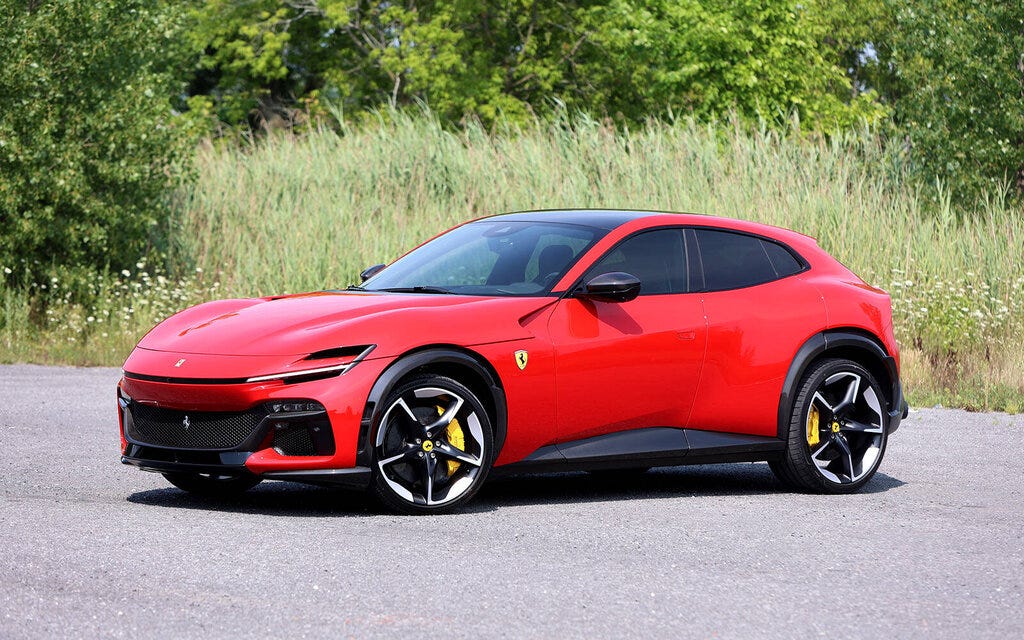
The SUV Purosangue was also roasted at launch. It was Ferrari’s first 4-seater and SUV. Many commented that “Enzo must be rolling in his grave”. Still, Purosangue went so gangbusters out of the gate that Ferrari had to cap its production to 20% of total sales, which would be ~2,500 vehicles a year. Mind you, people
If the Luce can hit half of that figure, it’s making some serious dough. Especially when you consider that personalization and customization are 20% of total revenue.
The Luce has 35 colors to choose from and dozens of configurations for the interior.
Some napkin math: (1,250 x $640,000 x 1.20) = $960,000,000 (or 12% of 2025 sales).
At a 30% operating margin, that is $288,000,000 (which covers the e-building investment).
In our analysis of the Swatch and Audemars Piguet, we talked about the “dream equation”, the luxury marketing concept about how brands have to maintain a balance between awareness and accessibility (actual sales).
The Luce is a way drum up interest large swathe of rich buyers who may never have wanted a Ferrari and just didn’t care about the technology. But Ferrari controls that demand by saying “uh, we are actually unable to make any more…just put your name on the list.”
Ferrari also seems to be hedging its EV effort with the LoveFrom collaboration.
If this is a total bust, then Ferrari gets to wash its hands and call the Luce a one-off. If it becomes the start of an entire EV line, then that’s a W (and Ive will be laughing his way to the bank because LoveFrom owns the design language).
That’s my read of this statement from Ferrari’s CEO Benedetto Vigna: “When you have a new technology, you need to make sure that that technology is properly represented in the design, so the design must be different.”
Same messaging from Ferrari’s Chief Design Officer Flavio Manzoni: “The problem is that we are living in an era where the nostalgic approach is very high. Everybody’s looking at the past, not the future.”
Or instead of reading between the lines, just look at the fact that Ferrari’s launch campaign highlighted the light blue color instead of its classic red.
The Luce really is a different product (also probably not a coincidence that Ive’s first major hit with Jobs — the iMac — was prominently unveiled in a “Bondi Blue” colorway).
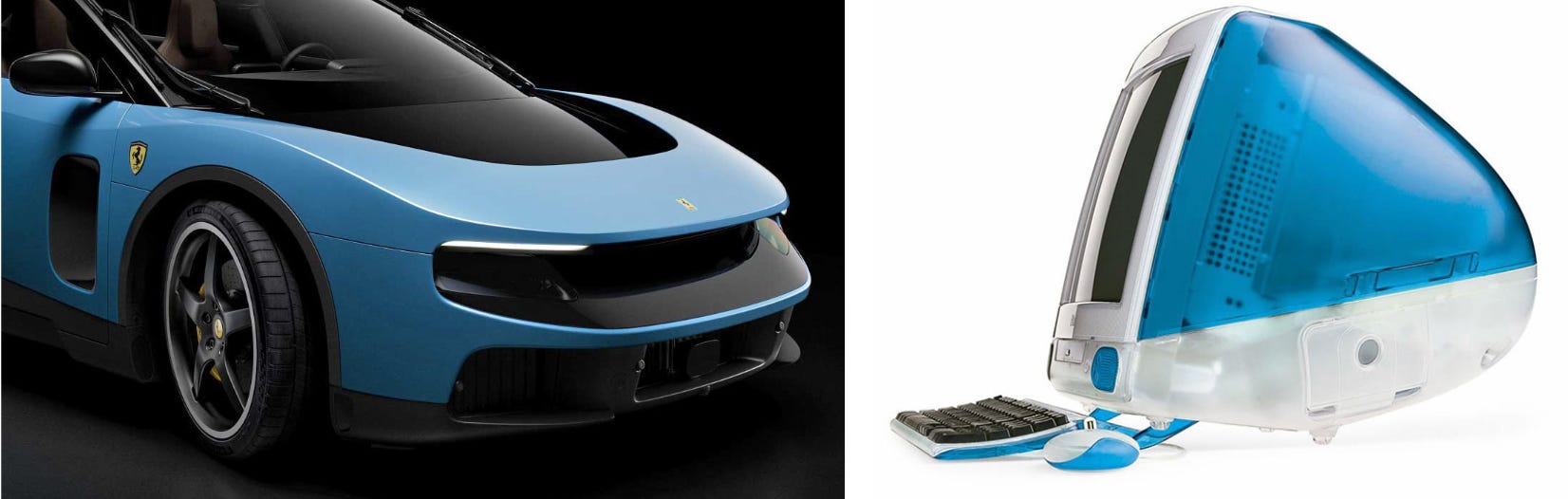
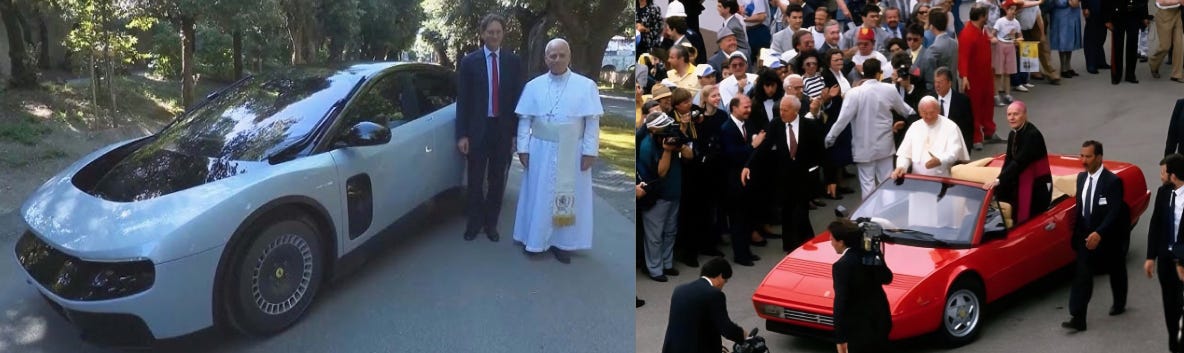
The split really stood out to me when Ferrari had Pope Leo XIV tour the vehicle as part of its PR campaign. Compare the Luce image to that time Pope John Paul II subbed out his Popemobile for a Ferrari convertible to tour the streets of Ferrari’s Maranello HQ in 1988:
Since we’ve seen all the hot takes — including from Luca the Legend — I’ll wrap this up with a few words from Jony Ive. Specifically, this passage from the LoveFrom book research that kicked off the Luce project:
“We often think of the Swiss watch industry during the electric quartz revolution. It’s hard not to see parallels between valuable historic brands like Patek Philippe, who survived and grew through the transition primarily because they retained their traditional mechanical movements. If it had been legislated that Patek Philippe had to transition its entire product line to quartz, the resulting challenge would appear similar to the transition Ferrari is facing. While we’re mindful of the enormity of this transition, we know that pursuing well-founded, big, ambitious ideas will enable the most powerful, compelling, and profoundly successful outcome.”
Them Wild Ferrari Luce Post


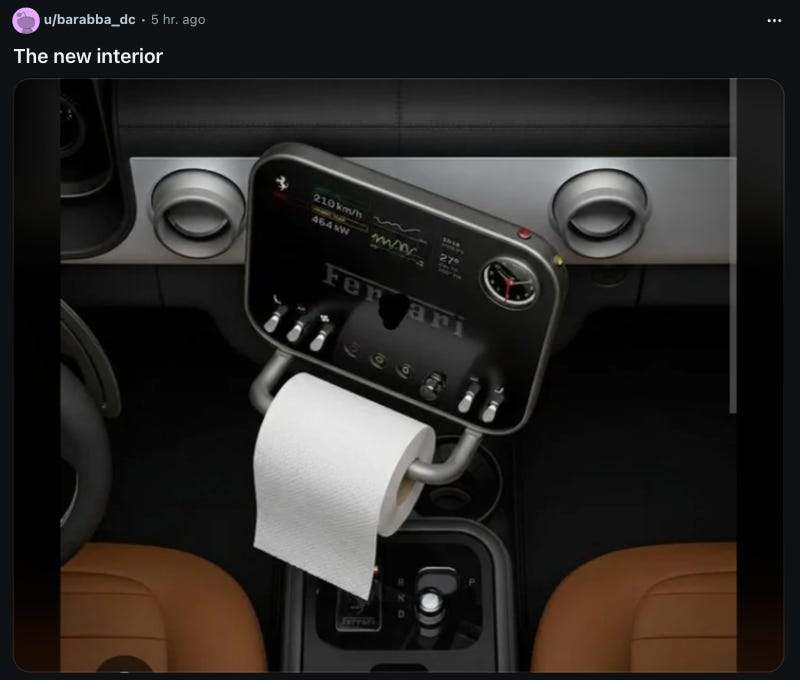


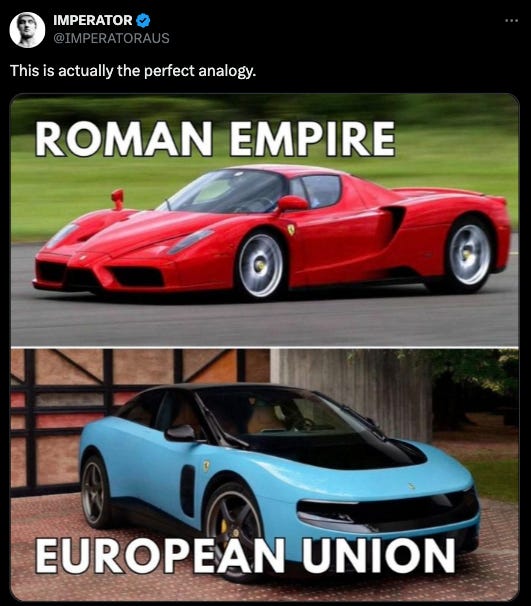

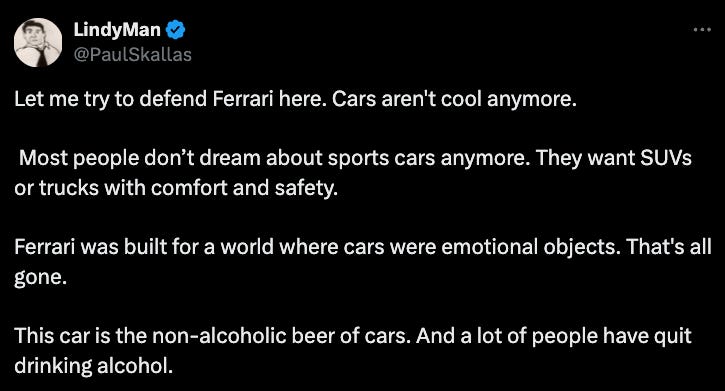
Finally, we gonna need to talk about what the ease of AI-generated videos and images means for brands controlling their image…


Links and Memes
Some other links for your weekend consumption:
IMAX put itself up for sale. Whoever buys it — currently $2B market cap — will get a tiny (but interesting) part of the business: IMAX Enhanced, which builds custom IMAX theatres for homes or yachts starting at $500k.
Last week was the 50th anniversary of the Judgement of Paris. The famous blind wine taste testing when California wines surprisingly beat French wines. Time Magazine wrote about it a few weeks after it happened and the quotes when judges misidentify the wine are incredible: 1) Sips Napa wine (“Ah, back to France.”); and 2) Sips French wine (“This is definitely California. It has no nose.”).
The Enhanced Games only saw one new world record set in 10 events. It was for 50m freestyle swim, which came with a $1m bonus. The event is now offering $10m to someone that can break Usain Bolt’s 100m run (9.58 seconds) at next year’s event. Here is a video of what people actually wanted to see happen.
Simon Willison makes the case that OpenAI and Anthropic have fully found product-market fit with enterprise agents/coding. A key stat: 33% of OpenAI and 26% of Anthropic open job listings are enterprise sales and support type roles.
A solid thread about Law & Order…and how the writing was much tighter before the streaming era.
Conan O’Brien gave the Harvard commencement speech…and dropped some absolute gems including, “No university in our nation has produced more Nobel laureates or white-collar criminals. So, whether you choose good or evil, know that you are among the very best.”
This dude on FB Marketplace has multiple listings for heavy Caterpillar industrial equipment…superimposed with AI-generated female models. Must have industry-leading click through rates.
Blue Origin had a massive explosion…on the launchpad (thankfully no one was hurt). I wrote about the SpaceX IPO last week and they’ve gotten so good at the launch business that I think we forget how hard it is to actually put mass into orbit.
Pope Leo XIV’s Encyclical on AI. Linch Zhang did a deep dive on the 40,000 word document and finds “evidence that the first papal encyclical on AI was substantially written by AI” (it looks like a number of different authors working on different sections; Pope Leo XIV is in the clear).
…and them wild posts:



Amazing rundown as always sir. One of my favorite parts of my Saturdays
I subscribe to too many newsletters. If I had to reduce it to just one read a week, it would be this one. Consistently entertaining and informative. Thanks.